
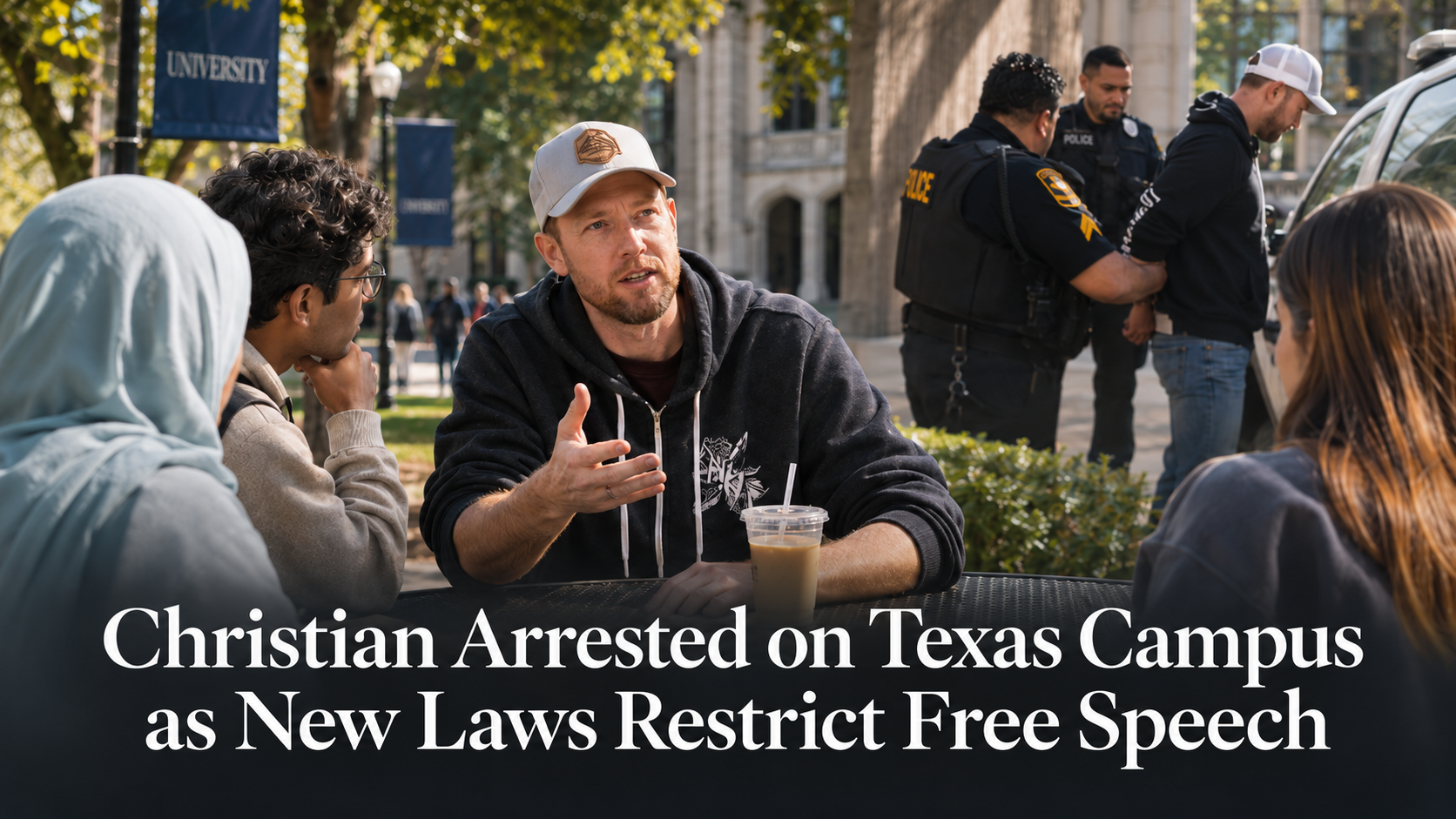
A Christian campaigner spent twenty-four hours in custody after discussing abortion with students at the University of Texas at Dallas. Behind his arrest lies a remarkable reversal of Texas legislation protecting freedom of speech, an administrative culture increasingly intolerant of independent expression, and an uncomfortable lesson for conservatives who entrust the regulation of dissent to public authorities.

On Wednesday, 18 November 2026, T. Russell Hunter, founder of the Oklahoma-based organisation Abolitionists Rising, visited the University of Texas at Dallas. He was in the area following a debate with the Catholic apologist Trent Horn at the University of Dallas, a separate, private Catholic institution. Taking advantage of the visit, Hunter and his colleagues established a small display on the state university’s campus and invited passing students to discuss abortion.
One young woman who disagreed with Hunter remained in conversation with him for approximately an hour and a half. Their discussion ranged from the legal protection of unborn children to the existence of God, the historical claims of Christianity and the Christian understanding of redemption. Other students stopped to express their appreciation; some recognised Hunter from his online broadcasts. The recorded exchanges included laughter, disagreement and expressions of goodwill. The young woman, by the account of Hunter’s organisation, remained unconvinced. Nobody appears to have regarded her disagreement as an impediment to continuing the conversation. Then the university intervened.1
Tricia Losavio, Associate Dean of Health and Wellness Initiatives, approached Hunter and asked whether he was affiliated with the university or any of its student organisations. When he explained that he was not, she informed him: “We’re not an open campus anymore.” At least one student expressly requested that Hunter be permitted to remain. Losavio refused. Asked about the complaints she said she had received from students, she explained that they disliked what was being shown.
The published recording supplies no evidence that Hunter had threatened anybody, obstructed access to university facilities or interrupted teaching. His attorney, C. J. Grisham, subsequently maintained that Hunter had used no amplified sound, blocked no pathways and spoken to those who voluntarily engaged with him.2 The police officers summoned to the scene informed Hunter that he was required to leave because a university official had instructed him to do so. Hunter disputed their interpretation of the law, appealing to the First Amendment and requesting that the officers consult his legal representatives. The supervising officer explained that his refusal to leave constituted criminal trespass. Hunter was arrested, taken to Richardson City Jail and released on bond the following afternoon. His organisation has announced its intention to pursue legal action.
Warren Smith, whose encounters with students at Brown University were examined in these pages last week, has drawn attention to Hunter’s arrest in a separate broadcast. Whereas the Brown footage raised questions about the willingness of students to entertain difficult conversations, the Dallas recording presents a different and, in certain respects, more troubling phenomenon. Here were students willing to converse with someone whose convictions they did not necessarily share. It was an officer of the university who brought their conversation to an end.3

The University of Texas System has subsequently defended the intervention. In a statement reported on 24 November, the Office of the Board of Regents maintained that the controversy concerned the permissible use of university property rather than freedom of speech itself. External speakers, it explained, must ordinarily receive an invitation from an authorised university organisation. The statement included an extraordinary admission: no part of the University of Texas at Dallas campus is presently designated as a traditional public forum open to the general public.4
The university’s published Speech, Expression and Assembly policy confirms the position. Members of the public may engage in expressive activities in areas designated as traditional public forums by the Board of Regents; the policy proceeds immediately to explain that no such areas have been designated. The document nevertheless affirms the importance of freedom of speech and assembly to the university’s educational mission.5 A visitor may enter university property for legitimate purposes, but his entitlement to initiate public discussion is treated quite differently.
Losavio’s assertion that the campus was no longer open was consequently grounded in an actual administrative policy. Whether that policy is consistent with constitutional protections, whether it was properly applied to Hunter’s particular activities and whether his arrest was justified are separate questions. The origins of the policy deserve considerably more attention than they have received in much of the commentary surrounding the incident.
In 2019, the Texas Legislature enacted Senate Bill 18, strengthening protections for freedom of expression at public universities. The legislation required institutions to recognise their common outdoor areas as traditional public forums and extended protection for peaceful expressive activity to members of the public. Six years later, Republican legislators substantially reversed that settlement.
Senate Bill 2972, sponsored in the Senate by Republican Brandon Creighton and in the House by Republican Jeff Leach, was developed in response to concerns about campus disturbances, particularly those associated with demonstrations over the conflict between Israel and Palestine. The legislative proposals addressed encampments, intimidation, amplified sound and disruptions to university life.6
There were perfectly legitimate reasons for universities to address such conduct. Students should be able to attend lectures without obstruction, Jewish students should be protected against intimidation and harassment, and university authorities have an obligation to maintain the ordinary functioning of their institutions. None of these responsibilities is incompatible with protecting peaceful political or religious expression. The legislation which emerged, however, extended well beyond the regulation of disruptive behaviour.
Effective from 1 September 2025, Senate Bill 2972 removed the requirement that all common outdoor areas be treated as traditional public forums. It narrowed the statutory guarantee of access for expressive activities to enrolled students and university employees. There remained an important qualification. Section 51.9315(d-1) of the amended Texas Education Code requires governing boards to designate public forums consistently with the federal and state constitutions. Subsection (l) preserves constitutionally protected freedom of expression.7
The legislation does not itself command universities to exclude every unaffiliated speaker from every outdoor space. The University of Texas System’s adoption of restrictive institutional policies, including the absence of any designated traditional public forum at Dallas, represents an administrative decision for which the university authorities bear responsibility.
Texas legislators concerned about encampments and intimidation have thus furnished university administrators with powers now invoked against a Christian discussing the morality of abortion with students who wished to hear him. Conservatives who welcomed the legislation ought to consider whether the administrative discretion they supported was ever likely to remain confined to its original political objects.
Losavio’s intervention on 18 November was not her first reported involvement in a dispute concerning freedom of expression at the university. On 7 April 2025, the independent student newspaper The Retrograde published an account of an encounter between Losavio and members of Students for Justice in Palestine. The organisation had reserved an area of the campus for fundraising and had begun drawing a design in chalk. Losavio instructed the students to stop. When they invoked their constitutional rights, she reportedly responded: “The policy supersedes your First Amendment.”8
The dispute concerned a university prohibition on chalking which administrators treated as a form of graffiti. The university was entitled to regulate the marking of its property, subject to applicable legal constraints. The student newspaper’s account does not establish that Losavio acted unlawfully. Her reported remarks are nevertheless instructive. Several months before the new Texas legislation came into force, the same administrator involved in Hunter’s arrest had apparently expressed a conception of her authority under which university regulations took precedence over the constitutional freedoms invoked by students.
In the earlier instance, the students were campaigning for Palestine; in the latter, the speaker was a Christian campaigning against abortion. The similarity of the two encounters suggests that the problem cannot adequately be explained by alleging hostility towards Christianity or conservatism alone. There is a more pervasive administrative presumption at work, whereby the freedom to express a conviction is increasingly conditional upon institutional permission.
Whether one sympathises with Students for Justice in Palestine has no bearing upon the proper relationship between an institutional policy and the United States Constitution. Nor does agreement with Hunter’s opposition to abortion establish, of itself, that every aspect of his legal argument must succeed. Both cases require the university to justify the powers it claims.
Hunter’s arrest occurred while aspects of the 2025 legislation were already the subject of federal constitutional litigation. On 3 September 2025, the Foundation for Individual Rights and Expression (FIRE) commenced proceedings on behalf of a coalition including the Fellowship of Christian University Students at the University of Texas at Dallas, The Retrograde, Young Americans for Liberty and student musical organisations. Their challenge concerned restrictions upon expressive activities, including a prohibition on such activities between 10 pm and 8 am and prohibitions on invited speakers, amplified sound and percussion instruments during the final two weeks of academic terms.
On 14 October 2025, United States District Judge David Alan Ezra granted a preliminary injunction against the challenged provisions. His judgement examined both the breadth of the restrictions and the political circumstances in which the legislation had originated.9 The State appealed, and oral arguments were heard before the United States Court of Appeals for the Fifth Circuit on 6 October 2026.10
The injunction concerned particular restrictions challenged by the plaintiffs; it did not invalidate Senate Bill 2972 in its entirety or automatically restore the former statutory entitlement of unaffiliated members of the public to engage in expressive activity throughout university campuses.
Hunter’s prospective litigation raises related but distinct questions. The relevant constitutional jurisprudence recognises that government ownership of property does not automatically establish an unrestricted public forum. Universities may distinguish between facilities intended for academic use and spaces opened to public expression. In Bloedorn v. Grube (2011), for example, the Eleventh Circuit upheld aspects of a public university’s regulation of unaffiliated speakers, although the university concerned did provide a designated area in which external speakers could obtain permission to speak.11 The absence of any equivalent designated area at Dallas is therefore particularly pertinent.
The Fifth Circuit, whose jurisdiction includes Texas, has also recognised that the character and actual use of university outdoor spaces are relevant to determining the constitutional protections applicable to them. Its judgement in Hays County Guardian v. Supple (1992) examined the use of campus pavements and plazas, alongside the university’s established policies, when determining their status as forums for student expression.12
A university cannot conclusively settle a constitutional question merely by assigning a convenient description to its property. Hunter’s lawyers will need to establish the nature of the particular location, the applicability of the restrictions, the significance of its previous use and whether the policy was enforced reasonably and without discrimination. The recorded explanation that students disliked the material being shown will require particular examination. If Hunter’s message was the effective reason for initiating enforcement, the university may face a substantially different constitutional difficulty from that involved in the impartial application of a legitimate access policy. The complaints themselves, the police records and evidence of the university’s treatment of comparable unaffiliated speakers will be important to establishing what occurred.
Much of the discussion has understandably concentrated upon Hunter’s freedom to speak. Less attention has been paid to the students whose freedom to hear him was curtailed.
The university’s own policy acknowledges the corresponding rights of students to listen to speech which interests them and disregard speech which does not.5 The young woman who spent ninety minutes discussing religion and abortion with Hunter was exercising precisely that freedom. She questioned his beliefs, challenged his reasoning and offered her own understanding of matters upon which they disagreed. She apparently felt sufficiently at ease to continue the conversation long after she could have departed. There was no need for her to obtain the approval of an associate dean before reaching her own conclusions. It is difficult to understand what educational benefit she derived from the termination of the exchange.
In last week’s examination of Warren Smith’s encounters at Brown University, Nuntiatoria considered the danger of students learning which opinions could safely be expressed rather than acquiring the intellectual confidence to examine them. At Dallas, the students themselves provide something of an encouragement. Several appear to have possessed a greater appreciation of the value of open discussion than the administrator who intervened.
Their willingness to engage also complicates the suggestion that Hunter’s presence was inimical to student welfare. Those who found his material objectionable were entitled to decline his invitation. They were equally entitled to challenge his claims. Their objections did not establish that other students required protection from hearing them.
British readers will recognise aspects of this controversy from the development of abortion buffer-zone legislation. In April, Nuntiatoria examined the dismissal of proceedings against a Scottish grandmother who had offered consensual conversation near an abortion facility. The case exposed the difficulties inherent in legislation which treats the potential influence of peaceful expression as a matter for criminal enforcement.13
The British and American legal regimes are different, and the circumstances of access to an abortion clinic cannot simply be assimilated to those of a university campus. There is nevertheless a resemblance in the administrative reasoning by which activities ordinarily regarded as innocent become grounds for police intervention because of the setting in which they occur. In both circumstances, authorities ought to be required to demonstrate that the restrictions they impose bear a proportionate relationship to the harm they profess to prevent. The mere existence of objections to the content of speech cannot supply an adequate justification.
Hunter is a Protestant abortion abolitionist whose wider theological and legislative positions Catholics need not endorse indiscriminately. His recent debate with Trent Horn itself illustrates the existence of substantial disagreements within the wider movement opposed to abortion. Catholic teaching concerning the deliberate destruction of innocent unborn life is unequivocal. Questions concerning criminal liability, individual culpability, the appropriate penalties for particular offences and the prudential responsibilities of legislators require further moral and legal distinctions. These are legitimate subjects of public discussion, including between Christians whose theological convictions differ.
The Catholic intellectual tradition has ample experience of disputation. The medieval university incorporated objections into the very method by which a proposition was examined. An erroneous proposition could be heard, understood and answered without its expression being regarded as an injury to those present. Indeed, a considerable part of the educational enterprise consisted in acquiring the intellectual discipline necessary to recognise why an argument was mistaken, rather than merely knowing that its conclusions were unacceptable.
The pursuit of truth entails discrimination between sound and unsound arguments, and civil authority has legitimate responsibilities towards the common good. There is no obligation to tolerate every conceivable form of expression in every circumstance. An authority which prevents willing persons from examining a proposition simply because others object to it, however, risks obstructing the very process by which error might be exposed and truth apprehended.
For Christians, the freedom to discuss abortion possesses an additional significance. Much of the contemporary justification for abortion depends upon disputed claims concerning human identity, autonomy, dependency and the obligations owed by one human being to another. Those claims should be capable of examination in precisely the institutions entrusted with higher education. It would be a curious accomplishment for an educational system to produce graduates capable of performing an abortion, advising upon its legality or developing public policy concerning it, while considering a conversation about its moral legitimacy a matter requiring police intervention.
There is a practical danger in making the enjoyment of a liberty contingent upon the discretion of officials. Citizens may suppose that the power will be exercised sympathetically while the political circumstances favour them. They discover its actual character when it is exercised by someone whose convictions they do not share.
Republican legislators in Texas sought to address disruptive campus protests. University administrators subsequently acquired greater discretion over access by external speakers. A Christian opponent of abortion has now spent a night in jail following the exercise of that discretion. Those who applauded restrictions upon the expression of their political opponents have particular cause to reflect upon the consequences.
The legal proceedings may eventually establish whether the University of Texas at Dallas exceeded its constitutional authority. They may also require an examination of whether the legislature intended the designation of public forums to permit their complete absence from a university campus. There is, however, a question the university should be capable of answering without awaiting litigation. What legitimate educational purpose was served by terminating a voluntary conversation between an adult student and a visiting Christian, when the student herself was perfectly capable of deciding whether she wished it to continue?
The university’s statement explains the policy under which Hunter was removed. It has yet to explain the educational necessity of removing him.
FOOTNOTES
1. Abolitionists Rising, I Got Arrested…, November 2026.
2. The Christian Post, Abortion abolitionist releases UT Dallas arrest video, 23 November 2026; Protestia, Arrested Anti-Abortion Activist Released From Jail, Legal Update and Lawsuit Incoming, 20 November 2026.
3. Warren Smith, Commentary on the arrest of Russell Hunter, November 2026; Nuntiatoria, The Price of Speaking Freely: Charlie Kirk, Brown University and the Fear of Dissent, 20 November 2026.
4. Protestia, Texas University Responds to Viral Arrest of Anti-Abortion Activist: “Free speech…was not the issue”, 24 November 2026.
5. University of Texas at Dallas, UTDSP5001: Speech Expression and Assembly, revised 12 August 2025; Speech Expression and Assembly Policy Brief.
6. Texas Legislature, Senate Bill 2972: Committee Report and Bill Analysis, 89th Legislature, 2025.
7. Texas Legislature, Senate Bill 2972: Enrolled Text, 89th Legislature, 2025; Texas Education Code, Section 51.9315: Protected Expression on Campus.
8. The Retrograde, “The policy supersedes your First Amendment”, 7 April 2025.
9. United States District Court for the Western District of Texas, Fellowship of Christian University Students at the University of Texas at Dallas et al. v. Eltife et al.: Order Granting Preliminary Injunction, 14 October 2025.
10. Duke University School of Law, Campus Speech Database, Fellowship of Christian University Students at the University of Texas et al. v. Board of Regents of the University of Texas System; Foundation for Individual Rights and Expression, Fellowship of Christian University Students at the University of Texas at Dallas v. Eltife, case history.
11. United States Court of Appeals for the Eleventh Circuit, Bloedorn v. Grube, 631 F.3d 1218, 28 January 2011.
12. United States Court of Appeals for the Fifth Circuit, Hays County Guardian v. Supple, 969 F.2d 111, 1992.
13. Nuntiatoria, Free Speech on Trial: The Crown’s Failure at Glasgow and the Fragility of Britain’s “Buffer Zone” Regime, 28 April 2026.






Leave a Reply