
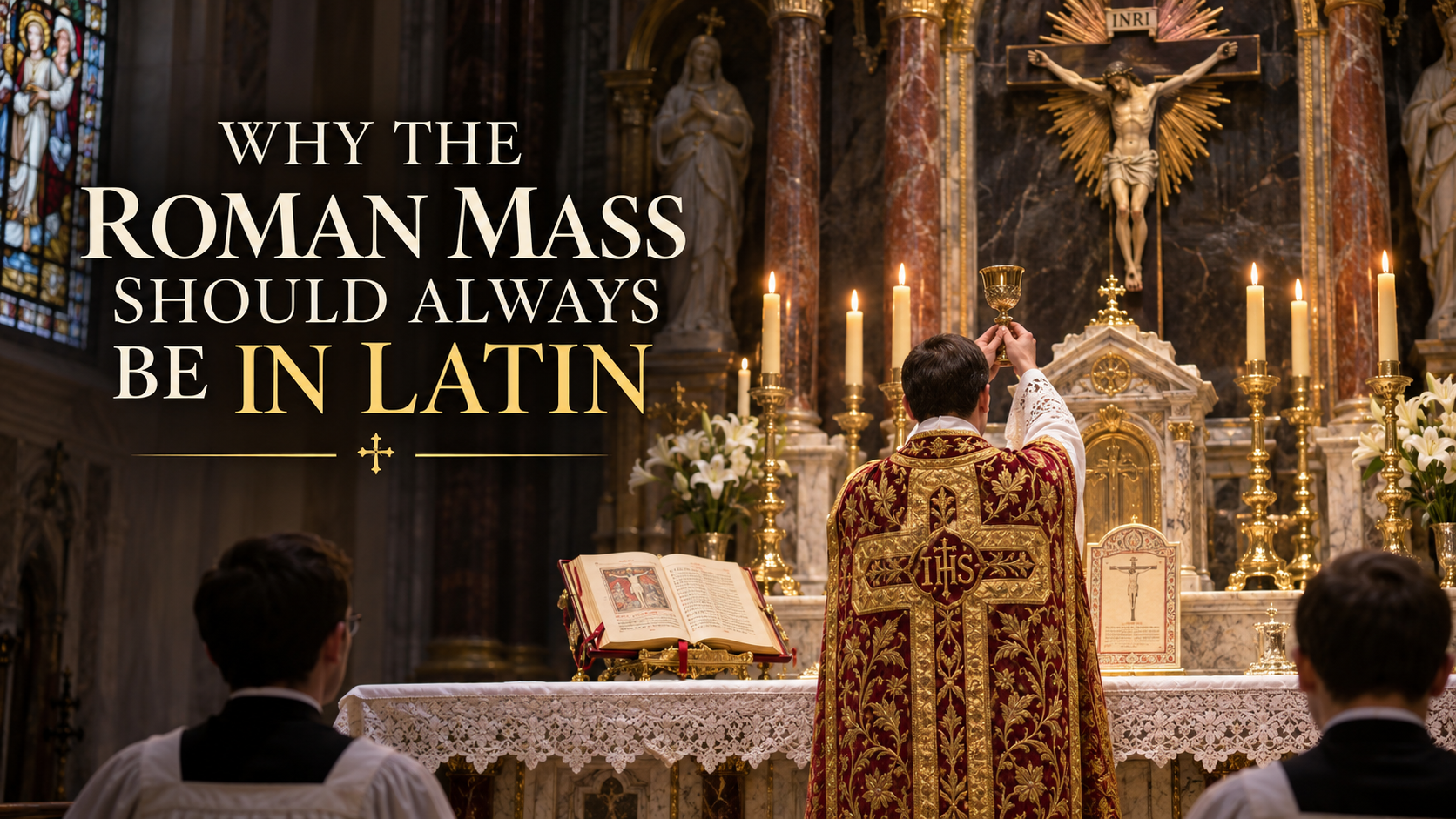
The Latin language belongs to the theological, musical and spiritual inheritance of the Roman Rite. Its preservation concerns the integrity of Catholic worship, the transmission of doctrine and the unity of the Church across nations and generations.
On 22 February 1962, scarcely eight months before the opening of the Second Vatican Council, Pope John XXIII promulgated the apostolic constitution Veterum sapientia, reaffirming the importance of Latin in the life of the Catholic Church. He recalled the judgement of Pius XI that a Church which embraces all nations and is destined to endure until the consummation of the world requires a language whose character is universal, stable and distinct from ordinary speech.¹
Seven years later, on 26 November 1969, Pope Paul VI acknowledged that the introduction of the vernacular would entail the sacrifice of much of the musical and spiritual inheritance associated with the Latin language. He considered that sacrifice justified by the anticipated advantages of greater intelligibility and participation in divine worship.² The intervening decades afford sufficient grounds for reconsidering the assumptions upon which that judgement rested.
Even amongst Catholics attached to the traditional Roman liturgy, the suggestion periodically arises that its wider restoration might be facilitated by celebrating it in the vernacular. The ancient prayers, sacrificial theology, ceremonial and orientation of the altar would be retained; the Latin alone would be relinquished. Such a proposal considerably underestimates the extent to which the language of the Roman Mass belongs to its constitution and the purposes which its preservation has historically served.
The character of a sacred language
One of the more persistent misconceptions concerning the history of Christian worship is that Latin was adopted by the Roman Church simply because it was the language of the marketplace. Its subsequent replacement by modern languages is therefore represented as a return to the pastoral wisdom of Christian antiquity.
The historical circumstances were rather more sophisticated. Greek occupied a prominent place in the worship of the earliest Christian communities in Rome, and the establishment of Latin as the principal language of Roman Eucharistic worship occurred gradually during the first Christian centuries. Yet the Latin employed in the developing liturgy possessed characteristics which distinguished it from ordinary contemporary speech.
The Dutch philologist Christine Mohrmann demonstrated in Liturgical Latin: Its Origins and Character that Christian liturgical Latin developed as a specialised religious idiom, incorporating biblical expressions, established rhetorical forms and a deliberate cultivation of sacred style. Its solemnity was already apparent whilst Latin remained a living language.³ The assumption that intelligibility to contemporary Romans implied an absence of linguistic distinction between the sanctuary and the street is historically unwarranted.
The Roman Canon illustrates the point particularly well. Its formal petitions, carefully ordered enumerations, expressions of supplication and characteristic cadences belong to a solemn public act of religion. The opening invocation, Te igitur, clementissime Pater, establishes a manner of addressing Almighty God quite distinct from ordinary conversation. Its language reflects the dignity of the action in which it is employed.
Christian antiquity also displayed remarkably little embarrassment about retaining sacred expressions inherited from languages which worshippers might not ordinarily understand. Amen, Alleluia, Hosanna and Sabaoth survived successive linguistic transitions; the Greek Kyrie eleison retained its place in the Latin Mass. Such expressions were received as part of the religious inheritance of the Church, their meaning enriched by centuries of scriptural and liturgical employment.
The emergence of sacred languages throughout the Christian world was hardly peculiar to Rome. Church Slavonic, Syriac, Coptic, classical Armenian and Geʽez acquired a comparable religious significance within their respective traditions. Even the exceptional employment of Church Slavonic in the Roman Rite amongst certain Croatian communities illustrates the distinction between a venerable liturgical language and contemporary colloquial speech.⁴
The Catholic case for Latin does not require the assertion that every Christian must worship in it. It concerns the preservation of the particular inheritance of the Roman Church, just as the Eastern Churches rightly cherish the languages in which their own liturgical traditions have matured.
The instability of the vernacular
The history of English Christianity affords a particularly instructive example of the difficulties inherent in making liturgical language dependent upon contemporary usage.
When the English Reformation substituted the Book of Common Prayer for the inherited Latin liturgical books, its language was substantially intelligible to the people for whom it was intended. Over succeeding centuries, however, that same English acquired a distinctly hieratic character. Expressions which had once been familiar became peculiar to religious observance, surviving in church long after they had disappeared from ordinary speech.
Generations of Anglicans consequently developed an affection for precisely that quality of linguistic separation which advocates of liturgical modernisation frequently regard as an impediment to worship. The language of the Prayer Book became precious partly because it was recognisably different from that employed elsewhere. Its expressions acquired associations through baptism, marriage, burial and the recurring observances of the Christian year which no newly commissioned translation could immediately reproduce.
Had the English liturgy been established in the age of Chaucer and retained substantially unchanged, considerable instruction would now be required to render it intelligible to an ordinary English congregation. Even the language of Shakespeare, considerably nearer to our own, requires annotation for many contemporary readers.
The vernacular is a temporary condition of a language. A liturgy constructed around the assumption of contemporary intelligibility must either accept that its language will eventually become archaic or submit itself periodically to revision. The resulting changes disturb the associations which generations of worshippers have formed with particular prayers and expressions, whilst inviting recurrent controversy concerning the theological and literary merits of their replacements.
Latin has already passed beyond this difficulty. Its preservation allows the Roman Church to maintain a stable liturgical text whilst making its meaning available through translations appropriate to successive generations. An English hand missal published today may improve upon one published a century ago without requiring any alteration to the prayers pronounced at the altar.
There is considerable pastoral wisdom in placing the obligation of linguistic adaptation upon the translation rather than upon the sacred rite itself.
The language of Gregorian chant
A further consideration, frequently overlooked by advocates of a vernacular traditional Mass, concerns the relationship between the Latin language and Gregorian chant. The music of the Roman Rite developed in association with its sacred texts over many centuries. The melodies, accents, phrasing and cadences of the chant belong to the particular linguistic character of those texts.
Pius XII explained this relationship in his encyclical Musicae sacrae disciplina of 1955. The close correspondence between the melody and its sacred text enables Gregorian chant to interpret and communicate the meaning of the words themselves. The Pope consequently regarded the preservation of Gregorian chant in association with its traditional Latin texts as an important means of maintaining the universality of Roman worship.⁵
English, French and other languages are perfectly capable of beautiful sacred music. The difficulty arises when the musical inheritance of one language is expected to accommodate the linguistic characteristics of another. A translation must frequently alter the number and distribution of syllables, the position of accents and the natural cadence of a sentence. The adaptation of Gregorian chant to a vernacular text therefore entails musical decisions which may substantially modify the received composition.
The history of English ecclesiastical music demonstrates the practical consequences. John Merbecke’s The Booke of Common Praier Noted, published in 1550, provided musical settings for the English liturgy introduced the previous year. The revisions of the Prayer Book in 1552 and 1559 rendered much of his work obsolete. Its nineteenth-century revival required further adaptation.⁶
The comprehensive vernacularisation of the traditional Roman Mass would place its entire musical inheritance in a comparable predicament. Successive national communities would have to determine how much of the original melody could be retained, what alterations were necessary and whether the resulting compositions remained suitable for liturgical employment.
As Nuntiatoria recently observed in Gregorian Chant and the Catholic Crisis of Self-Expression, the disappearance of the Church’s traditional music cannot adequately be understood apart from the alteration in Catholic assumptions concerning the purpose of liturgical worship.⁷ To recover the traditional Mass whilst relinquishing the language in which its music developed would perpetuate one of the principal difficulties occasioned by the twentieth-century reform.
Paul VI understood that the widespread introduction of the vernacular would entail the loss of much of the Gregorian repertory. Catholics who desire the restoration of that inheritance should scarcely be expected to repeat the sacrifice.
The protection of Catholic doctrine
In Mediator Dei, promulgated on 20 November 1947, Pius XII described Latin as “a manifest and beautiful sign of unity, as well as an effective antidote for any corruption of doctrinal truth”.⁸
The importance of this observation extends well beyond the question of whether individual translations are satisfactory. Every living language undergoes changes in usage and meaning. Expressions acquire associations which their original authors could not have anticipated; familiar words are appropriated by particular intellectual movements; terminology which once conveyed an unambiguous proposition may subsequently admit competing interpretations.
The relative stability of ecclesiastical Latin allows the Church to retain an authoritative theological vocabulary through such developments. Its precision derives from the accumulated intellectual labour of centuries, during which theologians, councils and pontiffs employed and refined expressions whose meanings could be established by reference to an existing body of doctrine.
The Latin language possesses no supernatural immunity from error. The truth of Catholic dogma derives from divine revelation and the teaching authority of the Church. The Fathers of Nicaea established the consubstantiality of the Son with the Father through the Greek term homoousios. Nevertheless, the subsequent reception of that definition in the Latin consubstantialem Patri furnished Western Christendom with a stable expression of the doctrine, capable of surviving innumerable changes in the languages ordinarily spoken by Catholics.
The controversy surrounding the translation of pro multis illustrates the practical importance of retaining an authoritative Latin text.
In his letter of 14 April 2012 to Archbishop Robert Zollitsch, President of the German Episcopal Conference, Benedict XVI explained how the rendering of these words as “for all” had been adopted in the belief that it conveyed the theological significance of the scriptural expression. Christ indeed died for all mankind. The difficulty was that the translators had incorporated a particular exegetical explanation into the words of the Eucharistic prayer itself.
Benedict insisted upon the restoration of “for many”, accompanied by the catechesis necessary to explain its theological meaning.⁹ Throughout the controversy, the Latin Missal had continued to say pro multis. The existence of that authoritative text enabled the precise nature of the departure to be identified and corrected.
Similar considerations apply to the relationship between the language of prayer and the transmission of Catholic doctrine more generally. Most Catholics encounter the theological expressions of the Church far more frequently in the liturgy than in the decrees of councils or the works of theologians. The words which they habitually hear and employ in prayer inevitably influence their understanding of what the Church believes.
The ancient principle lex orandi, lex credendi recognises that intimate relationship. The liturgy expresses the faith of the Church and communicates it to succeeding generations. Its language consequently deserves a degree of protection considerably greater than that ordinarily afforded to religious literature.
The wholesale abandonment of Latin exposes the public prayer of the Roman Church to the decisions of innumerable translators, commissions and linguistic authorities. Even where their intentions are entirely orthodox, differences of interpretation and theological emphasis are difficult to avoid. The experience of successive English translations of the revised Roman Missal ought to have dispelled any lingering illusion that translation is a merely mechanical exercise.
The stability of Latin provides an enduring means of reference against which such judgements can be examined. Its continued employment in the actual celebration of the Mass preserves something further: the direct participation of the faithful in the received prayer of the Church, without the obligatory mediation of a particular generation’s translators.
The language of sacrifice
The argument for sacred language ultimately concerns the nature of the Holy Sacrifice itself.
The Mass is the sacramental offering of the Sacrifice of Calvary, in which Christ, through the ministry of the ordained priest, offers Himself to the Eternal Father. The congregation participates in that action according to the character of the common priesthood received in baptism, uniting its prayers and self-oblation to the offering of the divine Victim.
The assumption that the language of the Mass must therefore be immediately intelligible to everybody present proceeds from a conception of liturgical worship which gives disproportionate importance to its instructional character.
The Mass certainly instructs. The reading of Sacred Scripture, the prayers proper to particular feasts and the ceremonies themselves communicate the truths of the Catholic faith. Yet the essential action taking place at the altar is sacrificial. Its efficacy does not depend upon the linguistic comprehension of the congregation, nor does the priest require its intellectual assent to each successive prayer in order to accomplish what Christ entrusted to the sacerdotal ministry.
Fr Nikolaus Gihr, in his celebrated exposition The Holy Sacrifice of the Mass, distinguishes linguistic comprehension from the spiritual dispositions which enable the faithful to receive abundantly the fruits of the Sacrifice. Knowledge of the prayers is desirable, but faith, charity, contrition, humility and reverence are of more immediate consequence to the spiritual fruitfulness of one’s attendance at Mass.¹⁰
A man may understand every word of the Confiteor whilst entertaining no sorrow for his sins. Another may know comparatively little Latin and yet strike his breast with a profound consciousness of his need for divine mercy. The possession of a translation cannot of itself supply what the former lacks.
Gihr also emphasises the peculiar eloquence of the ceremonies of the Mass. Their symbolic character communicates truths which are not exhausted by verbal explanation. The genuflections, signs of the Cross, inclinations, elevations, incense and ritual silences belong to an established language of sacred action. They manifest the character of the worship being offered and assist the faithful in disposing themselves appropriately towards it.
The recovery of this understanding is particularly necessary after decades in which active participation has frequently been identified with audible responses, visible activity and immediate comprehension of the spoken word.
As Nuntiatoria previously observed in examining Cardinal Grzegorz Ryś’s account of the progress of liturgical reform, the Catholic Church possessed a developed theology of active participation long before the Second Vatican Council.¹¹ Pius XII had explained in Mediator Dei how the faithful offer the divine Victim through the hands of the priest and in union with him, associating their own offering with that of Christ.
The Catholic kneeling quietly during the Canon may be engaged in an act of profound participation whilst uttering no word and hearing little of what the priest pronounces.
Indeed, the translation of the traditional Canon into English would leave much of the supposed difficulty unresolved. Its prayers, pronounced according to the traditional rubrics, would remain inaudible to most of the congregation. Anyone who considered their immediate audibility indispensable would consequently have to propose a further alteration to the rite.
The Council of Trent expressly rejected the condemnation of the Roman practice of pronouncing portions of the Canon and the words of consecration in a low voice. It likewise condemned the proposition that Mass ought to be celebrated exclusively in the vernacular.¹² The Fathers recognised that the dignity and efficacy of the sacred action did not depend upon its being conducted as an audible discourse addressed to the congregation.
The verbal iconostasis
The employment of a sacred language contributes to the distinction between divine worship and the ordinary affairs of human life. Catholic tradition has consistently recognised the religious importance of such distinctions, expressed architecturally, ceremonially and through the reservation of particular objects, vestments and spaces for sacred purposes.
The Epistle to the Hebrews draws extensively upon the worship of the Old Covenant in explaining the eternal priesthood of Christ. Its account of the sanctuary, the veil and the sacrificial blood provides the means of understanding the Redeemer’s entrance into the heavenly sanctuary. The mysteries of Christian worship fulfil realities which the ceremonial of the Temple had prefigured.¹³
The Eastern Christian tradition expresses something of this distinction through the iconostasis. Its sacred images and ceremonial openings reveal the mysteries of redemption whilst distinguishing the sanctuary from the body of the church.
Latin may similarly be understood as a kind of verbal iconostasis within the Roman Rite. Its reservation for sacred worship helps establish an atmosphere appropriate to the mysteries being celebrated. Together with the silence of the Canon and the orientation of the altar, it directs attention towards an action whose significance infinitely exceeds the ordinary affairs of human intercourse.
The analogy has its limits. The Byzantine iconostasis retains its significance irrespective of the language in which the Divine Liturgy is celebrated. Nor does the unfamiliarity of a language automatically confer reverence upon those who hear it. Nevertheless, the deliberate employment of a sacred idiom belongs to the same general religious instinct which reserves particular vessels for the altar and distinguishes the vesture of the priest from his ordinary clothing.
A certain poverty of religious imagination is evident in the supposition that everything employed in divine worship must correspond as closely as possible to the ordinary experience of the worshipper. The Catholic enters a church precisely because something takes place there which he cannot encounter elsewhere.
The incomprehensibility of the divine mysteries is, moreover, of an entirely different order from ignorance of a language. Even the most accomplished theologian, listening to the Eucharistic prayer in his mother tongue, cannot comprehend the mystery of the consecration in its entirety. An accurate translation may acquaint him with the words; faith acquaints him with the reality which those words sacramentally effect.
The traditional employment of Latin assists in preserving a consciousness of that distinction.
The universality of Catholic worship
One of the most remarkable consequences of the traditional linguistic discipline was the ability of Catholics to participate in substantially the same liturgy wherever the Roman Rite was celebrated. An English Catholic travelling in France, Poland, Italy or the Philippines could recognise the prayers, respond to the priest and sing the familiar chants without having acquired the language of the country in which he found himself.
Latin belonged equally to all of them. It demanded no submission to the cultural or political predominance of a contemporary nation, and its employment placed Catholics of different linguistic backgrounds upon a substantially equal footing.
Pius XII recognised this as a particularly beautiful manifestation of the unity of the Church. John XXIII likewise understood that a universal language corresponded to the character of an institution whose mission transcended national frontiers and whose life extended across successive historical epochs.¹⁴
The increasing movement of peoples throughout the modern world might reasonably have furnished an additional argument for preserving that inheritance. Instead, many Catholic communities have become divided according to linguistic preference, with separate celebrations provided for different nationalities inhabiting the same parish.
Such provision may answer genuine pastoral needs under present circumstances. It nevertheless illustrates the loss of a common liturgical language which formerly enabled Catholics of different nationalities to worship together without one community’s language necessarily taking precedence over another’s.
A universal Latin liturgy allows the Catholic to recognise himself as a member of a Church whose worship belongs as much to the stranger beside him as it does to himself. Its universality extends also to the dead and to generations yet unborn. The prayers pronounced at the altar are substantially those which nourished the devotion of his predecessors in the faith and which he may reasonably hope will nourish the devotion of his descendants.
The significance of this continuity was expressed with particular affection by Fr Gihr, who recalled the innumerable saints, bishops, priests and faithful whose spiritual lives had been formed through Latin worship. The same liturgical language had resounded in the churches of Christian antiquity, the monasteries and cathedrals of medieval Christendom and the mission territories to which the Roman Church subsequently carried the Gospel.
To participate in that inheritance is to encounter the Catholic tradition as something living and received, rather than as an historical subject reconstructed for contemporary consumption.
The responsibility of the clergy
The defence of Latin imposes a corresponding obligation upon those entrusted with the care of souls. The Council of Trent, whilst judging the universal introduction of the vernacular inexpedient, expressly required pastors frequently to explain portions of what was read at Mass and some aspect of the mystery of the Holy Sacrifice, particularly on Sundays and holy days.¹⁵
The Fathers of Trent were sufficiently acquainted with the realities of parochial life to recognise that the faithful required systematic instruction. Their judgement concerning the preservation of the traditional liturgical language rested alongside a positive obligation upon the clergy to make the treasures of the liturgy accessible to their people.
Fr Gihr likewise regarded previous instruction in the meaning of the prayers and ceremonies as an essential assistance to fruitful participation. His defence of Latin provides no excuse for leaving Catholics ignorant of the worship in which they take part.
A parish which retains the traditional Mass whilst neglecting to explain its theology, prayers and ceremonies has discharged only part of its responsibility. The provision of bilingual missals, the repetition of the Epistle and Gospel in the vernacular, regular preaching upon the Holy Sacrifice and the instruction of children in the ordinary responses of the Mass belong naturally to the pastoral cultivation of traditional Catholic worship.
The Second Vatican Council itself envisaged the preservation of Latin in the Latin rites, whilst allowing wider employment of the vernacular under specified conditions. It expressly required provision for the faithful to sing or recite in Latin those parts of the Ordinary which pertained to them and reaffirmed the privileged position of Gregorian chant.¹⁶
Whatever judgement may be formed concerning subsequent developments, the Council’s own provisions demonstrate that the cultivation of a common Latin liturgical vocabulary was still regarded as a reasonable expectation of Catholic congregations in 1963.
There is something curiously condescending in the contemporary assumption that ordinary Catholics cannot be expected to acquire even a modest acquaintance with the language of their own liturgy. People routinely acquire specialised vocabularies in the pursuit of their professions, recreations and intellectual interests. They learn musical notation, technical expressions and the conventions of unfamiliar disciplines because they consider the object of their attention worth the effort.
The recurring prayers of the Mass require no comparable linguistic accomplishment. Their continual repetition affords the faithful ample opportunity to acquire familiarity with their meaning. Children are particularly capable of learning such expressions, and the experience of countless Catholic families before the liturgical reform demonstrates how readily familiarity can be established through ordinary religious formation.
The man who encounters the traditional Mass for the first time deserves every assistance in understanding it. His initial unfamiliarity provides no compelling reason why the accumulated inheritance of the Roman Church should be altered on his account.
The case for retaining Latin permanently
The preservation of Latin is ultimately a question of ecclesiastical prudence informed by Catholic theology and historical experience. Its employment is not a condition of sacramental validity, and the Church possesses the authority to regulate the languages used in her liturgies. Legitimate historical exceptions to the Latin discipline, and the venerable traditions of the Eastern Catholic Churches, are sufficient evidence of that authority.
But the existence of the authority to change a discipline establishes neither the wisdom nor the necessity of exercising it. A practice which has developed through centuries of Catholic worship, whose advantages have been repeatedly identified by the Roman Pontiffs and whose preservation serves the unity, doctrinal integrity and spiritual character of the Roman Rite, deserves considerably more than an argument about contemporary convenience before it is relinquished.
The extensive introduction of the vernacular during the twentieth century has manifestly failed to ensure that Catholics understand the sacrificial nature of the Mass. The widespread intelligibility of the liturgical vocabulary has coexisted with grave difficulties in Eucharistic belief, sacramental practice and religious formation. It would be simplistic to attribute those difficulties exclusively to the abandonment of Latin; it would be equally unreasonable to persist in regarding linguistic accessibility as a sufficient remedy for them.
The proposal to celebrate the traditional Mass entirely in the vernacular risks perpetuating the very misconception which contributed to its displacement: that the primary responsibility of the liturgy is to accommodate the contemporary worshipper, rather than that of the Church to form him for the worship of Almighty God.
The advantages of Latin have not diminished with the passage of time. In an increasingly mobile world, its universality retains particular relevance. Amidst the instability of contemporary religious vocabulary, its doctrinal precision remains valuable. Its association with Gregorian chant preserves an extraordinary musical inheritance, whilst its sacred character assists in maintaining a proper distinction between divine worship and secular life.
The Roman Church has every reason to retain Latin permanently as the language of her inherited liturgy, accompanied by the generous provision of vernacular instruction and translations necessary for the formation of her children.
The task of the clergy is to teach Catholics to understand the Mass in the language in which the Church has received it. The impoverishment of that inheritance is a remarkably expensive substitute for catechesis.
FOOTNOTES
¹ John XXIII, Veterum sapientia, apostolic constitution, 22 February 1962.
² Paul VI, General Audience of 26 November 1969, concerning the introduction of the revised Order of Mass.
³ Christine Mohrmann, Liturgical Latin: Its Origins and Character, Catholic University of America Press, Washington, 1957.
⁴ Catholic Encyclopedia, Slavonic Language and Liturgy, 1912.
⁵ Pius XII, Musicae sacrae disciplina, 25 December 1955, §§43–49.
⁶ Trinity College Dublin Library, John Merbecke: The Booke of Common Praier Noted, In Tune: A Millennium of Music in Trinity College Library, concerning the 1550 edition and subsequent revisions.
⁷ Nuntiatoria, Gregorian Chant and the Catholic Crisis of Self-Expression, 24 November 2026.
⁸ Pius XII, Mediator Dei, 20 November 1947, particularly §§46–48, 60 and 93–108.
⁹ Benedict XVI, Letter to Archbishop Robert Zollitsch concerning the translation of Pro Multis, 14 April 2012.
¹⁰ Nikolaus Gihr, The Holy Sacrifice of the Mass: Dogmatically, Liturgically and Ascetically Explained, §32, The Language Used in the Celebration of the Holy Mass, English edition, 1902.
¹¹ Nuntiatoria, Cardinal Ryś and the Liturgical Reform That Must Never Be Judged, 23 October 2026.
¹² Council of Trent, Doctrine on the Sacrifice of the Mass, Session XXII, 17 September 1562, canon IX.
¹³ Hebrews ix. 1–14; x. 19–22.
¹⁴ John XXIII, Veterum sapientia, 22 February 1962; Pius XII, Mediator Dei, §60.
¹⁵ Council of Trent, Doctrine on the Sacrifice of the Mass, Session XXII, chapter VIII.
¹⁶ Second Vatican Council, Sacrosanctum Concilium, 4 December 1963, §§36, 48, 54 and 116.




Leave a Reply