
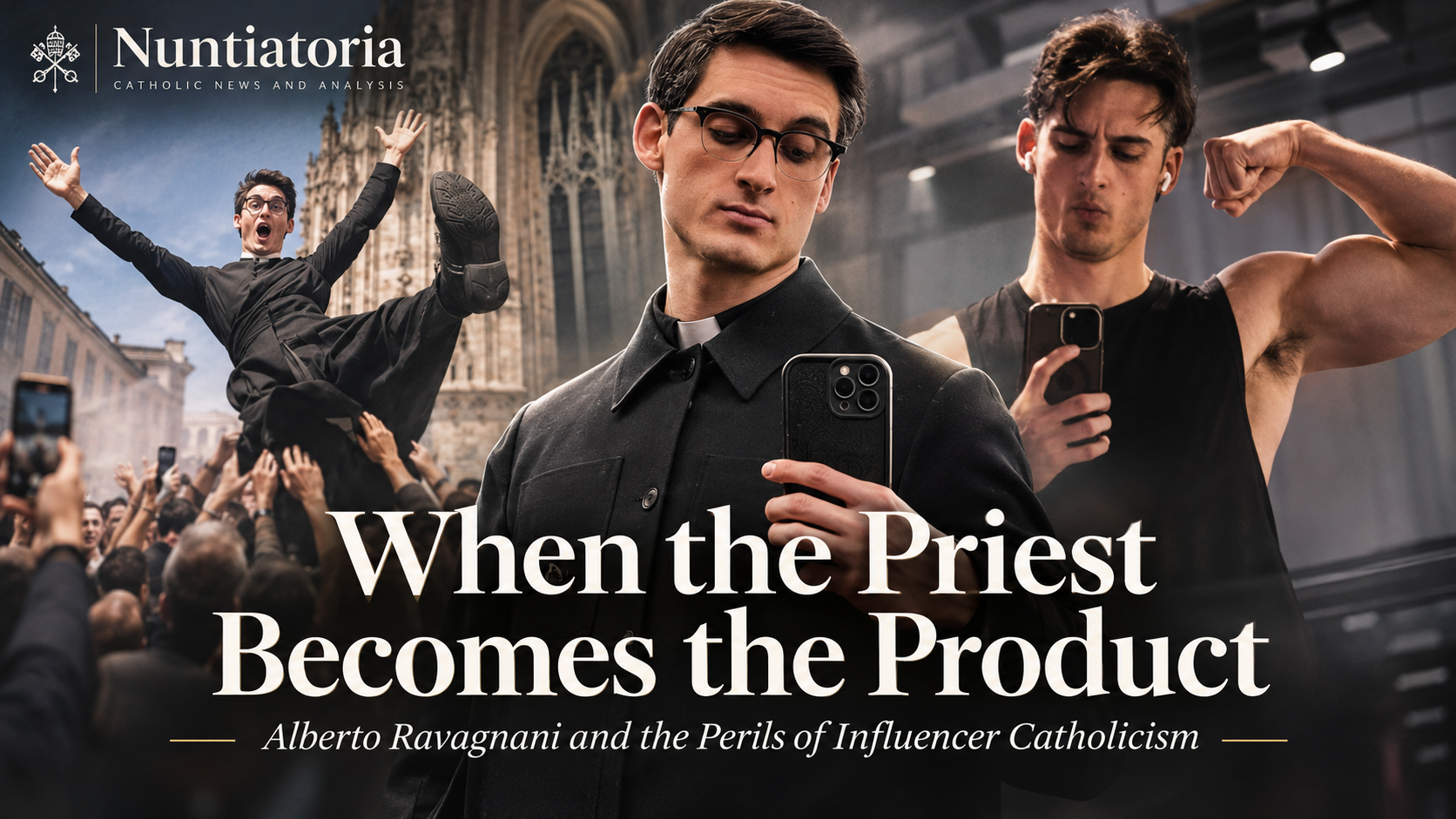
Ten months after withdrawing from priestly ministry in Milan, Alberto Ravagnani is appearing on Italian television as a celebrity contestant. His suggestion that he might evangelise more effectively without being a priest deserves rather more attention from ecclesiastical authorities than his performances on the dance floor.
On 21 November, Alberto Ravagnani and his professional dancing partner appeared in the eighth instalment of Rai 1’s Ballando con le stelle, the Italian equivalent of Strictly Come Dancing. In July last year, Ravagnani had participated in the Jubilee of Catholic Digital Missionaries and Influencers in Rome. In September he was defending a commercial advertisement for nutritional supplements; by 31 January 2026 he had informed the Archbishop of Milan of his decision to discontinue priestly ministry.¹
Perhaps the most revealing document in this sequence is neither a television interview nor the announcement from the archdiocese. In the Feltrinelli group’s advance trade catalogue for January and February 2026, a letter from Ravagnani addressed to booksellers explains the origins of his autobiography, La scelta. In it he suggests that he might evangelise better without being a priest.²
The proposition invites examination of the very conception of evangelisation upon which his prominence as a priest was founded. Much of what made Ravagnani attractive to the secular media before his departure from ministry has remained commercially attractive afterwards. What, then, was the contribution of his priesthood to his popularity, and what had his popularity contributed to his priesthood?
From the apostolate to advertising
Ordained in 2018, Ravagnani acquired his following during the coronavirus lockdowns, when he sought to maintain contact with the young people of his apostolate in Busto Arsizio through the internet. His success was considerable. By September 2025, according to Il Giorno, he had some 270,000 followers on Instagram alone. The same month he published a sponsored advertisement for nutritional supplements, employing his own physique in the promotion and linking followers to the company’s shop. He defended the arrangement on the grounds that the proceeds were intended to finance his apostolate.³
There is nothing novel about priests raising money for their work, and the history of religious commerce, from monastic breweries to Catholic publishing houses, ought to discourage any indiscriminate objection to the sale of goods for ecclesiastical purposes. The transaction in Ravagnani’s case was rather different. A commercial enterprise was purchasing access to an audience gathered around a priest, whose personal appearance and religious standing lent value to the endorsement. His explanation of the intended use of the proceeds did not dispose of the propriety of the means employed to obtain them.
Nor, apparently, did the Archdiocese of Milan consider the matter unproblematic. On 20 September, Il Giorno, citing diocesan sources, reported that Ravagnani had been asked not to repeat the advertisements, which were considered inappropriate and unauthorised. Canon 286 of the 1983 Code prohibits clerics from engaging in business or trade without the permission of legitimate ecclesiastical authority, even for the benefit of others. Whether this particular arrangement fell within the prohibition would require examination of its terms. There is no evidence here of a formal canonical penalty.⁴
In August 2025, Nuntiatoria had examined the enthusiasm surrounding the Vatican’s Jubilee and the emergence of the physically attractive influencer priest as a celebrated figure in Catholic communications. The concern was that the attraction exerted by the individual might obscure the object of his apostolate.⁵ Ravagnani’s subsequent career offers an opportunity to consider that concern against an actual case rather than an anticipated danger.
The choice
On 31 January 2026, Milan’s Vicar General, ✠Franco Agnesi, informed the faithful that Ravagnani had decided to suspend his ministry. His appointments at San Gottardo al Corso and in diocesan youth ministry ceased. Particularly noteworthy was the assurance that the Thursday evening Eucharistic adoration at San Gottardo would continue under the care of the parish clergy.⁶ Whatever the shortcomings of Ravagnani’s public apostolate, young people had evidently found something of value there which the diocese wished to preserve.
His autobiography was published by SEM on 10 February. In an interview with Federico Rocca for Vanity Fair Italia four days earlier, Ravagnani denied that the proximity of his announcement to the publication constituted a marketing exercise. He said that the manuscript had already been delivered when he made his definitive decision. He also denied that the curia had exerted pressure upon him to leave.⁷
The advance catalogue confirms that his reconsideration of priesthood was already part of the book’s promotional material. Its precise date of circulation has not been established, however, and there is no sufficient reason to dismiss his account of the sequence of events. The full autobiography is not available for examination here; his public interviews and the letter to booksellers afford ample evidence of the position he has chosen to defend.
The designation ‘former priest’, commonplace in Italian reporting, requires some qualification. The Council of Trent defined the permanence of the sacramental character conferred in ordination, a doctrine reiterated in the Catechism of the Catholic Church. A man validly ordained may be deprived of the exercise of his priesthood or released from obligations attaching to the clerical state. His ordination cannot be undone. The Milan announcement established the cessation of Ravagnani’s ministry; it did not establish his dismissal or release from the clerical state, still less a papal dispensation from celibacy. No subsequent public confirmation of such a dispensation has been located.⁸
The body and the freedom of the priest
Speaking to Giusy Taglia of Corriere della Sera on 3 October, Ravagnani explained that he had initially declined the invitation to participate in the dance competition in February. His travels in Asia during the summer had occasioned a change of mind. He saw the programme as a further opportunity to discover himself. He also described his former attitude towards attention to his appearance, which he had regarded as potentially distracting from intellectual and spiritual pursuits.⁹
It is an account worth considering alongside the advertisements and fitness-related material he published whilst exercising priestly ministry. A man who had been able to employ his physical appearance in a commercial partnership as a priest can scarcely be said to have been denied every opportunity for its public expression.
Catholicism could hardly teach contempt for the body whilst professing the Incarnation and the resurrection of the flesh. Exercise, recreation and the enjoyment of ordinary human friendships are no impediment to holiness in the clergy. The obligation of chastity, however, applies to every Christian according to his state of life, and the ordinary discipline of the Latin Church requires candidates for the priesthood to undertake the obligations of celibacy and continence before ordination.
Married priests in the Eastern Catholic Churches demonstrate that celibacy is no condition of the validity of Holy Orders. Its observance in the Latin Church rests upon the suitability of a life of undivided consecration to the priest’s ministry and upon the example of Christ Himself. A man who freely undertakes that discipline is not deprived of his freedom by its subsequent demands. The ability to bind oneself, whether in marriage or in a life consecrated to God, is itself a remarkable exercise of human freedom. Were the continued validity of every commitment dependent upon the satisfaction derived from it, the word fidelity would have very little application to human affairs.
In March, Ravagnani told the Australian Broadcasting Corporation that he thought compulsory celibacy might contribute to sexual abuse as a trigger, although he identified the misuse of power as the underlying problem.¹⁰ The evidence warrants a more discriminating judgement. The 2011 John Jay College investigation into American clerical abuse found no single cause; its investigators rejected celibacy as an explanation of the abuse. The Australian Royal Commission in 2017 judged compulsory celibacy and vowed chastity to be contributing factors in conjunction with other risks, whilst expressly distinguishing them from a direct cause.¹¹ Neither investigation supports an assumption that sexual abstinence in itself produces abusive behaviour. Both give ecclesiastical authorities cause to consider the quality of formation, supervision and safeguarding. The protection of children cannot depend upon whether a priest is married.
The formation of the priest in virtue
Ravagnani’s own testimony complicates a convenient explanation of his departure. He told Vanity Fair that he had undergone years of psychotherapy in the seminary, had received spiritual direction and regarded himself as having been properly prepared for priesthood. Before leaving, he consulted his spiritual director, his psychologist, a religious sister and a former priest. According to him, none encouraged him to take the decision.¹²
The question is rather what he had been taught to understand by priestly formation. The traditional seminary was concerned with the acquisition of virtue as much as with the acquisition of knowledge. Its discipline, from the observance of the daily rule to the performance of quite ordinary and unglamorous duties, afforded the seminarian opportunities to learn obedience before he could exercise authority. The man who would one day stand at the altar had first to learn to govern his own will.
In Ad Catholici Sacerdotii (1935), Pius XI charged bishops to choose seminary professors who would teach priestly virtue principally by their example. Addressing the seminarians themselves, he expressly enjoined humility, purity, obedience and discipline alongside their studies.¹³ Pius XII, in Menti Nostrae (1950), warned priests against seeking human praise or taking complacent satisfaction in their own talents. He understood humility as disposing the priest towards obedience, and insisted that the chastity of candidates for ordination must be cultivated and tested over a considerable period. He also cautioned priests against commercial enterprises that might compromise their pastoral duties or the esteem in which the faithful held their office.¹⁴ The relevance of his observations to the circumstances in which Ravagnani acquired his prominence is striking.
Consider what a young priest encounters upon acquiring several hundred thousand followers. Every compliment on his appearance, every invitation to speak and every expression of admiration may be quite innocent; yet their cumulative effect makes the cultivation of humility more arduous. If the priest comes to rely upon his public following for income, a legitimate instruction from his bishop to discontinue some profitable activity may entail a substantial sacrifice. The habits acquired in the seminary ought to have prepared him for just such an eventuality. The ability to accept correction without resentment is of considerably greater importance to his vocation than his ability to attract an audience.
Psychotherapy can help a man to understand his emotions and recognise difficulties which might otherwise escape his attention. It cannot, in its own right, teach him the supernatural end for which he must exercise his freedom. Self-knowledge has always had a place in Catholic asceticism; its practical value lies partly in enabling a man to recognise which inclinations require restraint, where his judgement is susceptible to self-love and how he might grow in charity. With the assistance of grace, he learns to fulfil his duties even when he experiences little immediate satisfaction in doing so. The seminarian who has only been encouraged to articulate his feelings may be poorly prepared for the day when fidelity requires him to act against them.
Had Ravagnani received a formation thoroughly imbued with this ascetical tradition, he would at least have been furnished with habits and spiritual means expressly intended to meet the temptations to which his public career exposed him. Whether his formation did furnish them, and how faithfully he practised them, cannot be established from his interviews. Traditional seminaries were never immune to failures of perseverance either. The question for those responsible for formation is whether the cultivation of such virtues enjoys in practice the importance which the Church has always assigned to it.
In When Priesthood Becomes a Job, published on 28 August, Nuntiatoria considered the consequences of treating priestly ministry chiefly as a professional occupation.¹⁵ Ravagnani’s description of priesthood as a restrictive role is pertinent to that argument. A man who understands his priesthood chiefly in terms of the work he does may reasonably conclude that another occupation would suit him better. His formation should have taught him to understand the consecration of his person to the service of Christ and the sanctification of souls, irrespective of the relative success or obscurity of the particular work assigned to him.
Nor did the pre-conciliar teaching disappear from the Magisterium with the reforms of the twentieth century. In Pastores Dabo Vobis, John Paul II expressly required spiritual formation to foster penance, interior discipline and self-denial, observing that the ideals conveyed by the mass media could render such practices particularly difficult for candidates.¹⁶ The provision of psychological assistance, priestly fraternity and spiritual direction after ordination is entirely consistent with this teaching. Bishops should ensure that priests can acknowledge difficulties without fear of immediate discredit. But the greater pastoral solicitude due to a priest in difficulty cannot consist in ratifying the assumption that the obligations undertaken at his ordination are incompatible with his humanity.
The price of a public personality
On 18 November, the Italian communications regulator AGCOM announced proceedings concerning an interview broadcast on Rai 2’s BellaMa’ on 3 November. Its investigation concerns, among other things, the repetition of questions about a guest’s intimate life after he had indicated his unwillingness to answer. The guest was Ravagnani. The regulator is examining compliance with Rai’s public-service obligations concerning human dignity; its announcement did not constitute a finding of wrongdoing.¹⁷
Ravagnani is entitled to the privacy he sought to preserve. The incident is nevertheless instructive for the ecclesiastical authorities encouraging priests to cultivate personal followings. A public whose interest has been directed towards a man’s personal life may prove less amenable to his wishes when he decides where that interest should cease. The entertainment industry has considerable experience in making a man’s religious convictions, his relationships and his subsequent change of mind profitable subjects of public discussion.
Pope Leo XIV had, in fact, warned the participants in the July 2025 Jubilee against preoccupation with follower numbers and the cultivation of egocentrism. He asked them to use their activities to bring others to Christ.¹⁸ The difficulty for the dioceses and Roman dicasteries lies in putting that counsel into practice when the platforms upon which their missionaries depend reward precisely the habits the Pope deprecated.
A priest need not be a dull broadcaster to be a good priest. Fulton Sheen’s television career ought to have settled that question long ago. There is nevertheless a difference between attracting an audience by the quality of one’s exposition of the Faith and cultivating an interest in one’s own personality as the substance of the apostolate. The latter is particularly hazardous when the individual comes to regard his ecclesiastical obligations as an impediment to maintaining that audience.
Ravagnani may yet prove a popular communicator in his new circumstances. Lay Catholics can be excellent evangelists, and nothing in the doctrine of Holy Orders suggests that an ordained man will necessarily be more eloquent or persuasive than a layman. But no degree of popularity can compensate the faithful for the loss of the priest who offered Mass for them, heard their confessions and gave them absolution. An audience is not a congregation merely because its favourite broadcaster happens to wear a Roman collar.
Milan’s determination to continue Eucharistic adoration at San Gottardo after Ravagnani’s departure provides perhaps the most satisfactory ecclesiastical response in this whole affair. The enduring fruit of his ministry will be found among those young people who still go there to pray, where the departure of a priest need not mean the end of the apostolate through which they came to know Our Lord.
FOOTNOTES
¹ RaiPlay, La Salsa di Alberto Ravagnani e Erika Martinelli, 21 November 2026; AdVaticanum, Italian ‘influencer priest’ competes on Dancing with the Stars, 24 November 2026.
² Feltrinelli, Gennaio Febbraio 2026 Polo Feltrinelli, pp. 114–115.
³ Il Giorno, Don Alberto Ravagnani nella bufera: “Sponsorizza integratori sui social, un prete dovrebbe fare altro”, 19 September 2025.
⁴ Il Giorno, Il prete-influencer e lo spot che ha fatto infuriare Curia e fan, 20 September 2025; Holy See, Code of Canon Law, can. 286.
⁵ Nuntiatoria, A New Kind of Mission? The Vatican’s Embrace of Influencer Clergy Sparks Evangelical and Ethical Debate, 10 August 2025.
⁶ Agenzia SIR, Diocesi: Milano, don Alberto Ravagnani sospende il ministero presbiterale, 31 January 2026.
⁷ Feltrinelli Editore, Don Alberto Ravagnani. La scelta del prete influencer, 10 February 2026; Federico Rocca, Vanity Fair Italia, Alberto Ravagnani: «Il ruolo di prete mi stava stretto», 6 February 2026.
⁸ Holy See, Catechism of the Catholic Church: The Effects of the Sacrament of Holy Orders, §§1581–1584; Council of Trent, Session XXIII, canon 4; Code of Canon Law, cann. 290–293.
⁹ Giusy Taglia, Corriere della Sera, Alberto Ravagnani, ex prete influencer, a Ballando con le Stelle, 3 October 2026.
¹⁰ David Marchese, ABC News, Former ‘hot priest’ Alberto Ravagnani on why he couldn’t live with Catholic celibacy rules, 7 March 2026.
¹¹ USCCB, John Jay College Reports No Single Cause, Predictor of Clergy Abuse, 18 May 2011; Australian Royal Commission into Institutional Responses to Child Sexual Abuse, Religious institutions, 2017.
¹² Federico Rocca, Vanity Fair Italia, Alberto Ravagnani: «Il ruolo di prete mi stava stretto», 6 February 2026.
¹³ Pius XI, Ad Catholici Sacerdotii, 20 December 1935, especially §89.
¹⁴ Pius XII, Menti Nostrae, 23 September 1950, sections on priestly virtues and the moral formation of seminarians.
¹⁵ Nuntiatoria, When Priesthood Becomes a Job: Burnout, Modernism and the Destruction of Priestly Identity, 28 August 2026.
¹⁶ John Paul II, Pastores Dabo Vobis, 15 March 1992, §§43–44, 48, 70–81.
¹⁷ AGCOM, “BellaMa’”, Agcom verifica il rispetto del Contratto di servizio da parte della Rai, 18 November 2026.
¹⁸ Leo XIV, Address to Catholic Digital Missionaries and Influencers, 29 July 2025.




Leave a Reply