
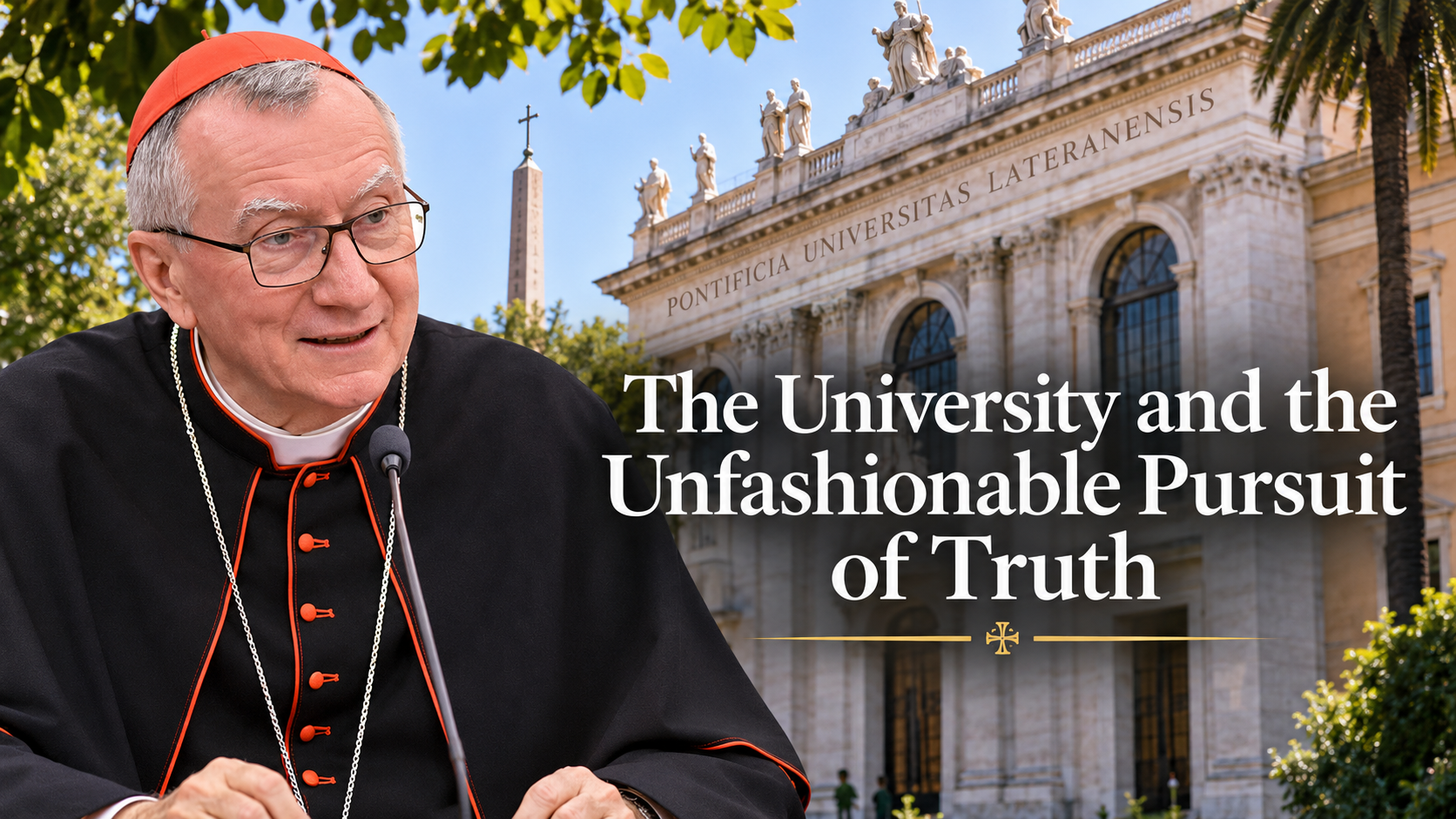
Cardinal Pietro Parolin’s address to the Pontifical Lateran University raises a question extending well beyond Rome: whether universities can recover their intellectual purpose, and whether Catholic universities possess sufficient confidence in their own intellectual inheritance to lead that recovery.
In the presence of the Italian President, Sergio Mattarella, Cardinal Pietro Parolin inaugurated the 254th academic year of the Pontifical Lateran University on Thursday, 26 November. The Secretary of State addressed an academic community whose responsibilities extend from the formation of priests and canonists to the study of peace and the environment. Among the contemporary problems he enumerated was the development of artificial intelligence. Yet perhaps the most consequential passage of his address concerned something considerably older: the disposition of the mind towards truth.
Parolin encouraged professors and students to cultivate “an authentic passion for the search for truth” and a willingness to ask searching questions. He expressly associated creative scholarship with fidelity to the Magisterium and the accumulated wisdom of Christian tradition.¹ Coming at a time when the freedom to ask certain questions has become contentious within universities themselves, these remarks deserve examination beyond the customary reporting of an academic inauguration.
The setting is particularly appropriate. The origins of the Lateran University lie in Clement XIV’s provision in 1773 for the continuation, under the secular clergy, of theological studies formerly entrusted to the Jesuits at the Roman College. Its subsequent development under Pius IX established the four faculties of theology, philosophy, canon law and civil law. Addressing the university last November, Leo XIV recalled this history and reaffirmed its peculiar relationship with the Successor of Peter.² Its ecclesiastical identity is consequently integral to its academic constitution.
Parolin acknowledged the urgency of a renewed proclamation of the Gospel in contemporary cultural and social circumstances. His address should therefore be read in its entirety rather than understood principally as another ecclesiastical intervention concerning peace, technological developments and environmental responsibility. These subjects certainly occupied his attention, but he situated their investigation within the evangelising mission of an ecclesiastical institution.
What is a university for?
In his Dublin discourses of 1852, subsequently incorporated into The Idea of a University, John Henry Newman exposed a curious contradiction in the emerging conception of higher education. An institution professing to concern itself with universal knowledge proposed to exclude theology from its intellectual deliberations. If God exists, and if something can be known of Him, the exclusion of that knowledge necessarily impoverishes the university’s understanding of reality.³
Newman understood that the cultivation of the intellect possesses a distinctive purpose. Knowledge enables a man to perceive relationships between apparently disparate subjects, distinguish competent authorities from presumptuous ones and recognise the limitations of his own particular field of expertise. The possession of specialised knowledge does not confer universal competence.
A distinguished biologist may have exceedingly little knowledge of jurisprudence. An accomplished economist may prove a remarkably inadequate moral philosopher. A theologian, for that matter, has no particular authority to determine the outcome of an experiment in physics simply because he understands the doctrine of creation. A properly constituted university provides the intellectual circumstances in which these disciplines can illuminate one another without appropriating one another’s authority.
The practical importance of Newman’s argument becomes apparent in the discussion of artificial intelligence, to which both Parolin and President Mattarella referred. The capacity of machines to perform increasingly sophisticated intellectual operations requires considerable scientific expertise to understand. Its implications for human responsibility, personal identity and moral agency require knowledge of another order.⁴
Whether a machine can reproduce the outward manifestations of human intelligence is a technical question. Whether such a machine thereby possesses the rational faculties, moral responsibility or spiritual nature of a human person is a philosophical question. An institution which lacks the intellectual resources to distinguish between them is particularly ill-equipped to adjudicate the consequences of technological development.
The Catholic intellectual tradition has something substantial to contribute here. Its understanding of man as a unity of body and rational soul, possessed of an intellect and will and created for a supernatural end, provides an account of human dignity which does not depend upon measurable intellectual performance. The dignity of a severely intellectually disabled person is consequently no less than that of the professor examining the capabilities of artificial intelligence. A machine which surpasses both in computational efficiency has acquired no corresponding claim to human dignity. These are precisely the sorts of judgements for which a university requires philosophy and theology.
Born from the heart of the Church
John Paul II addressed the purpose of Catholic higher education directly in his apostolic constitution Ex corde Ecclesiae, promulgated on 15 August 1990. Its opening words recall the emergence of the university from the intellectual life of the Church.
The constitution identifies four essential characteristics of a Catholic university: the Christian inspiration of the institution itself; scholarly investigation informed by Catholic faith; fidelity to the Christian message received through the Church; and institutional service to humanity in recognition of its transcendent destiny.⁵
The emphasis upon the institution is easily overlooked. A university does not fulfil these requirements simply by accommodating practising Catholics among its staff and students, maintaining a chaplaincy or preserving the architectural inheritance of its religious founders. Catholic identity concerns the intellectual and moral principles according to which the institution conducts its affairs.
It is perfectly possible for a Catholic university to excel in medicine, engineering or economics without every lecture containing an explicit reference to Catholic doctrine. Indeed, the integrity of the individual disciplines requires that their proper methods be respected. The Catholic character of their teaching becomes especially apparent when questions arise concerning the purposes for which knowledge may legitimately be employed.
A medical faculty cannot evade the moral questions occasioned by advances in reproductive technology. A law faculty must consider whether legal enactment is sufficient to establish the justice of a particular law. The study of economics cannot satisfactorily proceed on the assumption that human welfare is exhausted by material prosperity. The contribution of theology to university life ought therefore to extend considerably beyond the theology faculty.
John Paul II also understood that the Church’s relationship with universities necessitates a genuine freedom of intellectual investigation. The constitution recognises institutional autonomy and academic freedom according to the methods proper to the respective disciplines, exercised within the requirements of truth and the common good. In theology, the nature of the subject requires due recognition of the authority entrusted to the Church concerning divine Revelation.
A corresponding provision governs ecclesiastical universities such as the Lateran. Article 38 of Francis’s apostolic constitution Veritatis gaudium, dated 8 December 2017, recognises freedom of research and teaching while specifying the obligations of fidelity arising from the study of revealed truth.⁶ The two constitutions address related but juridically distinct institutions. Their underlying understanding of the relationship between faith and reason is nevertheless consistent.
The Catholic scholar has no theological reason to fear the discovery of a fact. Whatever is genuinely true of creation cannot contradict the truth of its Creator. Apparent contradictions may require the reconsideration of a scientific hypothesis, a philosophical assumption or an inadequate understanding of what the Church actually teaches. Each possibility deserves serious consideration.
The freedom to ask
Last week, Nuntiatoria examined Warren Smith’s encounters with students at Brown University and the difficulty of discussing the moral implications of Charlie Kirk’s assassination in an academic environment. The evidence warranted care: a selection of filmed conversations could not establish the opinions of an entire university. Nevertheless, the reluctance of some participants to engage candidly with difficult questions raised legitimate concerns about the intellectual habits being cultivated in higher education.⁷
Our earlier examination of the University of Sussex’s interpretation of its Prevent responsibilities considered the problem from the perspective of institutional governance. The university had described its statutory duty as preventing terrorism, omitting the words which specify that the duty concerns preventing people from being drawn into terrorism. The concern was that such an enlargement of safeguarding obligations might extend institutional supervision into areas of legitimate intellectual activity.⁸
Parolin made no reference to either controversy. His address did, however, identify the danger of superficial interpretations of human and social affairs, arising from fear and hardening into ideological positions. He assigned universities a responsibility to provide the intellectual resources by which such interpretations might be overcome.
Universities inevitably exercise authority over their students and employees. They determine academic standards, regulate conduct and distinguish competent scholarship from work which fails to satisfy the requirements of a discipline. The question is whether this authority is exercised for recognisably academic purposes.
A student should reasonably expect to have an inadequate argument challenged by his professor. He should equally be able to challenge his professor’s argument without fearing that the expression of disagreement will itself be treated as misconduct. The distinction between intellectual disagreement and personal hostility ought to be among the first lessons of university life. Without it, almost any controversial academic question can be converted into an allegation about the conduct or character of the person asking it.
There is also a considerable difference between the obligation to respect another person and an obligation to assent to that person’s opinions about himself, society or the nature of reality. The former belongs to justice and charity; the latter requires a justification which cannot be supplied merely by invoking the former. A university which confuses these obligations will struggle to investigate precisely those questions for which society most needs its assistance.
Catholic identity and academic freedom
The Catholic university is sometimes presented as an inherently problematic institution because its fidelity to the Church supposedly compromises the freedom of its scholars. The objection deserves a serious response, particularly because Catholics themselves can occasionally lend it credibility through an unduly suspicious attitude towards legitimate scholarly investigation.
Benedict XVI addressed the matter at the Catholic University of America in Washington on 17 April 2008. Speaking to Catholic educators, he expressly defended academic freedom and the scholar’s responsibility to follow the evidence. He also maintained that academic freedom could not justify the contradiction of Catholic teaching by those entrusted with the educational mission of the Church.⁹
The obligations of an ecclesiastically appointed theologian differ from those of a historian investigating a disputed episode in medieval ecclesiastical administration. The authority of the Magisterium in matters of faith and morals does not establish the accuracy of every historical judgement expressed by an ecclesiastical official. Nor does it render every administrative decision immune from examination.
Catholic theology itself admits of legitimate disagreement in matters which the Church has not definitively settled. It would be difficult otherwise to account for the existence of the Thomist, Scotist and other recognised theological schools, or indeed the history of Catholic theological scholarship. The considerable intellectual freedom enjoyed within those schools proceeded from a common acceptance of the Faith. Their disagreements frequently concerned the explanation of truths which their adherents held in common.
There is something particularly instructive in the structure of the medieval quaestio disputata. Before reaching his determination, the master was obliged to consider objections to the position he intended to defend. Readers of the Summa Theologiae will recognise the extraordinary seriousness with which St Thomas Aquinas treats arguments opposed to his own conclusions. He frequently grants substantial elements of an objection before demonstrating where its reasoning fails.
The contemporary student who has learnt to recognise an objection principally as evidence of the objector’s objectionable character would benefit from an afternoon with the Angelic Doctor.
Catholic universities have a responsibility to preserve the conditions in which this kind of scholarship remains possible. That responsibility includes protecting their institutional Catholic identity. Under the 1983 Code of Canon Law, the use of the designation Catholic university requires ecclesiastical consent. University authorities have obligations concerning the doctrinal integrity and moral conduct of academic staff, while those teaching theological disciplines require an ecclesiastical mandate. Canon 810 requires that any removal of teachers who cease to satisfy the prescribed conditions follow the procedure established in the university’s statutes.¹⁰
These provisions impose responsibilities upon ecclesiastical authorities as well as academics. Bishops and university administrators must understand the difference between established Catholic doctrine, legitimate theological opinion, ecclesiastical policy and their own prudential preferences. An institution cannot convincingly commend fidelity to truth while discouraging legitimate examination of its own conduct.
The education of judgement
President Mattarella’s contribution to the Lateran inauguration included a concern that artificial intelligence might diminish the exercise and development of human intelligence itself. His observation deserves particular attention from those responsible for higher education.¹¹
The increasing availability of information, and now of apparently competent answers to virtually any question, makes the cultivation of judgement more necessary. The student who can obtain a plausible essay within seconds may have little understanding of the argument it contains. He may be unable to recognise a fabricated reference, assess the quality of its evidence or explain why its conclusions follow from its premises.
Knowledge was never simply the possession of information. Newman understood this long before the emergence of computers, and Parolin’s encouragement of creative study beyond the accumulation of facts belongs recognisably to that intellectual tradition. The implications are particularly serious for the formation of priests.
A seminarian may successfully reproduce an approved formulation of Catholic doctrine while possessing insufficient understanding to explain it to an intelligent sceptic. He may know the conclusion of a moral argument without being able to reconstruct its reasoning. When confronted with a pastoral difficulty which differs from the examples encountered in his textbooks, he may consequently prove incapable of applying the principles he ostensibly knows.
As Nuntiatoria considered in its recent spiritual conference, The Formation of the Catholic Mind, intellectual cultivation and moral formation remain distinct, although the Catholic ought to pursue both in the service of God.¹² A priest requires an intellectual formation adequate to the demands of his vocation. So, in their respective circumstances, do Catholic teachers, physicians, lawyers and parents. Their ability to explain the Faith with intelligence and conviction has consequences for the Church’s evangelical mission.
An institutional responsibility
Parolin’s address was an exhortation delivered at an academic inauguration. It announced no new regulations concerning university governance, academic freedom or the enforcement of Catholic identity. Its practical consequences will depend upon the willingness of academic and ecclesiastical authorities to give effect to the principles he articulated.
There are reasonably straightforward ways in which Catholic universities might demonstrate that willingness. Their students should receive sufficient philosophical formation to recognise the assumptions underlying their specialised studies. Theology should be available as a serious academic discipline to students outside theological faculties. Procedures governing controversial research, invited speakers and complaints about expression should distinguish demonstrable misconduct from intellectual disagreement.
Institutions should also be able to explain how their appointments, curricula and public activities fulfil their obligations under Ex corde Ecclesiae. The preservation of Catholic identity requires rather more than retaining the name of a religious founder above the entrance to a university whose educational philosophy has become indistinguishable from that of its secular competitors.
There will inevitably be difficult cases. The investigation of a contested question may require considerable patience, and neither university administrators nor ecclesiastical authorities will invariably find the resulting discussion comfortable. The Catholic university nevertheless enjoys an intellectual advantage in such circumstances. It possesses a coherent account of truth, of the human capacity to know it, of the moral obligations attending its pursuit and of the ultimate purpose for which knowledge is acquired.
Whether Catholic institutions are making sufficient use of that inheritance is a question which the Secretary of State’s address has made particularly timely. It would be instructive to examine how many Catholic universities require their undergraduates to study philosophy and theology, and what place these subjects actually occupy in the education of students pursuing professional qualifications. The answer might tell us more about their institutional Catholic identity than the declarations of their governing bodies.
FOOTNOTES
¹ Cardinal Pietro Parolin, L’audacia di uno studio creativo che porti ad aprirsi a orizzonti più grandi, L’Osservatore Romano, 26 November 2026; Vatican News, Cardinal Parolin: Universities must help humanity navigate today’s challenges, 26 November 2026.
² Leo XIV, Address to the Pontifical Lateran University for the Inauguration of the Academic Year, 14 November 2025.
³ John Henry Newman, The Idea of a University, Discourse II: Theology a Branch of Knowledge, 1852.
⁴ Sergio Mattarella, Intervento del Presidente Mattarella all’inaugurazione dell’Anno Accademico 2026/2027 della Pontificia Università Lateranense, 26 November 2026.
⁵ John Paul II, Apostolic Constitution Ex corde Ecclesiae, 15 August 1990, §§12–19, 27–29 and 48–49.
⁶ Francis, Apostolic Constitution Veritatis gaudium, 8 December 2017, art. 38.
⁷ Nuntiatoria, The Price of Speaking Freely: Charlie Kirk, Brown University and the Fear of Dissent, 20 November 2026.
⁸ Nuntiatoria, When the Law Is Quietly Rewritten: Sussex, Prevent, and the Expanding Reach of Institutional Power, 29 May 2026.
⁹ Benedict XVI, Meeting with Catholic Educators at the Catholic University of America, 17 April 2008.
¹⁰ Code of Canon Law, 1983, cann. 808–812; see also can. 818.
¹¹ Sergio Mattarella, Intervento del Presidente Mattarella all’inaugurazione dell’Anno Accademico 2026/2027 della Pontificia Università Lateranense, 26 November 2026.
¹² Nuntiatoria, The Formation of the Catholic Mind: A Spiritual Conference for Nuntiatoria CXXXII, 17 November 2026.






Leave a Reply