
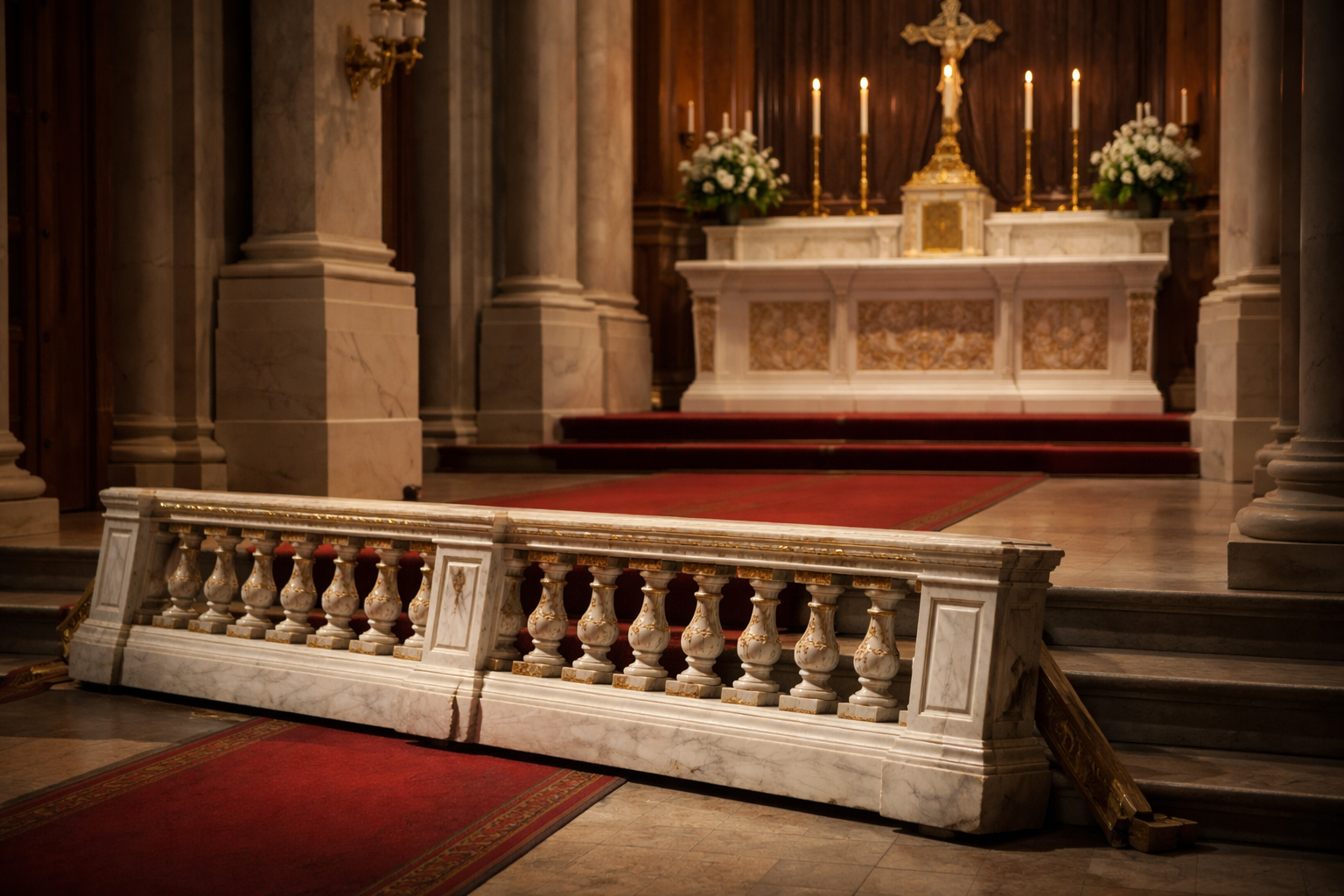
Reverence Restricted: Charlotte Bishop Bans Altar Rails in School Liturgies
The Diocese of Charlotte has entered a new phase of liturgical regulation under Bishop Michael Martin. Reports confirm that Catholic high schools in the diocese are to follow directives forbidding the use of altar rails or kneelers for the reception of Holy Communion. Students are instructed to receive either standing or kneeling without the support of a rail. School Masses must also include students serving as extraordinary ministers of Holy Communion, projectors and screens in chapels to display texts (such as the Gloria and Creed) instead of printed worship books, and at larger Masses a student testimony between final prayer and dismissal.¹
These instructions were not promulgated in a written decree but communicated verbally to school leadership, leaving parents and students uncertain about their binding force.¹ For the moment, the directives apply only to diocesan schools, though earlier drafts of diocesan norms suggested that wider restrictions might follow.²
Liturgical Law and Tradition
The ban on altar rails has provoked particular controversy. For centuries, altar rails served not only as a practical support for kneeling communicants but also as a clear architectural demarcation between sanctuary and nave, reinforcing the sacrificial character of the Mass. Pope Pius XII, in Mediator Dei, defended such elements of tradition as fostering reverence and signifying the holiness of the altar.³
The Fathers of the Church testify to this posture of humility before the Eucharist. St Augustine taught: “No one eats this flesh without first adoring it; we should sin were we not to adore it.”⁴ St John Chrysostom warned the faithful to approach Holy Communion “with fear and trembling, with purity of conscience,” for in the sacred mysteries “the angels surround the altar.”⁵
While the General Instruction of the Roman Missal permits Communion either standing or kneeling, it does not mandate removal of altar rails, nor forbid their use.⁶ GIRM paragraph 160 states: “The norm established for the Dioceses of the United States of America is that Holy Communion is to be received standing, unless an individual member of the faithful wishes to receive Communion while kneeling.”⁷ Thus kneeling remains legitimately permitted.
Participation or Performance
Other aspects of the directives show a further drift from Catholic liturgical theology. The installation of screens and projectors in place of missals or hymnals conforms more to a utilitarian aesthetic than to the sacred. The insertion of student testimonies after Communion transforms the Mass into something resembling performance rather than worship.
The requirement that students serve as extraordinary ministers of Holy Communion raises canonical concerns. Redemptionis Sacramentum (2004) states that extraordinary ministers may assist the priest only when necessity demands—for example, when ordinary ministers are lacking, or if the number of communicants is so large that the Mass would be unduly prolonged.⁸ Making their use mandatory in school liturgies, without evident necessity, violates that norm.
A Broader Trend
This move in Charlotte cannot be isolated from the wider campaign against traditional liturgy and piety. Earlier this year Bishop Martin restricted the Traditional Latin Mass to a single chapel in Mooresville, in line with Traditionis Custodes.¹ The directives for schools continue this trajectory: restricting legitimate gestures of reverence, enforcing practices that dilute sacramental clarity, and promoting innovations foreign to Catholic tradition.
What is most striking is the disparity between the stated aim of fostering unity and the actual effect of these measures: alienating faithful students and families who desire to kneel in devotion or to receive Our Lord at the rail. Unity in worship is found not by suppressing expressions of reverence but by conforming more fully to the perennial Roman tradition, which has always placed God—not the assembly—at the centre of the liturgy.
A Call to Fidelity
The faithful in Charlotte are confronted with the perennial choice: fidelity to the Faith as handed down or conformity to ephemeral innovations. In an age of declining belief in the Real Presence, what is most needed is not the removal of rails and kneelers but the restoration of reverence and clarity. True “active participation” is not achieved through projectors and student speeches, but by uniting hearts to the sacrifice of Christ renewed upon the altar.
As Pope Benedict XVI reminds us in Sacramentum Caritatis, “The best catechesis on the Eucharist is the Eucharist itself, celebrated well.” The liturgy requires not experimentation but fidelity. By impoverishing the rites in schools, Bishop Martin risks training a generation in irreverence, not reverence; in novelty, not tradition.
The Church will not be renewed by suppressing rails or silencing kneeling communicants. She will be renewed only by returning to the perennial liturgy, where altar rails, silence, and kneeling all testify to the truth: Dominus est—it is the Lord.
Footnotes
- The Catholic Herald, “Charlotte bishop confirms altar rail ban in liturgical directives for schools,” September 6, 2025.
- CatholicVote, “North Carolina bishop bans use of altar rails at diocesan high schools,” September 9, 2025.
- Pius XII, Mediator Dei, 1947, §62.
- Augustine, Enarrationes in Psalmos 98,9 (PL 37:1264).
- John Chrysostom, Homily 50 on the Gospel of Matthew (PG 58:508).
- The Catholic Messenger, “Question Box: Posture for Receiving Communion,” June 6, 2024.
- General Instruction of the Roman Missal, §160.2, United States Conference of Catholic Bishops edition.
- Congregation for Divine Worship, Redemptionis Sacramentum, 2004, §158.



Leave a Reply