
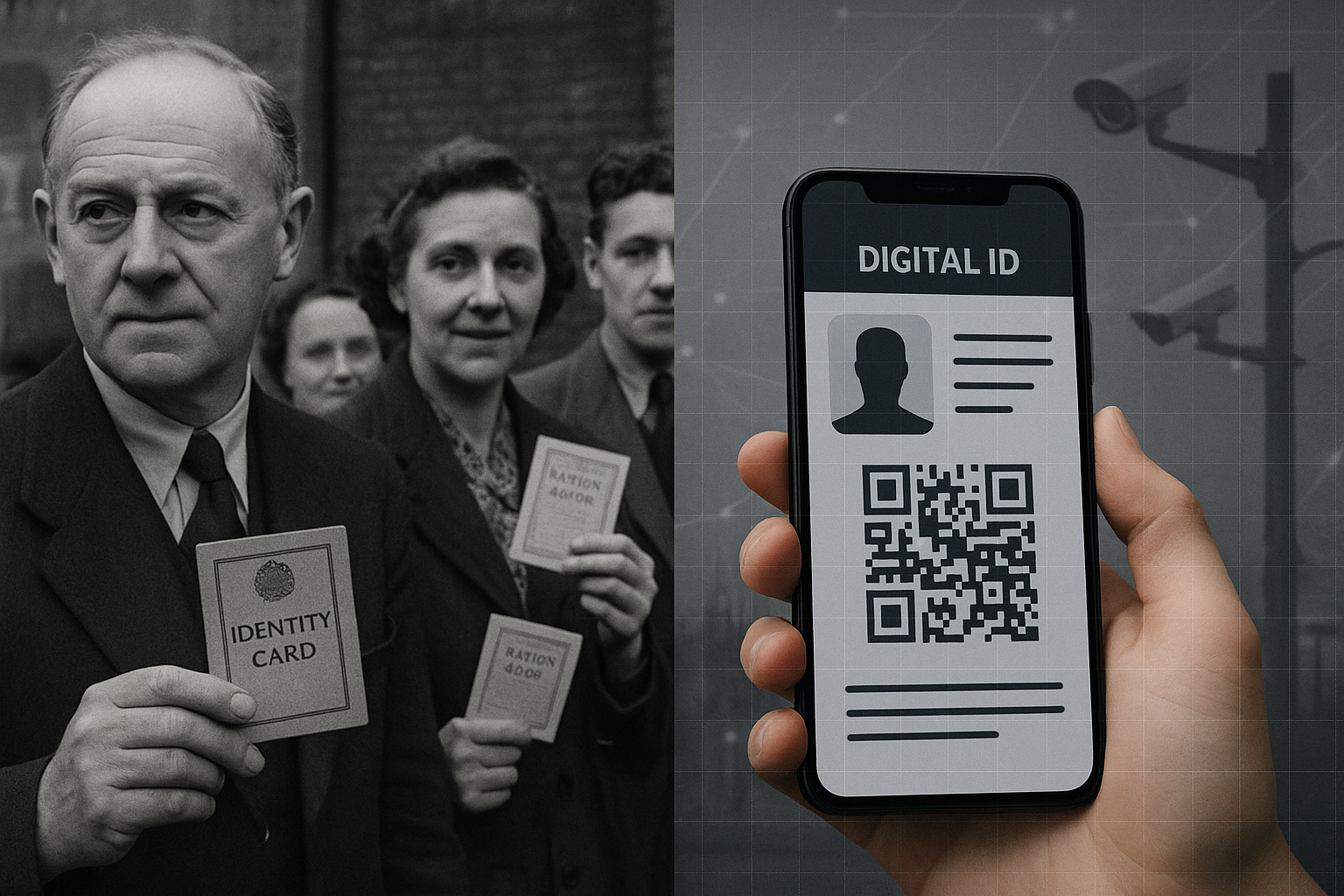
The Return of the “Brit Card”?
Starmer’s Digital Identity Gamble and Britain’s Forgotten Instinct for Liberty
When reports surfaced in late September that Prime Minister Keir Starmer would soon unveil plans for a universal digital ID card scheme, Britain’s political landscape jolted with a sense of déjà vu. The proposal — cast as a modern solution to illegal immigration and labour exploitation — immediately triggered memories of past battles over identity cards, civil liberties, and the role of the state in the daily lives of its citizens. What seemed consigned to history a decade ago has returned, this time dressed in the sleek rhetoric of technology and efficiency.
A troubled history
Identity cards in Britain have always carried the mark of suspicion. The first modern ID system emerged during the Second World War, justified by the exigencies of total war and rationing. While the cards served a limited purpose in verifying access to food and services, they quickly became resented as intrusive. By 1952, three years after peace had returned, Winston Churchill’s government abolished them, with Lord Chief Justice Goddard memorably declaring that such cards were “a nuisance” and symbolised unnecessary peacetime restrictions¹.
Half a century later, under Tony Blair’s New Labour government, the idea resurfaced. The Identity Cards Act 2006 sought to create a National Identity Register, linking biometric ID cards to a centralised government database. Ministers argued that terrorism, illegal immigration, and organised crime required a twenty-first century solution. Critics, however, rallied against what they called a “database state.” The Liberal Democrats, civil liberties groups, and even elements within Labour warned of unprecedented state intrusion. When the coalition government came to power in 2010, the Act was repealed. Theresa May, then Home Secretary, memorably described the scheme as “intrusive, bullying, ineffective and expensive”².
Starmer’s rationale
Today, Keir Starmer insists that the world has changed. Britain faces migration pressures of a different order, coupled with a labour market in which exploitation of undocumented workers undermines both fairness and public confidence. His allies frame the new scheme not as a surveillance tool but as a necessary foundation of governance. A digital ID, they argue, would allow every employer to verify a worker’s right to remain instantly, cutting through bureaucracy and reducing reliance on paper documents prone to forgery. It would, they claim, restore faith that the government is in control of the borders without erecting physical barriers or expanding detention³.
Yvette Cooper, the Home Secretary, has suggested that “Britain cannot manage twenty-first century migration with twentieth century tools”⁴. Others in government point to the ubiquity of digital verification in daily life — from online banking to airport security — as proof that a state-backed framework is merely catching up with reality.
Supporters’ arguments
Business groups, too, have welcomed the prospect. The Confederation of British Industry has long complained of burdensome checks and legal uncertainties around employing foreign workers. A streamlined digital ID system, they argue, would save costs and shield firms from accidental breaches of immigration law. Pro-migration think tanks claim that such a system could also be the first step towards rationalising Britain’s fragmented visa framework, allowing for more transparent pathways for legal migrants while closing off avenues for exploitation.
Some civil society groups even present digital IDs as a social equaliser. “For marginalised communities, having a secure, universally recognised identity is empowering,” notes one advocate, pointing to homeless charities who have lobbied for easier forms of ID to access healthcare and housing.
Critics’ warnings
Yet the chorus of criticism has been equally sharp. Civil liberties organisations such as Big Brother Watch have branded the plan a dangerous step toward a surveillance state. Their concern is not only with the cards themselves but with the architecture behind them — the databases, the cross-linking of personal information, the potential for function creep.
In their 2025 report Checkpoint Britain, Big Brother Watch warns that such a scheme would create a “Papers, please” society, requiring proof of identity for everyday activities like renting a flat, registering with a GP, or opening a bank account. They note that 63% of Britons do not trust the government to keep digital ID data safe, and more than 90,000 have already signed petitions against the “BritCard”⁵. Director Silkie Carlo has been blunt: “A universal digital ID is not about controlling borders but controlling people”⁶.
Even sympathetic outlets have sounded caution. The Guardian argued that a centralised ID scheme could quickly morph from immigration control into a system where access to rights and services depends upon constant verification⁷.
International comparisons
The debate cannot be disentangled from the global landscape. Most European countries already require citizens to carry ID cards. In France and Germany, such systems are widely accepted, though their scope and data content vary. In Estonia, the e-ID has become a model of digital governance, granting access to government services, banking, and even voting. Advocates point to these examples as proof that a digital identity can coexist with democracy.
But not all comparisons are reassuring. India’s Aadhaar system, initially voluntary, has become a near-mandatory key to social services, despite widespread reports of data breaches and exclusion of the poor⁸. In China, digital IDs are integrated into the Social Credit System, where access to travel, loans, and employment can be restricted based on state-determined “trustworthiness.” Critics warn that Britain risks sliding toward this model, not overnight but gradually, as each new function is grafted onto the infrastructure⁹.
The most pertinent fear is mission creep. A system introduced for immigration control could soon be extended to healthcare access, financial services, or even political participation. The very efficiency that makes digital IDs attractive also makes them dangerously versatile.
Slippery slope concerns
Technology changes not only what is possible but what becomes expected. A generation accustomed to biometric logins and digital wallets may not initially resist. But when identity becomes a gateway to essential services, opting out ceases to be an option. What begins as convenience ends as coercion.
As David Davis MP once quipped during the 2006 debates, “The British state knows a great deal about criminals; it does not presume to treat the law-abiding like criminals as well”¹⁰. The reintroduction of ID cards, especially in digital form, blurs that distinction.
Cultural and civilisational stakes
At stake is more than policy. The question is whether Britain remains a society that trusts its citizens by default, or one that requires them to prove themselves to the state at every turn. This is not simply a matter of efficiency but of anthropology: do we see people as autonomous individuals endowed with inherent dignity, or as datapoints to be managed?
The spectre of China looms precisely because it represents the logical conclusion of a philosophy that reduces the citizen to a measurable unit of compliance. Few in Westminster advocate such a system, yet by adopting its infrastructure Britain would risk sowing the seeds of digital authoritarianism under the guise of progress.
Conclusion: liberty remembered
Britain has rejected ID cards twice before, and not merely out of stubbornness. The instinct was that liberty is diminished when the state assumes entitlement to demand credentials for ordinary life. That instinct was hard won and should not be lightly abandoned.
Nor is it clear that Starmer’s scheme addresses the actual problem. The central angst about immigration for most Britons is not whether undocumented workers can slip into the formal labour market, but whether the government can control who enters and remains in the country in the first place. A digital ID will not stop small boats crossing the Channel, nor will it ensure removals of those without legal right to remain. As Big Brother Watch notes, such schemes risk driving migrants further underground while penalising law-abiding citizens and employers¹¹.
At best, it tinkers at the edges; at worst, it burdens citizens with yet another layer of state scrutiny while leaving the real crisis untouched.
Starmer’s gamble may prove politically costly. To some, it signals seriousness on migration; to others, it betrays a failure to remember why ID cards were scrapped in the first place. The rhetoric of modernisation cannot erase the lessons of history: that systems built for efficiency can become instruments of control, and that once liberties are surrendered, they are rarely restored.
In the end, the issue is not whether digital IDs are technically feasible, but whether they are culturally and morally desirable. Britain must decide if it still values the liberty to walk untracked, to live unmeasured, to be a citizen rather than a subject. And it must ask whether this new “Brit Card” is a genuine answer to its immigration challenges, or simply a digital distraction.
- Lord Chief Justice Goddard, Willcock v Muckle (1951).
- Theresa May, Statement on the repeal of the Identity Cards Act, 2010.
- Financial Times, “Starmer set to announce digital ID cards for all UK adults,” 25 Sept 2025.
- Ibid.
- Big Brother Watch, Checkpoint Britain (Sept 2025), pp. 4–6.
- Silkie Carlo, quoted in Checkpoint Britain, p. 12.
- The Guardian, Editorial, “Keir Starmer expected to announce plans for digital ID cards,” 25 Sept 2025.
- Jean Drèze et al., The Hindu, 2017.
- Samantha Hoffman, “Social Credit: Technology-enhanced authoritarian control,” Journal of Strategic Studies (2018).
- David Davis MP, House of Commons debate on the Identity Cards Bill, 2006.
- Checkpoint Britain, pp. 9–11.






Leave a Reply