
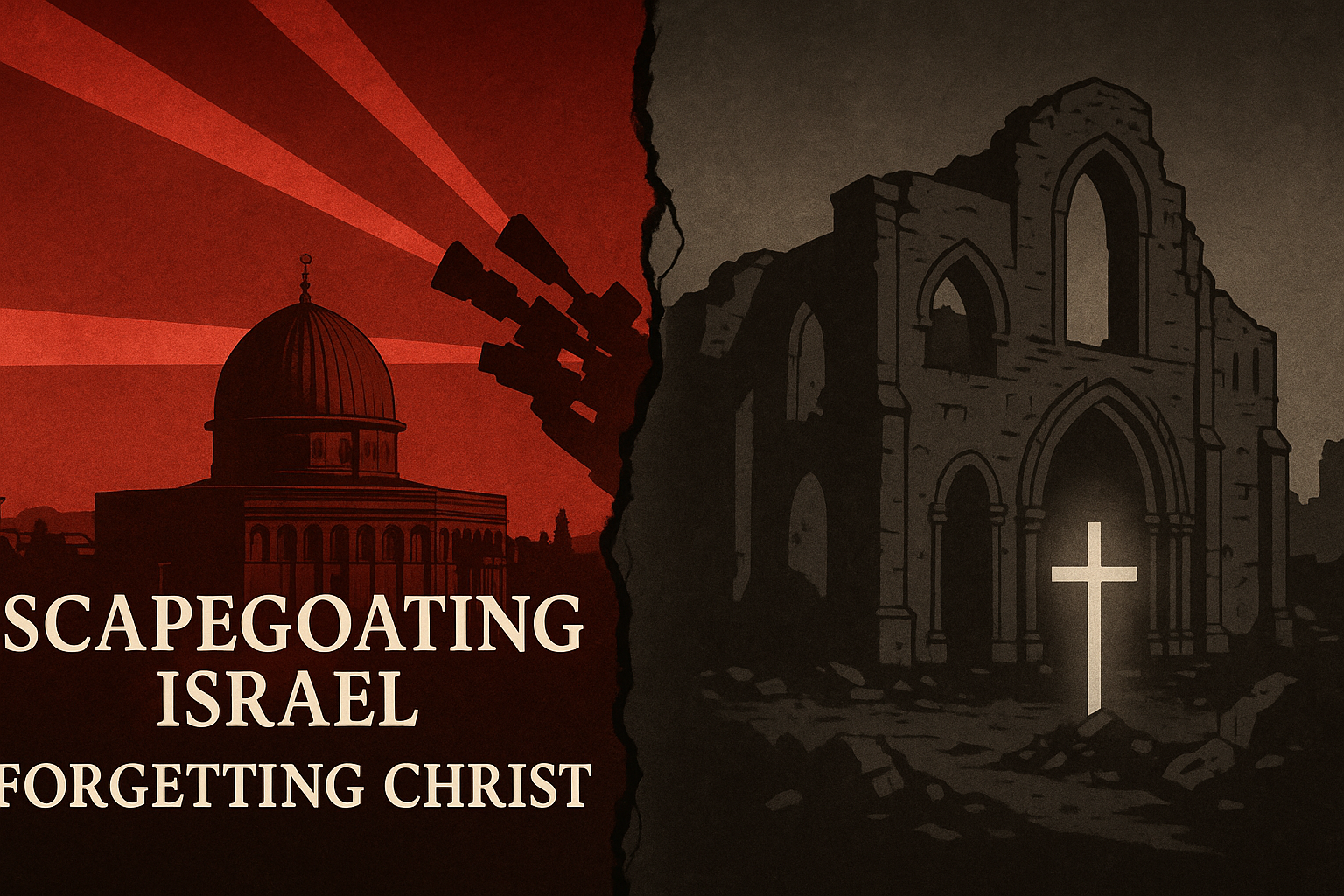
From Gaza to Mosul: Lies against Israel spread faster than truth, while Rome forgets her own martyrs
In an age obsessed with tolerance, Israel has become the one nation against which intolerance is respectable. In universities, in newsrooms, and in parliaments, condemnation of the Jewish state now functions as a badge of progressive virtue. It is framed as a defence of the oppressed, yet it often masks an old prejudice in new garb.
The language itself betrays the bias. Israel is not merely criticised, as any democracy might be; it is denounced as an “apartheid state,” a “colonial project,” even a “genocidal regime.”¹ Such terms are rarely applied to regimes that openly persecute minorities or practise ethnic cleansing, yet they have become stock phrases in Western politics. This selective outrage reveals not principle, but convenience.
The media, eager for powerful stories, readily amplify this narrative. A recent case illustrates the danger: reports claimed that a Gazan boy had been killed by Israeli fire, and the image of a child martyr spread rapidly. But, as Nuntiatoria revealed, the boy was alive.² By the time the truth emerged, the falsehood had already hardened into international memory. In the same way, casualty figures from Hamas’s own health ministry were repeated for months — only to be revised later, with thousands of supposed “children” quietly removed from the list.³ Yet the correction was ignored, and the original narrative remained fixed in the public imagination.
Such distortions create a glaring double standard. As Matti Friedman has shown, Israel is subjected to scrutiny unlike any other nation.⁴ Atrocities by neighbouring regimes are ignored, while minor infractions by Israel dominate global headlines. Even international institutions reinforce this imbalance. As Nuntiatoria uncovered, UN agencies refused to deliver aid in parts of Gaza despite Israeli guarantees of safe passage, allowing suffering to be used as a political weapon.⁵
The Silence of Western Politicians
The problem is not only in the press. Western politicians have seized upon these narratives, weaving them into the fabric of their own moral posturing. Condemning Israel offers them a cheap righteousness: a way to appear compassionate without confronting the more complex and costly questions of global justice.
In parliaments across Europe, leaders denounce Israeli defensive actions with grave solemnity, while ignoring massacres in Africa, Asia, or the Middle East itself. Their outrage is selective, their conscience performative. Resolutions are drafted, boycotts proposed, sanctions threatened — all in the name of defending the oppressed. And yet, when Christians are driven from their homes in Syria or Nigeria, when churches are torched in Egypt or Pakistan, these same leaders fall silent. There is no parliamentary emergency, no candlelit vigils, no outcry of solidarity.
This is not compassion. It is cowardice masquerading as principle. It is moral vanity, content to rail against the “safe villain” of the West’s imagination, while ignoring those oppressors whose condemnation might actually cost political capital.
The Forgotten Martyrs of the East
The reality is stark. From Egypt’s Copts to Iraq’s Chaldeans, from Syria’s Orthodox to Lebanon’s Maronites, ancient Christian communities — the first fruits of Pentecost — have been decimated. A century ago, Christians made up around 20% of the Middle East’s population; today they account for less than 4%.⁶ The decline is not demographic chance but deliberate persecution. Millions have been uprooted from their homes; countless others have been killed, kidnapped, imprisoned, or subjected to systematic discrimination. The 2019 UK-commissioned review warned that persecution of Christians in the Middle East is “coming close to genocide.”⁷
And yet, in Israel itself, Christian communities are not only surviving but growing.⁸ In Jerusalem, Nazareth, Haifa, and Jaffa, believers worship freely, build churches, and proclaim the Gospel without fear of the state. This is the paradox few critics acknowledge: the one nation condemned as oppressor is the very place where the Cross stands secure.
To acknowledge this is not to canonise Israel’s politics, but it is to recognise reality. The plight of Christians in the Middle East should haunt the conscience of the West. Instead, it is smothered beneath slogans and silences. Their suffering is inconvenient, because it does not fit the binary of “coloniser and colonised.” Their blood cries out, and our politicians turn away.
The Hesitation of the Holy See
Here the contrast becomes even sharper. When the Vatican wishes, it can move decisively. In June 2015, the Holy See signed a formal treaty recognising the “State of Palestine,” with the Vatican Press Office stressing its “support for a two-state solution.”⁹ Pope Francis welcomed Mahmoud Abbas to the Apostolic Palace with the honours of a head of state, calling him “an angel of peace.”¹⁰ At the United Nations, Vatican representatives have repeatedly urged “an end to the occupation” and pushed for binding resolutions critical of Israel.¹¹
Nor has its advocacy been limited to Palestine. On nuclear disarmament, John XXIII’s Pacem in Terris declared that “nuclear weapons must be banned,” and Francis told a 2017 symposium: “The threat of their use, as well as their very possession, is to be firmly condemned.”¹² On climate change, Laudato Si’ (2015) and Laudate Deum (2023) positioned the Vatican as an active player in environmental diplomacy, with papal delegations present at COP summits and constant exhortations to governments to meet their Paris commitments.¹³ On migration, Francis repeatedly condemned “the globalisation of indifference” and created an entire Vatican dicastery section to coordinate migrant advocacy.¹⁴
These examples demonstrate the ability of the Holy See to mobilise concrete political leverage when it perceives a cause as urgent. Yet for the survival of Middle Eastern Christians? The record is strikingly different. Popes have spoken movingly of their plight; Benedict XVI convened the Synod for the Middle East in 2010 and warned of a coming “exodus of Christians from the lands of the Bible.”¹⁵ Francis travelled to Iraq in 2021 to encourage the remnant flock. But beyond words, exhortations, and symbolic gestures, there has been no equivalent mobilisation of Vatican diplomacy: no binding treaties, no urgent pressure in the UN, no sustained campaign for humanitarian corridors or international guarantees.
As one recent analysis observed, the Vatican has been “an outspoken advocate of the Palestinians,” consistently urging recognition and concrete political action.¹⁶ By contrast, its concern for persecuted Christians, though heartfelt, has largely remained at the level of lamentation. Where the world applauds — Palestine, climate, migration, nuclear arms — Rome is loud. Where the world looks away — Mosul, Aleppo, Minya — Rome whispers.
A Prophetic Catholic Word
We cannot save the world by scapegoating one nation.
We cannot achieve justice by embracing lies.
We cannot make peace by equating the terrorist with his victim.
Israel is not beyond criticism. But neither is it beyond justice. To deny its right to exist is to deny the moral law itself.
And we cannot save the Church by ignoring her children.
We cannot claim to defend the poor while neglecting the persecuted.
We cannot speak of fraternity if we forget our brothers in the East.
The Church must be the conscience of nations. She must refuse both the blindness of uncritical partisanship and the blindness of ideological hatred. She must call the world back to truth.
Truth first — then justice.
Justice first — then peace.
Only on this foundation will reconciliation be possible. Only on this foundation will compassion cease to be counterfeit. And only then will our words about “human dignity” carry the weight of Heaven rather than the deceit of politics.
- Rashid Khalidi, The Hundred Years’ War on Palestine (New York: Metropolitan Books, 2020).
- The Manufactured Martyr: Gaza Boy ‘Killed by Israel’ Found Alive, Nuntiatoria, Sept 5, 2025.
- Hamas’s Own Numbers Collapse the Civilian-Casualty Narrative — and Expose the Politics of Famine in Gaza, Nuntiatoria, Aug 15, 2025.
- Matti Friedman, “What the Media Gets Wrong About Israel,” The Atlantic, Nov 30, 2014.
- The Spectacle of Neglect: UN Refusal to Deliver Aid in Gaza Exposed, Nuntiatoria, July 27, 2025.
- The Guardian, “Persecution of Christians ‘Coming Close to Genocide’ in Middle East,” May 2, 2019.
- Ibid.
- Pew Research Center, Christian Population in Israel (2016, updated 2022); Israeli Central Bureau of Statistics, Christians in Israel — 2023.
- Holy See–Palestine Comprehensive Agreement, June 26, 2015; Vatican Press Office Bulletin.
- Catholic News Agency, “Pope Calls Abbas an ‘Angel of Peace’ at Vatican Meeting,” May 16, 2015.
- America Magazine, “Vatican Urges Two-State Solution at UN, Calls for End to Occupation,” Aug 1, 2025.
- John XXIII, Pacem in Terris (1963), §111; Francis, Address to the International Symposium on Disarmament, Nov 10, 2017.
- Francis, Laudato Si’ (2015); Laudate Deum (2023); Vatican delegation participation at COP21 (2015), COP26 (2021), and COP28 (2023).
- Francis, Message for the 104th World Day of Migrants and Refugees (2018); Dicastery for Promoting Integral Human Development, Pastoral Orientations on Migrants and Refugees (2018).
- Benedict XVI, Ecclesia in Medio Oriente (2012), §31.
- TRT World, “Pope Francis, an Outspoken Advocate of Palestinians,” Oct 2023.
Israel #Palestine #MiddleEast #ChristianPersecution #Vatican #WesternPolitics #DoubleStandards #Truth #Justice #Peace #Nuntiatoria


Leave a Reply