
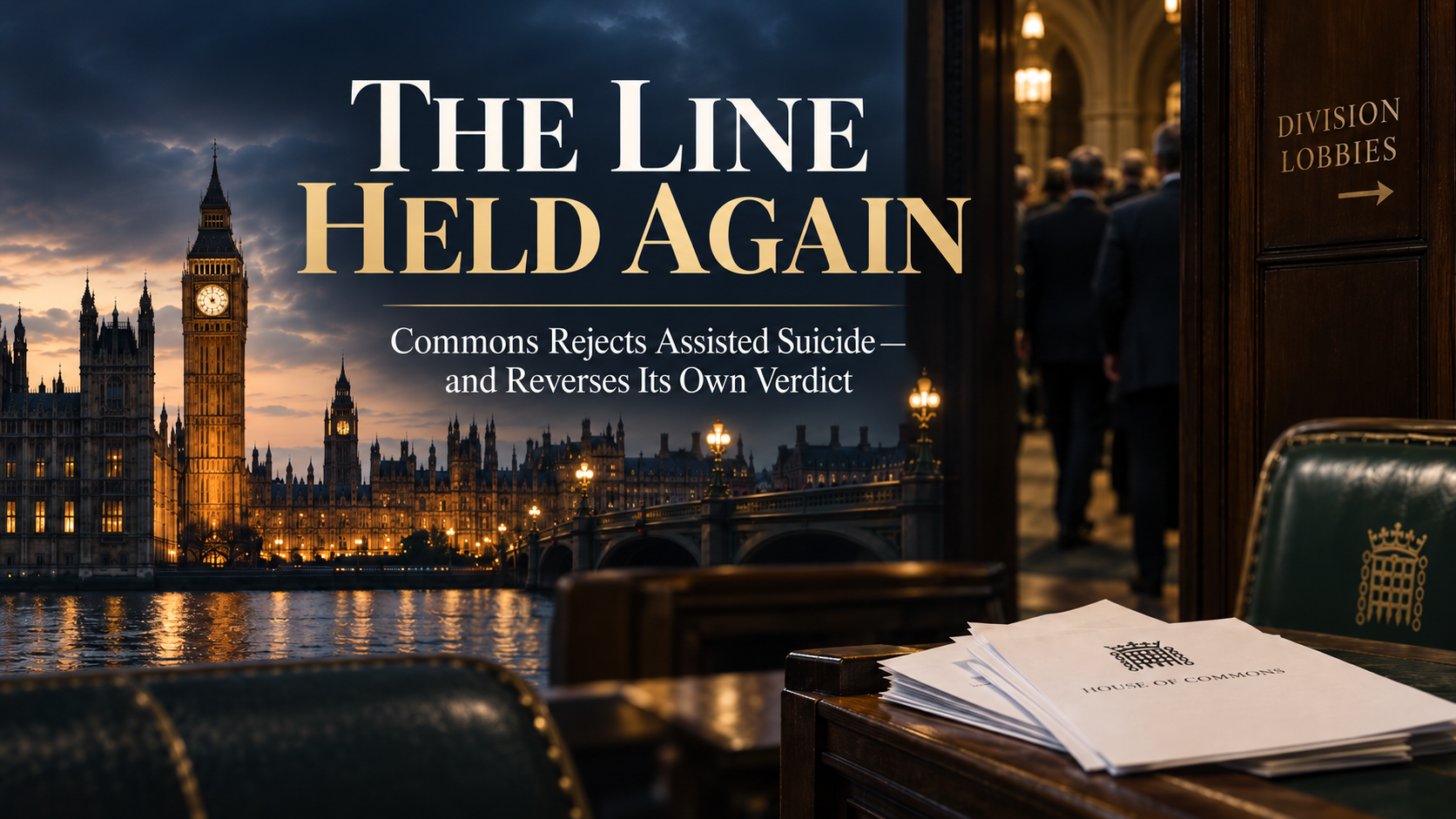
After nearly two years in which legalised assisted suicide was repeatedly presented as an approaching inevitability, the House of Commons has rejected it. By 286 votes to 270, MPs refused a Second Reading to the Terminally Ill Adults (End of Life) Bill. The importance of the vote lies not simply in the failure of another Bill, but in the direction in which Parliament has moved. The same House which endorsed the principle by 330 votes to 275 in November 2024, and passed Kim Leadbeater’s predecessor Bill at Third Reading by 314 votes to 291 in June 2025, has now said no. The arguments were heard, the safeguards examined and the consequences more fully understood. Support diminished rather than grew.
There are parliamentary divisions which settle little, and others in which the movement of the numbers is itself part of the story. On 29 November 2024 the House of Commons gave Kim Leadbeater’s Terminally Ill Adults (End of Life) Bill a Second Reading by 330 votes to 275, a majority of 55. Seven months later, after committee scrutiny, expert evidence and growing unease over the Bill’s safeguards, it survived Third Reading by 314 votes to 291, a majority reduced to 23. The measure then failed to complete its passage through the House of Lords before the end of the parliamentary session. Lauren Edwards subsequently reintroduced substantially the same project. On Friday, 11 September 2026, the Commons rejected that Bill by 286 votes to 270. In less than two years, a 55-vote majority for the principle of assisted suicide has become a 16-vote majority against it. That is not a procedural curiosity. It is a political reversal.¹
Supporters of legalisation will reasonably point out that parliamentary circumstances changed, that the previous Bill was frustrated by time in the Lords, and that opinion polling still frequently records majority support for some form of assisted dying. Those points ought to be acknowledged because the question is too serious for caricature. There are people approaching death who fear pain, indignity and loss of control. There are families who have watched somebody they love die badly. There are patients whose symptom management has failed and others whose experience of care has been fragmented, impersonal or frightening. No serious Catholic argument against assisted suicide can proceed by pretending those experiences do not exist. They are precisely why end-of-life care matters.
But suffering does not by itself settle the ethical question. The fact that a person is frightened, in pain or approaching death cannot relieve Parliament of the obligation to consider what follows once the state authorises doctors to participate in deliberately ending life. The issue has never been simply whether an individual may desire death under circumstances which most of us would find unbearable. The harder question is whether the law should convert that desire into a medical pathway, and what the existence of such a pathway does to medicine, to families, to vulnerable people and to the assumptions by which society regards dependence, disability and dying.
The Bill rejected on Friday would have permitted an adult resident in England or Wales, judged to possess mental capacity, diagnosed with a terminal illness and expected to have six months or fewer to live, to seek assistance from a doctor in ending his or her life. Two doctors would have assessed eligibility, after which the case would have passed to an Assisted Dying Review Panel. Following the required process and reflection period, an approved life-ending substance could have been supplied for self-administration. Within those statutory conditions, conduct which would otherwise fall within the prohibition on assisting suicide under section 2 of the Suicide Act 1961 would have become lawful.²
The expression “assisted dying” has undoubtedly become the preferred political term, but terminology cannot be permitted to obscure the substance of what Parliament was being asked to authorise. The existing law speaks of assisting suicide because one person intentionally assists another to bring about his own death. The proposed legislation would have created a carefully defined exception to that prohibition. Supporters may sincerely believe such an exception compassionate and humane; nevertheless the intended outcome of the intervention is death. That distinction matters because much of the political argument has depended upon presenting this legislation as though it were simply another form of end-of-life care rather than a fundamental change in what doctors may lawfully do.
That question has run through Nuntiatoria’s treatment of the subject from the beginning. When Parliament first moved towards legalisation, we argued that the central issue was never merely whether a sufficiently elaborate apparatus of safeguards could be constructed around an individual decision. It concerned the conception of human dignity upon which medicine and law depend. Before the previous Third Reading, we warned that a society which permits the intentional ending of life in response to suffering crosses a boundary quite different from one which permits patients to refuse burdensome or futile treatment. When the Leadbeater Bill passed the Commons in June 2025, the danger lay not merely in the provisions of one statute but in the altered presumption behind it: that under certain circumstances a vulnerable life might become something medicine could lawfully help to end rather than something society remained bound to protect.³
The intervening period has made those concerns more difficult to dismiss, not less. One of the most important contributions to Friday’s debate came from Ashley Dalton, the Labour MP for West Lancashire, who has stage-four incurable breast cancer. Her opposition cannot easily be filed away as the anxiety of somebody untouched by terminal illness. She spoke from within the reality around which the legislation was constructed and nevertheless concluded that the Bill was unsafe. Her remark to the Commons was characteristically plain: “My days may be numbered, but that doesn’t mean that I want this chamber to rush through bad law.”⁴
Dalton’s intervention matters because discussion of assisted suicide has often been conducted through a strangely selective use of personal testimony. Accounts from people who want legal assistance to die are understandably compelling and frequently treated as possessing an almost decisive moral authority. Yet testimony from disabled people, palliative-care doctors, terminally ill opponents of assisted suicide and patients who fear becoming a burden is too often treated as a technical objection to be overcome by another safeguard. Dalton punctured that assumption. Terminal illness does not generate one politically correct conclusion. Somebody can understand the terror of dying from personal experience and still judge that the dangers inherent in changing the law outweigh the autonomy which legalisation promises.
The most serious danger has never been the crude image of malign relatives openly demanding that an elderly or sick person die. Human coercion generally works with far greater subtlety. People know when their care is costly. They know when spouses or children are exhausted. They see the strain placed upon families when employment has been reduced or abandoned to provide care. They hear conversations about money, housing and inheritance. They may already feel embarrassed by needing help to wash, eat or use the lavatory. A statutory interview can establish that nobody has issued a threat. It cannot reliably measure the accumulation of guilt, loneliness, dependence, exhaustion and fear which can persuade somebody that the kindest thing he can do for those around him is to disappear.
For that reason, the language of “choice” carries far more weight in this debate than it can bear. Choices are never made in abstraction. A terminally ill patient surrounded by competent palliative specialists, secure housing, adequate pain relief, psychological support and a family whose practical burdens have been eased is in a very different position from somebody waiting for overstretched community services while worrying about money and watching exhausted relatives struggle to cope. Formally, both might satisfy the legal test of autonomy. In reality, the circumstances in which each chooses are radically different. The danger is not that autonomy is meaningless, but that Parliament can mistake the existence of a legally available option for proof that the decision to use it has been made in conditions of genuine freedom.
The condition of British palliative care makes that problem impossible to treat as theoretical. On the day MPs debated the Bill, Hospice UK warned that one in three people who need palliative care already miss out, that 28 hospices in England had announced service cuts since the first version of the Bill was introduced in October 2024, and that nearly six in ten hospices had made or were considering frontline reductions during the year.⁵ This is not a subsidiary argument about NHS funding which can be separated neatly from the ethics of assisted suicide. Before the state establishes a legal mechanism through which a dying person can obtain assistance to end his life, it ought to be capable of giving that same person reasonable confidence that excellent palliative care will be available should he choose to continue living.
Lauren Edwards and other supporters of the Bill argued that this presents a false choice: Parliament could improve palliative care while also legislating for assisted death. At the level of abstract policy that is true. There is no logical reason why a government could not do both. The difficulty lies in the actual circumstances of British health and social care. Statutory rights create procedures, obligations, staffing requirements, training programmes, regulatory systems and budgets. If assisted suicide becomes a guaranteed legal pathway while specialist palliative medicine remains unevenly available, dependent upon charitable fundraising and subject to repeated cuts, the resulting moral asymmetry is difficult to ignore. The patient may not be able to obtain the hospice bed, specialist nursing or psychological support which would make continued life bearable, while the machinery required to facilitate his death exists because Parliament has required it to exist.
No suggestion of conspiracy is necessary. British doctors and nurses are not waiting for parliamentary permission to dispose of inconvenient patients, and arguments which imply otherwise merely make serious criticism easier to dismiss. The concern is institutional. Medical culture is shaped by what medicine is authorised to regard as treatment. Once assisting death becomes part of lawful healthcare, doctors must be trained in its operation, professional bodies must issue guidance, regulators must supervise it, hospitals must establish protocols, conscientious objection must be defined, disputes must be resolved and eligible patients must be informed that the option exists. What begins in legislation as an exceptional permission cannot remain outside the ordinary structures of medicine because the law itself requires those structures to accommodate it.
The unease within medicine should therefore have carried considerable weight. The British Medical Association maintains a position of neutrality on the principle while insisting upon protections for doctors who refuse to participate. Other clinicians and professional bodies have repeatedly raised concerns about capacity, prognosis, coercion and the practical consequences of implementation. Archbishop Richard Moth, in appealing to MPs before Friday’s vote, likewise drew attention not merely to Catholic doctrine but to the unresolved questions surrounding conscience rights, safeguards and the vulnerability of people facing terminal illness.⁶ Those concerns cannot be dismissed as ecclesiastical interference in a secular question. They belong to the architecture of the legislation itself.
Nor is it credible to insist that experience abroad has nothing to teach Britain. Comparisons must certainly be made carefully. Different jurisdictions have different statutes, eligibility rules, medical systems and legal cultures, and it would be intellectually careless to claim that every development in Canada, the Netherlands or elsewhere would automatically be reproduced here. Yet the opposite claim is equally implausible. Laws establish principles from which later arguments proceed. Once the state accepts that intentional assistance in death may be an appropriate response to suffering in one defined category of patient, exclusions affecting other categories require justification. Campaigns for extension do not prove that every extension will occur, but they demonstrate why assurances that eligibility will remain permanently confined to its original boundaries deserve scrutiny rather than credulity.
Nuntiatoria addressed this point when Scotland rejected its own assisted-suicide legislation earlier this year. We called that decision “The Line Not Crossed”, because the importance of the prohibition lies partly in what it communicates to people whose lives have become difficult, dependent or painful: the law will not classify death as one of the solutions available to you.⁷ England and Wales have now stepped back from crossing the same boundary. That decision is all the more important because the political momentum two years ago appeared to be running overwhelmingly in the opposite direction.
Our recent examination of the FHR case, “When Food and Water Become ‘Treatment’”, approached a different legal and clinical question and should not be conflated with a Bill based upon a competent adult requesting assistance to die. Its relevance lies at the deeper level of anthropology. Modern medicine increasingly encounters circumstances in which the continuation of life is assessed through categories such as benefit, burden, quality, consciousness, prognosis and autonomy. Those considerations cannot simply be abolished; physicians must make difficult judgements every day. The danger arises when human worth itself becomes entangled with those judgements. Whether the vocabulary is autonomy in one case or best interests in another, the question remains whether the dignity of the person is intrinsic or contingent upon what his continued existence is judged to offer.⁸
Catholic moral teaching provides a clear answer while avoiding the opposite error of insisting that biological life must be prolonged at any cost. The Church has never taught that every possible medical intervention must continue until the body can sustain no further treatment. Extraordinary or disproportionate treatment may legitimately be refused or withdrawn when it no longer offers reasonable benefit or imposes excessive burdens. What cannot be done is to intend death as the means by which suffering is resolved. St John Paul II stated the distinction explicitly in Evangelium Vitae: refusing excessively burdensome treatment is not equivalent to suicide or euthanasia, whereas euthanasia involves an intention to cause death in order to eliminate suffering.⁹ The distinction is neither semantic nor peculiarly Catholic. It separates accepting the limits of medicine from turning death itself into a medical intervention.
The bishops of England and Wales therefore opposed the Bill directly. Archbishop John Sherrington warned before the vote about coercion, disabled people, those with eating disorders, victims of domestic abuse and healthcare workers whose consciences would prevent them from participating. After the result he thanked Catholics who had contacted their MPs, together with disability-rights advocates, lawyers and healthcare professionals who had argued against the legislation.¹⁰ That coalition matters. Resistance to assisted suicide cannot plausibly be portrayed as a confessional Catholic campaign imposed upon the rest of society. Some of the most persistent criticism has come from people whose opposition is rooted in disability rights, medical ethics, safeguarding or concerns about the operation of the law.
Friday’s result should nevertheless not be romanticised into evidence of some broad parliamentary rediscovery of the Christian understanding of life. Parliament remains deeply divided on bioethics, and the political culture which produced this legislation has not disappeared. Dignity in Dying and other campaigners have made clear that they regard eventual legalisation as unfinished business, while polling continues to record substantial public sympathy for assisted dying when the proposition is stated in general terms.¹¹ Another legislative attempt should therefore be expected. The defeat is important precisely because it is real, not because it is necessarily permanent.
What has changed is that the claim of inevitability has been damaged. In November 2024 the argument appeared to be moving in only one direction. The principle passed by 55 votes. By June 2025 that margin had fallen to 23. After prolonged scrutiny and public argument, MPs were confronted again with substantially the same proposition in September 2026 and this time rejected it by 16. The significance is not that every MP who changed position embraced the Catholic case against assisted suicide, nor that Parliament has settled the issue for a generation. It is that greater exposure to the policy did not consolidate support for it. The coalition behind legalisation became weaker as the proposal moved from a general moral appeal towards the practical business of creating law.
The vote has also removed, for the present session, the peculiar constitutional difficulty created by attempts to revive the previous legislation in substantially identical form and potentially make use of the Parliament Acts if the Lords again refused consent. That prospect had created unease even among some who favoured legalisation, because the desire to preserve the necessary continuity between Bills risked discouraging substantive amendment. By refusing the Bill a Second Reading, the Commons ended that argument before Parliament was forced into a confrontation over whether assisted-suicide legislation should be driven through despite the resistance which had developed during scrutiny.¹²
Opponents of assisted suicide now acquire a responsibility of their own. It is not enough to congratulate Parliament for refusing to legalise the intentional ending of life and then leave the dying person to an underfunded hospice system, a weary family and an overstretched GP. If the argument against assisted suicide is grounded in the claim that the vulnerable possess an inviolable dignity, public policy must treat that claim as more than an abstraction. Hospice funding, specialist palliative medicine, pain control, community nursing, social care, psychological treatment and support for unpaid carers belong to the same moral argument. A society cannot plausibly insist that death must never become the cheap answer to suffering while tolerating conditions in which adequate care becomes the expensive answer it repeatedly fails to provide.
The best response to somebody who fears dying in agony is competent pain control and access to clinicians who know how to provide it. The answer to the elderly woman who worries that she has become a burden lies not merely in assuring her that her life has value, but in creating conditions in which her family is not left to carry an impossible burden alone. The person who is frightened by loss of independence needs practical help as well as philosophical reassurance. If those who opposed this Bill want Friday’s vote to represent more than the preservation of a prohibition, the quality of British end-of-life care must become part of what follows from it.
We made a similar warning when the Leadbeater Bill became trapped in the Lords. Its failure was not the end of the campaign, and treating it as such would have been complacent.¹³ The legislation returned within months. The same caution is necessary now. Assisted suicide has suffered a serious parliamentary defeat, but those committed to legalisation are not going to abandon the cause because of one lost division. Another Bill will eventually be proposed, and when it is, many of the same arguments will be presented again in the language of compassion, autonomy and personal control.
What should give opponents confidence is that the debate no longer stands where it did in November 2024. The language of safeguards has been tested against legislation rather than aspiration. Questions about coercion, prognosis, mental capacity, medical conscience and palliative care have become harder to dismiss as peripheral objections. Disabled campaigners and terminally ill patients have complicated the assumption that compassion naturally belongs to the side seeking legalisation. MPs have had time to consider not simply the individual case which evokes sympathy, but the legal and institutional structure required once the exception becomes part of medicine.
For the present, the law continues to maintain the distinction it has long maintained. Patients may refuse burdensome treatment. Doctors may stop interventions which no longer offer proportionate benefit. Pain may be treated vigorously even when an unintended consequence could be the shortening of life. Natural death need not be postponed by futile medicine. None of those principles requires the state to authorise the intentional bringing about of death. That remains the line which separates care for the dying from assistance in suicide.
On 11 September 2026, the House of Commons came back to that line after having moved dangerously close to crossing it. The significance of the vote lies not in imagining that the argument is over, but in recognising that scrutiny changed minds. Parliament had been told that legalisation was compassionate, workable and inevitable. After examining the proposition for nearly two years, a majority was no longer convinced.
Britain has therefore been given another opportunity to do something better. The task is not merely to prevent doctors from helping patients to die, but to make certain that dying patients are cared for so well that abandonment cannot masquerade as autonomy and fear cannot be mistaken for freedom. If Parliament means what it has now voted, that is where the argument must go next.
The line held. What matters now is what we build behind it.
¹ UK Parliament, Terminally Ill Adults (End of Life) Bill — Second Reading, Division 51, 29 November 2024; UK Parliament, Terminally Ill Adults (End of Life) Bill — Third Reading, Division 245, 20 June 2025; UK Parliament, Terminally Ill Adults (End of Life) Bill — Second Reading, Division 75, 11 September 2026.
² House of Commons Library, Terminally Ill Adults (End of Life) Bill 2026–27.
³ Nuntiatoria, Statement: On the House of Commons Vote on the Assisted Dying Bill; Nuntiatoria, The Collapse of the Assisted Dying Bill and the Limits of Parliamentary Will.
⁴ UK Parliament, Terminally Ill Adults (End of Life) Bill — Second Reading debate, 11 September 2026; The Independent, MP with terminal cancer says backing assisted dying bill is ‘nothing short of irresponsible’ in impassioned plea.
⁵ Hospice UK, Action needed to protect hospice services as assisted dying Bill returns to Parliament.
⁶ British Medical Association, BMA briefing — Terminally Ill Adults (End of Life) Bill, Second Reading; Catholic Bishops’ Conference of England and Wales, Oppose Assisted Suicide; UK Parliament, Terminally Ill Adults (End of Life) Bill — Second Reading debate, 11 September 2026.
⁷ Nuntiatoria, The Line Not Crossed: Scotland Rejects Assisted Suicide and Reaffirms the Duty to Protect Life.
⁸ Nuntiatoria, When Food and Water Become “Treatment”.
⁹ St John Paul II, Evangelium Vitae, §§64–66.
¹⁰ Catholic Bishops’ Conference of England and Wales, Archbishop Sherrington warns of “flawed and dangerous” assisted suicide Bill; Catholic Bishops’ Conference of England and Wales, Archbishop thanks those who united to defeat assisted suicide Bill.
¹¹ Reuters, UK lawmakers reject bid to legalise assisted dying; UK Parliament, Terminally Ill Adults (End of Life) Bill — Second Reading debate, 11 September 2026.
¹² Hansard Society, Must MPs choose between improving the assisted dying bill and using the Parliament Act?.
¹³ Nuntiatoria, The Collapse of the Assisted Dying Bill and the Limits of Parliamentary Will.






Leave a Reply