
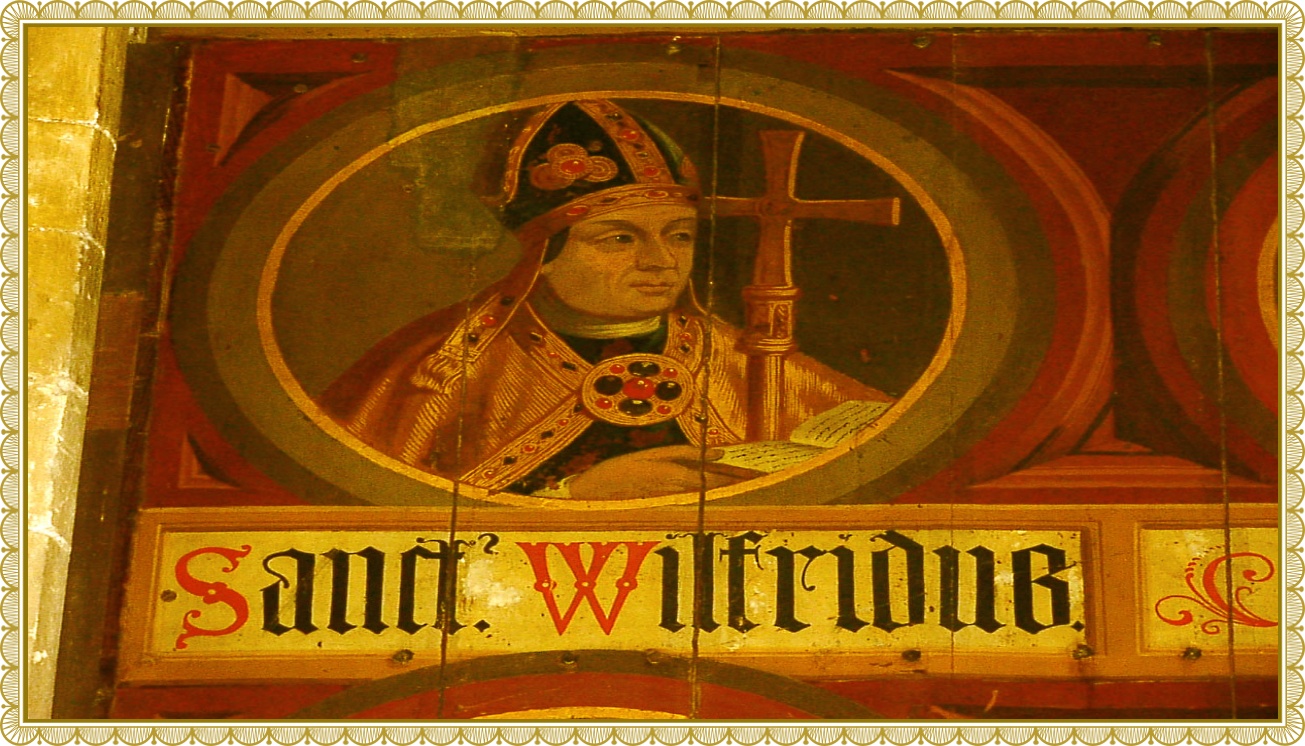
St. Wilfrid/Eighteenth Sunday after Pentecost
by the Revd Dr Robert Wilson PhD (Cantab), Old Roman Apostolate UK
Today we celebrate the feast of St. Wilfrid, as well as commemorating the Eighteenth Sunday after Pentecost. St. Wilfrid was born in 634, the son of a Northumbrian nobleman. He was brought up in the Irish tradition of the monastery of Lindisfarne, an island off the coast of Northumbria. He soon became dissatisfied and desired to broaden his knowledge by travelling to France and Italy. He stayed for a time in Canterbury, where he learned the Roman tradition under St. Honorius, the Archbishop of Canterbury. In 654 he set out for Rome with St. Benedict Biscop, a fellow Northumbrian nobleman. St. Wilfrid stayed for a year in Lyons, where the bishop, St. Annemund, was so impressed by him that he offered him his niece in marriage. But St. Wilfrid refused as he had determined to follow a religious vocation. After staying for some time in Rome he returned to Lyons for three years, where he was tonsured after the Roman manner. When he returned to England King Alcfrith of Deira desired instruction in the Roman tradition. He made St. Wilfrid abbot of the newly founded monastery at Ripon, where he introduced the Benedictine rule. He was also ordained a priest by St. Agilbert, the Frankish bishop of Wessex.
St. Wilfrid became the principal promulgator of the Roman as opposed to the Irish tradition (which had previously prevailed in Northumbria). The differences came to a head over the calculation of Easter because whereas King Oswy followed the Irish tradition, his wife Eanfled (who came from Kent) followed the Roman tradition. A conference was held at the monastery of St. Hilda at Whitby in 663. St. Wilfrid won the argument and the king agreed to follow the Roman tradition. Colman, Bishop of Lindisfarne, accepted defeat and returned to Iona (the Irish monastery founded by St. Columba whose monks had initially evangelised Northumbria). King Alcfrith desired to appoint St. Wilfrid as a bishop. He showed his contempt for the Irish tradition by choosing to be consecrated in France by St. Agilbert, who had originally ordained him to the priesthood and later returned to France. For reasons that are unclear St. Wilfrid remained in France so long after his consecration that King Oswy decided that St. Chad, abbot of Lastingham, should be consecrated bishop in his stead. When St. Wilfrid finally returned he retired to the monastery at Ripon.
In 669 St. Theodore of Tarsus, the newly appointed Archbishop of Canterbury, found St. Chad’s consecration to be irregular and removed him, replacing him with St. Wilfrid as bishop of York. He governed the diocese energetically, but quarrelled with king Ecgfrith (who had replaced Oswy). St. Wilfrid took the side of St. Etheldreda, the wife of the king, who had refused to consummate her marriage because she had a vocation to the religious life. The king pursued his grievance against St. Wilfrid. He encouraged the project proposed by St. Theodore of Tarsus for dividing St. Wilfrid’s large diocese. St. Wilfrid strongly opposed this decision to appoint three further bishops without his consent and appealed to Rome in 677. On the way to Rome he spent some time evangelising in Friesland, paving the way for the later mission of St. Willibrord.
St. Wilfrid arrived in Rome in 679. Pope Agatho assembled a synod which decided in favour of St. Wilfrid being restored to his see. When St. Wilfrid returned to England with the decree in his favour, the king rejected the decision and imprisoned him for nine months. After he was released from prison St. Wilfrid travelled to Sussex, the one remaining pagan kingdom, and he successfully evangelised the nation. He established his see at Selsey, where he remained for five years. When King Ecgfrith finally died St. Theodore of Tarsus was finally reconciled to St. Wilfrid and admitted that he had been wrong to deprive him of his see.
In 685 St. Wilfrid was restored to his see at York and monastery at Ripon. After five years he quarrelled with king Aldfrith (Ecgfrith’s successor) and in 691 he was again expelled from the kingdom. He spent time in Mercia, where he administered the vacant see of Lichfield. The new Archbishop of Canterbury, St. Berthtwald, was not favourable to St. Wilfrid. In 703 he summoned a synod which decided that St. Wilfrid should be deposed and retire to his monastery at Ripon. St. Wilfrid therefore again appealed to Rome, where Pope John VI eventually decided in his favour.
In 705 King Aldfrith died and St. Wilfrid finally agreed to a compromise in which he became bishop of Hexham, but spent most of the time in his monastery at Ripon, leaving the see of York to St. John of Beverley. St. Wilfrid died at Oundle in Northamptonshire in 709 and was buried in Ripon.
What conclusion can be drawn from St. Wilfrid’s long and controversial life? It should be said that on the fundamental principle at stake, namely that England should follow the Roman rather than the Irish tradition, St. Wilfrid had the stronger argument. The Irish tradition had developed in isolation from the rest of Europe and was designed for a tribal society with no towns and in which monasteries were the centres of evangelisation. This worked well in remote areas of Wales and Scotland but was less suited to the gentler landscape of England. St. Wilfrid recognised that the Roman Benedictine system, which restricted extreme asceticism and promoted stability, was better suited to the task of evangelising England. It also seems clear that he was right to protest about his treatment when his diocese was divided without his consent, and his case was vindicated on both occasions when he appealed to Rome. It is significant that St. Theodore of Tarsus later admitted that he had mishandled the situation. He was a great church builder and evangelist, and during his periods of exile he laid the foundations for later missionary work in Friesland, as well as converting the kingdom of Sussex.
However, not all of St. Wilfrid’s actions seem prudent. His conviction of the rightness of his own cause often led him to take matters too far and he seems to have quarrelled with most of those whom he worked with eventually. St. Theodore of Tarsus rightly recognised that St. Wilfrid’s diocese was too large and needed to be divided into more manageable units, although he treated St. Wilfrid unjustly (as he later admitted). In many ways St. Wilfrid would have been better suited to a bishopric in France, where his initial consecration took place.
It is significant that St. Bede, the great historian of the English people, seems to have been reserved in his attitude to St. Wilfrid. Like St. Wilfrid he strongly defended the Roman Benedictine tradition, but he still admired the Irish monks, scorned by St. Wilfrid, for their holiness and sanctity.
In the words of one historian, St. Wilfrid was “a man of clear vision, who saw the Church in England not as it was, but as it might be, he laboured with restless energy to attain some, at least, of his ideals. He was proud, domineering, arrogant, and as such he fails to win our love as it is won by the humility and simplicity of Aidan or Cuthbert: yet there is a touch of real greatness about this fiery servant of God, burning with zeal for evangelism and unswerving in his loyalty to the Church.”
Let us pray for grace to be faithful to that same faith which St. Wilfrid upheld in our own time and place.
Let us make today’s collect our own and pray that God in his mercy will direct our hearts, for as much as without him we are not able to please him.he bond of peace.



Leave a Reply