
| Dies | 6 SUN | 7 MON | 8 TUE | 9 WED | 10 THU | 11 FRI | 12 SAT | 13 SUN |
|---|---|---|---|---|---|---|---|---|
| Officium | Dominica XV post Pentecosten | Feria II infra Hebdomadam XV post Pentecosten | In Nativitate Beatæ Mariæ Virginis | Secunda die infra Octavam Nativitatis Beatæ Mariæ Virginis | S. Nicolai de Tolentino Confessoris | Quarta die infra Octavam Nativitatis Beatæ Mariæ Virginis | Sanctissimi Nominis Beatæ Mariæ Virginis | Dominica XVI post Pentecosten |
| CLASSIS | Semiduplex | Feria | Duplex II | Semiduplex | Duplex | Semiduplex | Duplex majus | Semiduplex |
| Color* | Viridis | Viridis | Albus | Albus | Albus | Albus | Albus | Viridis |
| MISSA | Inclína, Dómine | Inclína, Dómine | Salve, sancta | Salve, sancta | Justus | Salve, sancta | Vultum tuum | Miserére mihi |
| Orationes | 2a. A cunctis 3a. ad libitum | 2a. A cunctis 3a. ad libitum | 2a. S. Hadriani Martyris 3a. Ad Spiritum Sanctum | 2a. S. Gorgonii Martyris 3a. Ad Spiritum Sanctum | 2a. Tertia die infra Octavam Nativitatis Beatæ Mariæ Virginis | 2a. Ss. Proti et Hyacinthi Martyrum 3a. Ad Spiritum Sanctum | 2a. Quinta die infra Octavam Nativitatis Beatæ Mariæ Virginis | 2a. Sexta die infra Octavam Nativitatis Beatæ Mariæ Virginis 3a. A cunctis |
| NOTAE | Gl. Cr. Pref. de Trinitatis | Sine Gl. et Cr. Pref. de Communis | Gl. Cr. Pref. de B.M.V. | Gl. Cr. Pref. de B.M.V. | Gl. Cr. Pref. de B.M.V. | Gl. Cr. Pref. de B.M.V. | Gl. Cr. Pref. de B.M.V. | Gl. Cr. Pref. de Trinitatis |
| Nota Bene/Vel/Votiva | Missae votivae vel Requiem permittuntur | Missae votivae vel Requiem permittuntur | Missae votivae vel Requiem permittuntur | Dominica præcedit diem infra Octavam; dies infra Octavam commemoratur. |
Sunday, 6 September 2026 — Fifteenth Sunday after Pentecost
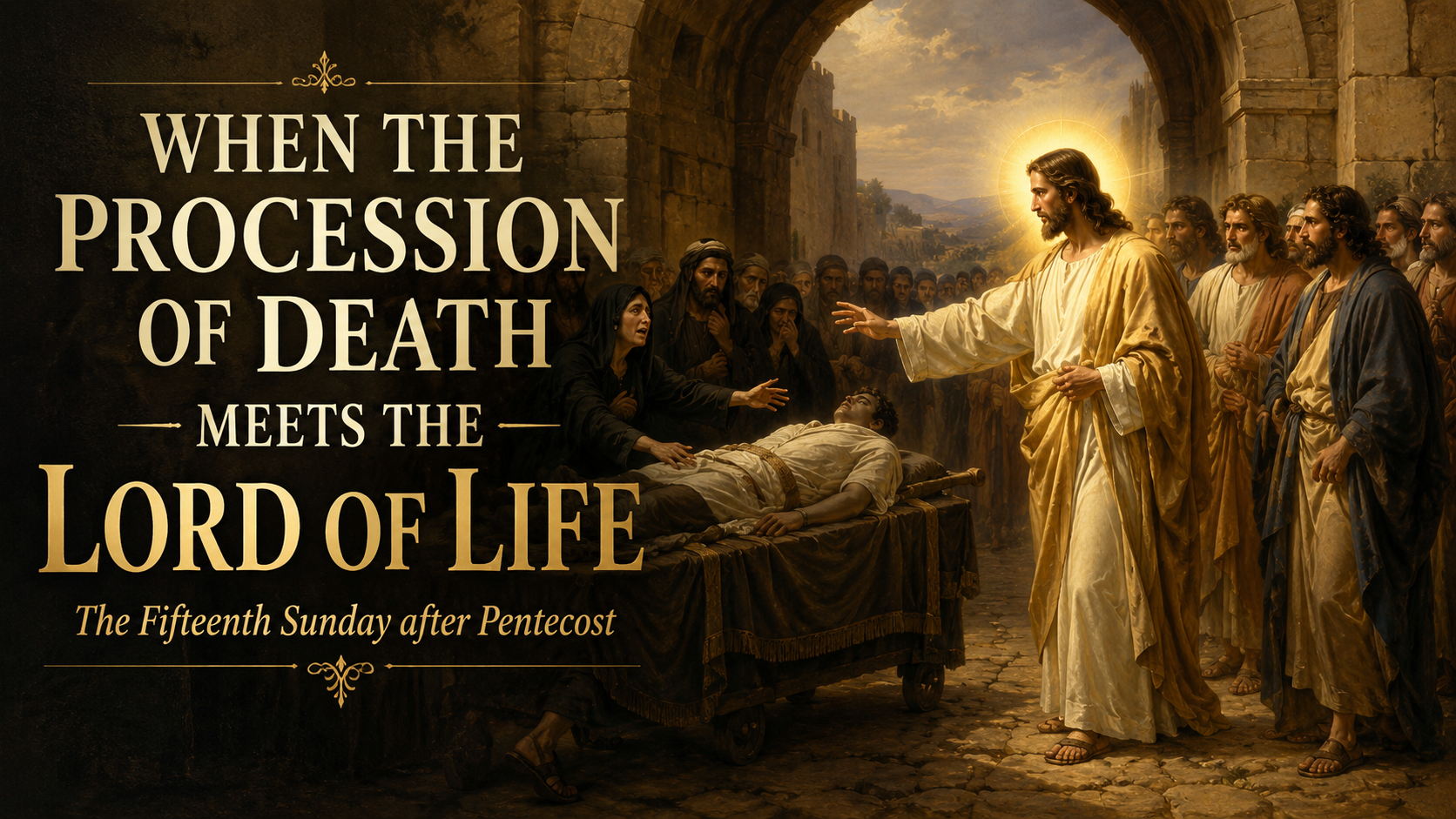
The Fifteenth Sunday after Pentecost places before us the Gospel of the raising of the widow’s son at Naim. Christ encounters a funeral procession and a mother bereft of her only son; moved with compassion, He commands the young man to arise and restores him to life. The Fathers saw in this miracle an image of the sinner restored by divine grace, and in the sorrowing widow an image of Holy Mother Church mourning those who have fallen into spiritual death. The Gospel is therefore both consoling and demanding: Christ alone is Lord of life and death, and no soul is beyond His power to restore.
Monday, 7 September 2026 — Feria
This ferial day continues the long school of the season after Pentecost, when the Church turns from the great mysteries of Christ’s earthly life to the patient work of sanctification in the soul. The apparent ordinariness of the day is itself instructive. Holiness is ordinarily formed through perseverance in prayer, fidelity to duty, repentance, charity and the quiet acceptance of sacrifice. On the eve of the Nativity of Our Lady, the day also prepares us to contemplate the hidden beginnings of that life through which the Mother of God would enter the world and become the chosen instrument of the Incarnation.
Tuesday, 8 September 2026 — The Nativity of the Blessed Virgin Mary
The Church rejoices in the birth of the Blessed Virgin Mary, whose coming into the world heralds the approaching fulfilment of the promises made to Israel. The Fathers loved to describe her birth as the dawn preceding the rising of the Sun of Justice, for from Mary would come Jesus Christ, the Redeemer of mankind. Unlike most saints, whose heavenly birthdays are celebrated on the day of their death, Our Lady is honoured also in her earthly birth because from the first moment of her existence she belonged wholly to God. Her Nativity therefore marks a decisive moment in salvation history: the long preparation of the Old Covenant is drawing towards its fulfilment, and the woman foretold in Genesis is already present among the children of men.
Wednesday, 9 September 2026 — Within the Octave of the Nativity of the Blessed Virgin Mary; St Gorgonius, Martyr
The joy of Our Lady’s Nativity continues within its octave, allowing the Church to linger over the mystery of the birth of the Mother of God and the place assigned to her in the divine plan. Today there is also remembrance of St Gorgonius, an early Christian martyr traditionally associated with the imperial household under Diocletian. According to ancient accounts, he held an honourable position at court but preferred fidelity to Christ to earthly advancement. When persecution broke out, he confessed the Faith openly and suffered death rather than offer sacrifice to the pagan gods. His witness reminds us that no worldly office or security can outweigh the demands of baptismal fidelity.
Thursday, 10 September 2026 — St Nicholas of Tolentino, Confessor
St Nicholas of Tolentino was born in the thirteenth century and entered the Augustinian Order while still young. He became renowned for his austerity, prolonged prayer, preaching and extraordinary charity towards the poor. His priestly ministry was marked particularly by concern for sinners and by a profound devotion to the souls in Purgatory, for whom he offered prayers, penances and the Holy Sacrifice of the Mass. Tradition consequently came to regard him as a special patron of the Holy Souls. Nicholas combined the contemplative life with tireless pastoral care, showing that authentic asceticism does not turn the soul inward upon itself but enlarges the heart for the needs of others. He died at Tolentino in 1305.
Friday, 11 September 2026 — Within the Octave of the Nativity of the Blessed Virgin Mary; SS. Protus and Hyacinth, Martyrs
The Church continues to contemplate the mystery of Our Lady’s Nativity while commemorating Saints Protus and Hyacinth, Roman martyrs traditionally associated with St Eugenia. Ancient Christian tradition remembered them as servants who shared not only in the earthly household of their mistress but also in her conversion to Christ and ultimately in her witness unto death. Their cult is of considerable antiquity, and the discovery of a tomb identified with St Hyacinth in the nineteenth century provided an unusually tangible link with the early Roman martyrs. Their memory recalls the hidden multitude of Christians whose names are scarcely known to history but whose fidelity helped build the Church through blood and sacrifice.
Saturday, 12 September 2026 — The Most Holy Name of Mary
The feast of the Most Holy Name of Mary honours the name given by divine providence to the Mother of the Redeemer. Christian devotion has always treated her name with particular reverence because it signifies the person who, after Christ Himself, occupies the highest place in the economy of salvation. The feast also carries a strongly historical character, having been extended to the universal Church in thanksgiving for the Christian victory over the Ottoman forces at Vienna in 1683, a deliverance attributed to the intercession of the Blessed Virgin. Her Holy Name therefore speaks at once of tenderness and strength: it is the name invoked by Christians in temptation, suffering and danger, and the name of the Mother who unfailingly directs her children to Christ.
Sunday, 13 September 2026 — Sixteenth Sunday after Pentecost; within the Octave of the Nativity of the Blessed Virgin Mary
The Sixteenth Sunday after Pentecost presents Christ healing the man afflicted with dropsy and then teaching the guests at the house of a Pharisee about humility. Our Lord exposes the spiritual sickness of pride and the human desire for precedence, commanding instead that we choose the lowest place. The lesson reaches to the heart of Christian discipleship: grace descends where self-exaltation has been abandoned, and the soul that humbles itself before God is raised by Him. The continuing octave of the Nativity of Our Lady provides a fitting Marian accompaniment to this Gospel, for in the Blessed Virgin the Church sees the supreme creaturely example of humility — she who called herself the handmaid of the Lord and was therefore exalted above all generations.


Leave a Reply