
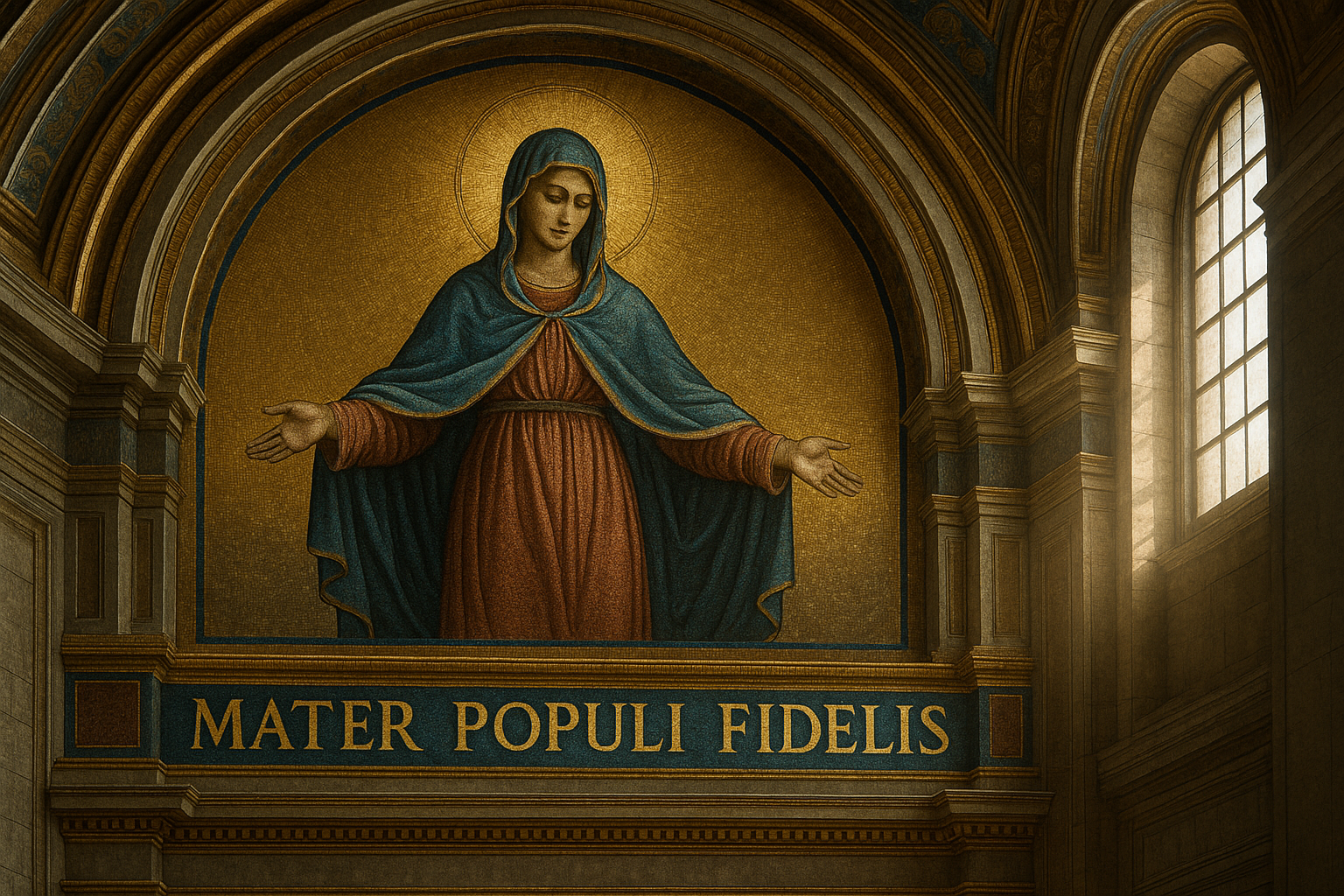
The Obedience of Truth: Why Mater Populi Fidelis Cannot Bind the Faithful
The Foundation of the Traditional Faith
The Catholic Church has consistently taught, through Scripture, the Fathers, and the Magisterium, that Christ alone is the Redeemer of the world, yet that the Blessed Virgin Mary participates uniquely and subordinately in His redemptive work. Her divine maternity is not a poetic honour but the hinge of the Incarnation itself. Through her fiat, the Word took flesh; through her fidelity, that flesh was offered back to the Father for the salvation of mankind.
The Scriptural foundation for this doctrine is manifest: Mary conceives by the Holy Spirit (Luke 1:35)¹; she stands united with her crucified Son (John 19:25–27)²; and from the beginning she is foretold as the New Eve who shares in the victory of the New Adam (Genesis 3:15)³. From these roots, the Church has drawn her teaching on Mary’s participation in Redemption and her maternal mediation of grace.
The popes of the nineteenth and twentieth centuries articulated this truth with remarkable unanimity. Pius IX in Ineffabilis Deus (1854) declared the Immaculate Conception as the preparation for her redemptive cooperation⁴. Leo XIII in Octobri Mense (1891) affirmed her role as Mediatrix⁵. Pius X in Ad Diem Illum Laetissimum (1904) taught that Mary “merited for us de congruo what Christ merited de condigno”⁶. Benedict XV, in Inter Sodalicia (1918), stated that she “merited for us, as it were, the grace of salvation”⁷. Pius XI referred to her publicly as “Co-Redemptrix”⁸. Pius XII, in Mystici Corporis (1943) and Mediator Dei (1947), called her “Mediatrix of all graces,” declaring that she “offered her Son on Calvary, together with the holocaust of her maternal rights and love”⁹. These pronouncements, consistent across pontificates, form part of the ordinary and universal Magisterium and thus bind the faithful in conscience¹⁰.
What Mater Populi Fidelis Proposes
The 2025 doctrinal Note, issued by the Dicastery for the Doctrine of the Faith and approved by Pope Leo XIV, discourages the use of the titles Co-Redemptrix and Mediatrix of all graces, calling them “theologically and pastorally inappropriate.” It proposes instead titles such as Mother of the Faithful and Mother of the People of God. While acknowledging Mary’s maternal intercession, it insists that her role be described only in “strictly subordinate and dependent” terms, warning that traditional titles may “obscure the unique mediation of Christ.”¹¹
In effect, the document forbids public or liturgical use of these ancient titles and restricts their appearance in catechetical and devotional materials. It thus marks a rupture with more than a century of papal teaching and devotional tradition.
The Theological Problem
To reject or suppress these titles is to obscure the mystery of the Incarnation itself. God’s saving work was not unilateral; it required the free cooperation of the Virgin’s will. No Mary, no Jesus. By her consent the Word became flesh, and by her fidelity the flesh of that Word was offered for our redemption. Grace does not abolish nature; it perfects it. In Mary, divine grace and human freedom meet without confusion or separation.
The Incarnation is therefore the permanent union of God and man in the one Person of Christ, the definitive rejection of all spiritualism that despises the flesh and of all rationalism that reduces grace to moral inspiration. The Arian and Protestant dualisms that separate the material from the spiritual are fundamentally incompatible with Catholic faith. In Mary we see the reconciliation of both—the restoration of flesh and spirit in harmony through grace. What was accomplished bodily in her is to be accomplished spiritually in us, until Christ be formed in every soul that believes (Galatians 4:19)¹².
Magisterial Authority and the Limits of Papal Novelty
No pope possesses the authority to contradict the defined or universally taught doctrines of his predecessors on faith or morals. As Vatican I declared in Pastor Aeternus, the Holy Spirit was given to Peter’s successors “not to make known new doctrine, but to guard and faithfully expound the revelation handed down through the Apostles”¹³.
The consistent papal teaching from Pius IX to Pius XII on Mary’s unique cooperation in Redemption constitutes an exercise of the ordinary and universal Magisterium, which is infallible when proposing truths to be definitively held (Lumen Gentium §25)¹⁴. A subsequent papal statement cannot abrogate what the Magisterium has consistently taught. Therefore, even if Mater Populi Fidelis carries papal approval, it lacks the note of continuity required for magisterial authority.
A Question of Discipline, Not Doctrine
The Dicastery’s Note must therefore be regarded as a disciplinary directive, not a doctrinal definition. It regulates the use of certain titles for pastoral reasons but does not alter the truths those titles express. In theological terms, it governs the lex orandi rather than the lex credendi—a question of permitted expression, not of revealed faith.
Disciplinary decrees are reformable and bind only insofar as they do not contradict divine revelation or the prior Magisterium. The Note’s restriction of language does not extinguish the underlying doctrine. Private and scholarly use of the titles Co-Redemptrix and Mediatrix of all graces, when properly explained, remains entirely legitimate. Future popes may restore them to honour, as similar titles once suppressed have later been vindicated.
When Discipline Obscures Doctrine
A Dicastery or papal instruction that attempts to obscure or obfuscate doctrine taught by the Magisterium exceeds its lawful authority. Ecclesiastical discipline is valid only when it serves revealed truth; it cannot be set against it. The Council of Trent required that all Church discipline be “wholesome and in conformity with sound doctrine” (Sess. XXII, ch. 4)¹⁵. Vatican I reaffirmed that the papal office is not to innovate, but to guard revelation faithfully¹⁶.
Thus, if a disciplinary or pastoral act undermines a truth already taught with magisterial authority, its binding force is null. According to Donum Veritatis (§30–31), theologians may withhold assent from non-definitive statements that appear inconsistent with prior teaching, provided they do so in fidelity and charity¹⁷. Canon law itself (Canon 33 §1; Canon 41) recognises that subordinates may suspend compliance with an act that appears unlawful or contrary to the Church’s mind¹⁸.
Catholic obedience is therefore ordered to truth, not to arbitrary will. As St. Thomas Aquinas teaches, no authority may command what is contrary to divine law or established truth (Summa Theologiae II-II, q.104, a.5)¹⁹. The authority of the Dicastery for the Doctrine of the Faith derives from its service to the deposit of faith; if it suppresses or confuses doctrine, it ceases to exercise true Magisterium and becomes merely administrative. Its decrees, though formally valid, lose moral and theological legitimacy when used to suppress truth.
The Peril of Tampering with the Lex Orandi
The Church’s ancient rule—lex orandi, lex credendi—binds worship and doctrine in a living unity. The law of prayer is the law of faith, because the liturgy is the Church’s voice before God, and its words and gestures teach as surely as the catechism. From the earliest centuries, the Fathers regarded the liturgy as the primary locus of theology: what was offered at the altar was believed in the heart²³.
To alter the lex orandi is therefore never a neutral act. When the Church’s official worship ceases to name or honour the Virgin under the titles Co-Redemptrix and Mediatrix of all graces, the faithful gradually cease to believe what those titles signify. Suppress the words, and you suppress the truth they convey. The danger is not merely devotional but doctrinal: language shapes belief. To regulate prayer so as to diminish truth is to invert the divine order.
Such an alteration risks introducing into the heart of the Church a subtle form of doctrinal erosion. What the saints once invoked at the altar, the faithful will no longer hear; what they once affirmed in their Rosaries, they will no longer learn. The faith of the people follows the language of the liturgy. When the liturgical lex is weakened, the doctrinal lex decays in its wake.
For this reason, the suppression of titles long honoured in the Church’s public prayer cannot be treated as mere pastoral policy. It touches the very articulation of belief. As Pope Pius XII warned in Mediator Dei, “The liturgy is a profession of immutable faith”²⁴. To change that profession without necessity is to risk obscuring the very truths it was instituted to manifest. The faithful may therefore regard with deep concern any measure that silences ancient expressions of Marian doctrine, for to mute the voice of the Church’s prayer is to muffle the confession of her faith.
Pastoral Consequences
Forbidding these traditional expressions risks confusing the faithful and weakening devotion. Throughout history, Marian doctrine has deepened faith in Christ, not diminished it. To silence the language of cooperation and mediation is to estrange the faithful from the living witness of the saints, the mystics, and the liturgy itself. The saints who invoked Mary as Co-Redemptrix—from St Bernard and St Alphonsus to St Maximilian Kolbe—did so precisely because they grasped that her glory magnifies, never rivals, that of her Son (Luke 1:46–47)²⁵.
Conclusion
The faithful, therefore, remain justified in adhering to the perennial teaching of the Church: that the Blessed Virgin Mary, by her unique and subordinate participation in Christ’s redemptive work, is rightly called Co-Redemptrix and Mediatrix of all graces. Mater Populi Fidelis, being disciplinary and prudential, cannot overturn this doctrine. Fidelity to Tradition in such a matter is not disobedience, but obedience to the truth once delivered to the saints (Jude 1:3)²⁶.
Let us hold fast, then, to what has been handed down, that we may not be led astray by new innovations that obscure the mystery of the Incarnation and diminish the glory of Christ through His Blessed Mother²⁷.
¹ Luke 1:35.
² John 19:25–27.
³ Genesis 3:15.
⁴ Pius IX, Ineffabilis Deus, 8 Dec 1854.
⁵ Leo XIII, Octobri Mense, 22 Sept 1891.
⁶ Pius X, Ad Diem Illum Laetissimum, §14, 2 Feb 1904.
⁷ Benedict XV, Inter Sodalicia, 22 Mar 1918.
⁸ Pius XI, Allocution to Pilgrims, 28 Apr 1935.
⁹ Pius XII, Mystici Corporis, §106; Mediator Dei, §90.
¹⁰ Lumen Gentium §25.
¹¹ Mater Populi Fidelis, §§9–10 (2025).
¹² Galatians 4:19.
¹³ Vatican I, Pastor Aeternus, ch. 4 (1870).
¹⁴ Vatican II, Lumen Gentium, §25 (1964).
¹⁵ Council of Trent, Sess. XXII, ch. 4.
¹⁶ Pastor Aeternus, ch. 4.
¹⁷ CDF, Donum Veritatis, §§30–31 (1990).
¹⁸ Code of Canon Law, Canons 33 §1, 41 (1983).
¹⁹ St. Thomas Aquinas, Summa Theologiae II-II, q.104, a.5.
²⁰ Luke 1:46–47.
²¹ Jude 1:3.
²² Pius XII, Mediator Dei, §90 (1947).
²³ Prosper of Aquitaine, Indiculus, ch. 8: “Ut legem credendi lex statuat supplicandi.”
²⁴ Pius XII, Mediator Dei, §46.
²⁵ Luke 1:46–47.
²⁶ Jude 1:3.
²⁷ Pius XII, Mediator Dei, §90 (1947).



Leave a Reply