
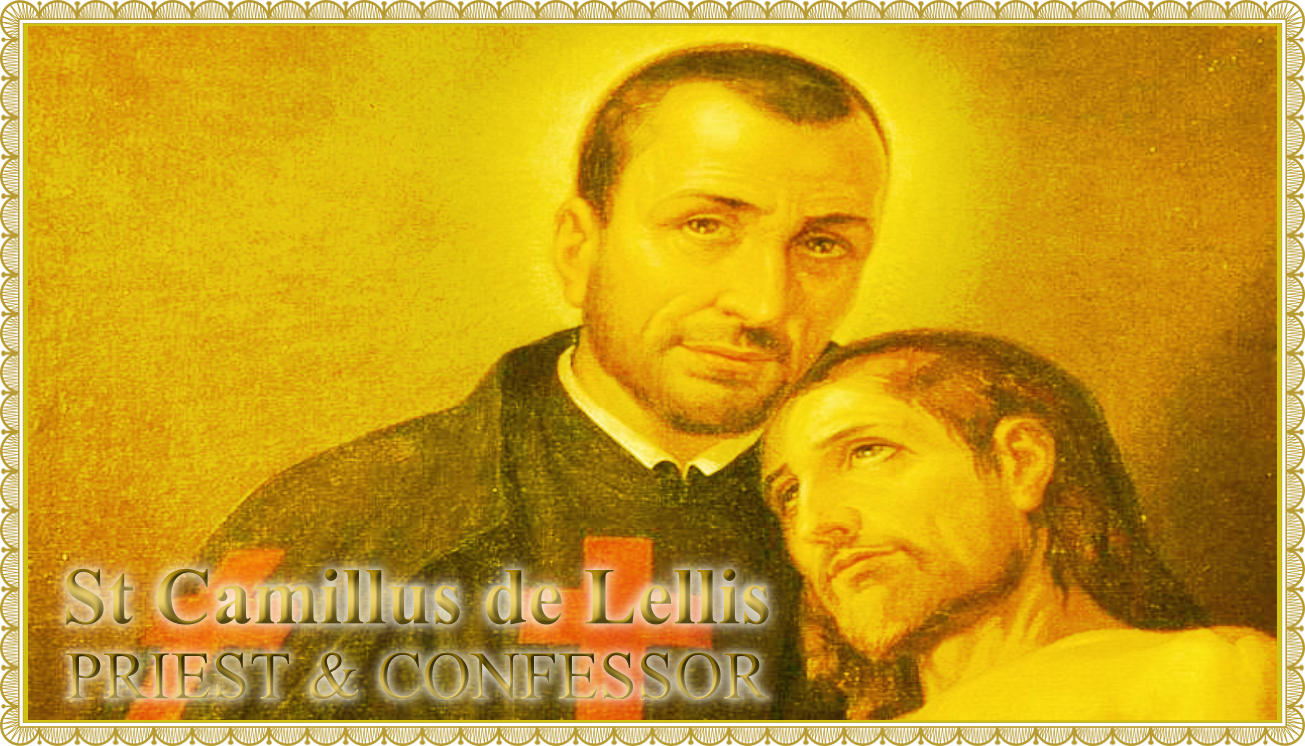
St. Camillus de Lellis
Today we celebrate the feast of St. Camillus de Lellis. He was born in 1550 in the kingdom of Naples. He initially led a dissolute life as a soldier, but later repented of his ways and entered the Capuchin order. On account of a sore to his leg Camillus was unable to pursue his vocation and had to enter a hospital. It was here that he found his vocation in ministering to the sick. He founded the congregation of Clerks Regular, consecrating themselves to the service of the sick. Inspired by the self sacrificial love of Christ the Clerks Regular promised to attend to the sick, even those stricken by plague. He is the patron saint of hospitals and of patients. He died in Rome on 14 July, 1614.
There is much to learn from the life of St. Camillus at the present time. Until the last few years the subject of sickness and death was something of a taboo that people tried to avoid. For twentieth first century Western man the marketplace had replaced morality, and people were taught that the main purpose in life was to gain as much for themselves as possible. There were seemingly no limits to what twenty first century Western man could achieve. He was emancipated from the constraints of religion and morality and was now free to follow his own devices and desires as he pleased. Admittedly it was tacitly recognised that people eventually fell ill and died, but this fundamental fact was not discussed.
A few years ago this mood shifted violently due to the impact of a new virus. Confronted by a new virus and the realisation of the risk of death public opinion shifted from demanding more and more economic gains to demanding that the government establish more and more controls over everyday life in order to reduce the spread of the virus. People who until recently saw the world in purely economic terms now demanded that countries shut down their economies in order to reduce the spread of the virus. People are frightened of death and they have been prepared to allow their governments to behave in ways that used to be called totalitarian because they believed it would prevent them from dying. Schools were closed, churches were closed and businesses destroyed because people believed that the policy of lockdown would reduce the risk of them dying. This produced the extraordinary situation of a society that had until recently prized economic gain above all and had allowed the marketplace to replace morality, to suddenly start destroying their economies and hand over responsibility for their actions to their governments. This was initially said to be a temporary situation, but because all power corrupts and absolute power corrupts absolutely, the climate of fear became so great that it proved to be a very difficult situation for people to get out from. Having already abandoned morality to the marketplace, personal responsibility has now been abandoned to the State.
The truth of the matter is that twenty first century Western man has got his priorities badly wrong. Sickness and death are fundamental facts of life in this fallen world which we cannot escape from. This should not cause us to panic, but rather to focus on what really matters. Instead of looking to the marketplace as the arbiter of morality, we should look to God, the Maker of all things and Judge of all men, as the source of all good and ultimate standards. Once we have recognised our own sins and shortcomings we can then learn that we need to take responsibility for our actions. We cannot abdicate responsibility to the government, but need to learn to take responsibility ourselves. Instead of abdicating morality to the marketplace and responsibility to the government, we need to learn to recognise God as the source of all good and to take responsibility for our own actions ourselves. When we have learned to love God then we will learn the folly of trying to build up treasure upon earth, where moth and rust doth corrupt and thieves break through and steal, and to seek first the Kingdom of God and his righteousness. Yet we should renounce the false standards of this world not in a spirit of despairing resignation, but in order to become more fully involved in it as we learn to see life in a true perspective. G. K. Chesterton said that “thoroughly worldly people never understand even the world….. The secularists have not wrecked divine things; but the secularists have wrecked secular things, if that is any comfort for them. The Titans did not scale heaven, but they laid waste to the world.”
When we have learned to love God we can then learn to love our neighbour. We can learn much from the example of saints like St. Camillus who did not allow his own ill health to lead him to cease to be concerned for the needs of others. Though he was unable to join an existing religious order he instead founded his own order specifically dedicated to the service of the sick, even those stricken by plague. He looked not only to his own needs, but to the needs of others. He followed him who said “A new commandment I give unto you, that you love one another as I have loved you.” When we have learned to love God and recognised our own sickness, then we can begin to attend to the sickness and needs of others.
Let us make our own the words of today’s collect:
O God, who didst endow saint Camillus with a special grace of charity for the relief of souls in their last agony; we beseech thee, by his merits to pour into our hearts the spirit of thy love, that in the hour of our death we may overcome the enemy, and deserve to win a heavenly crown.
by the Revd Dr Robert Wilson PhD (Cantab), Old Roman Apostolate UK




Leave a Reply