
Nigeria’s “Social Conflict”? Vatican Remarks Dismissed by Church Leaders:
Cardinal Parolin’s comments downplaying religious persecution provoke strong response
At a Vatican press conference unveiling Aid to the Church in Need’s Religious Freedom in the World report, Cardinal Pietro Parolin — the Holy See’s Secretary of State — described Nigeria’s long-running crisis as “a social conflict rather than a religious one.” The statement, brief and seemingly offhand, has since reverberated across the Catholic world. Many observers view it as the latest example of the Vatican’s growing reluctance to identify anti-Christian violence as religious persecution.
According to Vatican News, Parolin told reporters: “It’s not a religious conflict, but rather a social conflict, for example, between herders and farmers. Many Muslims who come to Nigeria are also victims of this intolerance.”¹ His framing echoes the Nigerian government’s narrative, which has consistently sought to present the country’s spiralling bloodshed as a product of poverty, land disputes, and climate change — rather than religious extremism. Yet this interpretation stands in stark contrast to on-the-ground testimonies from bishops, priests, and humanitarian workers, who have long warned of a deliberate campaign to eradicate Christianity from the nation’s central and northern regions.
A Crisis of Faith and Framing
Nigeria’s tragedy has been building for decades. The Observatory of Religious Freedom in Africa (ORFA) reports that between 2019 and 2023, 30,880 civilians were killed; over half of the victims were Christian.² Whole communities have been displaced, parishes burned, and seminarians abducted. Aid to the Church in Need describes the assaults as “a deliberate strategy to expel Christian populations,” orchestrated primarily by radicalized Fulani militias and Islamist groups linked to Boko Haram and ISWAP.³
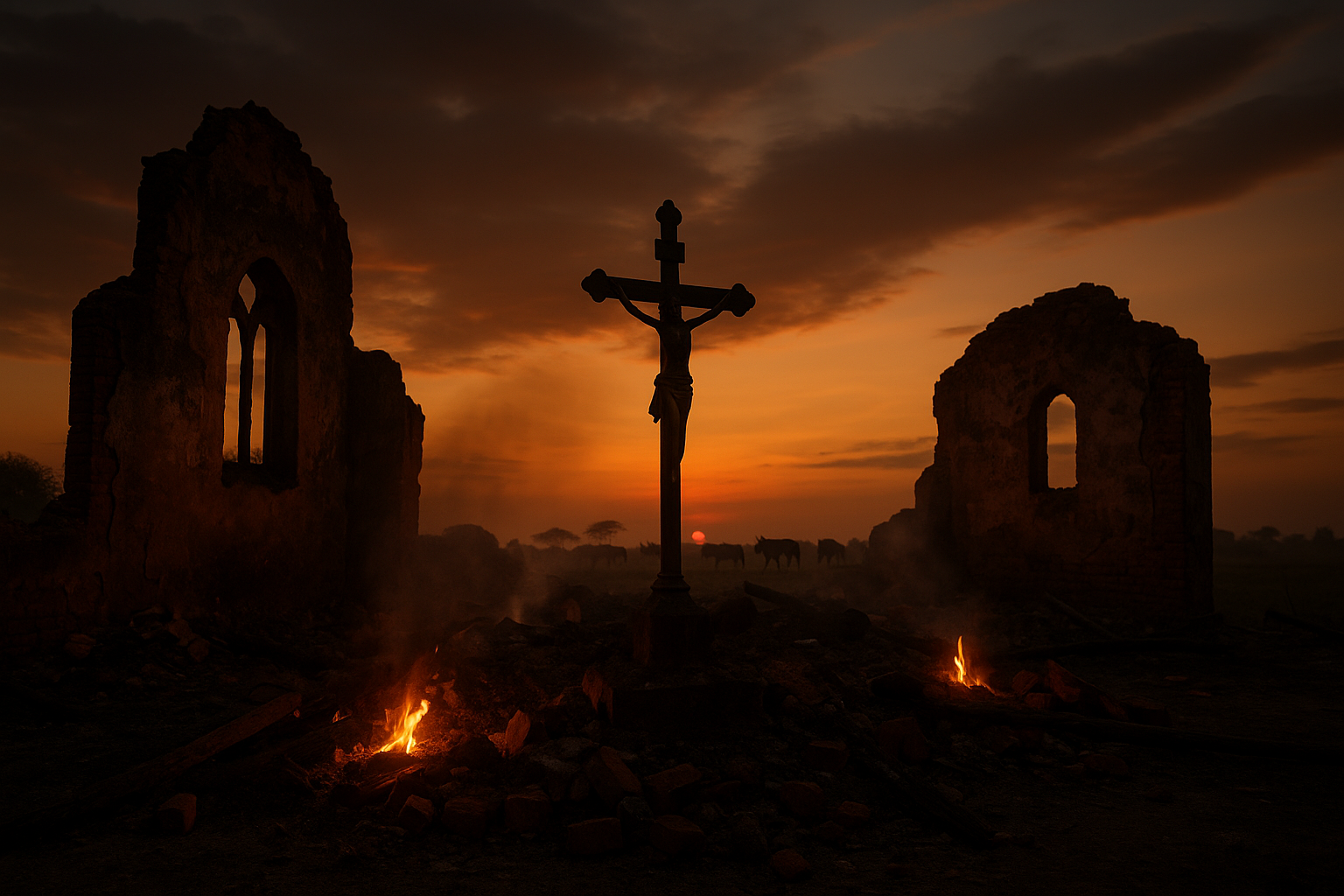
In rural dioceses such as Makurdi, Kafanchan, and Jos, the violence has reached genocidal proportions. Mass burials are common. Local clergy have risked their lives to recover the bodies of parishioners massacred at the altar or in their fields. In the last ten years alone, 145 Catholic priests have been kidnapped — some for ransom, others executed for refusing to deny Christ.⁴
It is against this backdrop that Parolin’s comments have landed with particular force. For many Nigerian Catholics, the issue is not simply one of interpretation but of truth. When the Vatican’s most senior diplomat publicly recasts religious persecution as “social conflict,” it sends a message — intentional or not — that the suffering of the faithful is negotiable in the language of diplomacy.
Reaction and Rebuke
Sean Nelson of Alliance Defending Freedom International called the cardinal’s words “particularly shocking,” given that they contradict the Vatican’s own sources.⁵ Aid to the Church in Need’s report, released at the very event where Parolin spoke, explicitly identifies Christian communities as “disproportionately targeted.” Nina Shea of the Hudson Institute went further, accusing the Vatican of “repeating the Nigerian government’s talking points that obfuscate the persecution of Catholics and other Christians.”⁶
The attempt to depoliticize or “contextualize” persecution has been a recurring pattern in Western discourse. In 2022, Irish President Michael Higgins suggested that climate change played a role in the Pentecost Sunday massacre at St Francis Catholic Church in Owo — where over forty parishioners were slaughtered during Mass. Bishop Jude Arogundade of Ondo condemned the remark, saying it sought to “rationalize pure evil.”⁷
Such responses, critics argue, betray a deeper failure of moral vision: a refusal to recognise that Nigeria’s crisis, while complex, is animated by religious hatred no less than by social decay.
Nigerian Voices Differ
Within Nigeria itself, Catholic leaders are divided in tone if not in substance. Bishop Wilfred Chikpa Anagbe of Makurdi told the U.S. House Foreign Affairs Committee earlier this year that “the persecution of Christians generally and Catholics in Nigeria is the work of an Islamic agenda to conquer territory and make it an Islamic state in West Africa.”⁸ His testimony, drawn from firsthand experience of attacks on villages and parishes, paints a stark picture of religiously motivated extermination.
At the same time, Bishop Matthew Hassan Kukah of Sokoto, a prominent intellectual figure within the Nigerian Church, cautioned against simplifying the crisis. “We are not dealing with people going around wielding machetes to kill me because I am a Christian,” he said during the Vatican conference. “Nigerians are dying unacceptable deaths across the country — not only because of their religion but also their ethnicity.”⁹ Kukah argued that Western calls for sanctions or political isolation of Nigeria risk worsening instability.
Bishop Gerald Mamman Musa of Katsina took a balanced view: “The violence in Nigeria has multiple drivers. Some are driven by crime, banditry, or land disputes. But it would be wrong to deny that some of the killings are based on religious motives.”¹⁰ His words capture the tension many clergy feel — acknowledging complexity without surrendering the moral clarity that martyrs demand.
A Global Reckoning
The debate has renewed calls for international accountability. Under the International Religious Freedom Act (IRFA) of 1998, the United States designates Countries of Particular Concern (CPC) for severe violations of religious freedom.¹¹ Nigeria was so listed under the Trump administration in 2020, but the Biden administration quietly removed it in 2021, a decision condemned by Christian advocacy groups. Senator Ted Cruz has since reintroduced legislation to restore Nigeria’s CPC status, accusing Abuja of “ignoring and even facilitating the mass murder of Christians by Islamist jihadists.”¹²
An open letter to President Trump on 15 October, signed by Christian and humanitarian leaders, echoed this demand: “The last several years have seen violent attacks specifically targeting rural Christians in the Middle Belt, while the government in Abuja barely lifts a finger to protect them.”¹³
The Vatican’s Silence
As of publication, the Vatican Secretariat of State has not clarified Parolin’s statement. Diplomatically, the comment may have been intended to maintain neutrality or avoid friction with the Nigerian government — a country with which the Holy See maintains sensitive relations. But the effect on the ground is very different. For priests in danger, for widows of murdered catechists, and for communities rebuilding burnt churches, such ambiguity feels like abandonment.
“The blood of our martyrs cries out,” said one Nigerian priest writing anonymously to Nuntiatoria. “We are not killed because we are poor farmers. We are killed because we are Christians.”
Cardinal Parolin’s words thus reopen an uncomfortable question at the heart of modern Vatican diplomacy: in the pursuit of dialogue, how much truth is the Church willing to obscure? In a century already soaked with martyrdom, the temptation to explain away persecution as mere “social tension” risks becoming a new form of denial — one that offends both justice and faith.
As Bishop Anagbe warned before the U.S. Congress: “Our people are dying for the name of Christ — and the world prefers to call it something else.”¹⁴
¹ Vatican News, “Cardinal Parolin on Nigeria’s Violence,” Oct. 22, 2025.
² Observatory of Religious Freedom in Africa (ORFA), Annual Report 2024.
³ Aid to the Church in Need, Religious Freedom in the World 2025, Nigeria section.
⁴ Ibid.
⁵ Sean Nelson, ADF International, statement on X (Oct. 22, 2025).
⁶ Nina Shea, quoted in National Catholic Register, Oct. 22, 2025.
⁷ Bishop Jude Arogundade, statement to Irish media, June 2022.
⁸ U.S. House Foreign Affairs Committee Hearing, testimony of Bishop Wilfred Anagbe, Feb. 2025.
⁹ Bishop Matthew Hassan Kukah, remarks at ACN report launch, Oct. 2025.
¹⁰ Bishop Gerald Mamman Musa, interview with ACI Africa, Oct. 19, 2025.
¹¹ International Religious Freedom Act (IRFA), U.S. Code § 6401–6471.
¹² Sen. Ted Cruz, Nigeria Religious Freedom Accountability Act, introduced Sept. 2025.
¹³ Open Letter to President Trump from Christian and humanitarian leaders, Oct. 15, 2025.
¹⁴ Bishop Wilfred Anagbe, testimony before U.S. House Committee, Feb. 2025.



Leave a Reply