
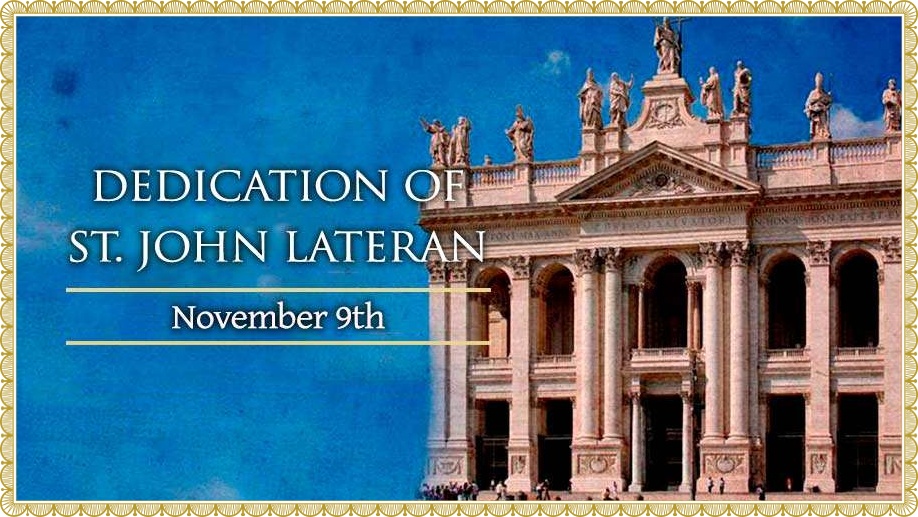
Dedication of the Basilica of St. Saviour/Twenty Second Sunday after Pentecost
by the Revd Dr Robert Wilson PhD (Cantab), Old Roman Apostolate UK
Today we celebrate the dedication of the basilica of St. Saviour, as well as commemorating the Twenty Second Sunday after Pentecost. This marks the occasion in 324 when St. Silvester, Bishop of Rome, consecrated the basilica of St. Saviour for Christian worship. This had previously been the Lateran palace belonging to Fausta, wife of the Emperor Constantine. After his conversion to Christianity the Emperor had given the palace to Pope St. Silvester as his private residence. It was a sign that the faith that the Empire had tried so hard to destroy had finally been granted toleration and indeed the status of most favoured religion as far as the Emperor was concerned.
Today’s epistle is from the conclusion of the book of Revelation in which St. John sees the holy city, the new Jerusalem coming down from God as a bride prepared for her husband. He heard a voice saying “Behold the tabernacle of God is with men and he shall dwell with them. And they shall be his people, and God himself with them shall be their God: and God shall wipe away all tears from their eyes: and death shall be no more, nor mourning, nor crying, nor sorrow shall be any more, for the former things are passed away.” It is a vision of the new heaven and new earth, where the old order of sin and death has finally passed away and all things are made new.
The reference to the tabernacle of God now being with men recalls the tabernacle that went before the Israelites as they journeyed through the wilderness on their way to the promised land. It was a sign of the presence of God in their midst. Subsequently, after the people had settled in the land, Solomon had built the Temple in Jerusalem and this took the place of the tabernacle as the centre of worship. But the people soon found that life in the promised land was not in practice the fulfilment of their hopes and dreams. The rulers were often worldly and compromised and the people failed to be faithful to the covenant which they had received in the wilderness through Moses. The prophets who spoke truth to power looked forward to a new covenant in which the law would no longer be written on tablets of stone, but in the hearts of men. The prophet Ezekiel looked forward to a new temple, which would be finally cleansed of the corruptions of the old one.
In the life, death and resurrection of Jesus the coming of the Kingdom of God, when he would finally dwell with his people, had broken into human history. God had come to be with men, not in a temple made by human hands, but in the Word made flesh who dwelt among, and in whom the divine glory was now revealed, the glory of the only begotten of the Father, full of grace and truth. He had come to seek and save the lost (as we heard in today’s Gospel from St. Luke about Jesus’ encounter with the tax collector Zacheus), for God was in Christ reconciling the world to himself. He pronounced judgement on the existing Jewish nation and temple, but vindication for himself and his followers. He spake of the temple of his body, which included his followers as his members.
Hence, in the new Jerusalem which St. John saw in his vision on the isle of Patmos, there will be no need of another physical temple building to replace the old one, for God will be all in all and dwell with his people permanently. Earthly sanctuaries will be made redundant, for God’s Kingdom will finally come on earth as it is in heaven.
But, if this is the case, we might say, why do we still have special consecrated places of worship at all? Did not Jesus himself say that the true worshippers now worshipped the Father in spirit and in truth? It is certainly true that we, who have been baptised into Christ, are already members of his body and are ourselves the new temple, the people of the new covenant, upon whom the Holy Spirit has been outpoured. But, although we have already received the first fruits of the Spirit, we still pray for the final coming of the kingdom, for we do not yet see all things subjected to him. The old order of sin and death, though it has been in principle defeated through the life, death and resurrection of Jesus, is still very much in evidence.
It is therefore appropriate that we mark out and consecrate special places and buildings for the worship of God. This is not because our worship should be restricted to such places, but rather as a marker of the Kingdom of Christ in this present age. The first Christians had originally set aside places for worship in private homes. As the Church grew in the third century it started to acquire public places of worship, but as the faith was still illegal, it was never really a safe activity. It was only after the Church was finally granted toleration that consecrated places of public worship now finally became widespread. There could be no better symbol of this transformation than the handing over of a palace originally used by a pagan family for divine worship.
In the world to come, heaven and earth, God’s space and human space, will be finally married together and there will be no need for special places of worship. But in this present age they mark out places where the Kingdom of God in Christ is especially present. In the first centuries of the Church, the faithful were trained for Christian dying, in the subsequent ages of faith for Christian living through what has been called the sanctification of time, as the Church lives by the liturgical year. If the cycle of feasts and fasts marks out time, so consecrated places of worship mark out space.
Both the liturgical year and consecrated places of worship are means by which the Kingdom of Christ is made present among us, as the Gospel is preached and the sacraments administered. In such places we can say with the patriarch Jacob that this is none other than the house of God and the gate of heaven.
In a world that is still fallen and sinful we still need to mark out special places and times for worship. But when God will finally be all in all there will be no need for any physical temple or place of worship, for he will tabernacle with us permanently.
Let us continue to mark time and space for God in this present age between the first coming of the Saviour in great humility and his final advent in glorious majesty, in that new heaven and new earth, wherein dwelleth righteousness.


Leave a Reply