
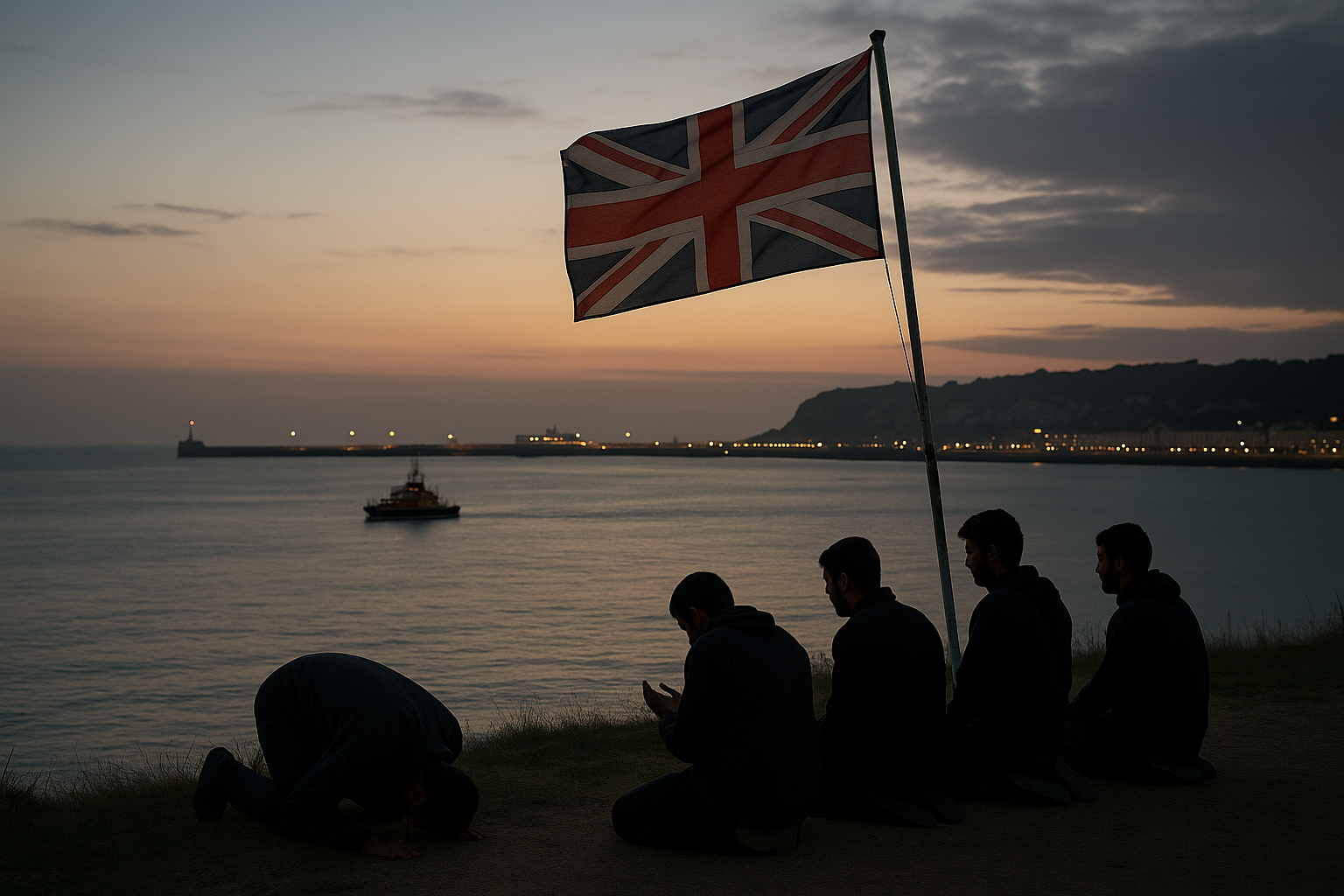
A Nation Adrift: Small Boats, Sovereignty, and the Moral Weight of Asylum
More than 168,000 people have crossed the English Channel in small boats since 2018 — a number now surpassing the 156,000 Allied troops who landed on D-Day. Yet while the D-Day landings liberated Europe from tyranny, today’s influx by sea reveals a Britain struggling to reconcile mercy with order, compassion with justice, and humanitarian concern with the preservation of national coherence.
The scale and composition of the crossings
The Home Office recorded 45,774 arrivals in 2022, 29,437 in 2023, and 36,816 in 2024, with approximately 17,000 more by October 2025. This brings the cumulative total to around 170,000 arrivals since the small-boats crisis began. Of these, 94–99% immediately claimed asylum, making this not a labour migration issue but an asylum system under immense strain.¹
Demographically, the crossings are overwhelmingly male and young. Approximately 87% of small-boat arrivals are men, and 71% are adult males aged 18 and over. Only 12–18% are women or children, with most minors being boys.² Although no official average age is published, the data suggest most arrive between their early 20s and mid-30s — a striking demographic profile for what is officially characterised as a refugee movement.
Religious and cultural background
The Home Office does not collect or publish data on religion, but country-of-origin statistics allow a credible estimate. In 2024, 57% of small-boat arrivals came from Afghanistan, Iran, Syria, Eritrea, and Sudan — nations that are all Muslim-majority, though Eritrea is roughly half Christian.³ When combined with arrivals from other Muslim-majority states such as Iraq, Turkey, Egypt, and Somalia, the proportion of migrants from Islamic backgrounds likely ranges between 70–80%, even allowing for minority Christians, Yazidis, and atheists fleeing persecution.⁴
Who genuinely deserves asylum
Of the total small-boat population, the Home Office’s own decisions indicate that between 55% and 70% ultimately qualify for refugee status or another form of protection.⁵ The key nationalities involved have among the highest asylum grant rates:
- Syria: 98%
- Sudan: 98%
- Eritrea: 87%
- Iran: ≈66%
- Afghanistan: ≈40% initially, but many refusals overturned on appeal.⁶
These figures confirm that the majority of small-boat migrants are indeed genuine refugees — though a significant minority are not. Weaker cases, including many Albanian, Turkish, and Vietnamese claimants, exhibit low grant rates (29–46%), suggesting largely economic motives or smuggler exploitation rather than persecution.⁷
Fiscal, social, and institutional impact
The clearest measurable effect of small-boat migration is not a surge in crime but the strain on public finances and local services. In 2023–24, the Home Office spent £4.7 billion on asylum support, £3 billion of which went on hotel accommodation.⁸ The Government also redirected billions from the foreign-aid budget to meet domestic asylum costs. Councils and NHS trusts in dispersal zones report intensified pressure on housing, GP surgeries, and social services, particularly where asylum seekers are barred from employment pending decisions.
Contrary to social-media claims, academic studies find no strong national correlation between immigration and crime. Oxford University’s Migration Observatory concluded that migrant conviction rates broadly match population share, while a detailed study detected only a 1% rise in property crime in areas with higher asylum densities — not the violent-crime spike often alleged.⁹ However, highly publicised offences in asylum hotels have amplified public anger, while the long asylum backlog fosters both community fatigue and migrant despair.
The moral and political crisis
Behind the numbers lies a moral collapse. Britain proclaims its humanitarian duty yet has allowed the asylum system to become both a magnet and a maze: a process that costs billions, delivers justice slowly, and leaves applicants idle and dependent. Compassion, detached from prudence, becomes chaos; law, without mercy, becomes cruelty.
The parallel with D-Day is not numerical but moral. In 1944, Britain’s shores launched an armada to liberate a continent; in 2025, those same shores receive daily flotillas that expose its moral uncertainty. A nation once confident in truth and duty now debates whether it can even define its borders.
A just policy must recover that equilibrium of mercy guided by truth: swift protection for those fleeing genuine persecution, firm return for those abusing the system, and honest reform to end the trafficking trade. Until Britain reclaims both control and compassion, the small-boats crisis will remain an emblem of national confusion — the tragedy of a people adrift between sentiment and sovereignty.
¹ UK Home Office, Immigration System Statistics, Year Ending March 2025.
² Home Office, Irregular Migration to the UK: Year Ending June 2023; Migration Watch UK, Gender and Age of Illegal Boat Crossers, 2024.
³ House of Commons Library, Research Briefing SN01403, 2025.
⁴ Pew Research Center, Global Religious Landscape, 2023; Migration Observatory, Irregular Migration and Asylum, 2024.
⁵ Home Office, Asylum Decision Data, 2025.
⁶ Refugee Council, Asylum Statistics Explainer, 2025.
⁷ Home Office, Irregular Migration to the UK: Statistical Summary, 2025.
⁸ National Audit Office, The Management of Asylum Accommodation, 2025.
⁹ Oxford Migration Observatory, Immigration and Crime in the UK, 2024.





Leave a Reply