
Law, Blasphemy, and the Limits of Offence: The Coskun Judgment and the Return of a Forbidden Word
The decision of the High Court of England and Wales to dismiss the appeal brought by the Crown Prosecution Service in the case of Hamit Coskun has clarified a point of law — yet it has also exposed a deeper cultural and civilisational fracture within contemporary Britain.¹ What began as a brief protest outside a diplomatic building has become a national test case about the boundaries between offence, disorder, and the role of the criminal law in a religiously plural society.
The Case in Context
The origins of the case lie in an incident on 13 February 2025 outside the Turkish consulate in London. Hamit Coskun, a 51-year-old man of Turkish origin, publicly burned a copy of the Qur’an while shouting an explicitly hostile slogan directed at Islam. Video footage circulated rapidly online, provoking immediate condemnation and strong reaction. Police arrested him at the scene.⁹
The Crown Prosecution Service subsequently charged Coskun under the Public Order Act 1986 with a religiously aggravated public order offence, relying on the aggravation provisions introduced by the Crime and Disorder Act 1998.² The prosecution did not — and could not — allege blasphemy, which was abolished as an offence in England and Wales by the Criminal Justice and Immigration Act 2008.³ Instead, the Crown argued that Coskun’s conduct, language, and choice of location amounted to disorderly behaviour likely to cause harassment, alarm or distress, and that he demonstrated hostility toward a religious group.
In June 2025, Coskun was convicted at first instance at magistrates’ level.⁸ The court accepted that the combination of burning a sacred text, the inflammatory language used, and the diplomatic context crossed the statutory threshold for disorderly conduct.
Coskun appealed. In October 2025, Mr Justice Bennathan sitting at Southwark Crown Court overturned the conviction.⁷ The appeal judgment emphasised that there is no offence of blasphemy in English law and that the criminal courts must carefully distinguish between conduct that is deeply offensive and conduct that meets the statutory standard of likely harassment, alarm or distress.
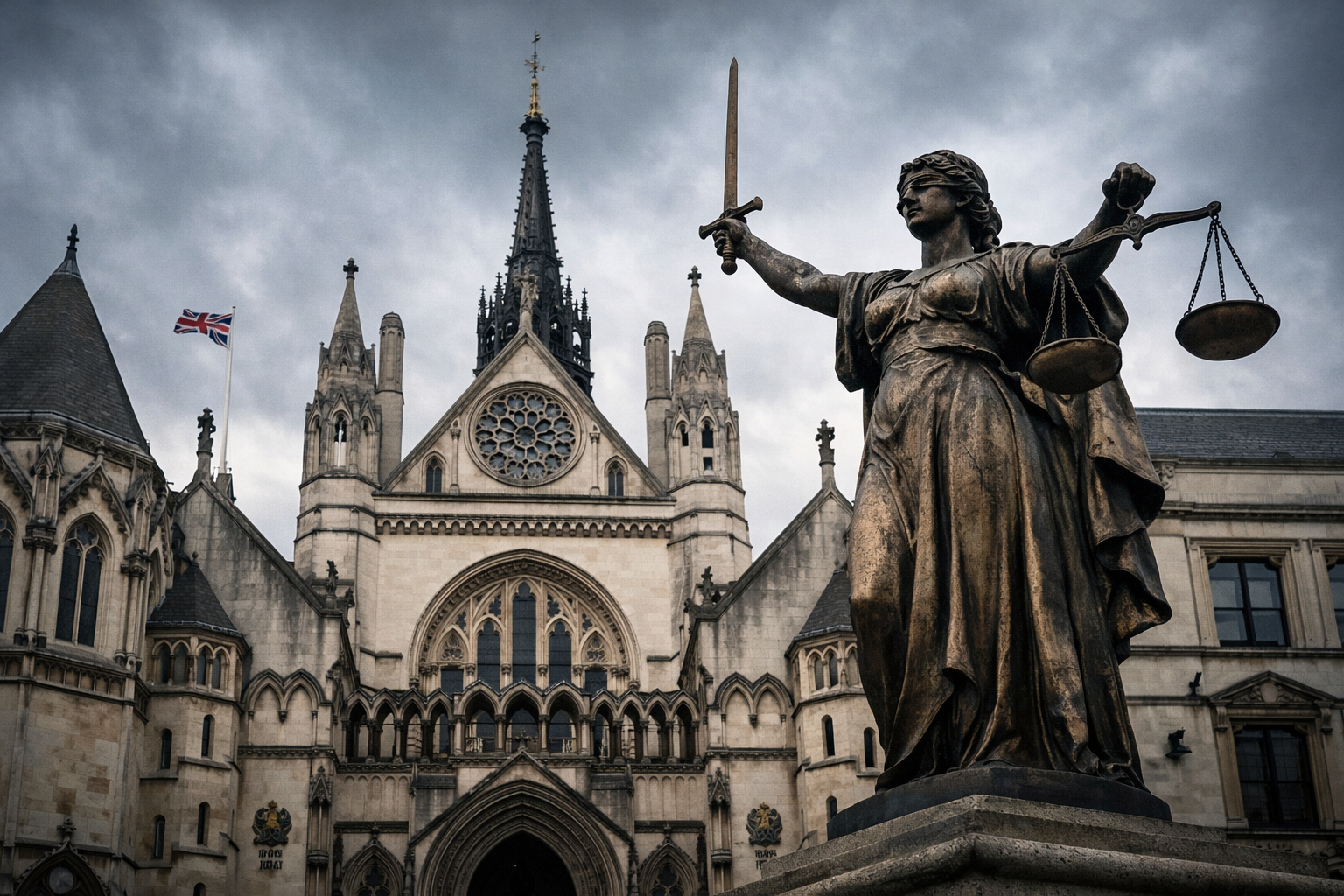
The CPS then pursued a further appeal by way of case stated to the High Court. The appeal was heard before Lord Justice Warby and Ms Justice Obi at the Royal Courts of Justice in February 2026. On 27 February 2026, the High Court dismissed the CPS appeal, holding that it was not persuaded the Crown Court had erred in law or relied on immaterial considerations.¹ The acquittal therefore stands.
The High Court did not pronounce on the morality of the act. It confined itself to statutory interpretation and procedural correctness. Yet the implications extend well beyond the individual defendant.

Blasphemy Abolished — and Reintroduced by Rhetoric
Some outlets described the case as a public order dispute. Others presented it as a landmark free-speech ruling. Yet the Muslim-oriented platform 5Pillars styled it as a “controversial blasphemy case,” explicitly reviving a term that no longer exists in English criminal law.⁴ That divergence of language is not accidental. It reveals competing understandings of what the law is for — and whom it protects.
Blasphemy was formally abolished in 2008.³ The state no longer adjudicates theological insult as a criminal matter. Yet the word persists in public discourse because the moral instinct behind it — the defence of what is held sacred — has not vanished. For many believers, burning a sacred text is not merely provocative protest but sacrilege. To describe the case as “blasphemy” is therefore an interpretive and moral framing, even if it is not a legal one.
By contrast, civil liberties advocates, including the National Secular Society, welcomed the High Court ruling as confirmation that “criminal law protects people from harm, not from being offended.”⁵ Their concern is that public order legislation must not become a surrogate blasphemy law — not by protecting doctrine explicitly, but by criminalising offence deemed likely to provoke outrage.
The judiciary’s language has remained careful and restrained. The principle reaffirmed is that offensive expression, however distasteful, does not automatically cross the statutory threshold into criminal disorder. The common law tradition, reinforced by European human rights jurisprudence, protects speech that “offends, shocks or disturbs.”⁶ That protection is not an endorsement of the content; it is a safeguard against subjective standards of moral insult becoming instruments of state coercion.
Offence, Harm, and the Fragile Settlement
The High Court’s judgment stands at a delicate boundary. It reaffirms that criminal liability requires demonstrable disorder or a clear statutory breach, not merely outrage. It resists the transformation of communal offence into prosecutable harm. And it underscores that the state protects persons from violence and harassment — it does not protect beliefs from criticism, rejection, or desecration.
Yet the case also reveals a deeper instability within British public life. Public order legislation now operates in a climate shaped by identity politics, religious pluralism, and heightened communal sensitivities. When religiously charged acts generate threats or unrest, the temptation to stretch statutory interpretation in order to contain escalation becomes stronger.
That is the quiet risk exposed by this litigation. A statute designed to prevent disorder can, if interpreted expansively, function as a de facto blasphemy law. The High Court has declined to endorse that trajectory. But the very fact that the appeal reached that level illustrates institutional uncertainty about where the boundary lies.
The legal and the moral questions remain distinct. A free society may judge certain acts corrosive, inflammatory, or socially destructive while nonetheless concluding that they do not meet the criminal threshold. The Coskun case does not settle the moral debate; it clarifies the legal one.
Blasphemy has vanished from the statute books. It has not vanished from public rhetoric. The High Court’s decision reasserts a constitutional principle that has defined modern British law since abolition: the state protects individuals from harm; it does not shield beliefs from insult. Whether that settlement can endure amid intensifying cultural volatility remains uncertain. For now, the line has been drawn — and it has been drawn in favour of legal restraint.
- R v Coskun (High Court appeal judgment), decision of Lord Justice Warby and Ms Justice Obi, Royal Courts of Justice, 27 February 2026.
- Public Order Act 1986, ss. 4A and 5; Crime and Disorder Act 1998, ss. 28–32 (religious aggravation provisions).
- Criminal Justice and Immigration Act 2008, s.79 (abolition of the offences of blasphemy and blasphemous libel in England and Wales).
- 5Pillars, headline describing the case as a “controversial blasphemy case,” February 2026.
- Statement issued by the National Secular Society following the High Court ruling, February 2026.
- Handyside v United Kingdom (1976) 1 EHRR 737, European Court of Human Rights.
- Crown Court appeal decision of Mr Justice Bennathan overturning Coskun’s conviction at Southwark Crown Court, October 2025.
- Initial conviction of Hamit Coskun at magistrates’ level, June 2025.
- Arrest and charging decision by the Crown Prosecution Service following the protest outside the Turkish consulate, February 2025.
RELATED ARTICLES


Latest ARTICLES
- Today’s Mass: October 29 St Narcissus, Bishop of JerusalemSaint Narcissus, Bishop of Jerusalem, was renowned for his piety and dedication to the church. Consecrated at an advanced age, he displayed unwavering vitality in governance. He presided over the Easter council, performed miracles, and faced wrongful accusations. Ultimately, he returned to serve until his death, exemplifying true Christian virtue.
- Today’s Mass: October 28 SS Simon & Jude, ApostlesToday, we honour Apostles Simon and Jude, believed to have been martyred together. Simon, known for his zeal, preached in various regions and is recognised as the patron saint of tanners. Jude, a relative of Jesus, authored an epistle urging faith and perseverance amidst challenges. Their joint feast is celebrated on October 28.
- Sermon for St. Simon and St. JudeToday marks the feast of St. Simon and St. Jude, two lesser-known apostles. St. Jude, distinct from Judas Iscariot, addresses issues of faith in his epistle, urging believers to uphold morality amidst challenges. He warns against false teachings and moral licence, highlighting the enduring relevance of these concerns in contemporary Christianity.
- CHRIST MUST REIGN HERE: A Spiritual Conference for the Feast of Christ the King, 2026HE ✠Jerome Lloyd calls on traditional Catholics to manifest Christ’s sovereignty in their lives, stressing personal conversion and the sanctification of home life. Through sacramental discipline, virtues, and active citizenship, he emphasises that the social reign of Christ can renew communities, starting with individual submission to His authority.
- Today’s homily: Vigil SS Simon & JudeOn the Vigil of Saints Simon and Jude, the Church recalls the sufferings of the Apostles and the supernatural source of their perseverance. Christ’s command to abide in Him challenges Catholics to unite doctrinal fidelity with personal holiness, courageous witness with charity, and devotion to tradition with genuine conversion of life.


Leave a Reply