
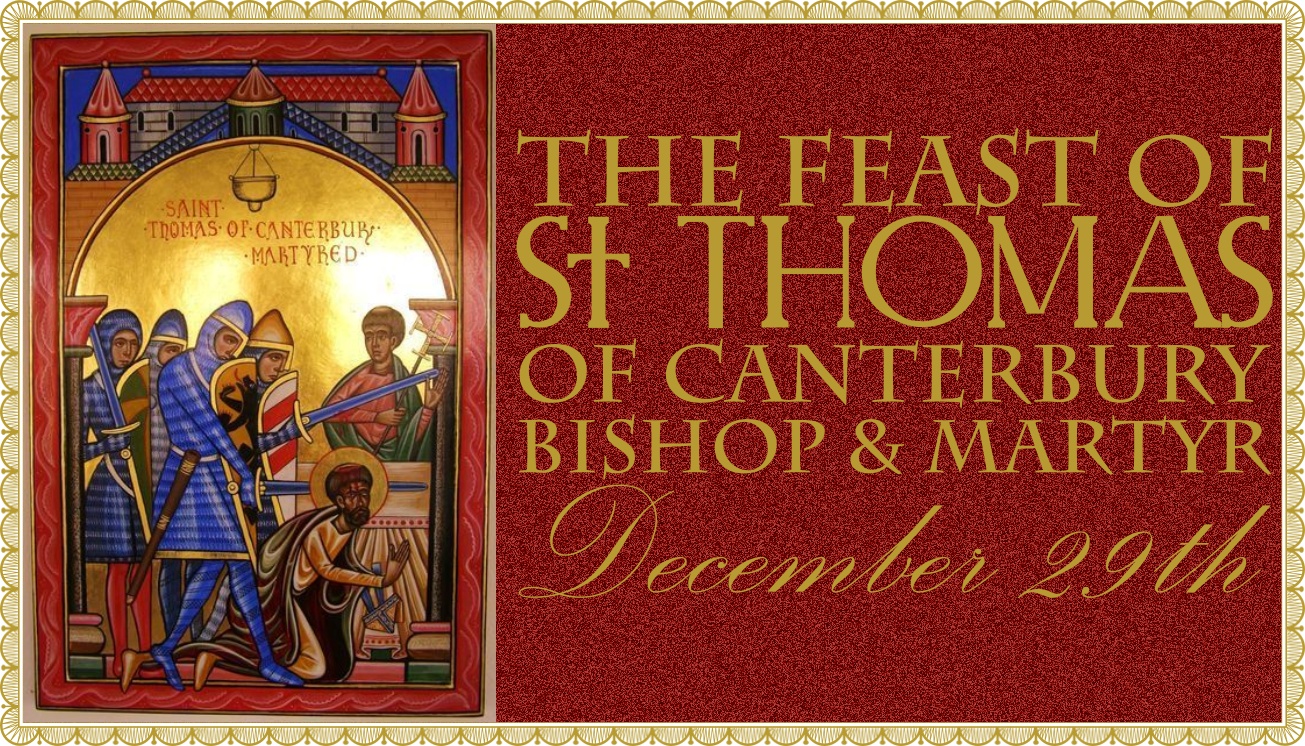
St. Thomas of Canterbury (29 Dec)
by the Revd Dr Robert Wilson PhD (Cantab), Old Roman Apostolate UK
Today we celebrate the feast of St. Thomas of Canterbury. St. Thomas a Becket came from a wealthy Norman family, and pursued a successful career in the ecclesiastical realm as archdeacon of Canterbury and in the civil realm as Lord Chancellor. As a friend and confident of King Henry II he seemed to be a man who, as Archbishop of Canterbury, would be a safe political appointment who would do the king’s bidding. Indeed, up until his appointment as Archbishop of Canterbury he had seemed more a man of the world than a seeker after holiness. However, much to the surprise of the king, once he became Archbishop of Canterbury he seemed to undergo a complete change of lifestyle to one of austerity, and became a fierce critic of the king and a strong defender of the rights of the Church. His opposition to the king’s policy led to his exile. When his return was eventually negotiated he continued to oppose the king. On one occasion the king became so exasperated with his erstwhile friend that he uttered the words, “Will no one rid me of this turbulent priest?” Some knights who heard this took this as a pretext for going to Becket’s cathedral in Canterbury and murdering him in his own cathedral. This was a public relations disaster for the king, who was forced to perform public penance for his actions. A shrine was soon established for St. Thomas in Canterbury and it became one of the most popular places of pilgrimage in England in the middle ages. It was destroyed by Henry VIII at the Reformation.
What was the issue at stake between Becket and King Henry II? It was the proper relation between the ecclesiastical and civil power. In Anglo-Saxon England there had been no clear distinction between the ecclesiastical and the civil courts. After the Norman Conquest the ecclesiastical courts were clearly separated from the civil courts. Initially this was not a problem for the civil power, but over the course of time the standard of the civil courts improved and the exemption of the clergy from being judged by the civil courts seemed to undermine the ability of the king to govern the realm. Becket refused to co-operate with this programme, insisting that the clergy must be judged by the ecclesiastical and not by the civil courts. He took a stand against the king’s policy that ultimately cost him his life.
What was the issue ultimately at stake beyond the immediate controversy? The issue was the relationship between the Church and the world. The Founder of Christianity had been crucified by the Roman governor Pontius Pilate because his messianic claims were a direct challenge to the power of the Roman empire. The Jewish authorities had collaborated with Pilate in order to preserve their own relative autonomy under Roman rule. Although Jesus’ message was non violent it was seen as a threat to the civil peace, because his teaching was in opposition to the world’s standards. The early Christians were persecuted because, although, like Christ himself, their message was non violent, they proclaimed that there was another king, one called Jesus. Consequently, they refused to accept the cult of the Emperor on which the civil peace was seen to rest. In effect, the Church presented an alternative society to that of the Empire. Eventually, the empire succumbed and accepted Christianity. The Church no longer trained its members for Christian dying, but for Christian living. Though in the West the Empire fell to the barbarian incursions they were converted to Christianity and Christendom was the result. Subsequently, Western societies succumbed to the Enlightenment and were secularised (the situation we find ourselves in today). In the East the Roman Empire continued as Byzantium for another thousand years before it too fell to the Islamic Ottoman Empire. The ideal of a Christian civilisation passed to Russia, before that itself fell to the militant atheism of the Soviet Union in the twentieth century (returning to a situation like that of the age of the martyrs).
In the West, the purpose of the European Enlightenment was to effect a separation between Church and State and so create a civilised but non religious humanity. In effect, Western societies repudiated Christian dogma, but still sought to live by a secularised version of Christian ethics. However, it now seems that our society is reverting to open paganism. The majority of people are not only no longer Christian, but actively prefer paganism.
It will be objected that in saying this we are placing ourselves in clear opposition to the spirit of the age. Our answer must be, as with the first Christians, that we must obey God rather than men. What matters is not what is fashionable but what is true.
If we are to follow the example of St. Thomas a Becket, we must be faithful to Jesus’ own words, “Render therefore unto Caesar that which belongs to Caesar and unto God that which belongs to God.” For, as St. Paul put it when writing to the Roman colony at Philippi, “our commonwealth is in heaven, and from there we await the Saviour, our Lord Jesus Christ, who will transform our vile body that it may like unto his glorious body, by the power whereby he is able to subject all things to himself.”




Leave a Reply