
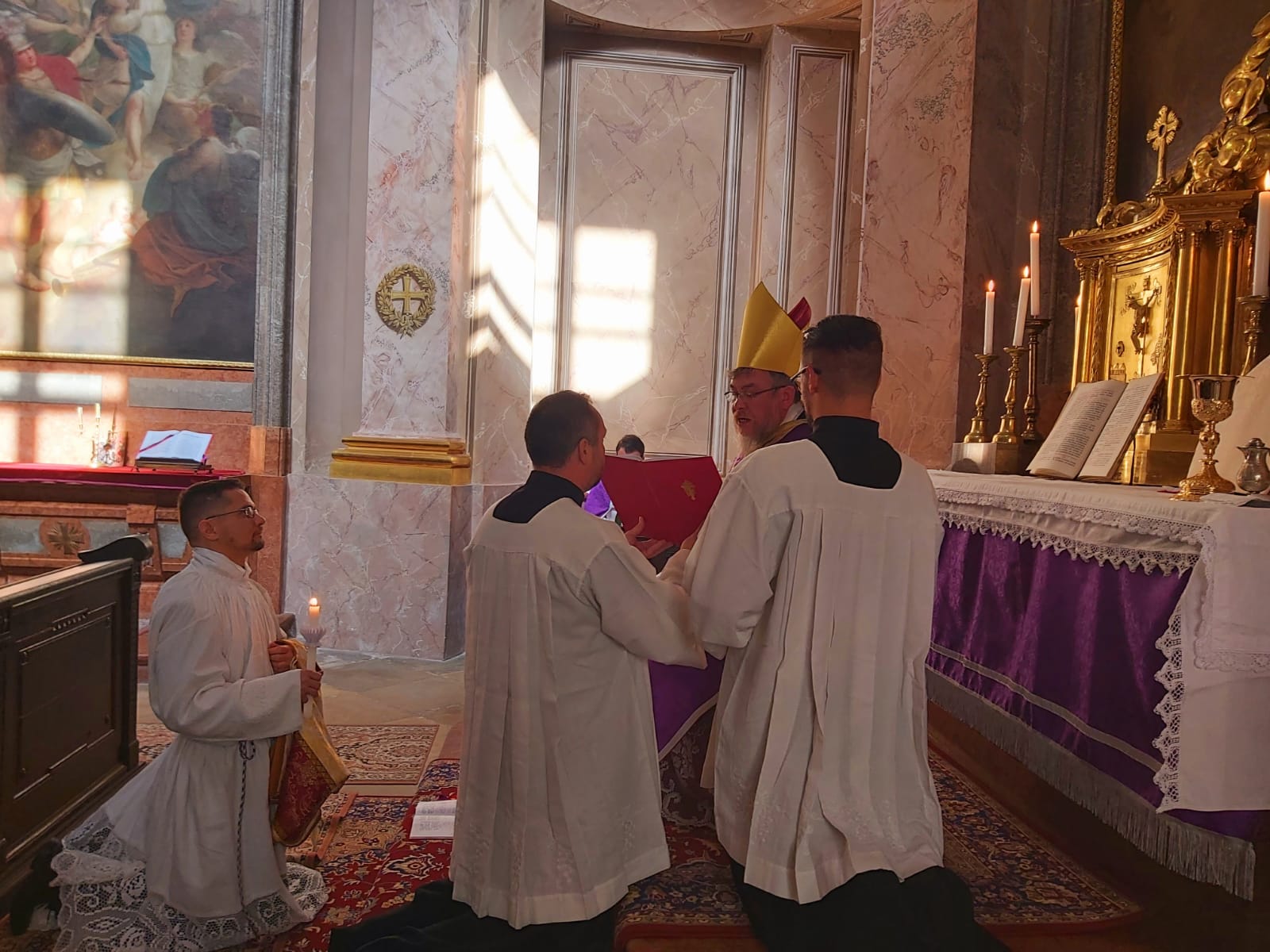
Haec est Via per Crucem — This is the Way of the Cross

To the clergy and faithful of the Old Roman Apostolate,
and to all who seek the truth of Christ,
grace and peace in Our Lord Jesus Christ.
Carissimi, Beloved in Christ,
As we mark the Exaltation of the Holy Cross this September, Providence itself has framed our new motto for the Apostolate: Haec est Via per Crucem. It is not chosen lightly. Reviewing the themes and testimonies of these recent days, as gathered in Nuntiatoria of 14 September 2025, we see the Cross traced everywhere — in the liturgy, in the life of the Church, and in the trials of the world.
It is for this reason that we, the Old Roman Apostolate, have taken as our motto: Haec est Via per Crucem. In these words lies both our confession and our mission.
The Cross in the Liturgy and the Saints
We reflect on the feasts of this week: the Triumph of the Holy Cross, the Sorrows of the Virgin Mother, the martyrdoms of Cornelius and Cyprian, Januarius and Eustace, the wounds of Francis, the humility of Joseph of Cupertino. Each saint testifies that Christian witness is not abstraction but suffering transformed by grace. The Church does not canonise comfort, but sacrifice. Their way is our way: the way of the Cross.
The Cross and Prophetic Witness
This edition of Nuntiatoria also recalls the visions attributed to Blessed Anne Catherine Emmerich, who foresaw a “strange church” erected “against all rules,” where worship was desacralised, the clergy lukewarm, and the faith surviving only in a few homes. Though filtered through the pen of Clemens Brentano, these images have resonated with many as uncannily parallel to the post-conciliar crisis: the collapse of doctrine, the trivialisation of liturgy, and the pressure on priests to concede what cannot be granted.
The Church teaches that such private revelations add nothing to the deposit of faith, yet they may rouse the faithful to vigilance. Emmerich’s visions remind us that the Cross will always be the test of authenticity. The “church of human design” avoids the Cross — offering relevance without sacrifice, fraternity without conversion, mercy without truth. But the Church of Christ is recognised by the marks of Calvary: suffering endured, truth proclaimed, and fidelity maintained.
Thus our motto Haec est Via per Crucem is not only a spiritual counsel, but a prophetic standard against the false promises of an age that seeks the crown without the Cross.
The Cross in the Life of the Church
This Cross is visible in our own times. Pope Leo XIV, addressing newly appointed bishops, spoke of humility and service, but avoided the clear affirmation of doctrine so desperately needed in an age of confusion. In Charlotte, a bishop forbade the use of altar rails in schools, as though reverence itself were dangerous. In China, the creation of a new diocese was trumpeted as progress, though it came at the expense of the underground Church still persecuted under the terms of the 2018 accord. Each example is a wound borne by the Body of Christ, a humiliation that faithful Catholics must endure in silence and fidelity.
As St Cyprian wrote in the days of Roman persecution: “The Lord has willed that we should rejoice and exult in persecutions, because when persecutions come, then the crowns of faith are given, then the soldiers of Christ are proved”¹. The way of the Cross is thus the measure of the Church’s renewal.
The Cross in the World
But there are also consolations. In France this year, Easter brought more than ten thousand adult baptisms — many of them young, many influenced by the witness of Catholics on social media. In London, record numbers marched for life outside Parliament, publicly testifying to the dignity of the unborn against the culture of death. In Scotland, bishops spoke out against assisted suicide, warning that a “death on demand” culture imperils every vulnerable life. In Ireland, bishops addressed child protection, refugees, and secularisation with mixed voices of hope and timidity. These events remind us that even amid decline, the Spirit stirs the waters, and hearts are drawn to Christ when He is boldly preached.
The Witness of Blood and Truth
We cannot forget the recent assassination of Charlie Kirk in America, struck down for his public witness. Though not a martyr in the canonical sense, his death bears the marks of martyrdom in the broader Christian sense: slain not for violence but for words; not for treachery but for testimony. He spoke the truths of natural law, of family, of the Gospel’s claims over society, and for this he was hated. In such moments we are reminded that Our Lord’s promise endures: “If they have persecuted me, they will also persecute you” (John 15:20). His death stands as a sober warning of the cost of discipleship in a hostile age, and a summons to courage for those who remain.
The Charism of the Apostolate
The Old Roman Apostolate exists for this very witness. Our charism is to guard the deposit of faith in its integrity, to preserve the traditional liturgy in its fullness, and to form Catholics who will stand before the world unashamed of the Cross. In an age of ecclesial compromise, political corruption, and cultural collapse, our vocation is not to soften but to strengthen, not to dilute but to confess, not to accommodate but to sanctify. As Pope St Leo the Great preached: “The cross of Christ, which was once for us the cause of redemption, will be for us the example of perseverance”².
Conclusion: No Other Way
Beloved, let us then not be deceived by the wide roads of human design — whether secular ideologies or ecclesiastical fashions. These promise peace but deliver emptiness. The Cross alone is the ladder to heaven. It is written: “If any man will come after me, let him deny himself, and take up his cross, and follow me” (Matt. 16:24).
Our motto is therefore not a pious ornament but a path: Haec est Via per Crucem. May the Blessed Virgin, who stood beneath the Cross, strengthen us. May the martyrs of September and the witnesses of today inspire us. And may Christ our King reign through our fidelity until He comes in glory.
Haec est Via.

✠Jerome Seleisi
Titular Archbishop of Selsey
Primus of the Old Roman Apostolate
- St Leo the Great, Sermon 71 on the Passion of the Lord.
- St Cyprian of Carthage, Epistula ad Fortunatum de exhortatione martyrii, c. 10.



Leave a Reply