
The Cross, the Crowd, and the Collapse of Consent: What the BBC’s Reaction Reveals About Britain in 2025
The BBC’s story as national diagnosis
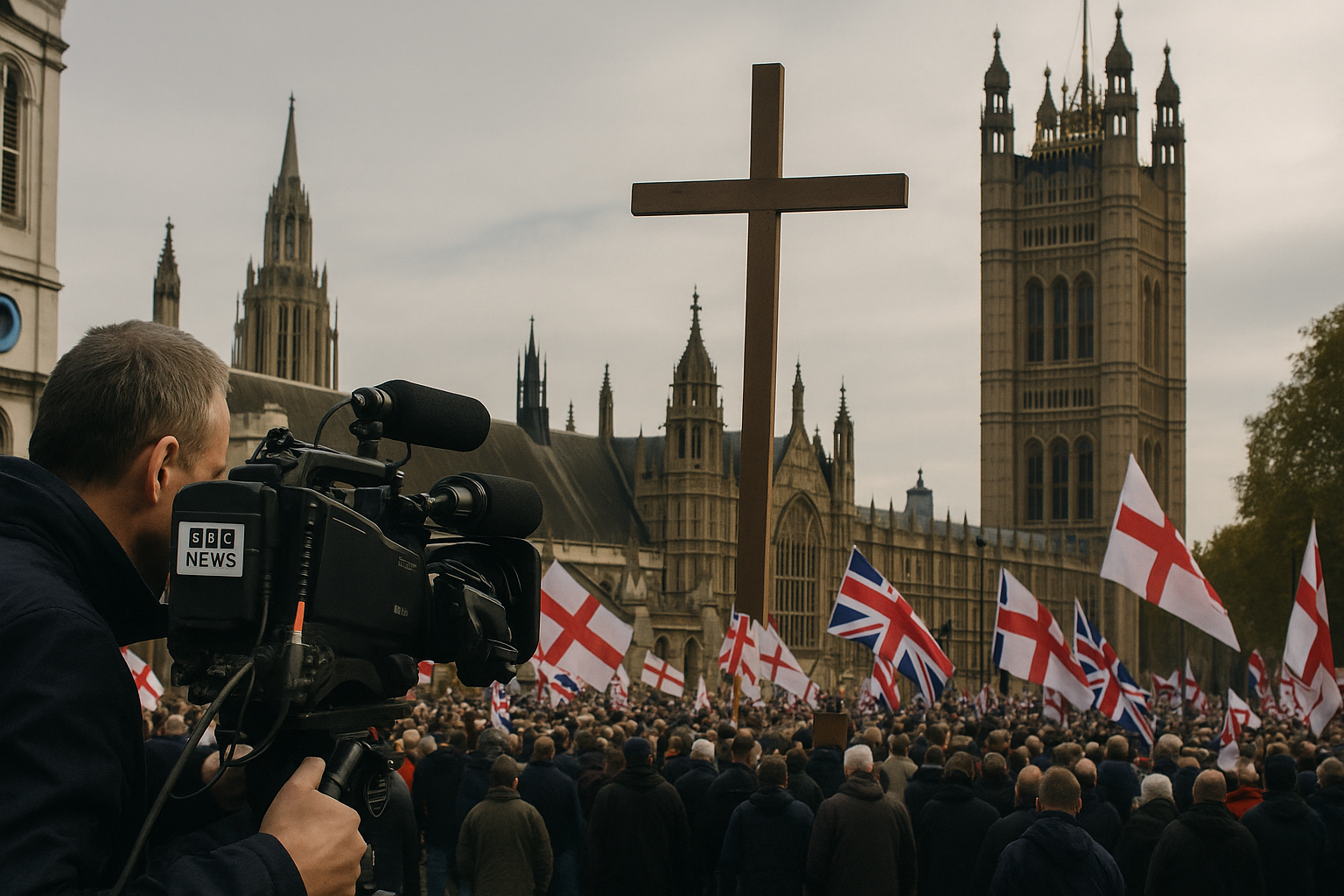
When the BBC ran a feature on 23 November titled “Tommy Robinson supporters are turning to Christianity, leaving the Church in a dilemma,” it inadvertently revealed more about Britain’s cultural fracture than about the individuals it profiled¹. The article framed the appearance of new churchgoers—particularly from working-class backgrounds and from the Unite the Kingdom rally—as a pastoral and political problem. Faith, which once served as the moral spine of the nation, has become something to be managed, interpreted, and quarantined by institutional gatekeepers.
The BBC treated the simple act of attending a parish service as though it were an unexpected variable in Britain’s public life. That reaction is far more telling than the story itself.
A Christian nation bewildered by Christians
This is the paradox: Britain retains bishops in its legislature, conducts coronations as liturgical rites, and orders its public holidays around the Christian year. Yet when citizens outside the metropolitan classes return to church, the country’s national broadcaster reacts with unease. Christianity is thus permitted to survive as ceremony and cultural ornament—but not as a living allegiance that springs up organically among ordinary people.
The BBC’s profile of Gareth from Bradford illustrates the discomfort. His reasons for attending church—concerns about cultural change, national identity, and the erosion of inherited values—were presented as if they were sociological anomalies. The report did not treat them as the moral instincts of a citizen seeking orientation in a disordered world, but as symptoms requiring clerical intervention.
This paternalism is now a feature of British institutional life: the presumption that unsupervised conviction is inherently suspect.
The rally as mirror, not aberration
The Unite the Kingdom rally drew between 110,000 and 150,000 participants¹. Many carried wooden crosses or Bible verses—a sign less of theological sophistication than of a population groping for the symbols their culture no longer teaches them to understand. The BBC noted this imagery, but its framing suggested that such public Christianity is inherently destabilising, especially when expressed by those associated with populist causes.
In reality, the rally revealed widespread discontent: a sense of being unheard, fears over uncontrolled migration, frustration with speech restrictions, and the painful shock of the Charlie Kirk murder only days earlier. These concerns are not restricted to any one movement; they mark a deep national unease. Yet the BBC chose to interpret them through the lens of ecclesiastical dilemma, as though the pressing issue were not the state of the country but the inconvenience posed to diocesan strategy.
Institutional Christianity and the fear of unscripted faith
Church leaders interviewed by the BBC reflected the same ambivalence. Bishops spoke of “misrepresentations” of Christian values and the risk of “co-opting the cross,” even as they acknowledged the genuine frustration felt by many¹. Their warnings were not unjustified; Christian symbols can be misused. Yet it was notable that the primary concern was not to address the grievances behind the rally, but to reposition the Church at a distance from the people who still look instinctively to Christianity as a source of meaning.
For decades, the national Church has largely retreated from public moral clarity. It now finds itself confronted with citizens who are reaching for the symbols the Church itself has allowed to fall silent. Unsurprisingly, clergy are divided. Some, like the Rev Derek Jones of Little Horton, attempt to listen and understand. Others, like the signatories of the September open letter condemning the use of crosses at the rally², seek to reassert interpretive control.
But the more the Church tries to control the symbol, the more it reveals its loss of authority over the society that once formed it.
Narrative anxiety and the crisis of consent
What unsettled the BBC—and, by extension, Britain’s governing class—was not “Christian nationalism,” nor the presence of religious symbols at a rally. It was the emergence of a constituency acting outside institutional permission structures. The story’s tone made clear that Christianity is expected to operate within boundaries set by broadcasters, bishops, and civil society bodies. When those boundaries are crossed, the reaction is disproportionate: alarm, categorisation, and the deployment of new ideological labels.
This reveals the deeper crisis: Britain no longer possesses a stable centre of moral and cultural authority. Institutions that once shaped belief now attempt to manage it. Symbols that once united the nation now divide it because their custodians no longer agree on what they mean—and, crucially, because they no longer command the consent of the people.
Faith that will not behave
The BBC’s dilemma is the Church’s dilemma, and both are symptoms of the same reality. Christianity is returning—not as an establishment ritual or a curated moral vocabulary, but as a raw, instinctive language for those who feel abandoned by political, cultural and ecclesial elites. It is messy, unschooled, and sometimes misdirected. But it is real. And it is precisely this independence that alarms institutions accustomed to setting the terms of public belonging.
Britain is discovering that faith, once awakened, refuses to stay within the boundaries assigned to it. The cross is not dangerous because of who carries it. It is dangerous because it still means something, and meaning outside official control is the one thing the modern establishment cannot easily tolerate.
- BBC News, “Tommy Robinson supporters are turning to Christianity, leaving the Church in a dilemma,” 23 November 2025.
- Church of England bishops and ecumenical leaders, open letter condemning use of crosses at the Unite the Kingdom rally, September 2025.
- Reuters, “Up to 150,000 join Tommy Robinson rally,” 14 September 2025.
- Premier Christianity, analysis of Christian symbolism at the Unite the Kingdom rally, 15 September 2025.
related articles


LAtest articles
- Today’s homily: St Pius X, PopeThe text reflects on the life and legacy of Pope St Pius X, who was chosen from humble beginnings to reform the Church. His pontificate focused on defending the Catholic Faith, restoring liturgical sanctity, and fostering deeper connections between believers and Christ. Pius X exemplified a balance of truth and pastoral charity.
- Today’s Mass: September 03 Pope St Pius X,Pope St Pius X, born Giuseppe Melchiorre Sarto, was a significant reformer who emphasised preserving the Catholic Faith against Modernism. His pontificate (1903-1914) featured reforms in liturgy, frequent Holy Communion, and seminaries, rooted in a pastoral desire to restore everything in Christ. He died in 1914 and was canonised in 1954.
- Today’s homily: St Stephen of HungaryThe homily reflects on the life of Saint Stephen of Hungary, illustrating his transition from a powerful ruler to a saint. He embraced the responsibilities of kingship guided by faith, understanding his authority as stewardship. His legacy teaches that true governance comes with surrender to God, ultimately placing his kingdom under the protection of the Blessed Virgin Mary.
- Today’s Mass: September 02 St. Stephen the GreatSt. Stephen the Great, King of Hungary (977-1038), was a significant Christian ruler who reinforced the faith throughout Hungary. Anointed king in 1000 by Pope Sylvester II, he fought against paganism and promoted the Church. He was canonised in 1083 and is the patron saint of Hungary, symbolising national identity.
- QUAERITE PRIMUM REGNUM DEI – Seek First the Kingdom: Spiritual Conference for Nuntiatoria CXXIA spiritual conference, “Seek First the Kingdom,” emphasises prioritising God’s reign within individuals over earthly concerns. It explores the necessity of internalising Christ’s teachings, the importance of discernment, and the critical evaluation of the faith in relation to contemporary issues. A genuine Catholic life centres on Christ, fostering holiness and transformation.



Leave a Reply