
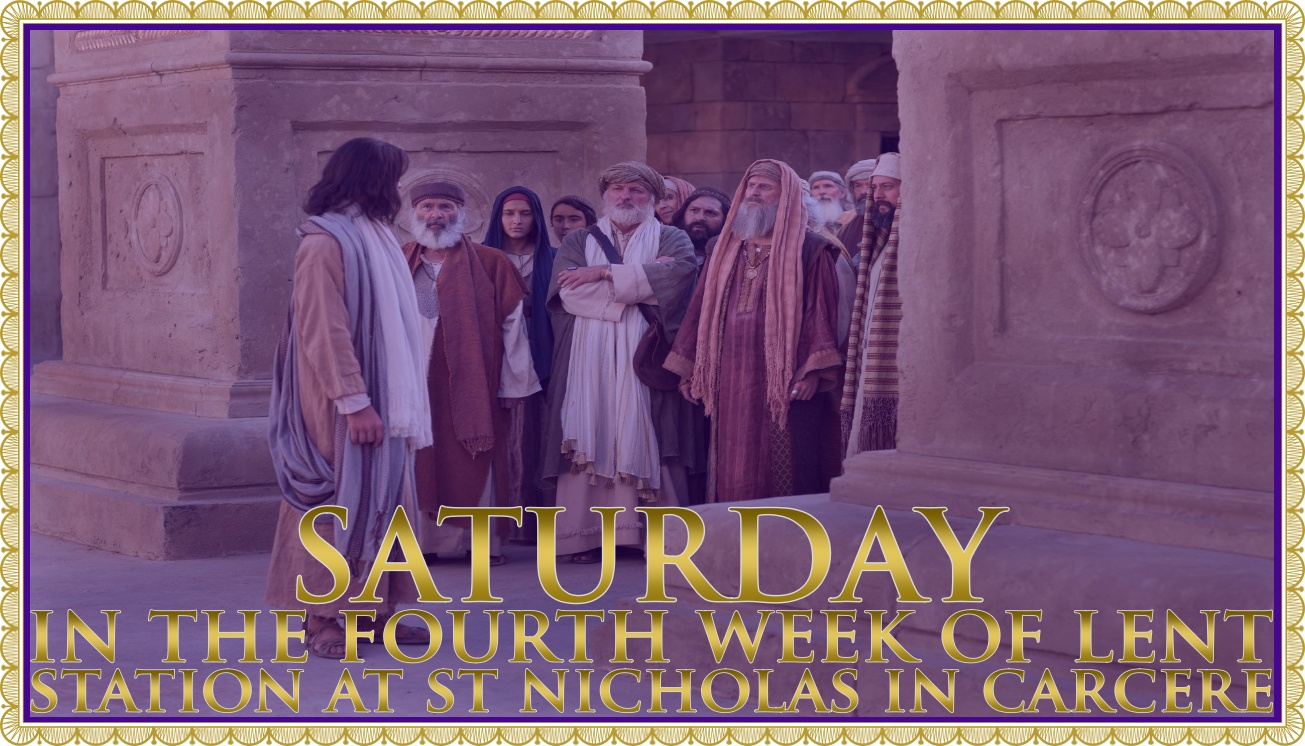
Saturday of the Fourth Week in Lent
by the Revd Dr Robert Wilson PhD (Cantab), Old Roman Apostolate UK
Today’s lesson from the prophet Isaiah records God’s words of consolation to his people. “In an acceptable time I have heard thee, and in the day of salvation I have helped thee: and I have preserved thee, and given thee to be a covenant of the people, that thou mightest raise up the earth, and possess the inheritances that were destroyed: that thou mightest say to them that are bound: Come forth: and to show them that are in darkness: Show yourselves.” In the restored nation of the future the people would neither hunger nor thirst. God would be their shepherd and they would drink from fountains of living waters. He would comfort his people and have mercy on them. “And Sion said: the Lord hath forsaken me, and the Lord hath forgotten me. Can a woman forget her infant, so as not to have pity on the son of her womb? And if she should forget, yet will not I forget thee.”
The prophets often pronounce judgement on a sinful nation. But in the face of seemingly unmitigated disaster there remains hope. This is not grounded on any human merit of attainment, but solely in the mercy of God. It might seem that the nation had collapsed because God had abandoned his people, but he had not forgotten them. He would comfort his people and have mercy upon them. He would be their shepherd and they would drink from fountains of living waters.
The Gospel of St. John (which we heard today) states that Jesus spoke to the multitudes of the Jews saying “I am the light of the world: he that followeth walketh not in darkness, but shall have the light of life.” The Pharisees said that he was giving testimony of himself, and this rendered it untrue. Jesus replied: “Although I give testimony of myself, my testimony is true: for I know whence I came and whither I go: but you know not whence I come or whither I go. You judge according to the flesh: I judge not any man: and if I do judge, my judgment is true, because I am not alone: but I and the Father that sent me. And in your law it is written that the testimony of two men is true. I am the one that giveth testimony of myself: and the Father that sent me giveth testimony of me.” They asked him where his father was. He said that they neither knew him nor his Father. If they had known him they would have known his Father also. He said these words in the temple treasury, but no man lay hands on him because his hour was not yet come.
Jesus had travelled to Jerusalem for the feast of Tabernacles and to make his final challenge to the Jewish nation. He had begun to teach in the middle of the feast and on the last day of the feast proclaimed himself to be both the water of life and the light of the world, the fulfilment of the ritual which marked the celebration of the feast. He stated that he was the bringer of the full, final and definitive revelation of God’s will. There was no need to look beyond him, for true knowledge of God came through him and to have seen him was to have seen the Father.
This claim understandably aroused both astonishment and anger. It has been said that if you think that you are the light of the world, you are so manifestly mad that nothing you say can be taken seriously. The scribes, the learned expositors of the Law, based themselves on custom and precedent. Each teacher might make some distinctive contribution to a greater understanding of how the Law could be applied in the lives of the people, but it was inevitably provisional to the circumstances of the time and there was no suggestion that it could not be later modified by another teacher. By contrast, Jesus spoke in his own name what the Law had said in God’s name. He claimed that the decisive moment of history was now dawning and it was marked by his own appearance. How could such an extraordinary self claim be justified?
Jesus replied to the criticism that he appeared only to give testimony to himself that he spoke not in his own name but in the name of the one who sent him. The Law indeed stated that the testimony of two men is true and Jesus was not alone because Father who sent him gave testimony to him. As the Jewish proverb had it: a man’s agent is as it were himself. He did everything with the seal, authorisation and accreditation of the one who sent him. They were utterly identified in action, though not identical, for the Father remained Father and not Son (as St. Athanasius later put it). But it meant that his claim to stand in God’s place, acting and speaking for him was indeed true. He claimed nothing for himself in his own right, but everything for what the Father was doing through him. His opponents were so blinded by their own preconceptions that they knew neither him nor his Father. If they had truly known him they would have known his Father also. Instead they passed judgement upon themselves by repudiating the truth that was incarnate in their midst.
C. S. Lewis once stated: “I believe in Christianity as I believe that the sun has risen, not because I can see it, but because in it’s light I can see everything else.” Let us continue to confess our faith in the true light of the world, knowing that in following him we will not walk in darkness but have the light of life.



Leave a Reply