
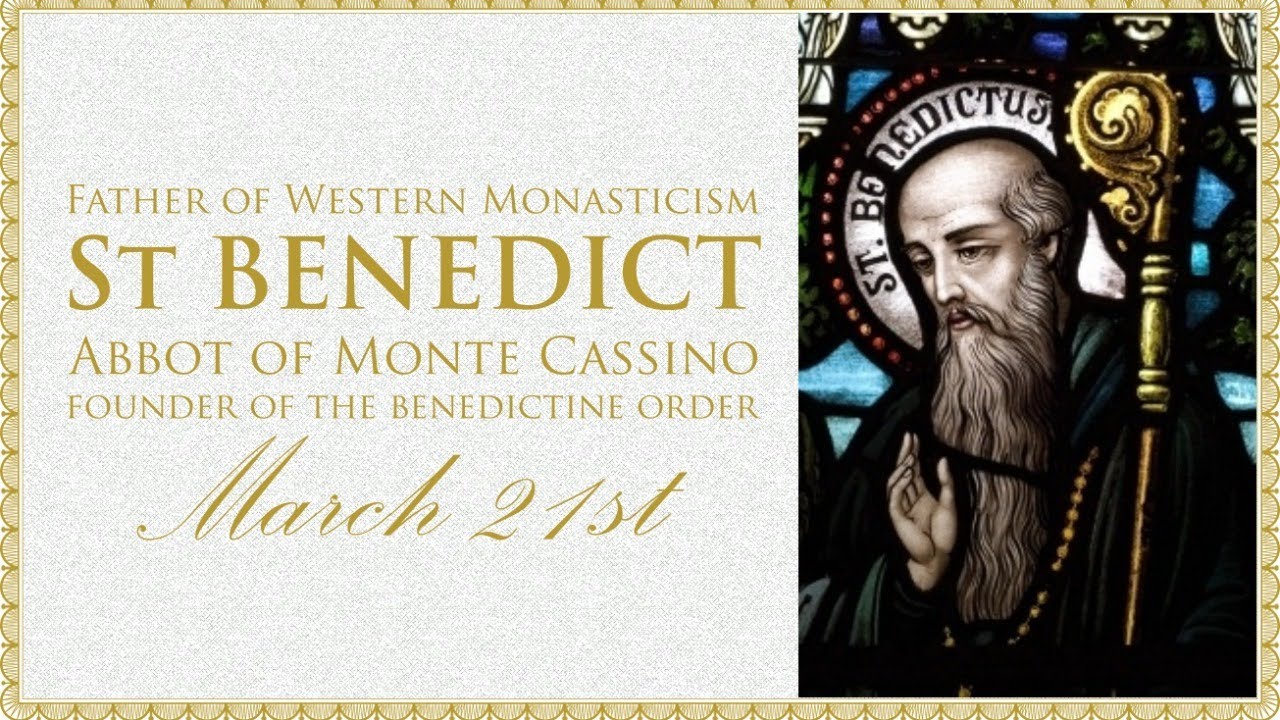
St. Benedict
by the Revd Dr Robert Wilson PhD (Cantab), Old Roman Apostolate UK
Today we celebrate the feast of St. Benedict. He was born and brought up in Nursia, but sent to Rome for his education. He determined to escape the life of the city and become a hermit. He travelled to Subiaco and remained there for the next three years, unknown except to Romanus, another monk in the area. Gradually he attracted a following, whom he settled in several monasteries each with its prior. He then withdrew from Subiaco to Monte Cassino. He no longer founded separate institutions, and now gathered his followers into one monastery ruled over by a prior and deans under his overall supervision. The place was more easily accessible from Rome than Subiaco and his reputation for sanctity became more widely known. It appears to have been during this period that he composed the rule for which he later became famous. He died in 547.
Why did the memory of St. Benedict not pass into obscurity like so many other seekers after holiness? The answer lies in the decision by Pope Gregory the Great at the end of the sixth century to write a life of St. Benedict and to popularise his rule as the model for others to follow. St. Gregory was the first monk to become Bishop of Rome. He lived in a time when Rome had degenerated from being the capital of the civilised world to a plague infested provincial town. Italy had been ravaged by conflict between the Ostrogoths and the Emperor Justinian’s attempt to regain the region for the empire, and there were then further wars with the Lombards. It seemed to St. Gregory that the world itself was coming to an end. There was no point lamenting a now defunct classical culture. The answer to the problems of the time lay in the life of holiness as made clear in the rule of St. Benedict. This was originally intended for the crisis situation in Italy, but it was adopted as the model of the monastic life by the missionaries to England under the leadership of St. Augustine of Canterbury. The Benedictine rule spread wherever the Roman rite came to be adopted, first in England and later, under the influence of missionaries from England such as St. Willibrord and St. Boniface, in the Netherlands and Germany. Hence, St. Benedict came to be subsequently venerated as the father of Western monasticism.
What was it about the rule of St. Benedict that made it so popular? The answer lies in the balance which was achieved between asceticism and what was realistically possible in a given situation. Those who had originally withdrawn into the Egyptian desert such as St. Anthony had been mostly individual seekers after holiness, desiring to escape the corruptions and compromises of a world that was beginning to be Christianised. There had been some, starting with St. Pachomius, who had formed communities. It was this later model that had taken hold as the example to be followed, first by St. Basil in the east and then by John Cassian in the west. But there was still a tendency for communities to practice such ascetic rigour that they were unapproachable to most.
By contrast, St. Benedict was far more realistic in what could be expected of his monks. He had himself originally lived as a hermit, but he came to recognise that the future lay with the adoption of a communal lifestyle. For this purpose the excesses and eccentricities of many of the ascetics was best avoided. Such practices may be appropriate for a particular type of person, but not for whole communities. He became especially noted for his saying that idleness is the enemy of the soul. The monks should not only devote themselves to the worship of God through reciting the offices, but also to a specific form of work such as agricultural labour or copying manuscripts. This was not because St. Benedict had any particular interest in these matters in themselves, but simply as a means of combating idleness.
However, this principle for his rule of life paradoxically had a crucial influence upon society as a whole. In an age when civilisation seemed to have collapsed and the Roman empire in the west had been replaced by tribal kingdoms, the monasteries that followed the rule of St. Benedict became the principal carriers of learning and education. The rulers saw that the monks cultivated the land, kept accounts and planned ahead. These were virtues that were valuable for society as a whole. Whereas today those adopting the religious life might be popularly dismissed as stuck in the past, in the so called Dark Ages the monks were venerated for being the most forward looking and innovative members of society. John Henry Newman rightly later called the period the Benedictine age.
It is important to emphasise that there is no evidence that St. Benedict was ever ordained and that his monasteries were essentially communities of laity. They were very different from the later highly clericalised monks of Cluny that became dominant many centuries later. The Cistercians desired to return to the austerity of the original rule of St. Benedict, withdrawing to remote areas and making use of lay brothers. But whereas St. Benedict’s monasteries were self governing, the Cistercians developed a highly regimented system of central control and were clerically dominated. St. Benedict had never intended the lay brothers to be a second class associate of the monks as happened with the Cistercians. Rather, St. Benedict’s rule was written for lay brothers. There was nothing centralised or clericalist about it. The strength lay in precisely the way it could be used as a template to be adapted to many different situations.
But, we might say, St. Benedict’s rule may have been appropriate for the so called Dark Ages, but it is not for us, because our world has advanced far beyond that now. A moment’s reflection should give us pause. The age of Enlightenment has faded and we are no longer as confident in western cultural superiority as we used to be. We lurch from one crisis to another, but lack an overall vision to move forward. In fact, our time is not as different as we might like to think from the Italy that St. Benedict and St. Gregory the Great knew. But in that age people prayed. They knew that they had no power of themselves to help themselves and asked for grace to think, will and do that which is good. Rather than becoming cynical and despondent they formed communities that became the principal cultural carriers from the world that had been lost to the one that was waiting to be born.
Some speak of a Benedict option in our own time. There is a need now just as much as then to withdraw from the corruptions of the age and seek the life of holiness. The monks laid the foundations for the future then and there is no reason why a similar revival should not do so now. After all, as G. K. Chesterton put it, it is not the case that the Church will drag us back to the Dark Ages. The Church is the only thing that got us out of them.
Let us therefore pray for grace that we may be enabled to follow the example of St. Benedict in our own time and place.


Leave a Reply