
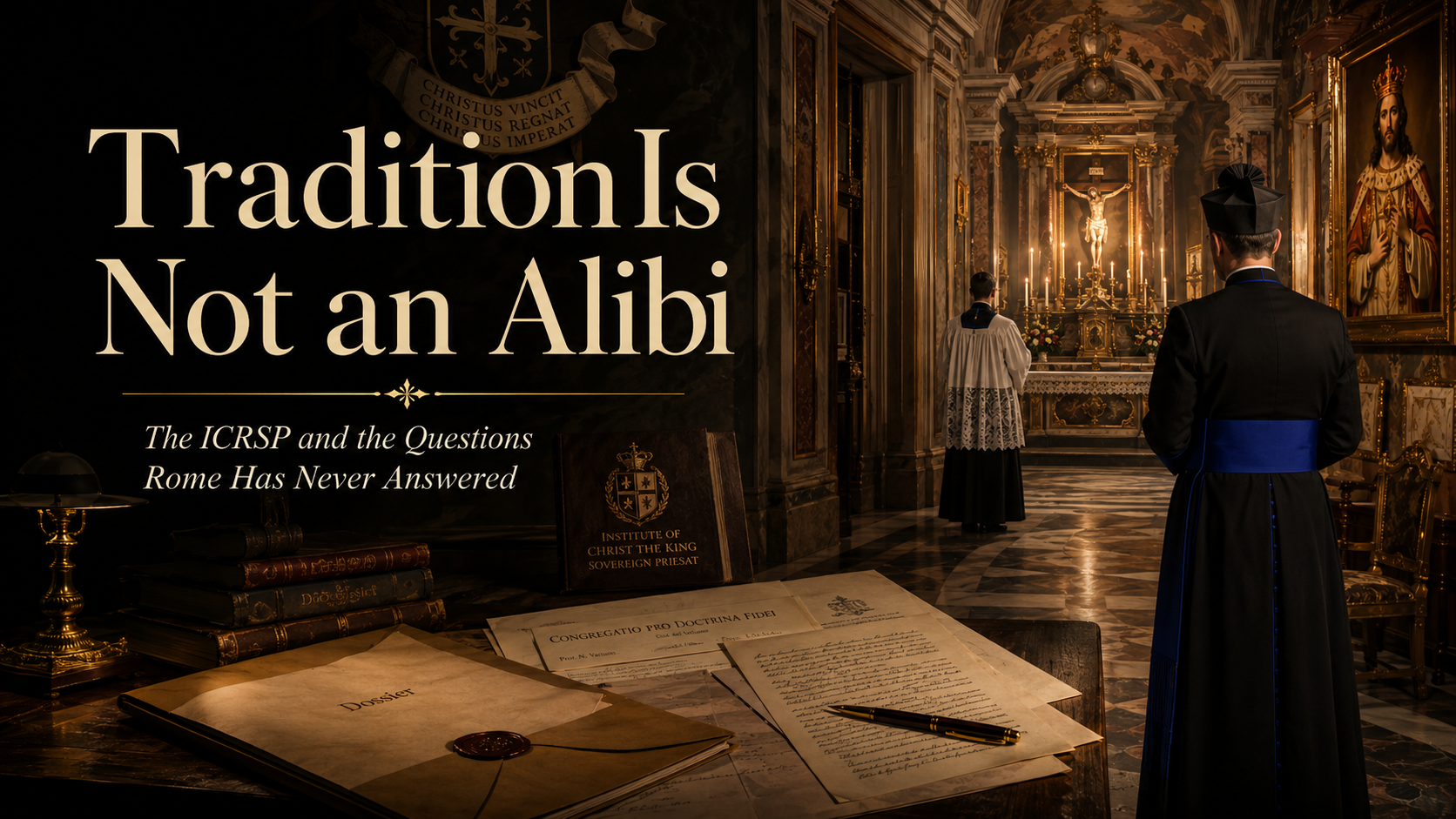
Gilles Wach, the ICRSP and the Questions Rome Has Never Answered
At the end of August 2026, Monsignor Gilles Wach was returned once again to the leadership of the Institute of Christ the King Sovereign Priest. He has headed the Institute since its foundation in 1990. Thirty-six years later, the same man remains at its summit.
Longevity is not evidence of misconduct. Continuity can be an institutional strength, particularly in an age in which Catholic communities are repeatedly destabilised by ideological fashion and administrative interference. Yet the re-election of a founder who has exercised supreme authority for more than three and a half decades cannot be considered in isolation when the allegations now surrounding his Institute concern precisely the exercise and concentration of authority. The question is therefore not whether Gilles Wach has served for too long according to some arbitrary modern expectation of management turnover. The question is whether an institution built so extensively around one founder possesses sufficiently independent mechanisms to scrutinise that founder and the culture established under him.
That question has become unavoidable.
The allegations now confronting the Institute of Christ the King Sovereign Priest do not originate from a single disgruntled former seminarian, one hostile newspaper or one anti-traditionalist organisation. They have accumulated over years and now arise from different sources, different countries and different parts of the Institute’s spiritual family. Former seminarians and priests have alleged authoritarian government, humiliation, intrusive control and a distorted conception of obedience. Former members of the Sisters Adorers have separately described intimidation, isolation and psychologically manipulative exercises of religious authority. The French episcopate’s own structures dealing with spiritual abuse have expressed concern. Reports have reached the French state body Miviludes. A confidential episcopal report was prepared in 2014. Rome conducted canonical visitations that same year. And at least one priest ordained for the Institute has a documented record of grave sexual offences against minors.
None of this proves every accusation now made against the Institute. It does something more limited but nevertheless decisive: it establishes that there is a case requiring serious, independent and transparent examination.
Traditional Catholics should be the first to insist upon it.
There is an obvious reason for caution. Much contemporary reporting about traditional Catholic communities is ideologically loaded. Words such as “fundamentalist”, “ultra-conservative”, “sectarian” and “far right” are routinely deployed as though they were descriptions rather than conclusions. Practices which belonged to ordinary Catholic life within living memory can be presented to secular readers as intrinsically sinister. A cassock is not evidence of coercive control. Latin is not a safeguarding problem. Silence, enclosure, asceticism, hierarchy, mortification and obedience are not psychological disorders. A demanding seminary is not thereby an abusive seminary, and religious life would become impossible if every renunciation demanded by a rule were interpreted through the therapeutic categories of contemporary secular individualism.
But the converse must be stated with equal force.
Tradition is not an alibi.
The traditional Roman Mass, doctrinal orthodoxy, beautiful vestments, Gregorian chant and attachment to the civilisation of Catholic Europe cannot become reasons for refusing to investigate credible allegations of abuse. Traditional Catholics rightly object when the contemporary hierarchy treats orthodoxy as suspicious; we cannot therefore treat orthodoxy as proof of innocence. The beauty of a liturgy tells us nothing, by itself, about whether justice is being done in the sacristy, the seminary, the chapter house or the superior’s office.
Indeed, Catholic Tradition provides a more demanding standard of authority than the managerial language of modern safeguarding ever could. Authority is not ownership. A superior does not possess his subjects. Obedience is not servility. Humility is not humiliation. Mortification is ordered to the destruction of vice, not personality. Spiritual direction does not confer sovereignty over another person’s conscience. No superior acquires the right to transform personal preference into the will of God merely because he wears a cassock or holds canonical office.
Saint Thomas places authority under justice. Saint Benedict repeatedly subjects the abbot himself to the judgment of God. Saint Francis de Sales joins firmness to gentleness. And Our Lord gives the governing principle with devastating simplicity: “The kings of the Gentiles lord it over them… But you not so.” Catholic authority is paternal precisely because it is limited by truth, charity, justice and the end for which authority exists—the salvation of souls.
It is against that standard, rather than the prejudices either of secular anti-cult organisations or defensive traditionalist partisans, that the allegations surrounding the ICRSP must be judged.
In September 2023, Le Parisien published a substantial four-part investigation based upon seventeen testimonies gathered over six months, including former seminarians, former priests, serving members and relatives of men within the Institute. The witnesses described what they regarded as an authoritarian culture at Gricigliano: humiliation in formation, intense restrictions upon communication, hostility towards questioning superiors, surveillance of correspondence and an expectation of personal service towards senior clergy. The newspaper also devoted considerable attention to allegations concerning expensive hospitality and the lifestyle surrounding Monsignor Wach.¹
Some of those claims are subjective. Some concern practices capable of innocent explanation. A seminary restricting telephones, social media or unsuitable reading is not in itself evidence of abuse. Nor is ceremonial splendour or formal clerical etiquette intrinsically incompatible with evangelical poverty. This is exactly why indiscriminate denunciation is unhelpful: exaggerating weak accusations makes it easier to evade stronger ones.
The stronger evidence came from within the Church itself.
✠Jean-Luc Brunin, then Bishop of Le Havre and responsible for the French Bishops’ Conference team concerned with emprise and sectarian abuses, told Le Parisien that the Institute represented a “heavy dossier” characterised by “numerous dysfunctions”. He said there were “signs of sectarian abuses” and described reports concerning authoritarianism, the exercise of excessive power over seminarians, expenditure and the denigration of the wider Church. He also stated that testimonies had been transmitted to Rome without the response he believed necessary.²
One may disagree profoundly with ✠Brunin’s ecclesiastical outlook. That does not make his testimony disappear. He was speaking not as a hostile blogger but as the bishop then charged with precisely this area of concern within the French episcopate.
Nor did the allegations end with the male Institute. In March 2026, The Pillar, an American Catholic news publication entirely independent of Le Parisien and the French anti-cult organisations, reported testimonies from former women in formation with the Sisters Adorers of the Royal Heart of Jesus Christ Sovereign Priest. They alleged a culture of intimidation and fear, manipulative spiritual practices and disordered governance. The community’s superior disputed that interpretation, maintaining that the complainants had failed to adapt to religious life and describing their concerns as exaggerations or misunderstandings.³
That response must be recorded. So must the testimony.
The importance lies particularly in the convergence. When materially similar accusations concerning authority, isolation and obedience emerge independently among people formed in different branches of the same spiritual family and in different countries, they cannot responsibly be dismissed merely by attaching the adjective “disgruntled” to those who speak.
There is also at least one matter which has passed decisively beyond the realm of allegation. Timothy E. Svea was ordained in 1992 by the Institute of Christ the King Sovereign Priest. The Diocese of Superior now lists him publicly among abusive clergy, records multiple allegations and states that he was ordained by the ICRSP and is also listed as credibly accused by the Diocese of La Crosse. Svea was convicted in 2002 of offences including second-degree sexual assault of a child under sixteen, exposing himself to minors and false imprisonment. The Institute had suspended him in 2001 after allegations emerged. In 2023, following a separate case involving child sexual-abuse material found on his computer, he was sentenced to a further three years in prison and lifetime supervision.⁴
This fact must be handled justly. The existence of one criminal priest does not prove that an institute is systemically abusive, and the available evidence that the ICRSP suspended Svea after allegations emerged should be stated rather than suppressed. But his case also prevents anyone from pretending that safeguarding questions surrounding men ordained for the Institute belong exclusively to the imagination of anti-traditionalist campaigners.
Then there is the confidential report of 2014.
Sister Chantal-Marie Sorlin, associated with the French Church’s work concerning sectarian abuses, prepared a report in February of that year concerning the ICRSP. Its full contents remain confidential, but subsequent reporting describes concerns including a “cult of the founder”, separation from the outside world, denigration of the wider Church and what was termed the “evangelically incoherent” life of senior figures. A collective formed by alleged victims in 2026 has now invoked that document in accusing the Church of “twelve years of inaction”.⁵
That phrase is rhetorically powerful.
It is also, literally understood, inaccurate.
By 22 April 2014, La Croix was reporting two canonical visitations concerning the Institute, and on 29 April the ICRSP itself publicly acknowledged an ordinary Apostolic Visitation ordered by the Pontifical Commission Ecclesia Dei. ✠François Bacqué, the former Apostolic Nuncio to the Netherlands, had been appointed visitor, with the Dominican Fr Luc-Thomas Somme involved in the visitation concerning the Saint Philip Neri seminary. The Institute presented the process as an ordinary manifestation of the Church’s solicitude for flourishing religious and priestly communities. Two years later, on 29 January 2016, the Holy See definitively approved the Institute’s Constitutions.⁶
Rome therefore did act.
And that makes the unanswered question considerably more serious.
What did Rome know?
The chronology is extraordinary. A confidential French episcopal report raising grave concerns exists in February 2014. Canonical visitations of the Institute and its seminary are taking place by April. We should not claim, without documentary evidence, that the Sorlin report caused those visitations or was even placed before the visitors. That connection has not been publicly established.
But that is exactly what now needs to be established.
Did ✠Bacqué or Fr Somme receive Sister Sorlin’s report? Did they interview the people whose testimonies informed it? Did they examine accusations concerning authority, finances, formation and the treatment of seminarians? Were members able to speak privately without fear of their testimony reaching superiors? What conclusions did the visitors send to Rome? Did they find the allegations unfounded? Did they identify defects? Were reforms recommended? Were they implemented? And if Rome concluded in 2014 that the Institute was healthy, why did senior French ecclesiastical figures continue receiving and forwarding materially similar complaints years afterwards?
These are not accusations disguised as questions. They are questions created by the documentary chronology itself.
And they cannot be answered simply by saying that a visitation occurred.
A visitation which examined the relevant allegations and credibly exonerated the Institute would be important evidence in its favour. A visitation which discovered problems and produced effective reform would likewise materially alter the present story. A visitation which never considered the central complaints would establish something different. A visitation whose recommendations were ignored would establish something different again.
The Catholic public has been told none of this.
That opacity matters particularly now that Monsignor Wach has been returned to office yet again. The Institute’s own published notice concerning his 2020 re-election stated that the General Chapter assembled at Gricigliano under Article 20 of the Constitutions and elected him for another six-year term. Contemporary reporting shows that the present six-year system has operated through successive chapter elections.⁷ Critics now allege that the constitutional structure gives Wach extensive influence over those participating in governance, but the full current constitutional and capitular provisions necessary to establish precisely how the 2026 electoral body was composed are not publicly available. It would therefore be irresponsible to repeat as fact the claim that Wach simply “appoints his own electors”.
But the legitimate question does not depend upon that claim.
No institution remains unaffected when the same founder governs it for thirty-six years. His personality, priorities, habits and judgments inevitably become embedded in its culture. That may produce extraordinary coherence. It may also make correction difficult. Where allegations concern precisely a cult of personality, excessive obedience and concentrated authority, it is reasonable to ask whether the mechanisms designed to examine those allegations possess sufficient independence from the culture they are supposed to judge.
Repeated election demonstrates continuity of support among those entitled to elect.
It does not, by itself, answer that question.
There is another danger here which traditional Catholics must recognise. Decades of persecution, caricature and unjust treatment can produce a siege mentality. Traditional clergy and faithful have seen bishops tolerate doctrinal dissent while suppressing the old Mass; they have watched obvious liturgical abuses excused while traditional seminarians are scrutinised for supposed “rigidity”; they have experienced a hierarchy that can suddenly discover canonical severity when the accused is traditional and remarkable elasticity when the accused is progressive.
That double standard exists.
It cannot become an excuse for a double standard of our own.
If traditional Catholics condemn bishops who protect institutions rather than victims, we cannot defend institutional reputation merely because the institution wears choir dress we admire. If we condemn the transfer of problematic clergy elsewhere in the Church, we cannot become incurious when similar allegations are made against a traditional society. If we demand transparency from dioceses, religious orders and episcopal conferences, we cannot suddenly rediscover the virtues of secrecy when the questions arrive at Gricigliano.
Principles which apply only to our opponents are not principles.
Nor should traditional Catholics fear the truth. If accusations have been fabricated, exaggerated or ideologically manipulated, an independent investigation can demonstrate that. If strict but legitimate Catholic formation has been maliciously relabelled “sectarian”, careful scrutiny can distinguish asceticism from abuse and vindicate the innocent. If Monsignor Wach and his collaborators have been calumniated, transparency serves them better than indefinite suspicion.
But if serious wrongdoing has occurred, beauty cannot absolve it.
That is perhaps the most uncomfortable truth of all. Traditionalists are particularly susceptible to equating the recovery of Catholic forms with the recovery of Catholic substance. We see a sanctuary ordered towards God, hear Gregorian chant, encounter disciplined priests in cassocks and understandably recognise something that the post-conciliar devastation attempted to erase. Yet ecclesiastical aesthetics can no more guarantee sanctity than modern informality can guarantee humility. A community may celebrate the Roman liturgy magnificently and still govern badly. A superior may defend Catholic doctrine and still abuse authority. Orthodoxy protects the intellect from error; it does not abolish concupiscence.
The Catholic ascetical tradition understood this perfectly. It is modernity, not Tradition, which confuses image with reality.
Rome therefore owes more than silence. The Institute of Christ the King Sovereign Priest is a society of apostolic life of pontifical right. Its ultimate ecclesiastical supervision belongs to the Holy See. Rome knew enough in 2014 to conduct canonical visitations. French bishops subsequently continued to communicate concerns. New allegations have now emerged in both the male and female branches of the Institute’s spiritual family. A victims’ collective exists. Questions surrounding sexual abuse, spiritual abuse and governance are being publicly raised.
The answer cannot be another confidential process whose existence is eventually discovered twelve years later.
There should be a genuinely independent canonical examination capable of reviewing the 2014 Sorlin dossier, the reports of the 2014 visitors, subsequent complaints received by the Holy See, safeguarding files, allegations concerning the treatment or relocation of accused clergy, formation practices at Gricigliano and within the Sisters Adorers, and the actual mechanisms by which authority is exercised and corrected. Present and former members must be able to speak confidentially without fear of retaliation. Those accused must be permitted a full defence. Unsupported accusations must be rejected. Substantiated wrongdoing must be confronted.
And, when the work is completed, Rome should publish enough of its conclusions for Catholics to understand what was investigated, what was established, what was rejected and what—if anything—must change.
That is not persecution.
It is justice.
The deepest scandal, if substantial elements of these allegations prove true, would not be that sinners were found among traditional Catholics. The Church has never promised otherwise. It would be that men and women drawn towards traditional Catholicism because they desired reverence, sacrifice, doctrinal clarity and holiness may instead have encountered a distortion of those very virtues: obedience transformed into submission to personality, humility transformed into humiliation, mortification transformed into psychological domination, loyalty to the Church transformed into loyalty to an institution.
And if the allegations prove false, then those who have been accused deserve the vindication which only a credible examination can provide.
Either way, secrecy no longer serves the truth.
The Institute itself has long used the words Veritatem facientes in caritate: “doing the truth in charity”. They are taken from Saint Paul and constitute an admirable programme for Catholic life.
They now offer the Institute, its critics and Rome the only defensible way forward.
“For there is nothing hid, which shall not be made manifest: neither was it made secret, but that it may come abroad.”
Truth is not the enemy of Tradition.
Falsehood is. Concealment is. Calumny is. Abuse is.
Let the truth be done in charity.
But let it be done.
¹ Vincent Mongaillard, four-part investigation into the Institute of Christ the King Sovereign Priest, Le Parisien, 29–30 September 2023; the accompanying Code Source account states that seventeen testimonies were obtained from former seminarians, former priests, serving members and relatives.
² Vincent Mongaillard, “‘Il y a des signes de dérives sectaires’ à l’Institut du Christ Roi : l’alerte de Mgr Brunin, évêque du Havre,” Le Parisien, 30 September 2023; Brunin’s concerns and the transmission of testimony to Rome are also described in the newspaper’s Code Source investigation.
³ The Pillar, “‘You just feel so defeated’ — Women await Vatican to investigate religious community,” 12 March 2026, reporting allegations by former postulants of the Sisters Adorers and the response of the community’s superior.
⁴ Diocese of Superior, “Abusive Clergy List,” entry for Timothy Svea ICKSP; Shereen Siewert, reports on Svea’s criminal history and 2023 sentencing, Wausau Pilot & Review, March 2023.
⁵ Après la CIASE, “Institut du Christ Roi Souverain Prêtre : un rapport sur des dérives sectaires présumées resté sans suite depuis 2014,” July 2026; see also subsequent reporting on the victims’ collective and the Institute’s response.
⁶ Céline Hoyeau, “Deux visites canoniques à l’Institut du Christ-Roi,” La Croix, 22 April 2014; ICRSP communication reproduced by Riposte Catholique, “Visite canonique ordinaire aussi pour l’ICRSP,” 29 April 2014; the Institute’s Constitutions were definitively approved by the Holy See on 29 January 2016.
⁷ “Réélection de Mgr Wach Supérieur de l’Institut du Christ Roi,” Riposte Catholique, 24 August 2020, reporting that the General Chapter assembled under Article 20 of the Constitutions and elected Wach for six years; reporting before the 2025 Chapter noted that the next election was due in summer 2026.


Leave a Reply