
When Elections Become Optional: Britain’s Quiet Constitutional Crossing
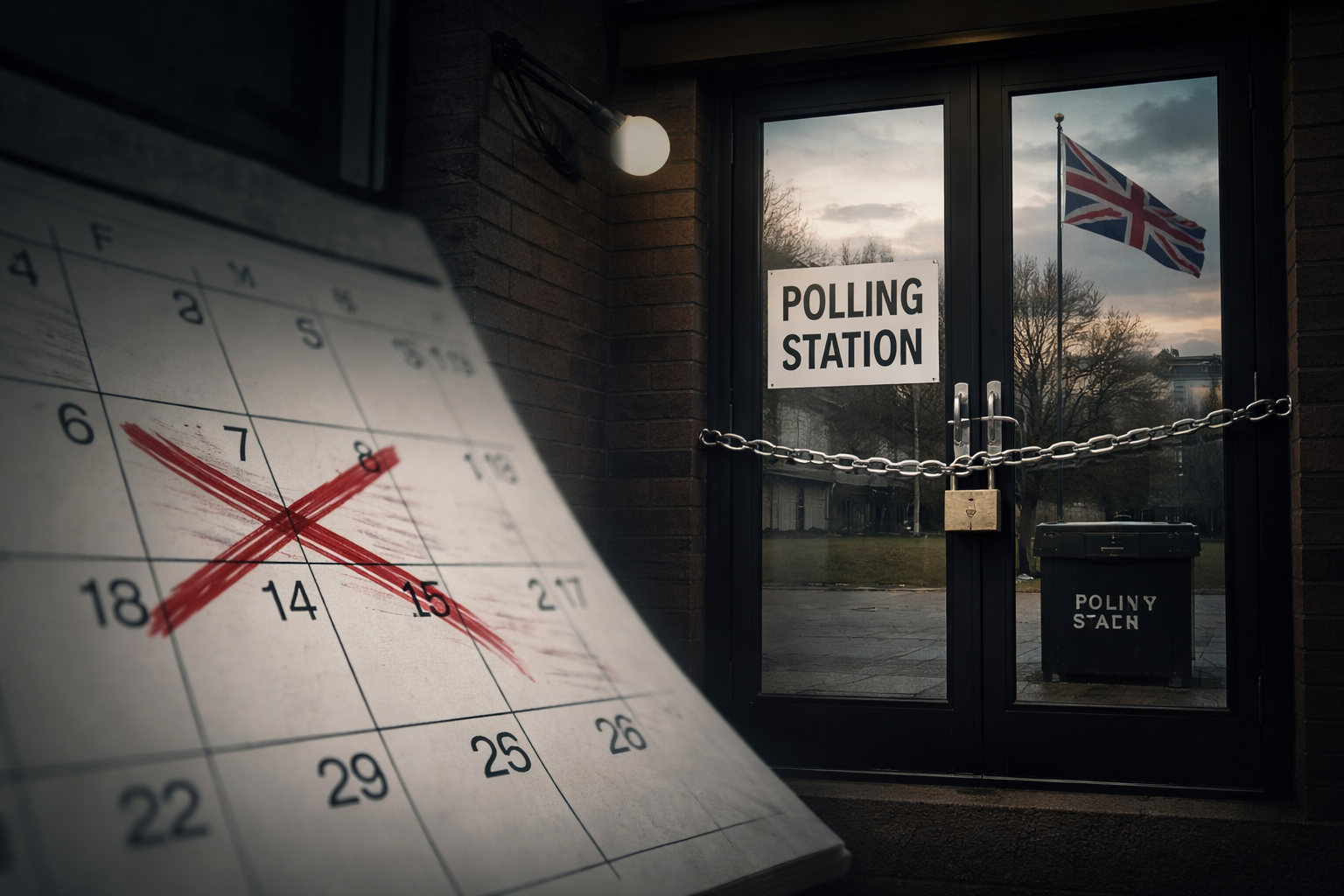
There is a line in any democracy which, once crossed, alters the nature of the system itself. It is the moment when elections cease to be a fixed obligation and become a variable—something negotiable, deferrable, or contingent. Britain has now reached that point, and what makes this moment especially grave is that the warning has not come from partisan opponents but from the state’s own elections watchdog, the Electoral Commission.
The Commission has been unambiguous. It has stated that the government’s justification for delaying local elections is not legitimate. This was not framed as a marginal judgement call or an administrative quibble. It was a finding about principle. Extending elected mandates without renewed consent, the watchdog warned, damages public confidence, undermines local democratic legitimacy, and creates an inherent conflict of interest by allowing councils to influence when they are next accountable to voters.¹ In any healthy democratic culture, such an intervention would be decisive. Here, it has been ignored.
The scale of what is proposed matters. Government plans would permit the postponement of elections in up to 63 council areas scheduled to vote in May 2026, pushing contests back to 2027 under the justification of local government reorganisation.² In parallel, four inaugural mayoral elections—including those for Sussex and Brighton, Greater Essex, Norfolk and Suffolk, and Hampshire and the Solent—have already been postponed until May 2028.³ This is not a marginal adjustment affecting a handful of authorities. It represents a substantial suspension of democratic participation affecting millions of voters across multiple layers of local governance.
The democratic deficit surrounding the postponed mayoral elections extends beyond scheduling. In some of the authorities now being considered for further deferral, scheduled council elections had already been deferred from 2025 amid wider local government reorganisation.¹¹ These changes entailed substantial alteration to local governance arrangements and electoral cycles. Yet they were not preceded by any binding local referendum, nor by any formal mechanism through which voters could approve or reject the restructuring of their local democratic institutions.
Instead, the public engagement that did occur has been criticised as limited, with contemporaneous reporting and some council records indicating that consultation was largely informational rather than deliberative.¹² Contemporary reporting and council records record concerns that options were, in some cases, presented as effectively settled rather than as proposals subject to public consent. The effect was not participatory decision-making but notification of outcomes already determined.
This sequence is constitutionally significant. While referendums are not legally required for every administrative adjustment, the alteration of electoral arrangements—particularly where it involves the creation of new executive offices, the suspension of scheduled elections, and the extension of existing mandates—raises questions of democratic legitimacy. Here, elections were first postponed to accommodate structural reform; mayoral elections were then delayed; and councils continued to govern without renewed electoral mandates. At no stage were voters invited to give or withhold consent to the reforms that necessitated these suspensions.
The cumulative effect is not a single exceptional deviation but a pattern: electoral opportunities deferred in order to implement institutional change, followed by further deferral justified by the disruption caused by that change. This materially weakens the claim that the delays are either benign or consensual. Consultation was substituted for consent, and democratic endorsement was assumed rather than obtained.
That decision marks a shift of category. What began as an administrative proposal has become a constitutional problem. Once an independent authority charged with protecting electoral integrity is overruled without correction or restraint, the issue ceases to be reform and becomes the protection of power.
The language used by ministers to justify the delays is revealing. Elections are framed as logistical inconveniences. Voters are treated as an operational burden. Democratic participation is reduced to a cost-management exercise—something to be postponed if reorganisation plans are mid-flow or “capacity” is stretched. Ministers insist that no election will be delayed without “local agreement,” presenting the policy as a locally led solution to administrative strain.⁴ But in a democracy, administration exists to serve elections. Elections do not exist to suit administration.
This inversion has prompted warnings from constitutional lawyers approaching the problem from complementary but distinct directions. Barrister Nicholas Freeman, widely known for his public analysis of constitutional and electoral procedure, has focused on how executive vulnerability drives defensive manoeuvre. He has argued that local elections function as early legitimacy signals, and that widespread local losses amount to a form of “death by a thousand cuts” for a governing party—publicly signalling likely collapse at the next general election.⁵ From this perspective, delaying elections is not neutral administration but political damage control: an attempt to suppress visible repudiation and buy time when authority is weakening.
Freeman’s analysis exposes a critical structural danger. Formal legality can be used to evade substantive democratic accountability. Electoral timetables, leadership rules, and procedural discretion may all remain technically lawful while being deployed to delay judgement by the electorate. Democracy, on this view, is not abolished outright but hollowed out through respectable process.
A different but equally serious warning comes from Steven Barrett, a constitutional specialist whose focus is not executive strategy but constitutional legitimacy itself. Barrett has emphasised that democratic systems do not fail only when governments overreach, but when citizens are conditioned to accept the erosion of non-negotiable norms. His central concern is acquiescence. Once election delays are normalised—once voters are persuaded that postponement is sensible, technical, or unworthy of concern—the principle of electoral obligation begins to dissolve.⁶
Barrett is particularly critical of the rhetorical strategy used to neutralise opposition: the dismissal of concern as conspiratorial or unserious. Such language, he argues, infantilises the electorate and obscures a foundational truth: the people are not an audience to democracy but its source. “We are the demos of a democracy,” he insists. Objection, protest, and scrutiny are not threats to constitutional order but expressions of it.⁷ When citizens are encouraged to stand down rather than push back, constitutional safeguards migrate from institutions to habit—and are quietly lost.
Together, Freeman and Barrett illuminate two sides of the same constitutional failure. Freeman describes how embattled executives exploit procedural flexibility to delay accountability. Barrett explains how such exploitation succeeds only when the public is persuaded to tolerate it. One diagnoses elite behaviour; the other diagnoses civic erosion. Both converge on the same conclusion: elections are being reclassified from obligations into risks to be managed.
The conflict of interest identified by the Electoral Commission lies at the heart of this convergence. Councils are being asked whether they would like to delay the moment at which they must face the electorate. This is presented as a “locally led approach,” but in constitutional terms it is self-dealing. No serious democratic system permits office-holders to influence the timing of their own accountability.¹
The damage is compounded by uncertainty. Candidates have been selected. Campaigns have begun. Money has been raised and spent. Yet with only a matter of months remaining before some scheduled polling dates, the government continues to leave open the possibility of cancellation. The Electoral Commission has described this level of uncertainty as unprecedented, noting that elections should, as a rule, go ahead as planned and that capacity constraints do not constitute a legitimate reason for late disruption.¹ That word—unprecedented—matters. Democracies rely not only on voting itself but on predictability: on the shared understanding that elections will occur as scheduled.
When challenged, ministers have retreated not into reassurance but into dismissal. Chris Bryant has waved away concerns as conspiratorial and suggested that “ordinary people” would think elections are “a bit daft.”⁸ This rhetorical manoeuvre is familiar in declining democracies: claim to speak for the public while denying them a voice. Democratic rights are reframed as abstract irritations raised only by obsessives. Participation is tolerated only when it aligns with political convenience.
To be clear, election delays connected to local government reorganisation are not entirely without precedent in Britain. Previous governments have postponed elections in limited circumstances where councils were being abolished or replaced by new unitary authorities.⁹ But the current situation differs in three critical respects: the scale of postponement, the repetition of delays across multiple cycles, and the timing of decisions taken months before scheduled polling. It is this cumulative pattern that has alarmed election administrators and constitutional observers alike.
None of this is happening in isolation. Mayoral elections have already been postponed. Now council elections are being pushed back again. Opposition parties across the spectrum—including Conservatives, Liberal Democrats, and Reform UK—have accused the government of undermining democratic norms and avoiding electoral accountability at a moment of political vulnerability.¹⁰ Public commentary, legal analysis, and institutional warnings converge on the same concern: democracy is being treated as conditional.
Both Freeman and Barrett warn that the deepest danger lies in precedent. Constitutional breakdowns are rarely announced. They are rehearsed. They emerge through smaller acts that condition both rulers and ruled to accept what would once have been unthinkable. If elections can be postponed after campaigns have begun, after candidates are in place, and after the watchdog has formally objected, then the principle of fixed electoral obligation is quietly abandoned. Voting becomes conditional. Democratic consent becomes something dispensed at the discretion of those already in power.
That is the threshold Britain is now approaching. The question is no longer whether delaying these particular elections is administratively convenient. It is whether the country is prepared to accept a political culture in which elections are negotiable, provisional, and subordinate to institutional comfort. Once that line is crossed, restoring trust is far harder than losing it—and the consequences will extend far beyond any single electoral cycle.
- Electoral Commission, Response to potential local election postponements, December 2025.
- Financial Times, “Electoral Commission says delaying local elections is not legitimate,” December 2025.
- Institute for Government, Government decision to delay inaugural mayoral elections, 2025.
- UK Government ministerial statements on local government reorganisation, December 2025.
- Nicholas Freeman, BlackBeltBarrister YouTube channel, video “Beginning of the END of This Labour Government?”, aired 13 November 2025.
- Steven Barrett, Steven Barrett Barrister YouTube channel, video “Can they cancel Elections?”, aired 13 December 2025.
- Steven Barrett, remarks on civic responsibility and constitutional legitimacy, Steven Barrett Barrister, “Can they cancel Elections?”, 13 December 2025.
- Chris Bryant MP, media remarks on election delays, December 2025.
- Local Government Information Unit (LGIU), Why were some council elections postponed?, 2021–2025.
- Parliamentary and media reporting on opposition responses to election delays, December 2025.
- Institute for Government, Explainer: postponed council elections and mayoral devolution, 2024–2025.
- Local authority consultation records and contemporaneous reporting on public meetings in affected combined authority areas, 2024–2025.
RELATED ARTICLES


Latest ARTICLES
- Today’s homily: St Pius X, PopeThe text reflects on the life and legacy of Pope St Pius X, who was chosen from humble beginnings to reform the Church. His pontificate focused on defending the Catholic Faith, restoring liturgical sanctity, and fostering deeper connections between believers and Christ. Pius X exemplified a balance of truth and pastoral charity.
- Today’s Mass: September 03 Pope St Pius X,Pope St Pius X, born Giuseppe Melchiorre Sarto, was a significant reformer who emphasised preserving the Catholic Faith against Modernism. His pontificate (1903-1914) featured reforms in liturgy, frequent Holy Communion, and seminaries, rooted in a pastoral desire to restore everything in Christ. He died in 1914 and was canonised in 1954.
- Today’s homily: St Stephen of HungaryThe homily reflects on the life of Saint Stephen of Hungary, illustrating his transition from a powerful ruler to a saint. He embraced the responsibilities of kingship guided by faith, understanding his authority as stewardship. His legacy teaches that true governance comes with surrender to God, ultimately placing his kingdom under the protection of the Blessed Virgin Mary.
- Today’s Mass: September 02 St. Stephen the GreatSt. Stephen the Great, King of Hungary (977-1038), was a significant Christian ruler who reinforced the faith throughout Hungary. Anointed king in 1000 by Pope Sylvester II, he fought against paganism and promoted the Church. He was canonised in 1083 and is the patron saint of Hungary, symbolising national identity.
- QUAERITE PRIMUM REGNUM DEI – Seek First the Kingdom: Spiritual Conference for Nuntiatoria CXXIA spiritual conference, “Seek First the Kingdom,” emphasises prioritising God’s reign within individuals over earthly concerns. It explores the necessity of internalising Christ’s teachings, the importance of discernment, and the critical evaluation of the faith in relation to contemporary issues. A genuine Catholic life centres on Christ, fostering holiness and transformation.



Leave a Reply