
God, Power, and the Public Square: Christianity’s Uneasy Return to British Politics
Faith, populism, and the limits of instrumental religion
The claim that “God is back” in British politics has gained renewed traction following the launch of a Christian fellowship within Reform UK and the increasingly explicit use of Christian language by populist actors. After decades in which political elites treated faith as an embarrassment—or at best as a private eccentricity—Christian references are once again being spoken aloud in public life. Commentators have been quick to frame this as a decisive cultural shift, even as evidence of civilisational decline continues to mount.
Yet visibility must not be mistaken for renewal. What is re-emerging in political discourse is not necessarily the faith of the Church in its fullness, but a contested and often instrumentalised version of Christianity—invoked as heritage, identity, or moral shorthand rather than as a demanding and transformative truth. The question is not whether Christian language can be made politically useful, but whether politics is willing to be judged, corrected, and restrained by the faith it now seeks to invoke.
This editorial therefore offers a necessary corrective. Christianity’s reappearance in political rhetoric may be real, but its meaning is far from settled. The decisive issue is not whether God is mentioned, but how He is used—and whether His kingship is acknowledged as public, binding, and ultimately non-negotiable.
Reform UK and the Retrieval of Cultural Christianity
The establishment of a Reform Christian Fellowship represents a deliberate recalibration on the political Right. For a generation, British politics followed the Blairite axiom that “we don’t do God.” Religious conviction was treated as a liability in public office, unsuitable for serious governance and best confined to private conscience. Reform’s wager is that this settlement has collapsed. In an atmosphere of cultural disintegration, moral relativism, demographic change, and institutional distrust, Christianity is being tested as a unifying grammar for arguments about borders, sovereignty, free speech, and national identity.
There is nothing entirely novel in this instinct. British conservatism historically presupposed Christian moral capital even when it avoided explicit theological claims. The legal, educational, and constitutional inheritance of the nation assumed a moral order shaped by Christianity, even when belief itself had thinned. What is new is the overt retrieval of Christian symbolism and language as an explicit political asset—an attempt to re-anchor national coherence in religious reference.
The danger lies precisely here. Christianity can easily be reduced to a civilisational badge—useful for cohesion, boundary-drawing, and mobilisation—while being emptied of its sacramental, penitential, and doctrinal substance. When faith is treated primarily as a cultural adhesive, it ceases to be a truth that judges power and instead becomes an ornament of power.
This risk is compounded by the contemporary habit of speaking vaguely of “Christian values” or “Judeo-Christian civilisation.” As Nuntiatoria has argued elsewhere, such language often functions as a polite substitute for the scandal of Christian particularity. Christianity is not a fusion of ethical inheritances nor a neutral moral code detachable from doctrine; it is the fulfilment of the Old Covenant in the Incarnate Word. When the faith is reduced to atmosphere rather than authority, it is already being domesticated.⁵
The American Template and Its Risks
Much of the present moment is shaped, implicitly, by American political theology. The fusion of national destiny, moral struggle, and Christian symbolism in U.S. conservative movements has emboldened British actors to attempt a similar synthesis. Politics is increasingly framed as an existential conflict between good and evil, order and chaos, faith and nihilism.
Such language is emotionally powerful, but theologically hazardous. It risks confusing providence with partisanship and redemption with victory. As the Archbishop of Selsey has warned, “a Church shaped by the categories of late modernity cannot credibly oppose the consequences of late modernity.” He continued by observing that *“a Church that attempts to heal the world by sharing its assumptions forfeits its capacity to act as a genuine counter-culture.”*¹⁰ When the Cross is pressed into service as a political emblem, it ceases to be a sign of self-sacrifice and becomes a banner of tribal allegiance. The Gospel is not advanced by being made respectable, fashionable, or strategically advantageous.
Christianity does not exist to sanctify a movement. It exists to convert souls, judge nations, and call rulers themselves to repentance.
The ‘Put Christ Back into Christmas’ Controversy Reconsidered
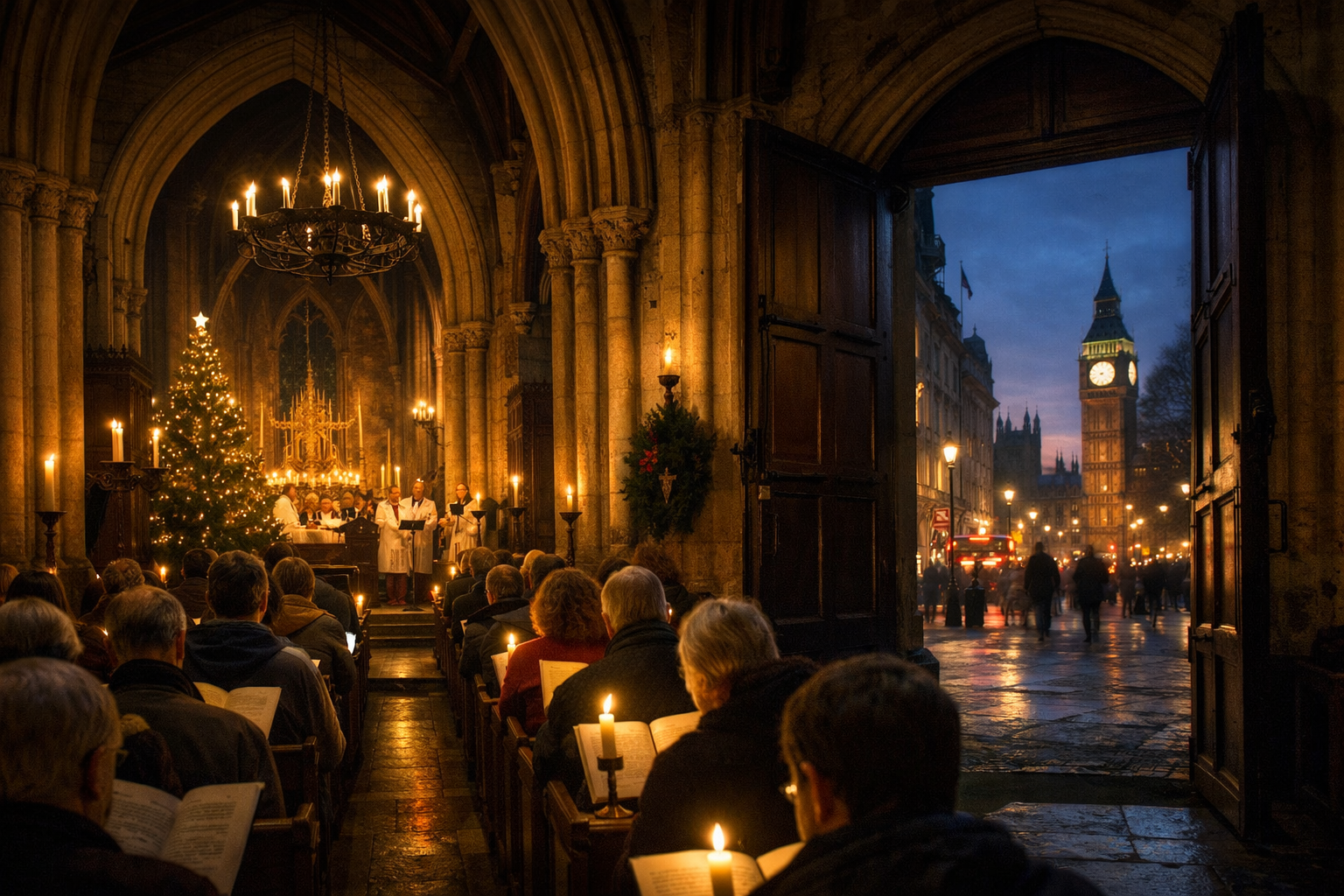
The controversy surrounding the “Put Christ Back into Christmas” demonstrations associated with Tommy Robinson revealed far less about the dangers of public Christianity than it did about the Church’s own discomfort with its visible assertion. While media coverage hastily framed the episode as an instance of religious “instrumentalisation,” Nuntiatoria’s analysis identified the real rupture elsewhere: in the speed and severity with which senior churchmen moved to discipline public Christian language, while remaining conspicuously silent about the far more pervasive ideological capture of the public square.¹ ²
Most striking was the intervention led by the Bishop of Kirkstall, who launched a poster campaign and issued public statements warning against the “capture of Christian language and symbols by populist forces.” The campaign presented the public naming of Christ as something inherently suspect—requiring rebuttal and correction—while offering no comparable critique of the routine capture of public institutions by secular ideologies. Only when Christ was named explicitly did episcopal anxiety suddenly materialise.
As Nuntiatoria observed at the time, this asymmetry is theologically revealing. The problem was not that Christianity was being politicised, but that it was being made visible. The charge of “instrumentalisation” was deployed selectively—not as a principled safeguard of the Gospel, but as a disciplinary mechanism aimed at restoring Christianity to a safer, quieter, and culturally subordinate role.
This posture stands in stark contradiction to the Church’s own magisterial teaching. In Quas Primas, Pope Pius XI insisted that Christ’s kingship is not confined to private devotion but extends publicly and socially: “It would be a grave error… to say that Christ has no authority whatever in civil affairs.” Rather than defending Christ’s public honour, senior clergy acted to contain His visibility—an inversion of the Church’s historic witness.
The Public Square and the Question of Free Speech
If Christianity is genuinely returning to public life, its first test will not be aesthetic symbolism or heritage rhetoric, but moral courage where law and intimidation narrow speech. Recent appeals under public-order legislation have affirmed that lawful expression does not lose protection simply because it offends or shocks. Yet these affirmations coexist with a widening use of “harassment,” “public alarm,” and safeguarding frameworks to chill lawful speech outside the courtroom.
Universities have become a parallel front. Despite statutory duties to protect lawful speech, speakers expressing mainstream religious or anthropological views have faced venue cancellations, procedural obstruction, and reputational smearing. Institutions dedicated to inquiry increasingly treat theological dissent as a safeguarding risk rather than a legitimate contribution to public discourse. In such a climate, Christianity is tolerated only when sentimental, abstract, or silent.⁸
Selective Scrutiny: Christianity Policed, Islam Accommodated
The asymmetry governing public reactions to Christianity becomes unmistakable when set against the routine accommodation of Islamic sectarian influence in British politics. While explicit Christian language is scrutinised for “instrumentalisation” or threats to neutrality, overt bloc mobilisation and confessional pressure—often justified in the language of cohesion and “community sensitivities”—rarely attracts comparable concern.
Nuntiatoria has documented how this dynamic operates through institutions. In the controversy surrounding the “Maccabi ban,” the issue was not merely administrative failure but the deeper pattern of sectarian agitation shaping public decision-making. Political actors amplified allegations as moral claims even as official accounts diverged, while institutions retreated from equal civic treatment in the face of organised pressure.²⁰
This pattern also appears in the management of public order itself. Rather than enforcing equal access and consistent standards, public bodies increasingly respond to anticipated sectarian mobilisation by restricting the party likely to attract agitation. Nuntiatoria’s analysis of the quiet return of institutional antisemitism traced this reflex with clarity: neutrality is redefined as appeasement, and civic equality yields to fear of unrest.²¹
The same asymmetry governs the policing of religious expression. Although Islamic teaching unequivocally condemns abortion, Muslim street prayer and public demonstrations—sometimes involving vocal prayer or temporary traffic disruption—are generally treated as legitimate manifestations of religion. By contrast, Christians have been questioned, fined, or arrested for silent prayer near abortion facilities, even when acting alone without engagement, signage, or disturbance.²² The law is not applied neutrally but selectively.
As Nuntiatoria has argued in its treatment of Islamophobia-definition debates, modern definitional regimes can function as quasi-blasphemy instruments, chilling lawful scrutiny and encouraging institutions to manage risk through deference rather than equal standards.²³ What emerges is not principled pluralism but selective secularism.
Decline, Anxiety, and the Illusion of Revival
Polling data frequently cited in support of “political Christianity” reveals something more complex than revival. Surveys show that many voters—particularly on the political Right—believe Britain is becoming less Christian and regard this as a cultural loss, often attributing it to immigration. Yet the same data reveal low levels of belief, sacramental practice, and moral adherence among those expressing such concerns. Anxiety about decline is repeatedly mistaken for faith.¹¹ ¹² ¹³
At the same time, modest growth in church attendance—especially among younger adults—appears largely independent of party politics. Where growth occurs, it is concentrated in Catholic and evangelical congregations and driven by conviction and moral clarity rather than mobilisation. Many new churchgoers are from migrant or second-generation backgrounds, often morally conservative yet wary of political projects perceived as exclusionary. Any attempt to harness Christianity politically while ignoring this ecclesial reality risks misreading the Church as it actually exists and fracturing rather than consolidating Christian witness.¹⁴ ¹⁵ ¹⁶
Christianity Is Not a Policy Tool
A political movement that invokes Christianity must be judged by Christianity’s own measure: its defence of the least powerful. The question is not whether Scripture can be quoted, but whether children and the vulnerable are protected. As Nuntiatoria has repeatedly observed, the modern scandal is not that suffering is hidden, but that it is tolerated—eclipsed by fashionable causes and rationalised by fear of accusation.⁴
Conclusion
Christian language is returning to British politics, but the recovery of vocabulary must not be confused with the recovery of truth. Words alone do not constitute repentance, nor does cultural nostalgia amount to conversion. A civilisation may remember the name of Christ while continuing to reject His authority; it may invoke Christian imagery while refusing Christian judgment. The present moment tempts precisely this illusion.
At root, this confusion is the long-term fruit of Protestantisation: the steady erosion of sacramental authority, doctrinal clarity, and ecclesial confidence in favour of accommodation, mediation, and managerial religion. Nuntiatoria’s analysis of the collapse of the Anglican via media—the attempt to be simultaneously “Reformed and Catholic”—illustrates the trajectory with painful clarity. What began as a claim to balance has ended in incoherence; what claimed continuity has dissolved into contradiction. A Church that cannot speak with authority to herself cannot speak with authority to the nation.²⁴
The same illusion underwrites contemporary calls for “restoration” without conversion. As Nuntiatoria has argued, Christianity without Christ—faith reduced to memory, custom, or moral ambience—produces a Church without authority, capable only of adapting itself ever more closely to the categories of late modernity.²⁵ Accommodation is baptised as accompaniment; silence is mistaken for pastoral sensitivity.
These concerns are sharpened by criticisms already voiced in response to the appointment of Richard Moth as Archbishop of Westminster. Observers have noted that his public record suggests continuity rather than correction: a pastoral approach marked by adaptation to prevailing cultural assumptions rather than a willingness to confront them. The fear is not personal inadequacy but ecclesial trajectory—that the Catholic Church in England and Wales, instead of recovering a clear counter-witness to the contemporary zeitgeist, will continue to translate the Gospel into the language of the age until little remains that can resist it.
The Church has faced this temptation before. In Immortale Dei, Pope Leo XIII taught that civil authority is not morally autonomous, but bound to divine law and accountable to a higher sovereignty. Politics does not generate its own moral legitimacy; it receives it. Later, in Quas Primas, Pope Pius XI made explicit what modern states have laboured to deny: that Christ’s kingship is not confined to private devotion or interior sentiment, but extends over societies, laws, institutions, and public life itself. To restrict Christ to the realm of personal meaning while excluding Him from public authority is not neutrality but rebellion.
This is why the current unease surrounding public Christianity cannot be resolved by tactical alliances or symbolic gestures. A Christianity that is welcomed only when it is useful, quiet, or safely abstract is not being restored but managed. A Church that accepts such terms may gain temporary access to influence, but it forfeits its prophetic office. The price of respectability is silence where speech is required and compromise where witness is demanded.
The deeper crisis, therefore, is not whether Christianity may appear in politics, but whether politics—and the Church herself—will submit to Christianity’s claims. Christ does not offer Himself as a civilisational ornament, a cultural adhesive, or a rhetorical weapon. He offers Himself as King: a King who judges nations as well as souls, who overturns false pieties, and who exposes the moral evasions of both rulers and priests.
Selective secularism reveals the cost of refusing this truth. When Christianity is policed for visibility while other religious or ideological pressures are accommodated out of fear, convenience, or political calculation, the result is neither pluralism nor peace, but incoherence and injustice. Law becomes managerial, authority becomes reactive, and liberty becomes conditional. A society that will not acknowledge Christ’s sovereignty will inevitably submit to lesser powers.
For the Church, the choice is unavoidable. She may continue to apologise for her presence in the public square, disciplining her own faithful while courting approval from a culture that despises her claims. Or she may recover the confidence of her own teaching: that Christ reigns, that truth binds consciences, and that no sphere of human life lies outside His dominion.
Only the latter path offers renewal. Not a Christianity of grievance or nostalgia, but a Christianity of conviction. Not a faith conscripted into politics, but a faith that judges politics. Only such Christianity—unafraid to be named, unashamed to be resisted—has ever renewed a civilisation.
¹ Nuntiatoria, Put Christ Back into Christmas: When Proclaiming Christ Becomes Extremism, 8 December 2025.
² Nuntiatoria, The Christmas carol service that was not a culture war: a peaceful celebration that confirms a wrong turn by mainstream religious leaders, 16 December 2025.
³ Nuntiatoria, The Cross in the Public Square: Christian patriotism at the Unite the Kingdom march, 24 September 2025.
⁴ Nuntiatoria, The Forgotten Innocents: The Global Plight of Children and the Call to Catholic Witness, 27 July 2025.
⁵ Nuntiatoria, The Problem with “Judeo-Christian”: Fulfilment, Not Fusion, 27 July 2025.
⁶ Archbishop of Selsey, Tradition or Accommodation: Why the Church Cannot Heal the World While Sharing Its Assumptions, address to the New Culture Forum, London, 20 December 2025.
⁷ Pope Leo XIII, Immortale Dei, Encyclical on the Christian Constitution of States, 1 November 1885.
⁸ Nuntiatoria, No Special Treatment: How Nick Timothy’s Free Speech Bill Challenges Britain’s New Blasphemy Laws, 24 July 2025.
⁹ Nuntiatoria, The Apathy of Apostasy: False Compassion and the Collapse of Faith, 27 July 2025.
¹⁰ Archbishop of Selsey, ibid.
¹¹ British Social Attitudes Survey, Religion Module, NatCen Social Research.
¹² YouGov polling on religion and national identity, United Kingdom, 2023–2025.
¹³ Office for National Statistics, Census 2021: Religion, England and Wales.
¹⁴ Bible Society, The Quiet Revival, United Kingdom report, 2024–2025.
¹⁵ Theos Think Tank, Religion and Belonging in Modern Britain.
¹⁶ Pew Research Center, Religion in Western Europe.
²⁰ Nuntiatoria, Police Fabrication and the New Double Standard: The Maccabi Ban, Sectarian Politics, and the Moral Collapse of British Institutions, 23 November 2025.
²¹ Nuntiatoria, Institutional Antisemitism: The Quiet Return of a Familiar Prejudice, 17 October 2025.
²² Nuntiatoria, The criminalisation of compassion: silent prayer, free speech, and the new UK abortion buffer zones, 2023–2025.
²³ Nuntiatoria, Labour tears up Islamophobia definition, 20 October 2025.
²⁴ Nuntiatoria, The Failure of the Via Media: How the “Reformed but Catholic” Motif Collapsed in Anglicanism, 7 November 2025.
²⁵ Nuntiatoria, The Illusion of Restoration: Christianity Without Christ, the Church Without Authority, 19 July 2025.
RELATED ARTICLES


LATEST ARTICLES
- 06.09.26 Nuntiatoria CXXII: NOMEN MANET, RES DEESTThis edition of Nuntiatoria explores the disconnect between the names of Catholic institutions and the realities they signify. Despite retaining their titles, many aspects of Catholicism—such as episcopal authority in China and religious practice in Poland—exhibit deteriorating substance. The piece cautions against superficial continuity, stressing the importance of genuine faith and practice over mere nomenclature.
- ORDO w/c 06.09.26The document outlines the liturgical schedule for the week of 6 to 13 September 2026, highlighting significant religious observances such as the Fifteenth Sunday after Pentecost and the Nativity of the Blessed Virgin Mary. It reflects on themes of compassion, holiness, fidelity, and humility, underscoring their importance in Christian life.
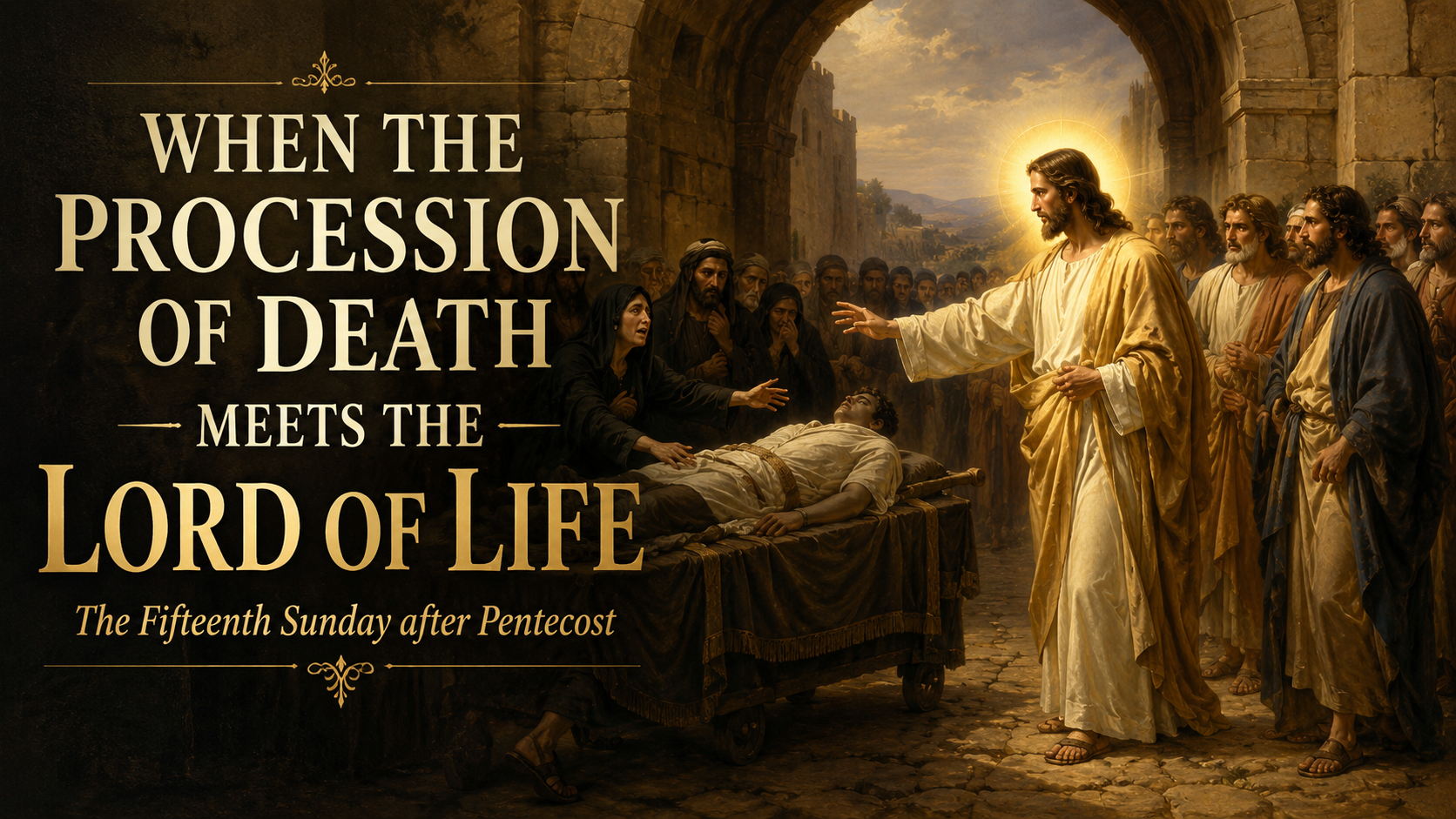
- The Fifteenth Sunday after Pentecost: When the Procession of Death Meets the Lord of LifeThe Fifteenth Sunday after Pentecost focuses on the transformative power of Christ, emphasising the supernatural life granted through grace. The liturgy highlights the Church’s role as a nurturing mother, mourning the spiritually dead while seeking their restoration. Christ’s compassion leads to resurrection, demonstrating that true life is found in dependence on Him.
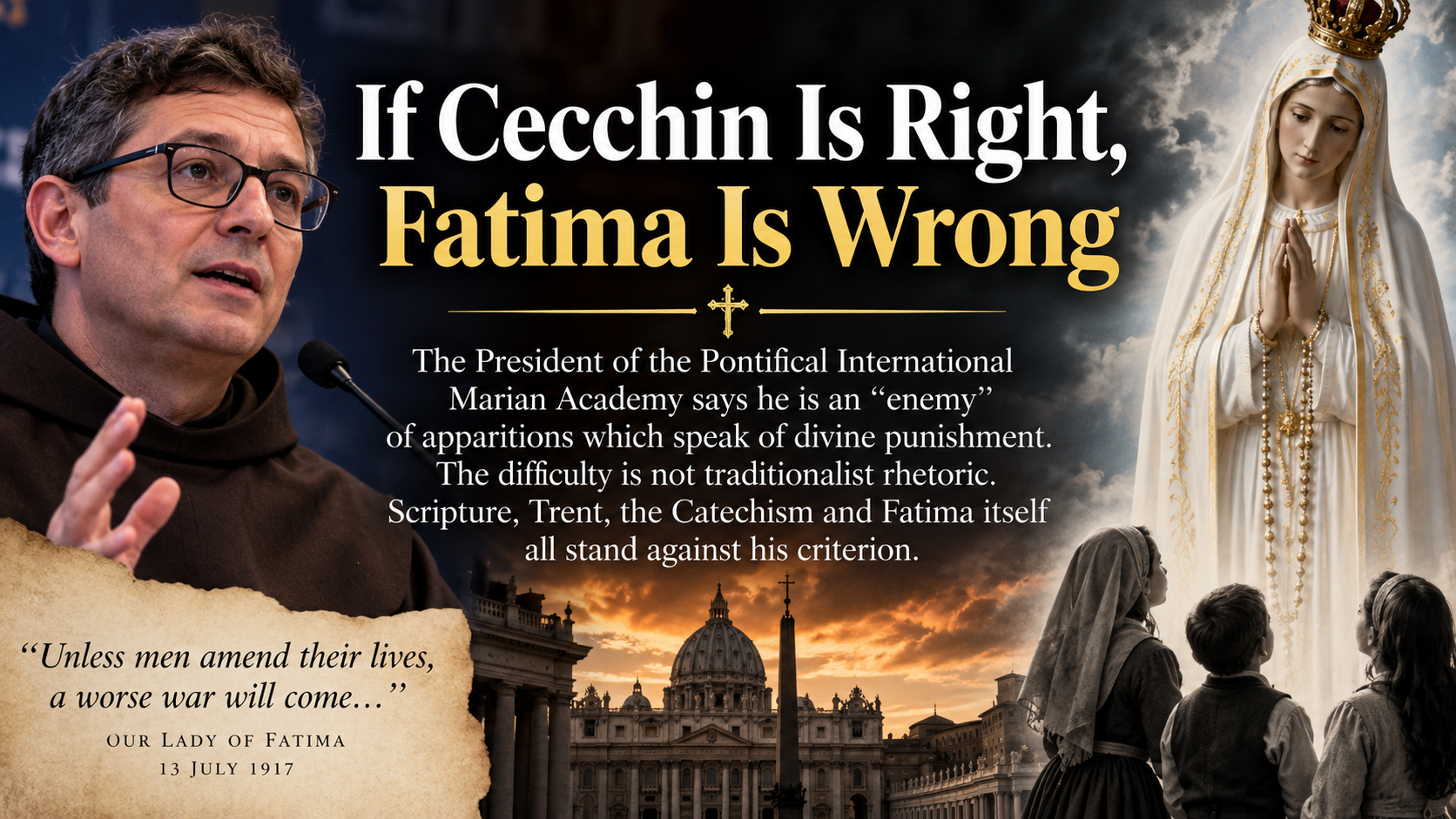
- If Cecchin Is Right, Fatima Is WrongFr Stefano Cecchin, President of the Pontifical International Marian Academy, has declared opposition to apparitions that speak of divine punishment, suggesting they are false. This stance contradicts fundamental Catholic doctrine, including teachings from Scripture, the Catechism, and specifically the Message of Fatima, which warns of divine consequences for sin.
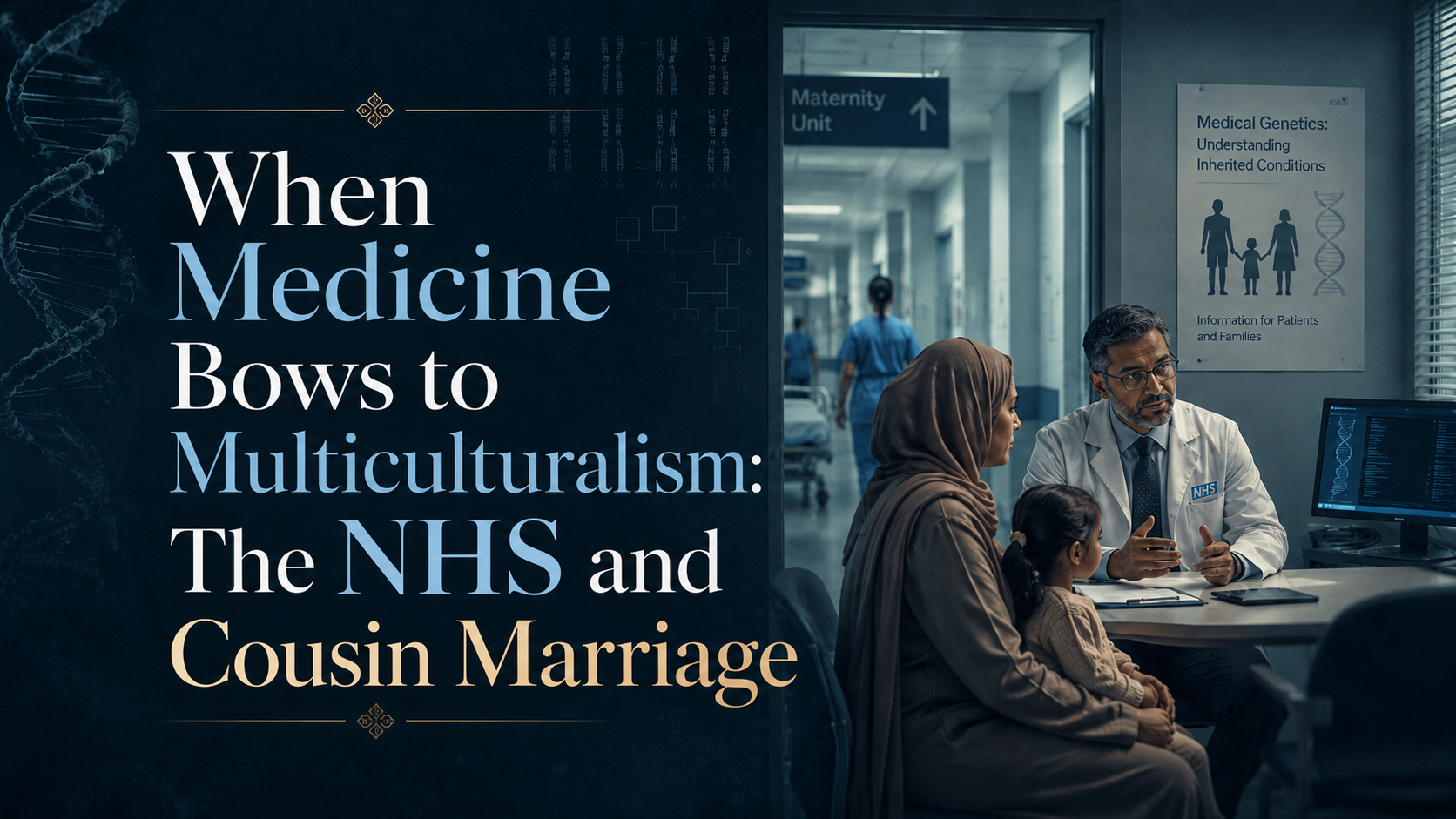
- When Medicine Bows to Multiculturalism: The NHS and Cousin MarriageThe NHS faced controversy over training that minimised the risks of cousin marriage, claiming associated health threats were exaggerated. Despite current materials recognising genetic risks, the government acknowledged previous educational content was inappropriate. This highlights concerns over prioritising cultural sensitivity over clear medical truths, potentially undermining public trust in healthcare.



Leave a Reply