
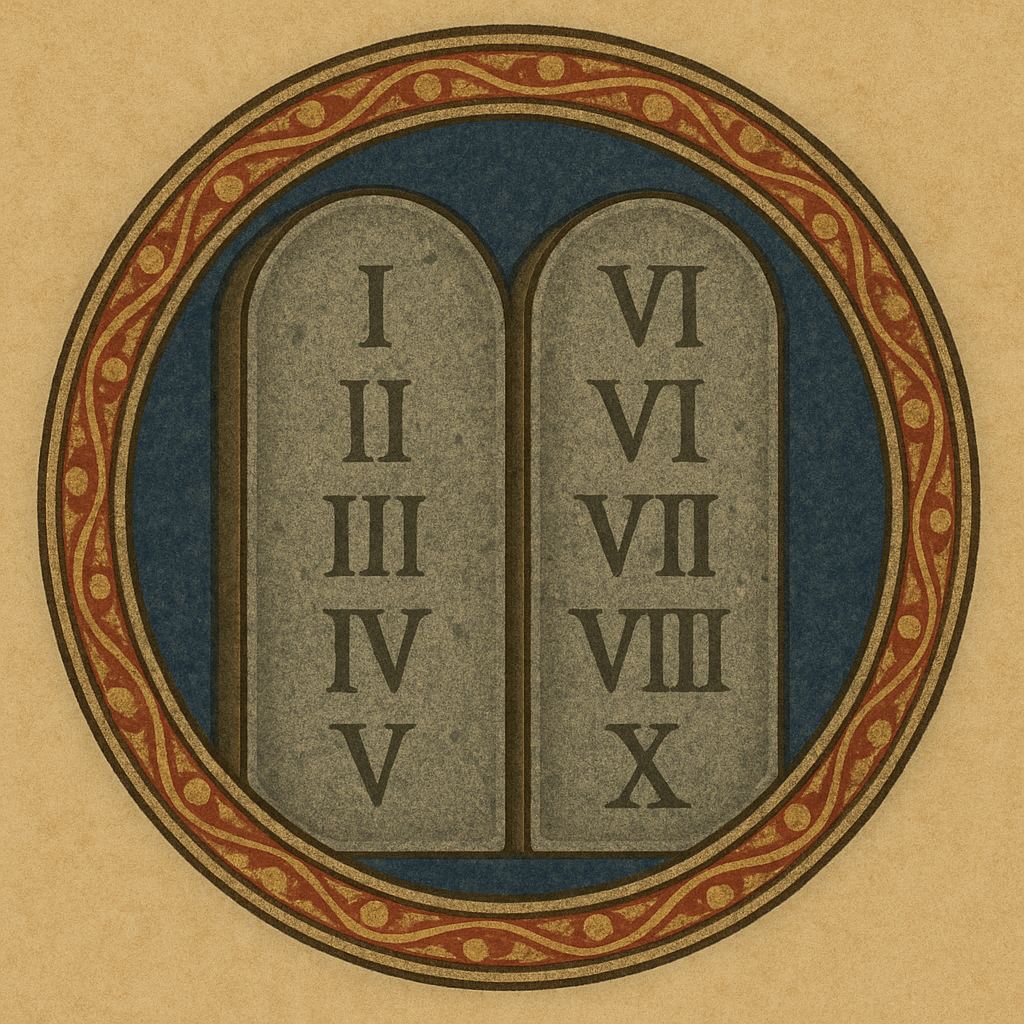
The Tablets of Witness: Sinai and the Formation of God’s People

At Sinai, the God who delivered Israel from Egypt reveals His Law, not as a burden but as the path to life. The Ten Commandments, engraved upon stone tablets by the very finger of God, form the covenant’s moral heart. They teach Israel who God is—holy, faithful, just—and who they must become as His chosen people. The Law is not an endpoint but a guide, preparing the human heart for the fullness of grace.
The Fathers understood the commandments not merely as rules but as revelations of divine love. St Augustine wrote that “the Law was given that grace might be sought; grace was given that the Law might be fulfilled.”¹ Sinai thus stands in continuity with Bethlehem: both unveil the God who draws near, forming a people capable of communion with Him. The stone tablets foreshadow the living law Christ will inscribe upon human hearts.²
The symbolism of the tablets on the Jesse Tree reminds us that Advent is a season of moral preparation. To welcome the Messiah, our hearts must be ordered toward God—turned away from idols, open to truth, committed to justice, purity, and fidelity. The Law exposes sin not to condemn but to heal, leading us toward the grace Christ brings. The God who thundered on Sinai will whisper in the manger, yet His call to holiness remains unchanged.
As we place the tablets upon the Tree, we recognise that the journey from Egypt to the Promised Land—and from Advent to Christmas—requires obedience born of love. The commandments reveal the contours of the redeemed life, forming the people through whom the world will see God’s holiness.
- St Augustine, On the Spirit and the Letter, ch. 28.
THE JESSE TREE REFLECTIONS


Related Articles


Latest Articles
- Today’s homily: St Pius X, PopeThe text reflects on the life and legacy of Pope St Pius X, who was chosen from humble beginnings to reform the Church. His pontificate focused on defending the Catholic Faith, restoring liturgical sanctity, and fostering deeper connections between believers and Christ. Pius X exemplified a balance of truth and pastoral charity.
- Today’s Mass: September 03 Pope St Pius X,Pope St Pius X, born Giuseppe Melchiorre Sarto, was a significant reformer who emphasised preserving the Catholic Faith against Modernism. His pontificate (1903-1914) featured reforms in liturgy, frequent Holy Communion, and seminaries, rooted in a pastoral desire to restore everything in Christ. He died in 1914 and was canonised in 1954.
- Today’s homily: St Stephen of HungaryThe homily reflects on the life of Saint Stephen of Hungary, illustrating his transition from a powerful ruler to a saint. He embraced the responsibilities of kingship guided by faith, understanding his authority as stewardship. His legacy teaches that true governance comes with surrender to God, ultimately placing his kingdom under the protection of the Blessed Virgin Mary.
- Today’s Mass: September 02 St. Stephen the GreatSt. Stephen the Great, King of Hungary (977-1038), was a significant Christian ruler who reinforced the faith throughout Hungary. Anointed king in 1000 by Pope Sylvester II, he fought against paganism and promoted the Church. He was canonised in 1083 and is the patron saint of Hungary, symbolising national identity.
- QUAERITE PRIMUM REGNUM DEI – Seek First the Kingdom: Spiritual Conference for Nuntiatoria CXXIA spiritual conference, “Seek First the Kingdom,” emphasises prioritising God’s reign within individuals over earthly concerns. It explores the necessity of internalising Christ’s teachings, the importance of discernment, and the critical evaluation of the faith in relation to contemporary issues. A genuine Catholic life centres on Christ, fostering holiness and transformation.



Leave a Reply