
He Shall Feed My People: The Shepherd-Kingship of David

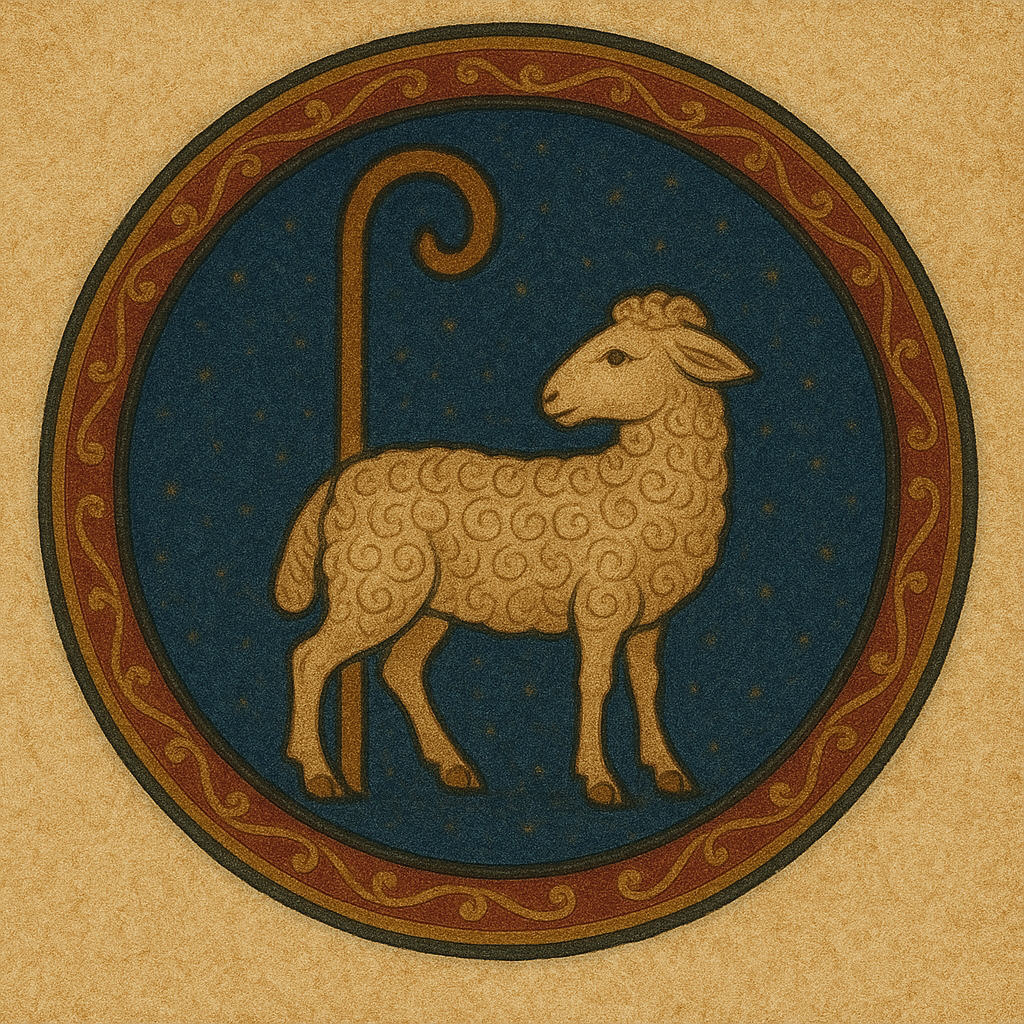
Before he was king, David was a shepherd — a vocation that shaped his soul long before he shaped a kingdom. When the tribes of Israel gather and proclaim him their ruler, they remind him: “Thou shalt feed my people Israel, and thou shalt be their leader.”¹ David’s kingship is pastoral before it is royal; he rules by guiding, protecting, and laying down his life for the flock entrusted to him.
The early Fathers saw in David a vivid type of Christ, the true Shepherd King. Just as David guarded his flock from lions and bears, so Christ delivers His people from sin and death.² Just as David reunifies the tribes, Christ gathers all nations into one flock. David’s crook and crown converge in Christ, who reigns not through domination but through sacrificial love.
The shepherd’s crook symbol on the Jesse Tree calls us to contemplate this paradox: the Messiah arrives not only as heir to David but as the Good Shepherd who knows His sheep.³ Bethlehem — the city of David and the birthplace of Christ — becomes the meeting place of prophecy and fulfilment, where shepherds are the first to adore the Shepherd King.
As we hang the shepherd’s crook upon the Tree, we recall that Advent prepares us to welcome not merely a ruler, but a Shepherd whose kingship is tenderness, vigilance, and self-giving love. His kingdom is built on care, fidelity, and the willingness to seek out the lost.
- 2 Samuel 5:2 (Douay-Rheims).
- Cf. St Augustine, Expositions on the Psalms, Ps. 23.
- Cf. John 10:11.
THE JESSE TREE REFLECTIONS


Related Articles


Latest Articles
- Today’s homily: St Pius X, PopeThe text reflects on the life and legacy of Pope St Pius X, who was chosen from humble beginnings to reform the Church. His pontificate focused on defending the Catholic Faith, restoring liturgical sanctity, and fostering deeper connections between believers and Christ. Pius X exemplified a balance of truth and pastoral charity.
- Today’s Mass: September 03 Pope St Pius X,Pope St Pius X, born Giuseppe Melchiorre Sarto, was a significant reformer who emphasised preserving the Catholic Faith against Modernism. His pontificate (1903-1914) featured reforms in liturgy, frequent Holy Communion, and seminaries, rooted in a pastoral desire to restore everything in Christ. He died in 1914 and was canonised in 1954.
- Today’s homily: St Stephen of HungaryThe homily reflects on the life of Saint Stephen of Hungary, illustrating his transition from a powerful ruler to a saint. He embraced the responsibilities of kingship guided by faith, understanding his authority as stewardship. His legacy teaches that true governance comes with surrender to God, ultimately placing his kingdom under the protection of the Blessed Virgin Mary.
- Today’s Mass: September 02 St. Stephen the GreatSt. Stephen the Great, King of Hungary (977-1038), was a significant Christian ruler who reinforced the faith throughout Hungary. Anointed king in 1000 by Pope Sylvester II, he fought against paganism and promoted the Church. He was canonised in 1083 and is the patron saint of Hungary, symbolising national identity.
- QUAERITE PRIMUM REGNUM DEI – Seek First the Kingdom: Spiritual Conference for Nuntiatoria CXXIA spiritual conference, “Seek First the Kingdom,” emphasises prioritising God’s reign within individuals over earthly concerns. It explores the necessity of internalising Christ’s teachings, the importance of discernment, and the critical evaluation of the faith in relation to contemporary issues. A genuine Catholic life centres on Christ, fostering holiness and transformation.



Leave a Reply