
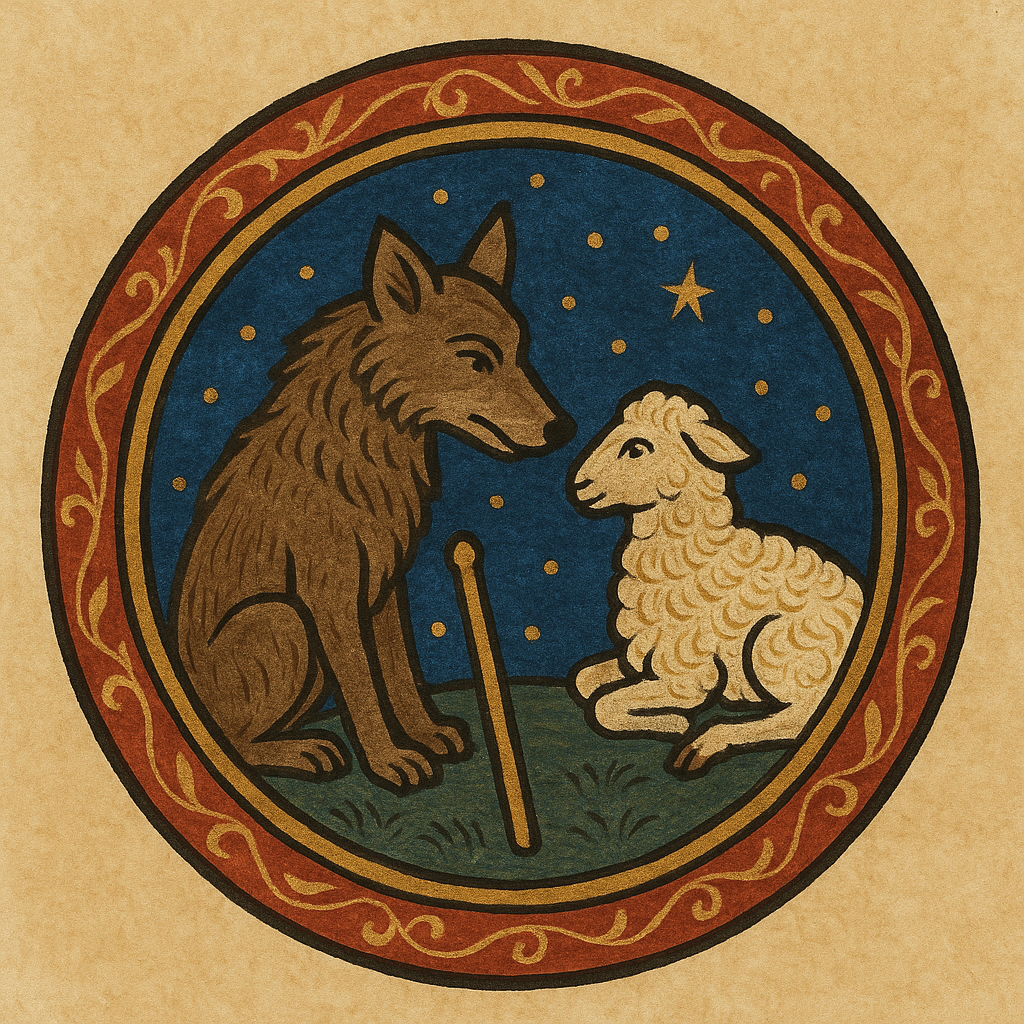
When the Wolf Dwells with the Lamb: The Kingdom Restored

Isaiah’s vision of the wolf dwelling with the lamb is one of Scripture’s most striking images of redemption restored. In a world marked by violence, rivalry, and fear, the prophet announces a future shaped by harmony: predators no longer devour, the weak are no longer threatened, and creation itself is healed. This peace flows not from political agreement but from the reign of the Messiah.
Symbol: Wolf and lamb
Scripture: Isaiah 11:6–9
Theme: Promise of the Gospel of Peace
The Fathers understood this passage both spiritually and eschatologically. Spiritually, the wolf and lamb represent the reconciliation of sinners and saints, enemies transformed into brethren by grace. St Jerome taught that Christ “changes the nature of the wolf,” not by destroying it, but by converting the heart.¹ The Gospel of Peace reshapes human nature from within, subduing violence through charity.
At the same time, Isaiah’s prophecy points forward to the final restoration of all things, when creation itself will be freed from corruption.² The peace of Christ is not a fragile truce but a cosmic renewal rooted in justice and truth. It begins now in the hearts of the faithful and will be consummated when the Messiah reigns openly over heaven and earth.
As we hang the wolf and lamb upon the Jesse Tree, Advent teaches us to long for this peace and to live as its witnesses. Christ comes not only to forgive sins but to restore harmony—between God and man, man and neighbour, and creation itself. The child born in Bethlehem is the Prince of Peace whose kingdom will finally know no end.
- St Jerome, Commentary on Isaiah, Book IV.
- Cf. Romans 8:19–22.
THE JESSE TREE REFLECTIONS


Related Articles


Latest Articles
- Today’s homily: St Pius X, PopeThe text reflects on the life and legacy of Pope St Pius X, who was chosen from humble beginnings to reform the Church. His pontificate focused on defending the Catholic Faith, restoring liturgical sanctity, and fostering deeper connections between believers and Christ. Pius X exemplified a balance of truth and pastoral charity.
- Today’s Mass: September 03 Pope St Pius X,Pope St Pius X, born Giuseppe Melchiorre Sarto, was a significant reformer who emphasised preserving the Catholic Faith against Modernism. His pontificate (1903-1914) featured reforms in liturgy, frequent Holy Communion, and seminaries, rooted in a pastoral desire to restore everything in Christ. He died in 1914 and was canonised in 1954.
- Today’s homily: St Stephen of HungaryThe homily reflects on the life of Saint Stephen of Hungary, illustrating his transition from a powerful ruler to a saint. He embraced the responsibilities of kingship guided by faith, understanding his authority as stewardship. His legacy teaches that true governance comes with surrender to God, ultimately placing his kingdom under the protection of the Blessed Virgin Mary.
- Today’s Mass: September 02 St. Stephen the GreatSt. Stephen the Great, King of Hungary (977-1038), was a significant Christian ruler who reinforced the faith throughout Hungary. Anointed king in 1000 by Pope Sylvester II, he fought against paganism and promoted the Church. He was canonised in 1083 and is the patron saint of Hungary, symbolising national identity.
- QUAERITE PRIMUM REGNUM DEI – Seek First the Kingdom: Spiritual Conference for Nuntiatoria CXXIA spiritual conference, “Seek First the Kingdom,” emphasises prioritising God’s reign within individuals over earthly concerns. It explores the necessity of internalising Christ’s teachings, the importance of discernment, and the critical evaluation of the faith in relation to contemporary issues. A genuine Catholic life centres on Christ, fostering holiness and transformation.



Leave a Reply