
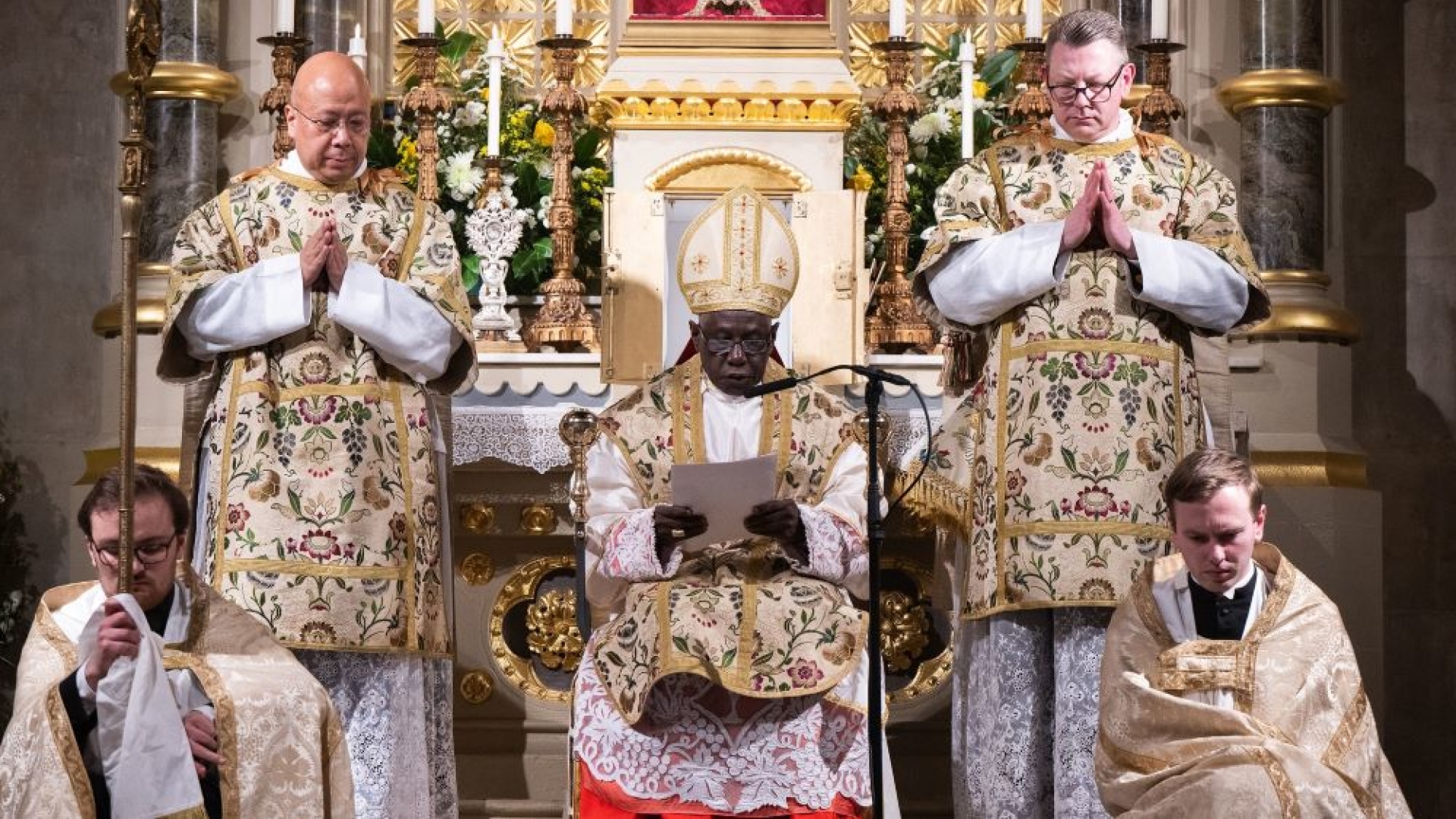
THE POPE IS THE FATHER OF ALL: Cardinal Sarah speaks of the Traditional Mass and unity under Pope Leo XIV
In a new interview with Tribune Chrétienne from his residence in Rome, Cardinal Robert Sarah has once again spoken with clarity and depth on a matter close to his heart — the sacred liturgy and the Church’s wounded unity following Traditionis Custodes. His remarks, both pastoral and theological, recall his enduring appeal for reconciliation through reverence, fidelity, and prayer.
The interviewer asked about his hopes for the future of the Traditional Latin Mass under the new pontificate, noting the pain caused in France by the sometimes “clumsy” application of Pope Francis’s motu proprio. Cardinal Sarah replied with evident sorrow at the divisions the Church has endured, lamenting that “we have turned the Mass into a battlefield — a war between so-called traditionalists and progressives. In doing so, we are profaning the Eucharist.”
He continued: “The liturgy is the one moment when man stands face to face with God — when he is in direct communion with the divine, when God listens to him and he speaks with God. Why should such a moment become a source of division? Why forbid this, or that? Who has given us that right — that power?”
In a striking line that echoes both the Fathers and the ancient principle lex orandi, lex credendi, he warned: “The question is not merely practical but one of faith itself. How we believe is how we pray. If there is no faith, nothing will change.”
He then drew attention to the vitality of the faithful attached to the traditional liturgy: “When we look honestly at those who are still practising Catholics today, it is often they who attend the traditional Mass. Why, then, are they being punished? On the contrary — they should be encouraged, supported, loved.”
When asked whether he had discussed the matter with the Pope, Cardinal Sarah confirmed, “Yes, I have had that opportunity.” He added that the Holy Father “is aware of this suffering; he knows of this battle within the Church.”
Referring to Cardinal Burke’s recent permission to celebrate the traditional Mass at Saint Peter’s Basilica, he concluded with words that have since resonated widely: “The Pope is the father of all — the father of traditionalists, of progressives, of every child of the Church. He cannot ignore any of his children. Each has his own temperament, his own sensibility; each must be taken into account. I believe he will try to act in that way — as a father, not as a partisan.”
A father’s task, a Church in travail
Cardinal Sarah’s words are neither polemical nor naïve; they are the seasoned reflections of a shepherd who has witnessed decades of liturgical turmoil and yet remains convinced that peace is possible — not through compromise, but through holiness. His call to “reflect” is not an appeal for endless dialogue but for interior conversion.
For Sarah, the liturgy is not a policy issue to be legislated by decree, but the Church’s living heart. His reminder that Jesus prayed for unity at the institution of the Eucharist recalls the teaching of Saint Augustine: *“The sacrifice of peace is the unity of the faithful in the bond of charity.”*¹ To weaponise the liturgy, he implies, is to betray its very purpose.
It is no small irony that, as diocesan participation declines across Europe, the communities most faithful to prayer, confession, and family life are often those gathering around the old Missal. Sarah’s recognition of this fact underscores what traditional Catholics have long maintained: that reverence for the ancient rites is not nostalgia, but evidence of a living faith rooted in continuity.
Awaiting a sign of reconciliation
Pope Leo XIV has not yet commented publicly on the future of Traditionis Custodes, but the tone of his early pontificate — marked by gestures of moderation and private audiences with senior prelates such as Cardinal Sarah — has rekindled cautious hope. The new Pope’s challenge will be to heal without erasing, to restore trust where authority has been used as a weapon.
If he indeed acts as pater omnium, the “father of all,” it may yet be said that this pontificate will be measured not by administrative reforms, but by whether the Church learns once again to kneel together before the same altar — in silence, in adoration, and in peace.
¹ Saint Augustine, Enarrationes in Psalmos 85.
² Tribune Chrétienne, “Entretien avec le Cardinal Robert Sarah,” October 2025 (video interview, French original).
³ Robert Cardinal Sarah, The Power of Silence: Against the Dictatorship of Noise (San Francisco: Ignatius Press, 2017).


Leave a Reply