
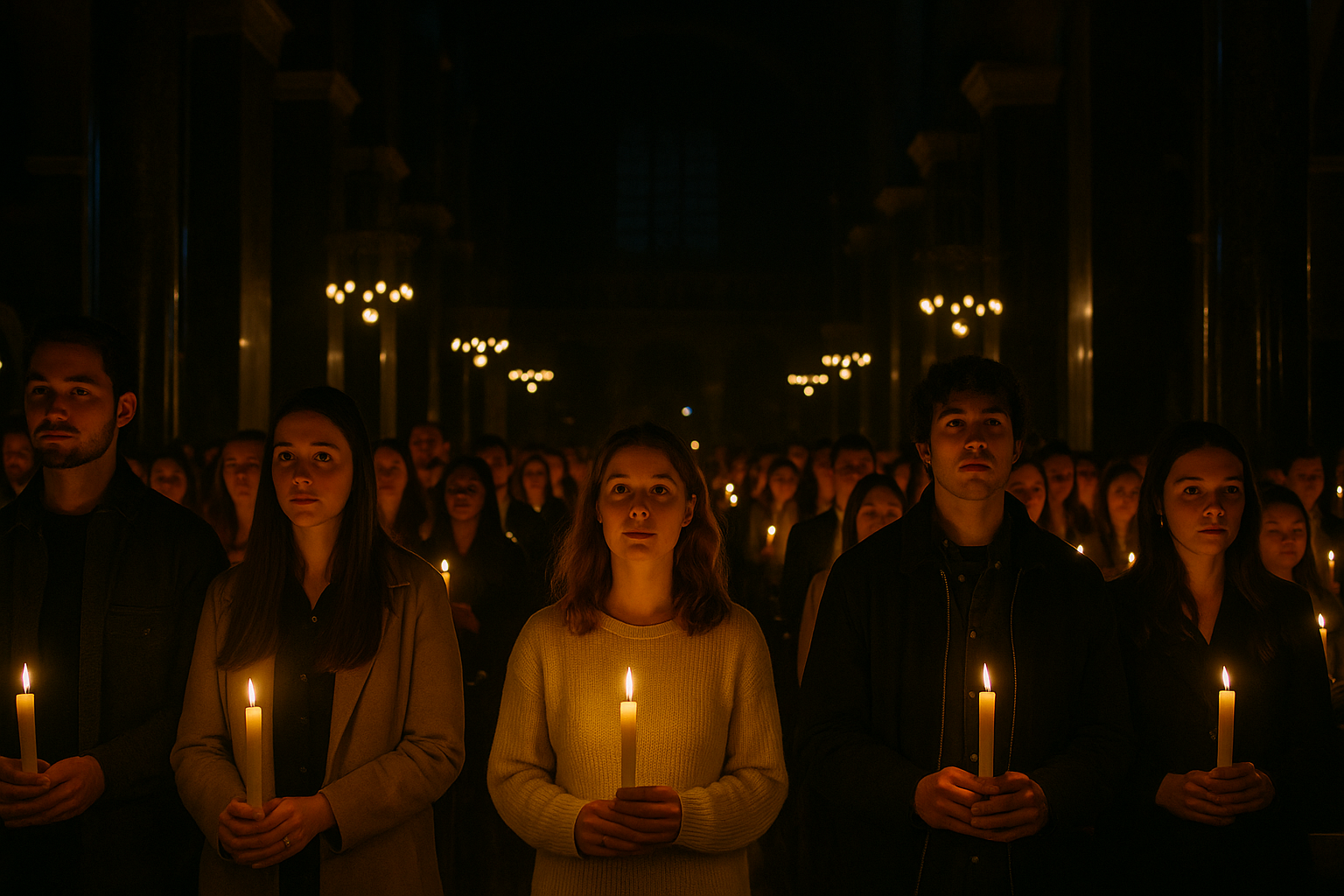
A Quiet Revival in Britain: Young Converts and the Reawakening of Catholic Faith
Across Britain, something unexpected is stirring in the Church. Against decades of secularisation and decline, dioceses from London to Liverpool are quietly reporting record numbers of young adults entering the Catholic faith. They come not in search of novelty but of truth, tradition, and transcendence—the things the modern world has forgotten.
The Resurgence of Faith Among the Young
According to the Bible Society–YouGov report Quiet Revival: Christianity and Gen Z (2024), the proportion of 18–24-year-olds in England and Wales attending church monthly or more has quadrupled since 2018—from 4 % to 16 %.¹ Among them, 41 % now identify as Catholic, while just 20 % describe themselves as Anglican.² The Catholic News Agency calls this a “quiet Catholic revival,” while The Guardian recently observed that “a revival is happening” as churches fill again with young faces once thought lost to secularism.³
Conversions on the Rise Across Dioceses
This national trend is confirmed by diocesan figures. In Westminster, more than 500 adults were received into the Church at Easter 2025—the highest figure since 2018.⁴ Southwark followed closely with over 450; Birmingham welcomed 201, up from 130 the previous year; Liverpool 140 (up from 110); Arundel & Brighton 210; Northampton 100; and Salford 103.⁵ These are not marginal changes but a clear pattern: every major English diocese reporting public figures shows substantial year-on-year increases.
The Archdiocese of Southwark described it as “the second consecutive year of over 450 adult entrants,”⁶ while Westminster noted that many new Catholics were introduced to the faith through online apologetics or personal contact with practicing Catholics. The trend extends beyond numbers—many of these entrants are in their twenties and thirties, and often converts from Protestant or non-religious backgrounds.
Pandemic Reflection and Digital Evangelisation
Sociologists trace the roots of this renewal to two converging forces: the existential pause of the pandemic and the digital spread of Catholic content. Lockdowns drove many young adults to reconsider life’s purpose, while Catholic creators such as Cameron Bertuzzi and Bishop Barron provided intellectually serious answers on platforms like YouTube and Instagram. In Britain, clergy testify that online debates and livestreamed liturgies have drawn many seekers to the faith.⁷
As one convert explained, “I visited dozens of churches, but it was only in the Catholic Mass that I felt the presence of God. The reverence, the history, the silence—it all spoke to something deeper than myself.” Such sentiments echo across testimonies gathered by the New York Post and others: beauty and stability are succeeding where moral relativism and entertainment worship have failed.⁸
Disillusionment with the ‘Lax’ and the Rootless
The Reverend Raymond Maria La Grange of St Vincent Ferrer, New York, has seen the same pattern: “Young people realise the world cannot provide them with moral order or reasons for living in any particular way. A culture of license has left them unmoored.”⁹ His words apply equally to Britain, where young adults express frustration with consumerist spirituality and the theological incoherence of liberal Protestantism.
In their search for permanence, they are rediscovering the faith of their ancestors. They find in the Church not repression but restoration; not dogmatism but direction. As one recent convert remarked, “I begged God not to make me Catholic—but I found freedom in obedience.”
Roots and Reverence
The demographic data are striking, yet the deeper story is spiritual. The pandemic shattered illusions of self-sufficiency. Social media exposed both nihilism and hunger for meaning. Amid the noise, the quiet rhythm of Catholic worship—kneeling, confession, the rosary, the Latin Mass—has become, paradoxically, countercultural. Many converts cite the discipline of prayer and sacrament as the very antidote to anxiety, fragmentation, and despair.
While immigration has contributed to Catholic vitality, analysts note that much of the new growth comes from native Britons.ⁱ⁰ This signals not merely demographic replacement but genuine conversion—a turning of the heart toward transcendence.
Challenge and Opportunity
The Church now faces a pastoral responsibility: to form, root, and accompany these new believers. Converts expect coherence; they seek orthodoxy, beauty, and stability. If parishes offer only diluted modernism, this renewal will wither. But if the Church boldly presents the fullness of her faith, these young souls may become the foundation of a new Catholic generation.
In an Age of Shadows, Light Returns
Britain’s “quiet revival” does not yet resemble a national awakening. Attendance remains a fraction of what it was a century ago. Yet within the ruins of secular modernity, the flicker of faith burns again. The very generation that was told religion was finished is kneeling before the altar. They have discovered that without God, even freedom is empty; with Him, even discipline is joy.
Footnotes
¹ Bible Society & YouGov, Quiet Revival: Christianity and Gen Z (2024).
² Ibid.
³ The Guardian, “A Revival Is Happening: Church Hails Resurgence Among Young in UK,” 26 Apr 2025.
⁴ Catholic News Agency, “Surge in Adults Entering Church in England This Easter,” 1 Apr 2025.
⁵ The Tablet, “Increase in Numbers Joining the Church at Easter,” Apr 2025.
⁶ Archdiocese of Southwark, Press Release, 28 Mar 2025.
⁷ Word on Fire Institute, “The Digital Apologetics Phenomenon,” 2023.
⁸ New York Post, “Young People Are Converting to Catholicism en Masse,” 17 Apr 2025.
⁹ Ibid.
ⁱ⁰ Reuters, “Catholicism Spreads Among Young Britons Longing for Something Deeper,” 7 May 2025.







Leave a Reply