
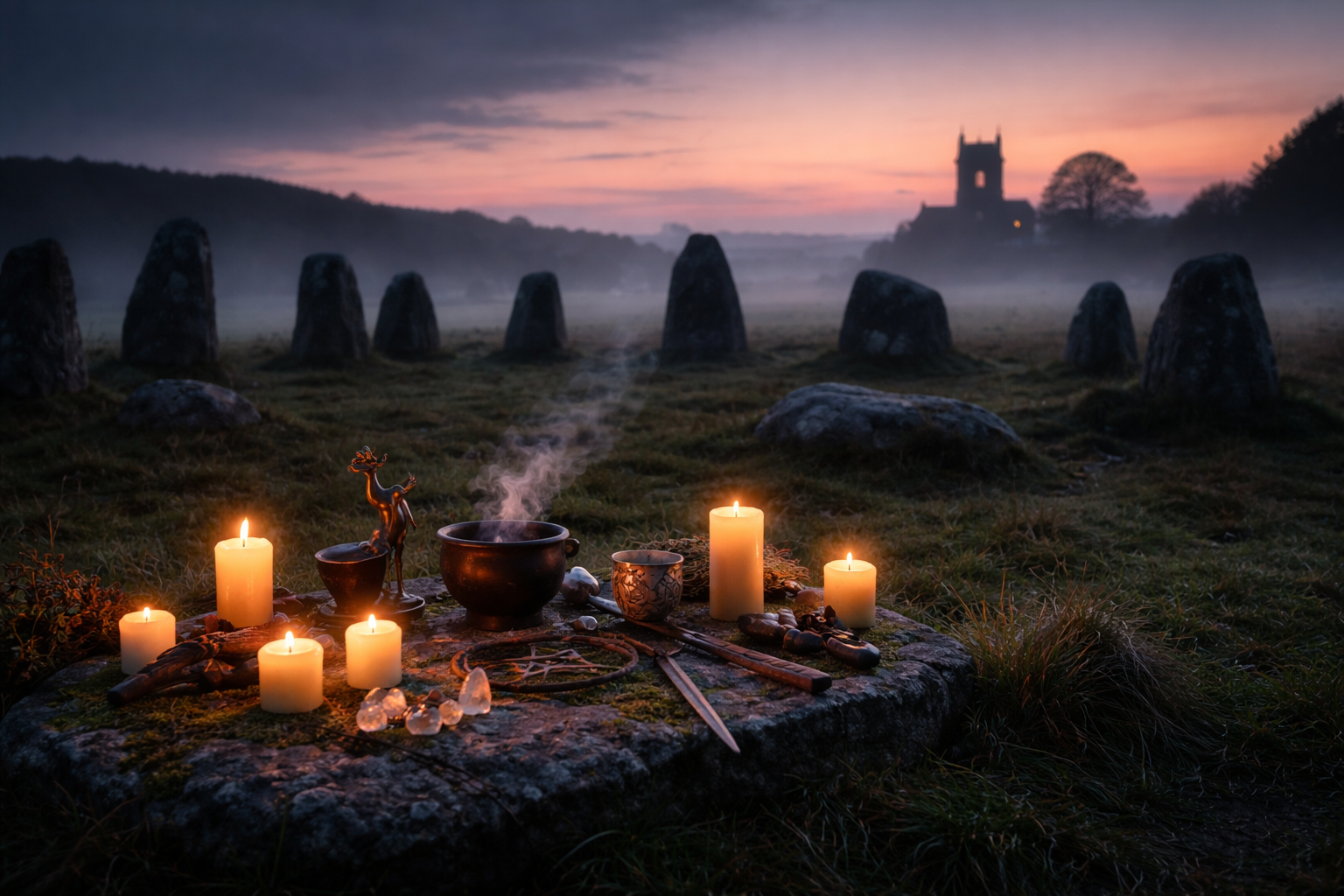
Paganism After Christianity: What the Rise of Neo-Paganism in Britain Really Reveals
The claim that Paganism is “on the rise” in Britain has become a minor refrain in recent cultural commentary. Historians, journalists, and religious sociologists have increasingly pointed to census figures, anecdotal reports, and small-scale surveys as evidence that modern Paganism represents a growing spiritual alternative in a society no longer anchored by Christianity. Ronald Hutton’s recent intervention frames this development as both serious and significant, suggesting that Paganism speaks directly to the conditions of late-modern Britain: pluralism, individualism, environmental concern, and disenchantment with institutional religion.¹ Yet such accounts tend to mistake visibility for vitality and proportion for substance. When the available evidence is examined carefully and placed within a longer civilisational perspective, a different picture emerges—one in which Paganism appears less as a resurgent faith and more as a symptom of Christianity’s retreat from cultural confidence and public authority.
What the Evidence Actually Shows
The strongest empirical basis for claims of Pagan growth lies in the census data for England and Wales. In 2011, individuals identifying as Pagan, Wiccan, Druid, or Heathen appeared largely through write-in responses, numbering in the region of 56,000.² By the 2021 Census, those figures had risen to somewhere between 74,000 and 80,000, depending on how overlapping categories are grouped by the Office for National Statistics.³ This represents an increase of roughly a quarter to a third over ten years—enough to be statistically visible, but not enough to be socially transformative.
Crucially, this growth must be read against the dramatic collapse of Christianity during the same period. Between 2011 and 2021, Christian self-identification fell by millions. Paganism’s increase, by contrast, amounts to a few tens of thousands. The language of “fastest-growing religion” often attached to Paganism relies on relative percentages rather than absolute numbers. A modest rise from a very low base can appear dramatic when surrounded by widespread decline.
Claims that Paganism has become a major destination for those leaving Christianity rest largely on small surveys of religious “switchers.” These studies frequently show that among the narrow subset of people who adopt alternative spiritual identities, Paganism features prominently.⁴ This is not evidence of mass conversion, but of niche consolidation. Paganism attracts those who reject Christianity yet remain reluctant to identify as secular, atheist, or irreligious. It provides a spiritual vocabulary without demanding assent to doctrine or submission to authority.
Other indicators—such as the registration of Pagan charities, the appearance of Pagan chaplaincy requests in prisons and universities, and the proliferation of online Pagan communities—reinforce this picture of increased visibility rather than deep institutional growth. Participation is typically episodic, self-directed, and highly individualised. There is little evidence of sustained intergenerational transmission, formal catechesis, or binding communal discipline.
Paganism as a Product of Religious Dislocation
To understand why Paganism has found this limited but noticeable foothold, it is necessary to situate it within the broader collapse of Christianity as Britain’s shared metaphysical framework. Christianity did not merely function as one belief system among others; it provided the moral grammar, symbolic order, and anthropological assumptions of British civilisation for over a millennium. Its erosion has not produced a vacuum of belief so much as a redistribution of the sacred.
Peter Berger famously argued that secularisation does not eliminate religion but fragments it.⁵ As institutional authority wanes, belief becomes privatised, eclectic, and experiential. Paganism fits precisely into this pattern. It does not compete with Christianity on doctrinal grounds, nor does it seek to offer a comprehensive moral vision. Instead, it absorbs those displaced religious impulses—ritual, myth, sacralised time, reverence for nature—that survive after belief in divine command and judgment has faded.
In this sense, Paganism is parasitic on Christianity’s collapse. It thrives not because it offers a more compelling account of reality, but because it avoids the demands that Christianity makes. It restores enchantment while declining obligation.
A Religion Without Commandments
One of the defining characteristics of contemporary Paganism is its rejection of moral law as divinely revealed. Pagan deities do not command, judge, or save. They accompany, affirm, and symbolise. Concepts central to Christianity—sin, repentance, redemption, grace, eternal judgment—are either absent or explicitly rejected.⁶
This theological posture corresponds closely with modern expressive individualism. As Charles Taylor has shown, contemporary Western culture increasingly treats authenticity and self-expression as the highest goods.⁷ In such a framework, religion is valued insofar as it facilitates personal growth and emotional coherence. Paganism excels here precisely because it does not claim objective truth or binding authority. It offers ritual as experience rather than worship, and myth as metaphor rather than revelation.
From a Christian theological standpoint, this represents not an alternative theology but an inversion of theology itself. God ceases to be the sovereign source of law and becomes an immanent projection of human aspiration. Worship ceases to be submission and becomes collaboration. The sacred is no longer something to which man conforms, but something he negotiates.
The Feminisation of the Sacred
The prominence of goddess spirituality within modern Paganism is often presented as a corrective to Christian patriarchy. Yet historically, this phenomenon owes far more to twentieth-century ideological currents than to ancient religious practice. Ronald Hutton himself has documented how modern goddess worship emerged from a fusion of Romantic primitivism, Jungian psychology, feminist theology, and selective readings of antiquity.⁸
Theologically, goddess spirituality functions less as an addition to the divine economy than as a redefinition of it. Transcendence gives way to immanence; authority to reciprocity; judgment to nurture. These shifts mirror broader cultural discomfort with hierarchy and asymmetry. The sacred feminine becomes a symbolic vehicle for rejecting paternal authority—divine and human alike.
Nature Without a Creator
Environmental concern plays a genuine role in Pagan attraction, particularly in an urbanised and technologised society hungry for contact with the natural world. Yet Pagan sacralisation of nature differs fundamentally from the Christian doctrine of creation. In Christian theology, nature is good precisely because it is created, ordered, and entrusted to man under God.⁹ Responsibility flows from stewardship.
In Paganism, nature itself becomes divine. This removes the need for moral obligation grounded in law. Reverence replaces responsibility; ritual replaces commandment. Environmental concern becomes spiritualised rather than moralised, expressive rather than juridical.
Personal Growth as Salvation
Perhaps the clearest marker of Paganism’s modern character is its understanding of human fulfilment. The goal is not sanctification but self-actualisation. The problem is not sin but imbalance. The solution is not grace but personal development. Reincarnation, where affirmed, serves less as an eschatological doctrine than as reassurance that nothing final is at stake.¹⁰
Philip Rieff identified this transformation as the replacement of moral culture with therapeutic culture.¹¹ Paganism exemplifies this shift with remarkable clarity. It is a religion designed for a society uncomfortable with judgment, allergic to repentance, and determined to preserve the sovereignty of the self.
Not Pre-Christian, but Post-Christian
Ancient pagan religions were not benign nature spiritualities. They were socially coercive, politically embedded, sacrificial, and often brutal. They imposed obligations, demanded loyalty, and reinforced hierarchies. Modern Paganism consciously rejects these features. It survives precisely because it has been purified of fear, command, and cost.
What remains is an aesthetic of antiquity repurposed for modern sensibilities. Paganism today is not the religion Europe abandoned, but the religion Europe invented after Christianity ceased to command belief.
Conclusion
The rise of Paganism in Britain is real, but its significance is easily overstated. It remains numerically small, socially marginal, and institutionally thin. Its growth reflects not the power of ancient gods reclaimed, but the fragility of a civilisation that has lost confidence in truth, authority, and judgment while remaining unable to live without the sacred.
Paganism flourishes where Christianity has fallen silent—not because it offers a truer vision of reality, but because it demands less of those who follow it. Until Christianity recovers the courage to proclaim God not merely as companion but as Lord, not merely as meaning but as judge and redeemer, the ground it has vacated will continue to be occupied by spiritualities that console the self while refusing to command it.
¹ Ronald Hutton, “Paganism is on the rise in Britain – this is why,” The Telegraph, 4 December 2025.
² Office for National Statistics, Religion in England and Wales 2011.
³ Office for National Statistics, Religion, England and Wales: Census 2021.
⁴ Institute for the Impact of Faith in Life, Religious Switching in Contemporary Britain, 2024.
⁵ Peter Berger, The Sacred Canopy (Anchor Books, 1967).
⁶ Margot Adler, Drawing Down the Moon (Penguin, 2006).
⁷ Charles Taylor, A Secular Age (Harvard University Press, 2007).
⁸ Ronald Hutton, The Triumph of the Moon (Oxford University Press, 1999).
⁹ Catechism of the Catholic Church §§299–301; Pope Leo XIII, Rerum Novarum (1891).
¹⁰ Graham Harvey, Listening People, Speaking Earth (Hurst, 1997).
¹¹ Philip Rieff, The Triumph of the Therapeutic (University of Chicago Press, 1966).
RELATED ARTICLES


Latest ARTICLES
- Today’s homily: Christ the KingThe homily reflects on Christ’s kingship as seen in the Gospel narrative. It contrasts earthly authority with divine truth, emphasising that true allegiance to God requires genuine obedience and transformation. Believers are called to examine their personal commitments and respond to Christ’s demands in everyday life, ultimately recognising their identity as bearers of God’s image.
- Sermon for Christ the KingToday marks the celebration of Christ the King and the Twenty Second Sunday after Pentecost, a feast asserting Christ’s sovereignty against totalitarianism. St. Paul emphasised Christ’s supremacy over power and principalities, challenging early Gnostic beliefs. The early Church’s victory over evil is affirmed in Christ’s resurrection, offering hope and unity amidst contemporary struggles.
- Today’s Mass: October 25 SOVEREIGNTY OF OUR LORD JESUS CHRIST, SUPREME KINGThe Feast of the Sovereignty of Our Lord Jesus Christ celebrates Christ’s dual kingship by birth and conquest. Established by Pius XI, it aims to deepen faith and counter anti-clericalism. The liturgical observance underscores His authority as King, advocating for societal recognition of His reign to bring peace and harmony.
- TRADITION BEHIND THE FENCEThe Vatican’s prohibition of the traditional Ad Petri Sedem pilgrimage to St Peter’s Basilica has sparked controversy, especially among traditional Catholics. While some cite scheduling conflicts, the broader issue lies in the restrictive policies of Traditionis custodes, which may confine traditional liturgical practices to specific enclaves, risking the transmission and recognition of Catholic Tradition within the wider Church.
- Today’s Mass: October 24 St Raphael the ArchangelThe Feast of Saint Raphael the Archangel highlights his healing powers as depicted in the Book of Tobit, where he aids Tobit and his son, Tobiah. Venerated as a protector of travellers and the blind, Raphael is celebrated for his miraculous interventions. His legacy includes support for nurses, matchmakers, and Catholic studies.





Leave a Reply