

Hypocrisy and the Double Standard: Speech, Citizenship, and the Credibility of the Rule of Law
The controversy surrounding the British citizenship and public welcome of Alaa Abd El-Fattah has revealed far more than a failure of communications or administrative diligence. It has exposed a widening fault line in British public life: the perception that the law governing speech, reputation, and public order is no longer applied consistently, proportionately, or without ideological preference. At its core lies a deeper question—whether equality before the law still functions as a governing principle or has been displaced by selective moral enforcement.
A clearer understanding of the controversy requires some background on Abd El-Fattah himself. Emerging in the mid-2000s as an Egyptian blogger and digital activist, he became internationally prominent during the 2011 Arab Spring, when online platforms were used to mobilise opposition to the Mubarak regime. From that point onward, Abd El-Fattah was treated by successive Egyptian governments as a dissident figure and repeatedly arrested, prosecuted, and imprisoned under national-security and public-order legislation.¹
His periods of imprisonment were lengthy and severe. Following the 2013 military takeover under President Abdel Fattah el-Sisi, Abd El-Fattah spent much of the following decade either incarcerated or subject to restrictive probation conditions. International human-rights organisations and Western governments, including the United Kingdom, repeatedly cited his case as emblematic of Egypt’s repression of political dissent.²
Alongside this record of repression, Abd El-Fattah maintained an extensive online presence. Between approximately 2008 and 2014, he published a substantial body of social-media commentary adopting an explicitly inflammatory tone. These posts included language endorsing or trivialising violence against police, expressing hostility toward “Zionists,” and framing Western societies as legitimate targets of revolutionary struggle.³ Supporters argue this rhetoric must be understood in its historical context; critics contend it crosses the threshold from dissent into incitement.⁴
Abd El-Fattah acquired British citizenship in 2021 through his British-born mother, under nationality provisions that did not require a discretionary ‘good-character’ assessment. His citizenship was therefore legally valid, though politically sensitive, having been granted while he remained imprisoned abroad and without public scrutiny of his online record.⁵
When Abd El-Fattah arrived in the United Kingdom in late December 2025, the Prime Minister, Keir Starmer, publicly welcomed his return. Declaring himself “delighted” that Abd El-Fattah had been reunited with his family, the statement carried symbolic endorsement beyond the narrow requirements of consular protection.⁶
That symbolism quickly unravelled. Once Abd El-Fattah’s historic posts resurfaced, Downing Street clarified that the Prime Minister regarded the remarks as “abhorrent” and would not have made his original statement had he been aware of them.⁷ The Foreign Secretary, Yvette Cooper, acknowledged “an unacceptable failure of information-sharing and due diligence,” announcing an internal review.⁸
The controversy, however, did not turn on procedural failure alone. It turned on contrast—specifically, between the indulgence shown in this case and the severity with which the state now treats politically inconvenient speech and reputation claims at home.
This contrast is embodied most starkly in the case of Lucy Connolly. Connolly was prosecuted, convicted, and imprisoned for a single social-media post made during a moment of public disorder—one she later deleted and for which she expressed remorse. The sentence imposed was custodial, immediate, and unforgiving. No allowance was made for deletion, apology, or proportionality.⁹
Connolly’s case matters because it is paradigmatic. It illustrates how the modern British state now treats online speech when the speaker is domestically inconvenient, politically marginal, or culturally unfashionable. Her punishment was not symbolic but real: incarceration, reputational destruction, and the chilling signal sent to others that even fleeting or impulsive expression may trigger the full coercive power of the state.
Reflecting on Abd El-Fattah’s welcome, Connolly herself drew the contrast with brutal clarity. “I was jailed for one tweet I deleted,” she said. “He’s welcomed with open arms despite years of violent posts. Tell me how that’s justice.”¹⁰ Her words resonated because they articulated what many now intuit: that proportionality has become discretionary, not principled.
A similar asymmetry appears in the Government’s treatment of Nigel Farage. Farage has been publicly berated by ministers and senior figures over allegations dating back nearly half a century—allegations resting not on judicial findings or tested evidence, but on hearsay and retrospective accusation.¹¹ In his case, the presumption of innocence has been quietly displaced by moral condemnation.
The contrast between these cases is instructive. In Connolly’s case, a deleted post results in imprisonment. In Farage’s case, unproven historical allegations justify sustained public denunciation. In Abd El-Fattah’s case, a documented record of violent rhetoric is contextualised, relativised, and bracketed off from state endorsement. The pattern is not accidental. It reveals a hierarchy of tolerance.
This hierarchy corrodes the principle of equality before the law. The rule of law does not merely prohibit arbitrary punishment; it prohibits arbitrary condemnation by the state. When allegation substitutes for proof in one case, while substantiated conduct is excused in another, legal neutrality collapses into ideological discretion.
At stake is not the fate of any single individual, but the credibility of the rule of law itself. In juridical terms, the rule of law rests on legal certainty, proportionality, predictability, and equality before the law. When materially similar—or even less substantiated—conduct yields radically different consequences, those principles are violated. Law ceases to function as a neutral framework and becomes an instrument of political sorting.
History offers sobering parallels. In late Weimar Germany, emergency powers introduced to preserve order were applied unevenly, habituating rule by exception. In the late Roman Empire, proliferating edicts enforced selectively across classes hollowed out citizenship. In post-war Europe, emergency speech and security regulations hardened into permanent mechanisms of control long after the crises that justified them had passed.
The lesson is consistent. Selective enforcement destroys legitimacy faster than open repression. A legal system perceived as arbitrary no longer commands the assent of conscience; it compels compliance through fear, reputational destruction, and deterrence.
What is required is not improved vetting alone, but a restoration of first principles. Proportionality must be restored. Equality before the law must be reaffirmed. Allegation must once again be distinguished from proof. Citizenship must signify equal obligation and equal protection, not fluctuating tolerance based on political alignment.
Absent such restoration, the law itself becomes suspect. And when law loses moral authority, it no longer binds a free people. That is the deeper danger exposed by this controversy—not who was welcomed, not who was jailed, not who was berated, but the quiet advance of a legal culture that has forgotten that justice must be even-handed or it will not endure.
¹ Reuters reporting on Abd El-Fattah’s early activism and arrests following the Arab Spring.
² Amnesty International and Human Rights Watch reports on Egypt’s post-2013 repression.
³ Archived social-media posts by Abd El-Fattah from 2008–2014, reproduced in UK press reporting, December 2025.
⁴ Commentary in UK national newspapers distinguishing contextual explanation from legal assessment of incitement.
⁵ UK Home Office nationality provisions; reporting on Abd El-Fattah’s citizenship acquisition, 2021.
⁶ Prime Ministerial statement welcoming Abd El-Fattah’s return, December 2025.
⁷ Downing Street clarification following resurfaced posts, December 2025.
⁸ Statement by the Foreign Secretary acknowledging due-diligence failures, December 2025.
⁹ Court reporting on the conviction and sentencing of Lucy Connolly, 2024–2025.
¹⁰ Public statement by Lucy Connolly following her release from prison, December 2025.
¹¹ Ministerial and government commentary referencing historical allegations against Nigel Farage, 2024–2025.
RELATED ARTICLES


LATEST ARTICLES
- Archbishop Viganò’s “Schism of the Head”: A True Diagnosis That Risks a False EcclesiologyArchbishop ✠Carlo Maria Viganò correctly identifies the limits of papal authority and the modernist practice of eroding doctrine through pastoral processes. His theory of a “schism of the head”, however, risks replacing papal maximalism with a private judgement that makes each resister the judge of whether the Pope remains united to the Church.
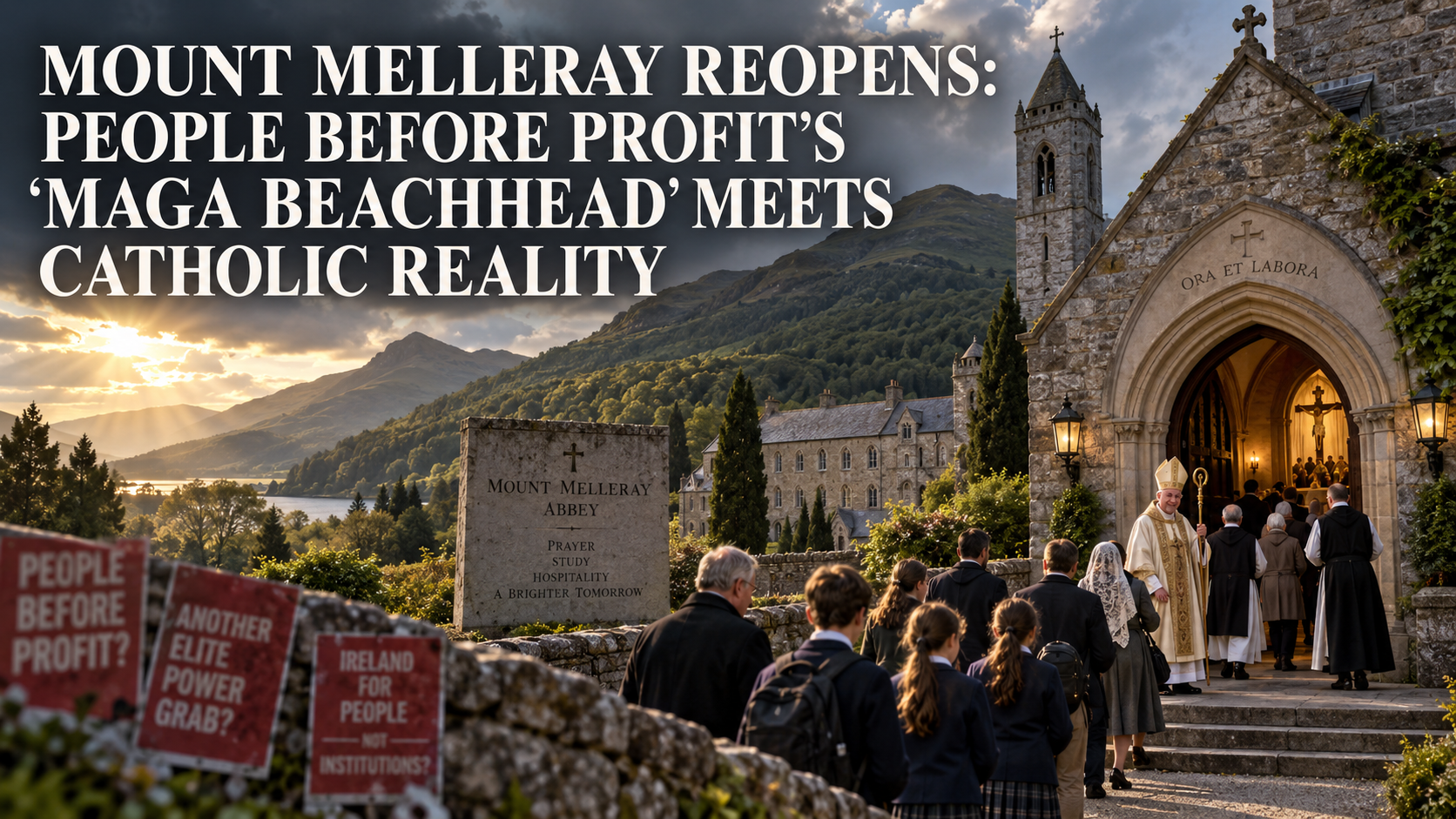
- MOUNT MELLERAY REOPENS: People Before Profit’s “MAGA beachhead” meets Catholic realityPeople Before Profit warned that Ave Maria University’s arrival at Mount Melleray would create a “MAGA beachhead” and has now demanded confiscatory taxation of Catholic property transactions. Yet the abbey has reopened with students, prayer, education and public worship. Behind the political rhetoric lies a more important question: when Ireland’s old religious communities can no longer sustain their foundations, must their patrimony inevitably be secularised?
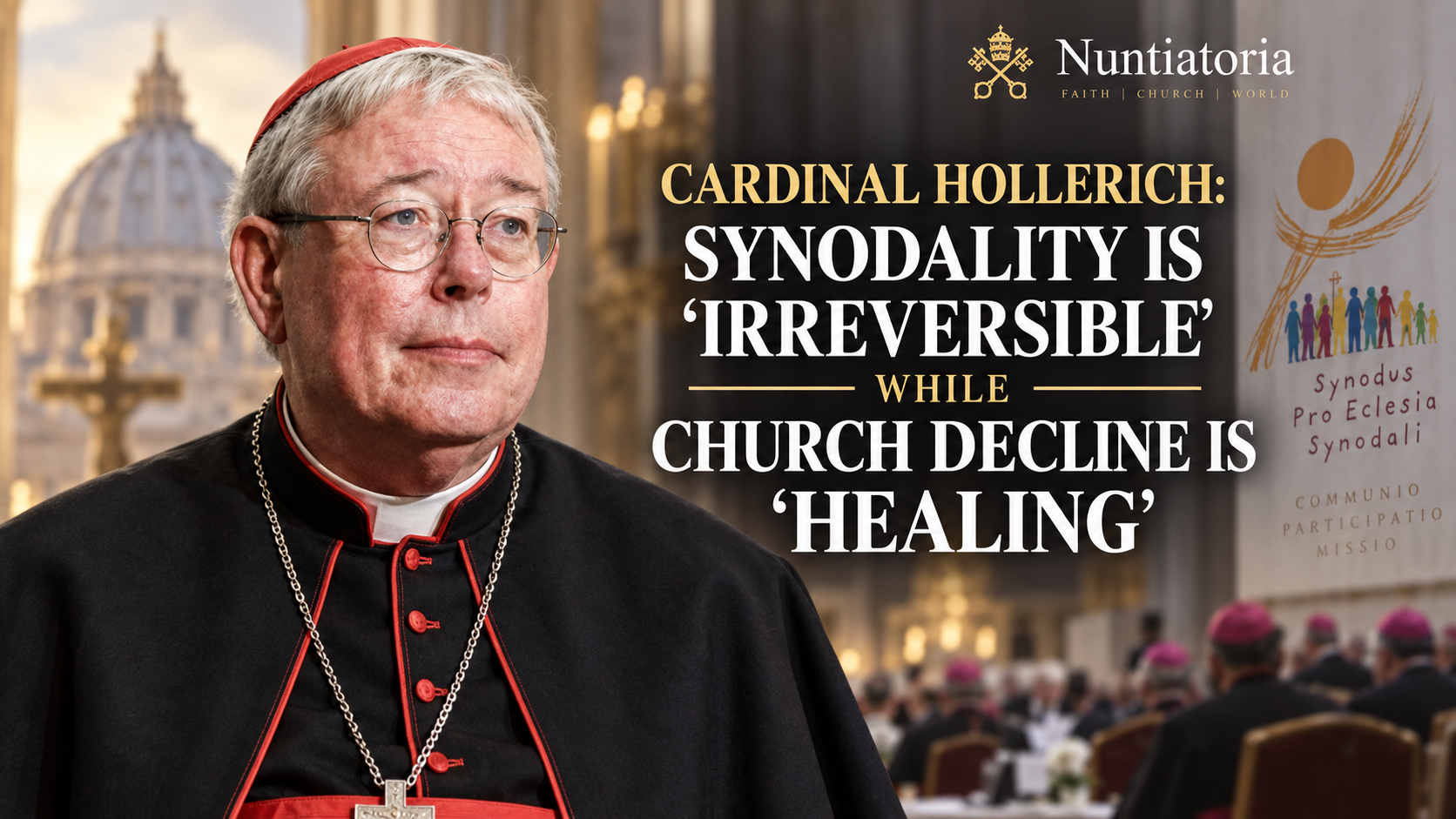
- Cardinal Hollerich: Synodality is “irreversible” while Church decline is “healing”Cardinal Jean-Claude Hollerich asserts that the synodal process initiated by Pope Francis is “irreversible”, viewing the decline in Catholic practice as a potential healing process. However, he warns against equating decline with justification. Evidence from France and Germany highlights the significant downturn in sacramental practice, urging a need for genuine evaluation of pastoral methods to ensure faithful transmission of the Faith.
- Cardinal Arborelius Faces New Evidence of Failure to Implement Vatican DecreeNew documentary evidence intensifies questions over the Diocese of Stockholm’s response to a Vatican decree declaring Fr Tobias Unnerstål’s suspension invalid. The affair has become a test not simply of one priest’s treatment, but of a more fundamental Catholic principle: whether canon law binds those exercising ecclesiastical authority as surely as those subject to it.
- Today’s homily: St Thomas of VillanovaThe homily reflects on the Gospel of Matthew, urging believers to actively use their God-given talents for good rather than burying them in fear or complacency. It illustrates the life of St Thomas of Villanova, emphasising mercy and service to the poor, reminding that true greatness lies in fulfilling one’s divine responsibilities.



Leave a Reply