
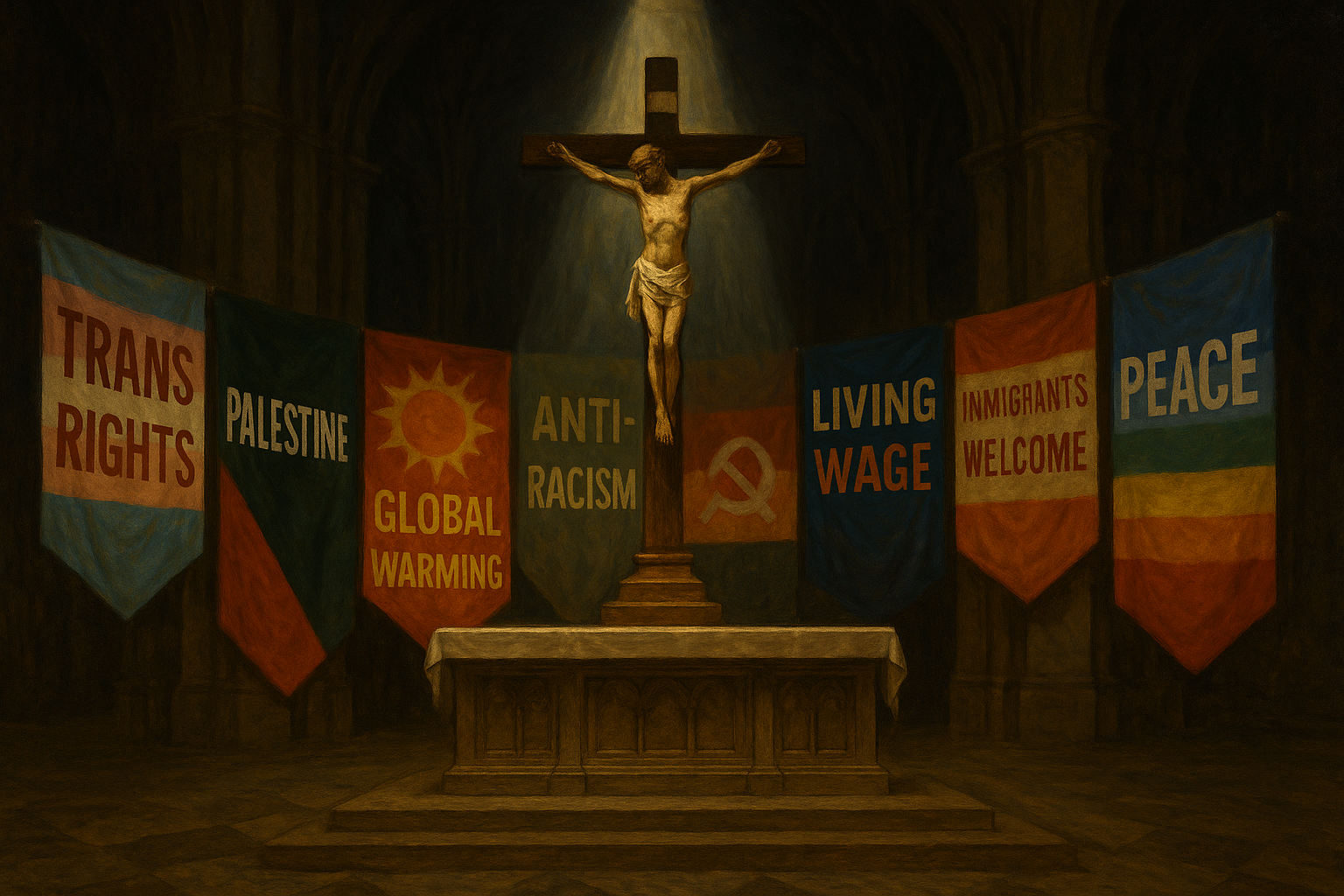
The Catholic Omnicause: From Moral Confusion to Ecclesial Compromise
In the modern world, everything has become a cause — and every cause, a creed. The age of belief has yielded to the age of belonging. Where once men sought truth, they now seek alignment. To be counted among the virtuous, one must march, post, and proclaim—preferably in unison. Every banner is linked to every other, for the spirit of the times insists that all wrongs are one and all truths negotiable.
This is the age of the omnicause: a single moral narrative woven from a thousand disparate threads — climate, race, gender, poverty, war. It is a faith without creed, a religion without revelation, and a solidarity without substance. Niall Gooch, in his lucid essay The Catholic Omnicause and the Danger of False Equivalence, diagnoses this disorder as both political and spiritual: the replacement of order with emotion, and of moral clarity with indiscriminate compassion.
Yet what Gooch observes in the political sphere has long since invaded the ecclesial. The Catholic omnicause has its own liturgy, its own slogans, and its own saints. Its theology is that of the seamless garment — a well-intentioned but fatally imprecise attempt to fuse every moral issue into one undifferentiated fabric of “life.” Proponents insist that one cannot defend the unborn without also campaigning for the living wage, open borders, or climate justice. The effect is predictable: the gravity of sin dissolves into the rhetoric of social care.
But the Church’s moral theology does not operate on the logic of slogans. The Magisterium teaches hierarchy, not homogeny. St John Paul II, in Evangelium Vitae §58, called abortion “particularly serious and deplorable,” precisely because it strikes at the foundation of all justice — the right to life itself. Cardinal Ratzinger, in his 2004 memorandum Worthiness to Receive Holy Communion, reaffirmed that “not all moral issues have the same moral weight.”¹² One cannot weigh murder against economic policy. To pretend otherwise is to exchange truth for symmetry.
Moral Equivalence Becomes Doctrinal Equivalence
The same false flattening now defines the Church’s approach to ecumenism. What was once a missionary enterprise — “that they may be one” — has become a diplomatic ritual. Unity is no longer sought in the confession of one faith, but in the embrace of all. The modern ecumenical movement, as practiced, is less about conversion than coexistence, less about reconciliation than relevance.
This drift was foreseen by Pius XI in Mortalium Animos (1928), who warned against those who “promote a federation of communities” in place of the one true Church.³ Yet in our day, the warnings have gone unheeded. The Church now invites her separated brethren to pray, speak, and even receive as though full communion were a matter of courtesy rather than creed. When Pope Leo XIV joins King Charles III in the Sistine Chapel for an “ecumenical prayer,” the symbolism is unmistakable: the altar of God is repurposed as the table of diplomacy.
Such gestures, while clothed in charity, reveal the same pathology as the omnicause. Just as moral relativism blurs the distinction between evil and error, ecclesial relativism blurs the distinction between the Church and the world. The Eucharist — once the sign of perfect unity — is wielded as an instrument of fraternity. The Cross, the sign of contradiction, becomes a token of consensus.
The Seamless Garment and the Frayed Faith
The irony of the “seamless garment” is that it unravels faith itself. By refusing to distinguish the greater from the lesser, the absolute from the contingent, it strips the Church of her prophetic voice. For prophecy requires discrimination — the ability to say this is sin and that is prudence. When every cause is a life issue and every faith a path to God, the supernatural order collapses into sociology.
Gooch’s warning against false equivalence applies equally to doctrine as to ethics. Just as not all wrongs are equally wrong, not all beliefs are equally true. Catholic social teaching presupposes Catholic faith; remove the faith, and social teaching becomes sentimentalism. Likewise, ecumenism without truth is not unity but confusion — an ecclesial humanitarianism that prefers harmony to holiness.
Restoring the Hierarchy of Truths
Authentic Catholic teaching recognises that the moral and doctrinal orders mirror one another: both rest upon divine proportion. Murder is worse than theft; apostasy is graver than error. To rank these rightly is not narrowness but justice. The Church’s task is not to balance all truths equally, but to keep them in their rightful order — sub ratione Dei.
The seamless garment, whether moral or ecclesial, must give way to the seamless robe of Christ — the unity of truth that was not torn even at the foot of the Cross. True unity begins not in negotiation but in conversion, not in consensus but in confession. The Church heals division not by broadening her boundaries, but by calling all to enter her fold.
The Cross Alone Stands Upright
In an age enthralled by activism and appeasement alike, the Church must recover her supernatural posture. The Cross stands not among causes, but above them; not as one light among many, but as the light that reveals all others as shadows. The world clamours for harmony; God demands holiness. And holiness begins by calling things by their right names.
Let the Church once more dare to distinguish: between life and death, between truth and error, between God and the world. For in the end, it is not our compassion that saves, but His Cross — standing alone amid the clamour of causes.
Footnotes
¹ Evangelium Vitae, §58 (1995).
² Congregation for the Doctrine of the Faith, Worthiness to Receive Holy Communion: General Principles (2004).
³ Pius XI, Mortalium Animos (1928), §§2–8.
⁴ John 14:6.



Leave a Reply