
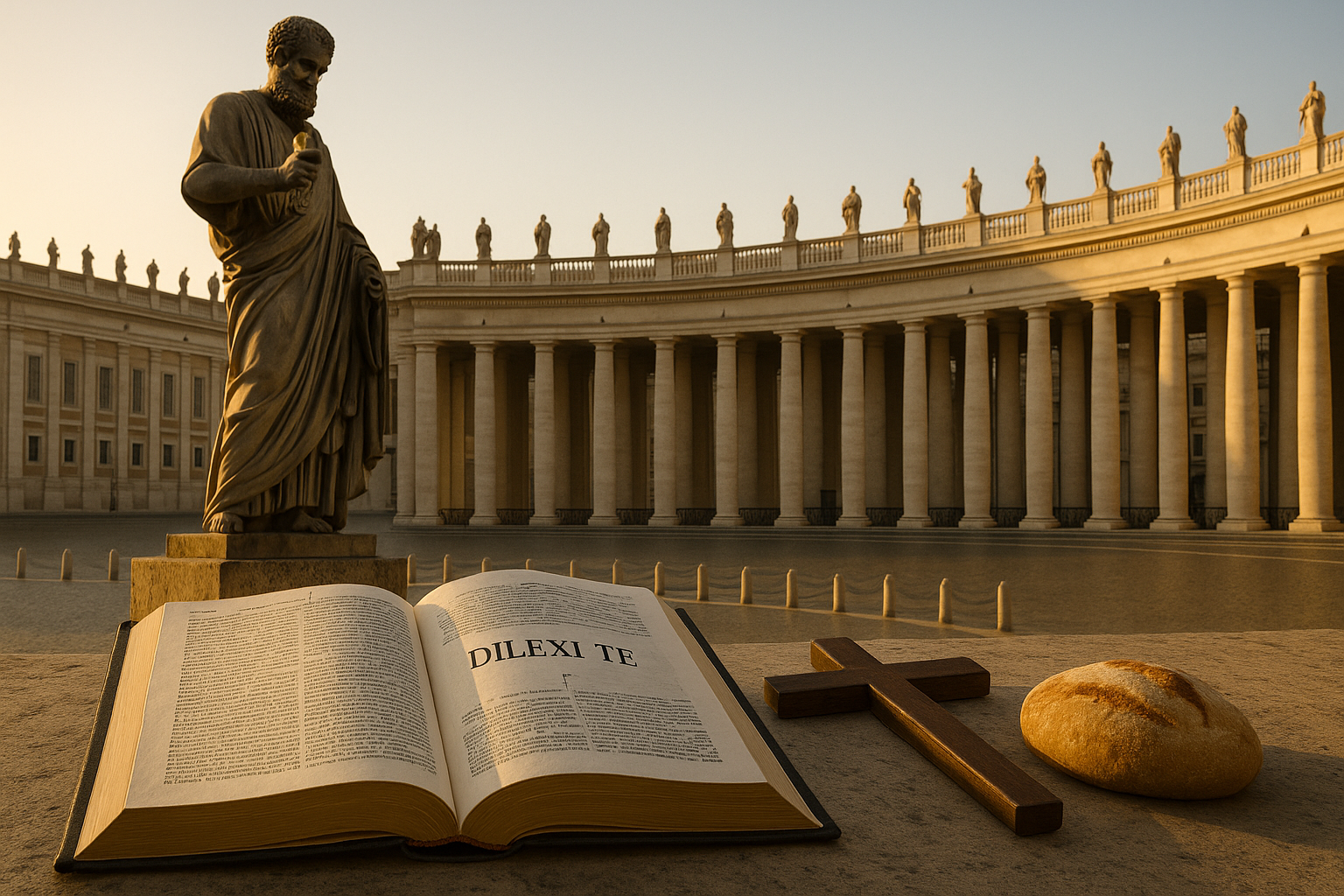
Dilexi te: Pope Leo XIV’s First Word to the Church
Pope Leo XIV’s first Apostolic Exhortation, Dilexi te—“I have loved you” (Rev 3:9)—opens his pontificate not with a programmatic statement but with a confession of faith. It is the voice of Christ addressed to His Church, a word of divine intimacy spoken to a world distracted by noise and division. In tone and substance, the document reveals a theology of love that stands in continuity with the Catholic tradition from the Fathers to the modern social magisterium.
Signed on 4 October 2025 and published five days later, the exhortation completes the work begun by Pope Francis under the draft title Dilexit nos (“He loved us”). Pope Leo acknowledges this inheritance but transforms it: “In continuity with my predecessor’s intention, I am happy to make this document my own, adding certain reflections appropriate to the beginning of my pontificate.”¹ The change of pronoun—from the collective nos to the singular te—is decisive. It signals a movement from general reflection to personal encounter, from social discourse to spiritual dialogue. The words are drawn from Christ’s promise to the Church of Philadelphia, “You have but little power, yet you have kept my word… I have loved you” (Rev 3:8-9). This choice situates the new Pope’s teaching within the mystery of divine condescension: God’s love revealed to the humble, not the mighty.
Faith and charity: an inseparable bond
At the heart of Dilexi te stands the conviction that love for Christ and love for the poor cannot be separated. “Contact with those who are lowly and powerless,” Leo writes, “is a fundamental way of encountering the Lord of history. In the poor, He continues to speak to us.”² The poor are not defined by economic status but by dependence—an image of the soul’s need for God. This spiritual anthropology echoes the patristic tradition. In the homilies of St John Chrysostom, the destitute were described as “the altars of Christ,” before whom believers must bow with reverence.³ For St Basil the Great, hoarded wealth was “the bread of the hungry,” while St Ambrose taught that “the earth was given to all, and not only to the rich.” These Fathers are not quoted by Leo but underlie his theology: charity is the form of justice because it reflects the self-emptying of the Incarnate Word.
Leo’s insistence on the inseparability of faith and charity recovers the realism of St James—“Faith without works is dead”—and of St Augustine, who wrote that the love of neighbour is the visible measure of the love of God. The Pope’s words, “Without love, nothing is valid, nothing is holy,”⁴ recall Augustine’s maxim that “if love is lacking, all else is vain.” The first chapter of Dilexi te thus restores the supernatural logic of Christian social concern: works of mercy are not human philanthropy but participation in Christ’s own compassion.
God’s preferential choice of the poor
The second movement of the document develops the “option for the poor” as a divine initiative, not a sociological policy. “By His Incarnation,” the Pope writes, “the Son of God became poor for our sake, so that by His poverty we might become rich.”⁵ Poverty here is not only material but mystical—the condition by which God draws near to humanity. Leo interprets this kenosis through St Paul’s teaching (2 Cor 8:9) and the patristic witness that the Creator stooped to the creature’s level in order to exalt him. St Gregory Nazianzen saw in the poverty of Bethlehem the first act of redemption: “He is made poor that I may be made rich.” For the Fathers, this inversion of human order revealed the divine order of mercy.
Pope Leo extends that theology to the modern world. The poor are not to be romanticised, still less instrumentalised, but recognised as the sacramental presence of Christ. In them, the mystery of the Cross is renewed. As in the preaching of St Leo the Great—his namesake—the Pope calls the faithful to contemplate in the suffering of others the face of the Redeemer: “The charity of Christ, poured into our hearts by the Holy Ghost, makes us all one body; and what each does for another, he does for himself.”⁶
Conversion before reform
A central theme of Dilexi te is the primacy of conversion over structural change. Leo warns that social evil is rooted in moral blindness: “There are those who think the poor are poor because they do not deserve otherwise. Such conceit cloaked as merit blinds the soul and hardens the heart.”⁷ He thus avoids the reduction of sin to systems, the error condemned in the CDF’s Libertatis Nuntius (1984). The Pope’s concern for justice is moral, not ideological. Structural sin is the extension of personal sin; reform must begin in repentance.
This teaching also stands in continuity with the patristic understanding of almsgiving as purification. St Cyprian described mercy to the poor as “the washing of sins”; St John Chrysostom said that “the merciful man is a harbour for those in distress.” The Fathers saw in generosity the sign of inner conversion—a theology revived in Dilexi te. Charity for Leo is not policy but penance, the visible fruit of metanoia.
The Church poor in spirit, rich in grace
In recalling the story of St Lawrence presenting the poor as “the treasures of the Church,”⁸ Leo unites liturgy and life. The Eucharist, he teaches, demands extension into charity: “If we do not serve Christ in His poor, our adoration of Him at the altar is incomplete.”⁹ The Pope’s insistence here harmonises with Chrysostom’s exhortation: “Do you wish to honour Christ’s body? Then do not neglect Him when you see Him naked.” The ancient Church never separated worship from mercy, and Dilexi te restores that synthesis. To feed the hungry is an act of orthodoxy; to adore without service is hypocrisy.
Governance and credibility: Coniuncta cura
Only days before issuing Dilexi te, Leo promulgated the motu proprio Coniuncta cura, reforming Vatican investment practice.¹⁰ The pairing of documents is symbolic: the same word, cura—care—governs both. Administration and compassion, stewardship and sanctity, are shown to belong together. The Pope teaches that charity must be truthful and truth charitable: “Justice without love becomes cruelty; love without justice becomes sentiment.” Though that line paraphrases his teaching rather than quoting it, the meaning pervades the text. A Church that preaches poverty must live transparency; integrity is the form of credibility.
Against Modernism: supernatural realism
Because Dilexi te speaks of social renewal, some commentators have questioned whether it inclines toward Modernism. Yet by every criterion of St Pius X’s Pascendi Dominici Gregis, the document resists that heresy. Modernism reduces revelation to experience and dogma to development; Leo grounds both in the Incarnation. His anthropology is not immanentist but Christocentric: grace precedes feeling, revelation judges culture, and salvation is supernatural. “Faith cannot be separated from love for the poor,” he writes, “for there our faith is tested.”¹¹ In that sentence, the word “faith” retains its traditional meaning—assent to objective truth—while “love” denotes the theological virtue by which man participates in God’s charity.
The Pope’s realism echoes that of the Fathers: the poor are not symbols but persons; divine love is not sentiment but action rooted in truth. His exhortation thus continues the line of Rerum Novarum, Quadragesimo Anno, and Deus Caritas Est rather than the secular ideologies of the last century. Where Modernism proclaims that man discovers God within himself, Dilexi te proclaims that God reveals Himself in the poor.
Conclusion
In his first major act as Supreme Pontiff, Leo XIV offers not a sociological treatise but a meditation on divine charity. Dilexi te invites the Church to be what she professes: the living continuation of the Word made flesh, poor in spirit yet rich in mercy. Like the early Christians described by St Ignatius of Antioch—“caring for the widows, rescuing the orphans, visiting the prisoners, and relieving the afflicted”—the faithful are called to manifest faith through love. The exhortation’s final line, “Without love, nothing is valid, nothing is holy,” gathers the whole Gospel in a single phrase. It is the voice of Christ through His Vicar, the same voice that once spoke to the little Church of Philadelphia: “I have loved you.”
Yet even as Dilexi te shines with clarity of doctrine and warmth of charity, it invites careful discernment. Its language of mercy, tenderness, and solidarity will inevitably be read through rival lenses. Those of a modernist temper will be tempted to treat it as a further vindication of the social-activist Church they have long sought to construct—a Church reduced to philanthropy, whose faith is measured by sentiment and whose hope is invested in earthly progress. Such a reading would betray the document’s supernatural core, mistaking its compassion for concession. The poor whom Leo exalts are not symbols of a new humanism but the living image of the Crucified; his call to reform is not ideological but penitential.
Traditionalists, for their part, may suspect that the continuity with Francis and the language of “structural sin” conceal yet another descent into ambiguity. They may fear that phrases such as “a Church of the poor” risk obscuring the divine priority of grace or diluting the Gospel in the language of sociology. Yet Dilexi te, when read in the light of tradition, resists that suspicion. Its theology is rooted not in horizontal activism but in the vertical mystery of the Word made flesh. The exhortation’s horizon is salvation, not sentiment; its energy is that of conversion, not accommodation.
It is precisely in this tension between compassion and conversion that the document’s true significance lies. Leo XIV’s first word does not abolish the work of his predecessor, but re-centres it. By placing the poor at the heart of the Church’s mission without displacing the Cross from its summit, he re-establishes the supernatural order that Modernism sought to dissolve.¹² If this exhortation indeed reflects the new Pontiff’s mind, the Church may discern in it a turning point—a light breaking through the clouds of the recent past, a movement away from confusion toward clarity, from sentimentalism toward sanctity.
For Dilexi te is not the echo of modern humanitarianism but the recovery of ancient faith. Its author speaks with the realism of the Fathers and the pastoral heart of the Gospel: a love that purifies, a truth that redeems. In these first words of Leo XIV, the Church may glimpse the promise of renewal.
Footnotes
¹ Dilexi te, §3 (Leo XIV, Apostolic Exhortation, 4 Oct 2025).
² Ibid., §6.
³ St John Chrysostom, Homilia 50 in Matthaeum, PG 58, 508.
⁴ Dilexi te, Final Benediction.
⁵ Ibid., §12 (cf. 2 Cor 8:9).
⁶ St Leo the Great, Sermo 6 de Quadragesima, PL 54, 285.
⁷ Dilexi te, §20.
⁸ Ibid., §18.
⁹ Ibid., §24 (cf. St John Chrysostom, Hom. in Matt. 50).
¹⁰ Motu Proprio Coniuncta cura, 29 Sept 2025.
¹¹ Dilexi te, §15.
¹² cf. Pascendi Dominici Gregis (1907), §38, on false compassion; see also Dilexi te, §§6–20 for the Pope’s corrective to sentimental humanism.



Leave a Reply