
Desecration and Reparation at St Peter’s: The Wounded Heart of Christendom
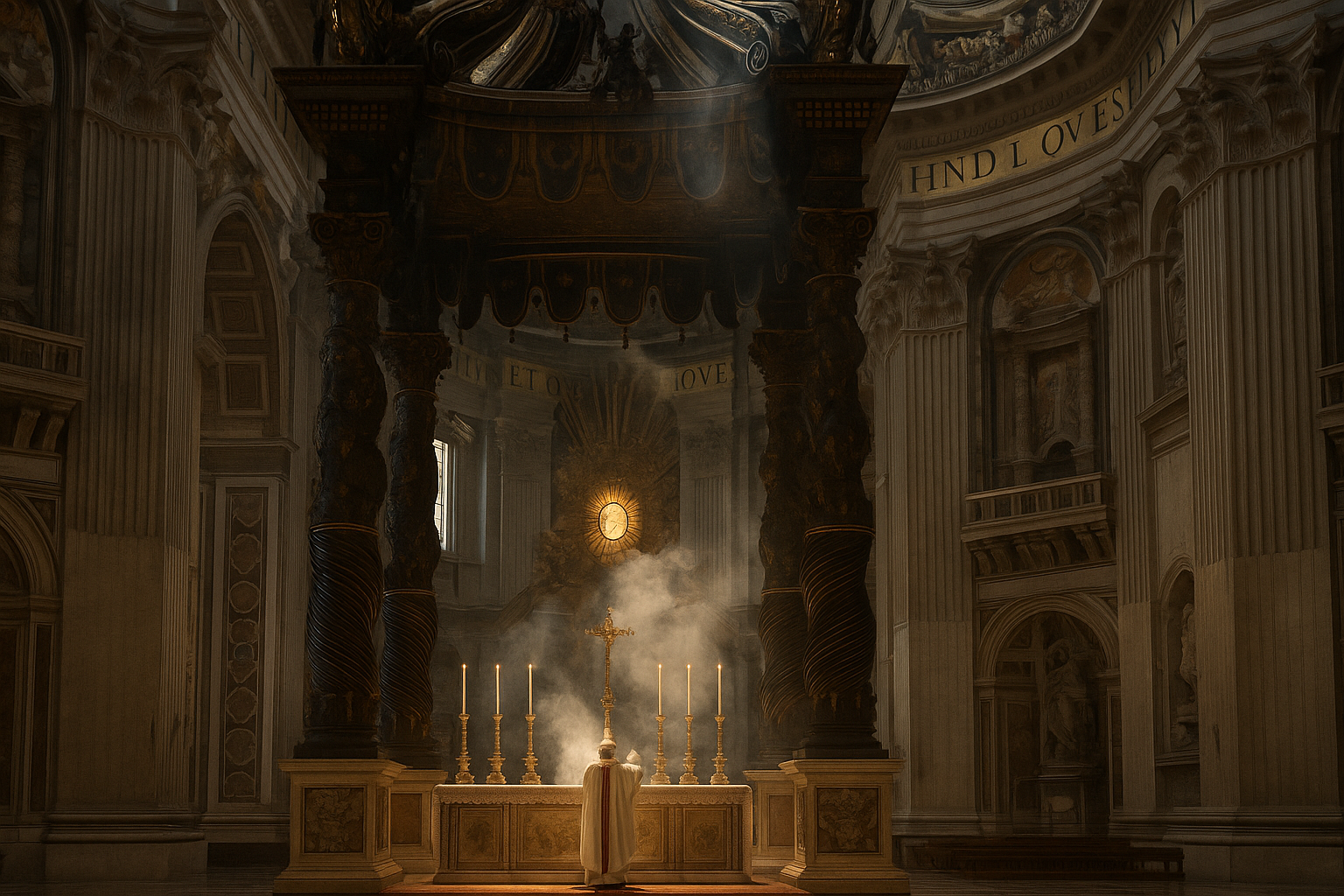
The marble splendour of Bernini’s baldachin—rising above the tomb of the Apostle Peter—has in recent years twice been profaned and twice reconsecrated through solemn acts of penitence. The most sacred altar in Christendom, the Altar of the Confession at St Peter’s Basilica, has become the stage for sacrilegious acts that reflect not only disorder in the world but also a diminished sense of the holy within the Church herself.
The most recent violation occurred on 10 October 2025, when a man ascended the high altar and urinated upon it in full view of pilgrims and tourists. The incident, filmed and widely circulated, provoked universal outrage. Three days later, on 13 October, Cardinal Mauro Gambetti, Archpriest of St Peter’s Basilica, presided over a solemn rite of reparation, sprinkling the altar with holy water and offering incense amid prayers of penitence and atonement¹. The rite, conducted in the presence of the basilica chapter, was intended to restore the altar’s sanctity, which the Church teaches is obscured by acts of grave irreverence.
This desecration followed an earlier incident on 7 February 2025, when a man, later identified as a Romanian national, climbed the same altar, removed the altar cloth, and threw six candlesticks to the ground before being apprehended². No public penitential rite was announced following that attack, though the faithful were invited privately to make reparation through prayer.
Further back, on 1 June 2023, a Polish protester stripped to the waist and climbed onto the high altar with the words “Save children of Ukraine” painted across his back. While Vatican authorities judged the act not to constitute formal desecration, Cardinal Gambetti nonetheless presided over a penitential rite of reparation on 3 June 2023, using holy water and incense as visible signs of purification³.
The Rite of Reparation
In Catholic theology, reparatio is an act of justice toward God, intended to make amends for offences committed against the sacred. When a church or altar is desecrated, its use for the Holy Sacrifice of the Mass is suspended until an appropriate rite of purification is performed. The Code of Canon Law (canon 1211) declares that sacred places desecrated “by gravely injurious actions done in them” may not be used again until “the ordinary, after consultation with experts, has determined that the offence has been sufficiently repaired.”⁴
The rite itself—traditionally called reconciliatio loci profanati—is not a pious gesture but a juridical and sacramental act of restitution. It may include:
– A penitential procession led by the bishop or archpriest;
– The sprinkling of holy water upon the altar and sanctuary, symbolising cleansing;
– The incensing of the altar, representing purification and intercession;
– The chanting of psalms of contrition and prayers of atonement;
– A concluding blessing and, often, the renewal of the Eucharistic Sacrifice upon the restored altar.
In the 2025 rite at St Peter’s, these elements were maintained in simplified form: holy water, incense, and prayer as the visible signs of purification and restitution.
The Meaning of Desecration and Restitution
In the theology of the Church, desecration is not a matter of emotion but of ontology. When an altar has been consecrated, it is no longer ordinary stone; it is sacer, withdrawn from profane use and irrevocably dedicated to the worship of God. To violate it is therefore to commit an objective offence, not against human feeling but against divine order. The injury remains even if no faithful witness it, for the act itself profanes what has been made holy.
The modern rites of reconciliation, pared down in the name of pastoral simplicity, risk obscuring this truth. By shifting the focus from the objective restoration of sanctity to the subjective contrition of the community, they blur the essential distinction between penance and reparation. Acts of penance are for sinners; acts of reparation are for the sanctuary. The guilty party is the perpetrator, but the wound belongs to the Church, whose sacred things have been violated. She therefore acts not as penitent but as custodian and restorer—performing, through her ministers, a juridical and sacramental purification of what has been desecrated.
In the traditional rites, this theology was visible. The bishop would wash the altar with water and wine, anoint it anew with holy chrism, incense it, and recite long prayers of expiation. These were not mere symbols but operative signs—intended to effect what they signified: the re-sanctification of a place that had objectively lost its fitness for divine worship. In the simplified post-conciliar forms, such visible and efficacious acts have too often been replaced by brief blessings and moral exhortations. Yet the reality of desecration does not lessen for lack of ceremony, nor is the offence repaired by sentiment. Only the objective restoration of the sacred can heal an objective wound to holiness.
Before and After the Council
Before the liturgical reforms of the Second Vatican Council, the Church’s ritual for reconciling a desecrated church or altar was lengthy and precise. The 1952 edition of the Pontificale Romanum directed that the bishop, vested in cope and mitre, should wash the altar with water and wine, anoint it with chrism, and burn incense upon it while reciting the Litany of the Saints⁵. The rite might continue for hours and included the re-anointing of the church’s walls and the sealing of relics within the altar stone.
After the Council, these rites were replaced by the 1977 Ordo Dedicationis Ecclesiae et Altaris, which merged dedication and reconciliation into a single framework. The bishop may now employ a shorter ritus reconciliationis, omitting the anointings, litanies, and re-sealing of relics, and focusing instead on penitential psalms and prayers. The reformers emphasised interior conversion and simplicity, but in doing so weakened the visible witness to the ontological reality of sacredness—that a thing once consecrated truly belongs to God and cannot be treated as common without consequence.
The Deeper Meaning
Every act of desecration wounds the visible expression of the Church’s faith in the Real Presence. The altar—Christ Himself, Priest and Victim—becomes the stage for defiance of the sacred. Yet the rite of reparation, however reduced, still proclaims that grace restores what sin destroys. The purification of marble mirrors the purification of souls; the cleansing of the altar calls all the faithful to repentance.
In an age that trivialises holiness, the sight of incense curling again around Bernini’s columns serves as both rebuke and consolation: a rebuke to a world that no longer trembles before God, and a consolation to those who still do. For though men may desecrate the altar, the sacrifice it bears cannot be undone—
Christus hostia nostra, immaculata et sempiterna—Christ our Victim, pure and eternal.
¹ Catholic News Agency, Cardinal presides over act of reparation in St Peter’s following desecration of altar, 13 Oct 2025.
² Catholic News Agency, Man attacks high altar of St Peter’s Basilica at the Vatican, 7 Feb 2025.
³ Catholic Review, Act of reparation performed on altar of St Peter’s Basilica, 3 Jun 2023.
⁴ Codex Iuris Canonici (1983), can. 1211.
⁵ Pontificale Romanum – De Reconciliatione Ecclesiae Profanatae (Ed. typ. 1952).



Leave a Reply