
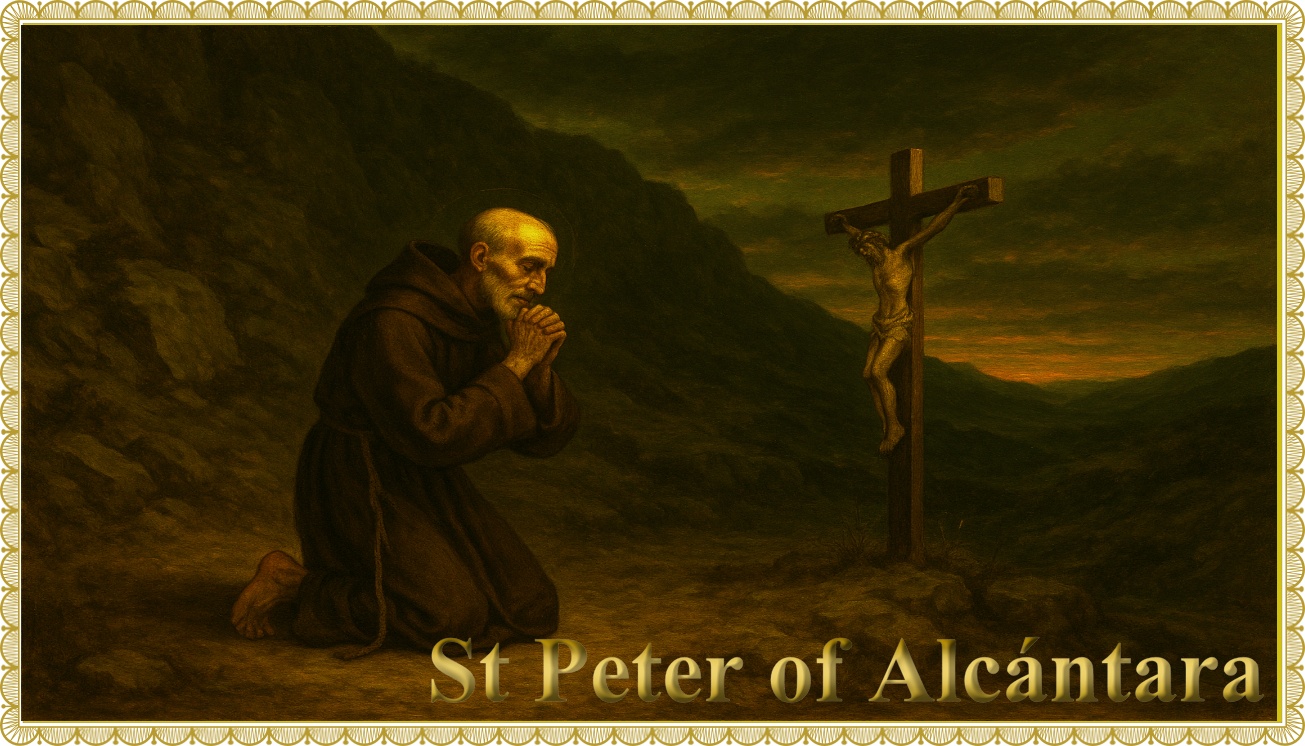
Feast of Saint Peter of Alcántara, Confessor (Oct 19):
Missa “Justus ut palma florebit”
Saint Peter of Alcántara, born in 1499 in the rugged province of Estremadura, Spain, was a man of prayer and penance raised by God in an age of turmoil. From his earliest youth, he sought solitude and austerity, preferring silence to speech and prayer to play. At sixteen he entered the Franciscan friary of Manjarez, exchanging noble comfort for the poverty of Christ. His humility and zeal soon marked him for reforming the Franciscan Order itself, and through him the Lord renewed among men the forgotten glory of the Cross.¹
A Saint of the Catholic Reform
At a time when much of Christendom was divided by heresy and weakened by worldliness, Peter became a living sermon of penance. Having first joined the Conventual Franciscans, he transferred to the Observants for a stricter life, and eventually founded the Recollects of St Peter of Alcántara—a reform that returned to the very marrow of the Franciscan Rule: poverty, fasting, silence, and prayer.² His friaries became true deserts of contemplation, their walls bare, their cells narrow, their altars adorned only by the crucifix. The friars possessed nothing, ate little, and spoke less. Their joy came from prayer and from the Mass—the one treasure that endures when all else is stripped away.³
Saint Peter himself was the exemplar of this reform. His bed was a wooden board, his food a crust of bread, his cell scarcely large enough to stretch his body. Yet he glowed with joy and charity, teaching that “a soul that is crucified to the world is the most free.” In the stillness of night, he would pass hours in adoration before the Blessed Sacrament, entering into the mysteries of Christ’s Passion and learning from them the sweetness of suffering.⁴
The Liturgy and the Saint
The Mass for his feast begins with the words “Justus ut palma florebit: sicut cedrus Libani multiplicabitur” — “The just shall flourish like the palm tree: he shall grow like the cedar of Lebanon.”⁵ The liturgy thus reveals the hidden meaning of Saint Peter’s austerity. Outwardly he seemed to wither through penance, yet in the eyes of God he flourished like a tree planted by living waters. The palm symbolises victory through endurance, and the cedar signifies steadfastness of virtue—both fitting images for a man who conquered the flesh and drew souls heavenward.
The Collect of the day prays that “through his intercession we may despise earthly delights and ever rejoice in the partaking of heavenly things.”⁶ It reflects perfectly his life: he who renounced all comforts found a joy unknown to the world, because he had entered into the joy of the Cross. In his Eucharistic devotion, he anticipated what the Church celebrates daily in the Holy Sacrifice—the transformation of suffering into sanctity, of offering into love.
The Gradual, “Beatus vir qui timet Dominum”—“Blessed is the man who fears the Lord”—expresses his wisdom. Fear of the Lord, for Saint Peter, was not terror but reverence: a filial awe that makes the soul gentle, recollected, and faithful. His perpetual adoration of the Eucharist was the fruit of that holy fear; his silence was its safeguard.
A Friend of Saints and the Voice of Reform
Saint Teresa of Ávila wrote of him in words that themselves seem part of the liturgy:
“He seemed to have triumphed over his body and to have placed it wholly under the dominion of his spirit. His penances were so great that it appeared impossible he could live; and yet he was always cheerful and pleasant.”⁷
To Teresa, he was the visible sign of the ideal she sought for the Carmelites—a man wholly possessed by God, living the Mass rather than merely attending it. Peter guided her reform with the same spirit that had guided his own, reminding her that “the reform of others begins with the reform of oneself.” He died in 1562, the same year Teresa founded her first reformed convent at Ávila, and she later saw his soul ascending to Heaven at the moment of his death.⁸
The Eucharistic Pattern of His Life
Saint Peter’s life mirrors the pattern of the Holy Sacrifice. In his humility he lived the Offertory, presenting himself wholly to God. In his fasting and mortification he entered the Canon, uniting his sufferings to Christ’s. And in his joy and serenity he lived the Communion, where the soul, purified by love, rests in divine peace. For this reason, his austerity is not merely moral but mystical; it was the outward expression of an inward Eucharistic life.
His own words capture this theology of sacrifice:
“The more thou mortifiest thyself, the more thou lovest; and the more thou lovest, the more thou art purified.”⁹
Here lies the secret of his joy: he had made his whole being an altar, and upon it he offered not only his labours but his will.
The Enduring Lesson
Saint Peter of Alcántara stands before every generation as a corrective to spiritual laziness and a sign of hope to the penitent. He proves that sanctity is not the privilege of the learned or the powerful but the fruit of total surrender. His example calls the Church back to the discipline of the altar—to that humble reverence which once shaped the whole of Christian life.
Thus, when the Church chants the Communio of his Mass—“Amen dico vobis, quod vos qui reliquistis omnia, et secuti estis me, centuplum accipietis” (“Amen I say to you, that you who have left all things and followed Me shall receive a hundredfold”)¹⁰—the words are fulfilled literally in him. He left all, and gained all: the Cross, the joy, and the peace that the world cannot give.
¹ Fr. Candide Chalippe, The Life of St. Peter of Alcantara (Dublin: James Duffy, 1864), pp. 3–5.
² Ibid., pp. 55–59.
³ Rev. Alban Butler, The Lives of the Fathers, Martyrs, and Other Principal Saints, Vol. X (London: Virtue & Co., 1866), p. 279.
⁴ Chalippe, Life, p. 91.
⁵ Psalm 91:13 (Vulgate).
⁶ Collect for the Feast of Saint Peter of Alcántara, Missale Romanum (1962).
⁷ St. Teresa of Avila, The Life of St. Teresa of Jesus, trans. David Lewis (London: Thomas Baker, 1904), ch. 27, p. 219.
⁸ Ibid., p. 224.
⁹ Chalippe, Life, p. 137.
¹⁰ Matthew 19:28 (Vulgate).



Leave a Reply