
Rome’s Photo-Op Communion: The Sacrament as Statecraft
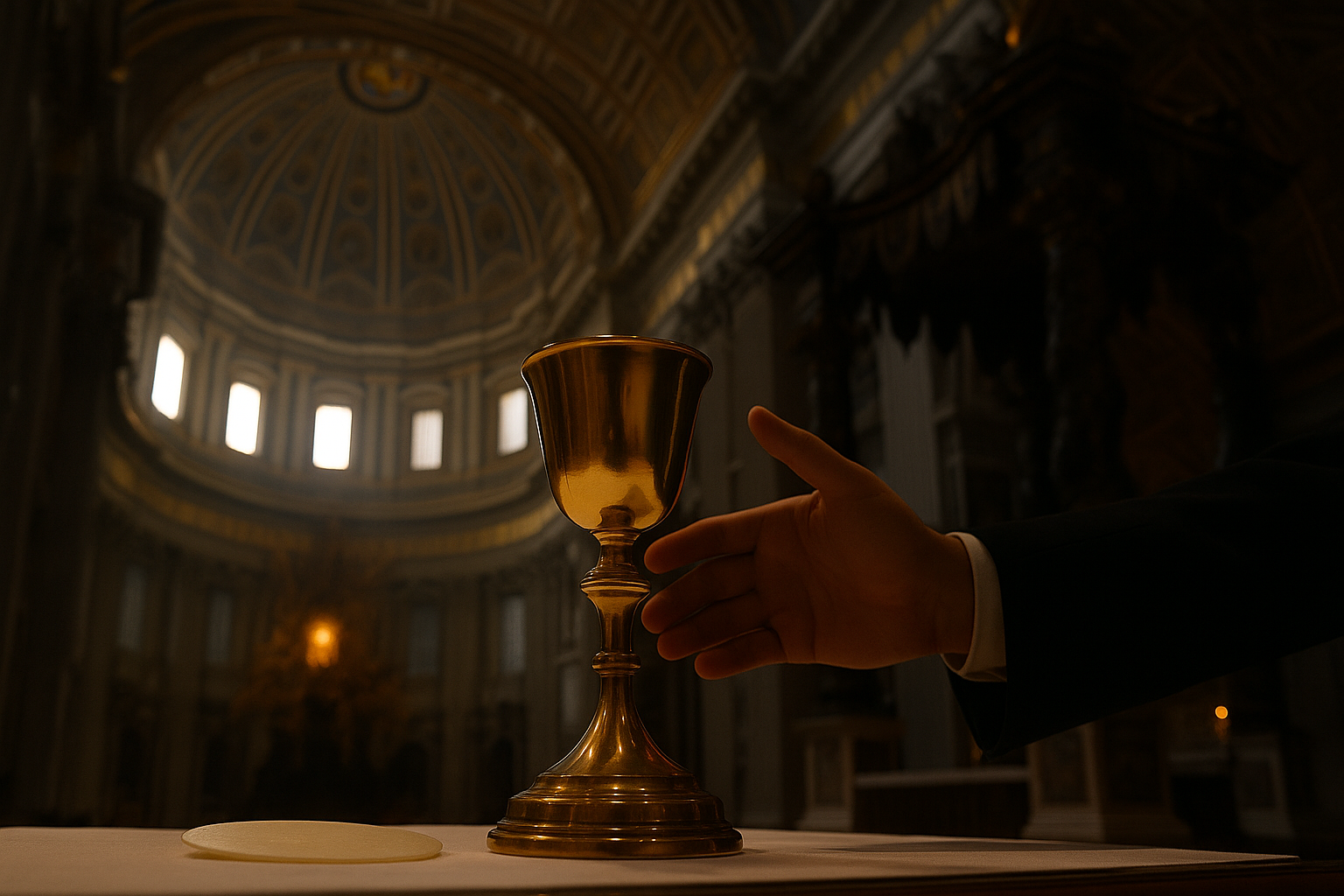
When Armenia’s Prime Minister, Nikol Pashinyan, stepped forward to receive Holy Communion at the canonizations in St Peter’s, the cameras lingered. The image was not one of a penitent communicant, but of a statesman in a choreographed act of reconciliation. Pashinyan, though a member of the Armenian Apostolic Church, was publicly communicated in the Roman Rite—an act canon law reserves only for rare, personal circumstances.
The Eucharist, the very mystery of unity in the Body of Christ, became an emblem of diplomatic concord. Its reception was presented as the natural conclusion of mutual goodwill, rather than the fruit of conversion or confession of the same faith. The political potency of such an image was obvious: in one gesture, Rome appeared magnanimous, Armenia appeared honoured, and the watching world saw a Church reconciled with history. But what was gained in appearance was lost in meaning.
Canon Law and the Exception That Swallowed the Rule
Canon 844§4 grants a narrow provision for certain Eastern non-Catholics who approach of their own accord, are properly disposed, and manifest Catholic faith in the sacrament. It was intended for those in genuine necessity, not for televised spectacle. The 1993 Directory for the Application of Principles and Norms on Ecumenism explicitly warns that these exceptions are pastoral and private—“never for the sake of mere ceremony or courtesy.” When a pope or his ministers distribute Communion to those visibly outside full communion, the exception becomes the norm, and the norm becomes meaningless.
Such gestures have their precedent in a new theology of diplomacy: the Eucharist as instrument of “fraternal encounter.” But the early martyrs died precisely to avoid the ambiguity such acts now celebrate. To consume the Body of Christ without confessing the Faith of Christ was once considered sacrilege; today, it is applauded as sensitivity.
The Canonizations and Their Contradiction
The canonization of an Armenian martyr of 1915—a victim of hatred against Christ and His Church—was meant to exalt fidelity unto death. Yet the same ceremony blurred the boundaries that defined the martyr’s sacrifice. How strange that the Church should honour those who died rather than deny the Faith, while simultaneously implying that confession of that same Faith is optional at her own altar.
In a single liturgy, Rome achieved what politics could not: a symbol of reconciliation, but also a symbol of doctrinal retreat. The Eucharist, once the test of truth, now serves as the gesture of goodwill. The sacrament that unites heaven and earth was reduced to the lingua franca of international diplomacy.
From Doctrine to Diplomacy
Modern Rome’s pastoral instinct is to dissolve dogmatic lines into gradients of dialogue. The result is predictable: clarity yields to choreography. A century ago, Mystici Corporis Christi defined the Church as “a society of men, united in faith, sacraments, and government.” Today, that unity is often staged for optics rather than lived in truth. A Church eager to appear universal risks forgetting what universality actually means—unity in the confession of the one, holy, catholic, and apostolic Faith.
If communion means communion, Rome should act like it. If it does not, the word has been evacuated and the sacrament politicized. Nothing erodes Eucharistic faith faster than bishops who treat intercommunion as a courtesy rather than a confession.
A Warning for the Faithful
For the faithful who still kneel in belief before the mystery of the altar, such gestures are not progress but profanation. They obscure the line between fides et diplomatia—between what belongs to God and what belongs to Caesar. The Eucharist cannot serve two masters: one of truth, one of optics. To use the Body of Christ as the currency of interreligious goodwill is to forget that unity with Rome means unity in the Faith, not unity before the cameras.
The faithful are left confused, even scandalized. The sense of the sacred—the awe that guards against sacrilege—wanes when the Church herself appears indifferent to her own discipline. When the holiest gift becomes a prop for politics, the altar ceases to be the throne of the Lamb and becomes the platform of men.
Rome’s Royal Courtesies
The same pattern emerged in Rome’s recent gestures toward King Charles III. Once again, the Holy See exchanged dogmatic clarity for diplomatic symbolism. A monarch who remains the Supreme Governor of a church Rome has declared void of apostolic orders was received with a reverence that implied sacramental equivalence. What Canon 844 does in practice, papal protocol now does in public: it blurs the distinction between communion and courtesy.
The image of a pope and a Protestant sovereign praying together in the Sistine Chapel would once have evoked the hope of conversion; today it signals contentment with separation. This is not the unity for which Christ prayed, but the appearance of unity that pleases the world. The Church of Rome, once the rock of certainty, risks becoming the mirror of sentiment—a Church that reflects the diplomacy of nations rather than the kingship of Christ.
Such spectacles feed the modern illusion that peace can be maintained by ambiguity. But true peace is the fruit of truth, not its substitute. The more Rome confuses these, the more the faithful must hold fast to what is unchanging: that Communion is not an act of civility but a profession of faith.
A Church of Optics or of Truth?
The tragedy of these ecumenical gestures is that they mask genuine hope for conversion with superficial harmony. The Church’s mission is not to make unbelief comfortable but to make truth known. Her unity is not negotiated—it is revealed and received in the same Christ who is both Victim and Priest. When His Body is offered for applause, the Church forgets what that Body suffered to make her holy.
The faithful should pray for Rome to recover her courage: to speak as she once did, to act as she once believed, and to remember that the world does not need a Church of diplomacy, but a Church of doctrine.
¹ Code of Canon Law, c. 844 §§ 3–4.
² Pontifical Council for Promoting Christian Unity, Directory for the Application of Principles and Norms on Ecumenism (1993), n. 130.
³ Pope Pius XII, Mystici Corporis Christi (29 June 1943), § 22.
⁴ Pope Leo XIII, Apostolicae Curae (13 September 1896), §§ 36–40.







Leave a Reply