
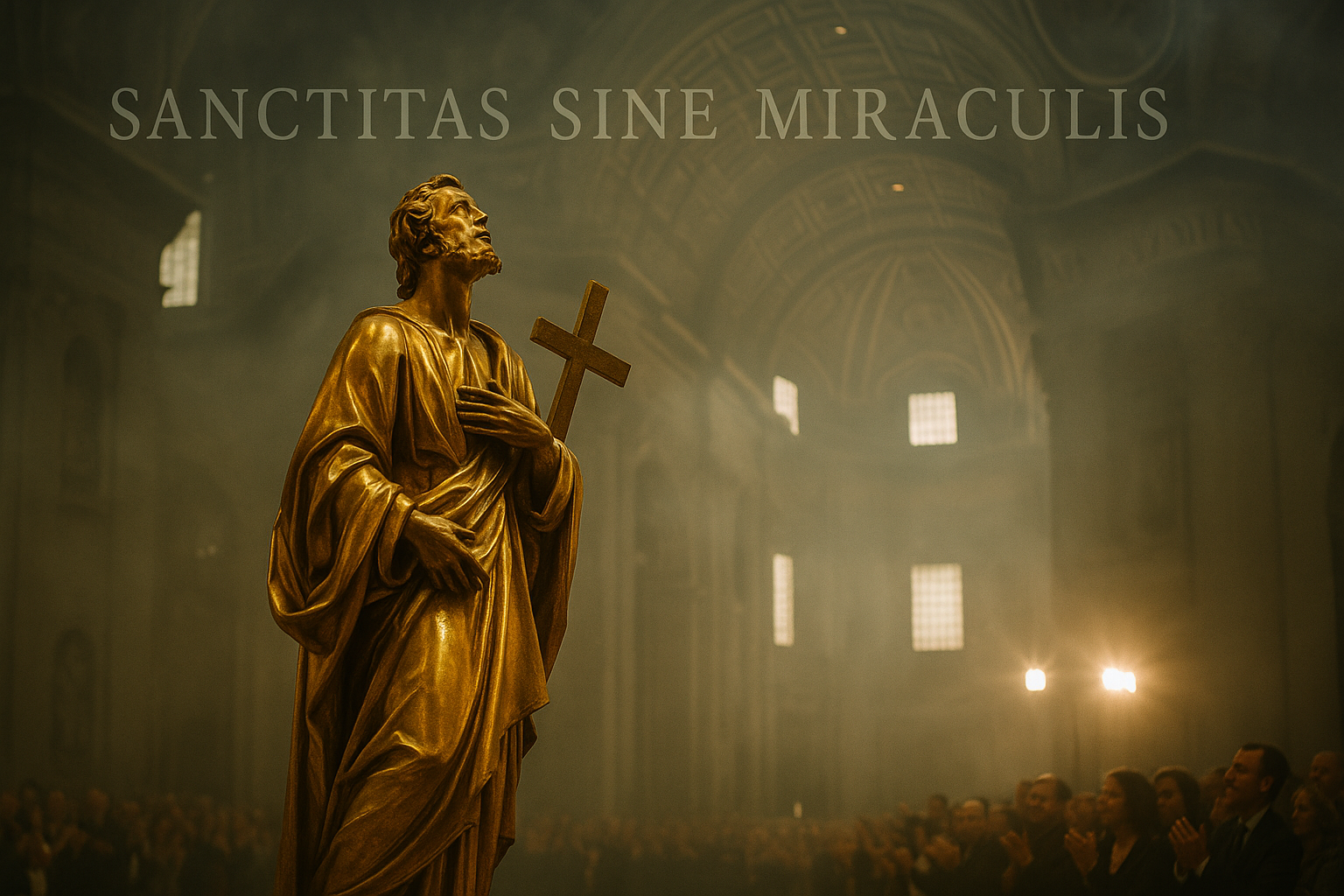
Saints Without Miracles, Popes Without Faith
Leo XIV’s canonizations mark the triumph of the new religion—miracles optional, dogma unspoken, and faith redefined as feeling.
The Age of Symbolic Sainthood
Sainthood once meant divine certitude: the Church’s most solemn declaration that a soul was in heaven and worthy of universal veneration. Today, canonization has become an act of symbolism—an expression of the Church’s desired self-image rather than heaven’s verification. Pope Leo XIV’s canonizations on October 19, 2025—of Bartolo Longo and José Gregorio Hernández—mark the latest stage in that transformation.
Bartolo Longo’s life was once the very pattern of a penitential saint. Born in 1841 near Brindisi, he fell into occultism while studying law at Naples, even claiming to have been “ordained” in a satanic ritual. A Dominican friar brought him back to the faith; Longo spent the rest of his life in expiation—founding the Shrine of Our Lady of the Rosary at Pompeii, promoting the Rosary, and serving the poor. Traditionally, such a conversion would have demanded decades of scrutiny. Instead, Leo XIV canonized him without the second miracle that the old law required.
The same day, the Pope raised to the altars José Gregorio Hernández, the Venezuelan “doctor of the poor.” A scientist, philanthropist, and devout Catholic, Hernández lived heroically, dying in 1919 after being struck by a car while serving a patient. Yet his veneration has long been intertwined with the María Lionza cult of spirit possession, where mediums claim to channel his ghost to “write prescriptions.” Anthropologists have documented this for decades, and Rome is aware. Nevertheless, the canonization proceeded, justified by “popular devotion.” Two saints of indisputable virtue—but two causes elevated more for narrative and national symbolism than for the rigorous standards that once defined infallible judgment.
From Trial to Testimony: The Lost Certainty of the Old Church
For centuries, canonization was not an accolade but a trial. Urban VIII’s decrees and the 1917 Codex Iuris Canonici demanded four verified miracles, two formal judicial processes, and the merciless scrutiny of the Promotor Fidei, the “Devil’s Advocate.” Nothing began until fifty years after death. Beatification gave a local cult; canonization required new miracles and granted universal veneration.
This adversarial procedure was not bureaucracy—it was theology in practice. Miracles were heaven’s countersign to the Church’s claim of infallibility. The process was slow precisely because canonization was understood to be divinely certain.
That changed in 1983, when John Paul II promulgated Divinus Perfectionis Magister. The reforms halved the required miracles, reduced the waiting period from fifty years to five, transferred much responsibility to local dioceses, and replaced the Devil’s Advocate with a cooperative “Promoter of Justice.” Holiness became “pastoral,” saints “models for our time.” Between 1588 and 1958 there were around 300 canonizations; since 1983 there have been over 1,700. As one writer quipped, “holiness went into mass production.”
Critics of Speed and Simplification
Traditional theologians, canonists, and even sympathetic Vatican observers have voiced concern. Unam Sanctam Catholicam compared the old and new systems and concluded that “the integrity of the contemporary procedure is lessened.”¹ The Society of St. Pius X has repeatedly warned that abolishing the adversarial element—the office designed to destroy the case if it could—undermines moral certainty: “It is not that modern canonizations are invalid, but the process no longer guarantees the same assurance of infallibility.”²
Others speak of a shift from trial to marketing. Religion Unplugged captured the mood in its essay *From Martyrdom to Marketing: Is There a Canonization Crisis?*³
“What’s happening now is a recalibration of the holy toward visibility, media appeal, and emotional resonance.”
In this view, canonization has become a tool of image management, rewarding visibility and relatability rather than the old tests of sanctity. The saints of today are those whose stories “translate well” to the digital age—social reformers, activists, and global figures—rather than mystics or martyrs.
Even Catholic scholars sympathetic to the reforms worry that the faithful no longer understand what canonization means. Theologian Charles Camosy asked whether modern canonizations have “lost their eschatological weight,” becoming inspirational but not infallible acts.⁴ Another commentator in Catholic Moral Theology posed the blunt question: “Is canonization largely irrelevant? The assumptions governing it no longer operate for most Christians.”⁵
The Canonization of an Era
The clearest evidence of this trend came when Pope Francis canonized John XXIII and John Paul II together in 2014, and later Paul VI in 2018. The rules bent each time—John XXIII’s second miracle waived, John Paul II’s waiting period suspended, Paul VI’s process expedited. Even secular journalists called it “the canonization of Vatican II.” Each of those popes represented a stage of the conciliar revolution: John XXIII convened it, Paul VI implemented it, John Paul II globalized it. Their sainthood became the Council’s self-canonization.
As Unam Sanctam Catholicam and others noted, this was less the Church declaring God’s verdict than the modern Church vindicating itself. The theological logic had reversed: infallibility once restrained novelty, now it was used to ratify it.
When Miracles Become Optional
The canonizations of Bartolo Longo and José Gregorio Hernández continue that pattern. Both causes were propelled by popular devotion, national pride, and pastoral tone rather than forensic rigor. Hernández’s cult—already blurred by folk religion—was incorporated as “inculturation.” The supernatural verification of miracles, once the decisive test, became optional.
Even defenders of the new method concede that the Church now relies more on “moral certainty” than “miraculous evidence.”⁶ As a result, the process now depends on credibility and media sympathy rather than divine intervention. The danger, as traditionalists warn, is that sainthood risks becoming a form of ecclesial branding: holiness as public relations.
Faith Turned Horizontal
Leo XIV’s homily for the canonizations confirmed the new theology. He described the saints as “authentic men and women,” praised them as “benefactors of humanity,” and proclaimed that “the Cross reveals God’s justice, and God’s justice is forgiveness.” It was eloquent, compassionate—and unmistakably anthropocentric.
Faith was redefined as “the bond of love between God and man.” Absent were references to dogma, the Creed, grace, or the necessity of the Church and sacraments. The Cross, once the altar of atonement, became a symbol of divine empathy. Sin was reframed as suffering; salvation, as therapy.
This is what many theologians now call the “horizontal turn” in sanctity. Religion Unplugged notes that modern saints are portrayed as “fellow travelers of humanity” rather than mediators between heaven and earth.⁷ The shift mirrors the wider post-conciliar trend: transcendence exchanged for immanence, reparation replaced by authenticity.
Holiness Without Hierarchy
The new language of sainthood emphasises compassion and accessibility—virtues noble in themselves but ambiguous when detached from transcendence. What the old Church called reparation, the new Church calls authentic selfhood.
In older canonizations, the faithful were warned of sin’s terror and heaven’s glory. Now they are encouraged to “stay positive.” The faith once defined by martyrs and mystics has been rewritten as moral optimism.
From the traditional perspective, the crisis is not merely about saints but about faith itself. Once the Devil’s Advocate was silenced, the Church lost its inner voice of doubt—the one charged to ask, Are we sure?
Conclusion: The Silence of Certainty
Bartolo Longo and José Gregorio Hernández may indeed be saints. The problem lies not in their holiness but in the method that declared it. Canonization has become the Church’s way of congratulating itself—where miracles are optional, procedure pliable, and faith emotional.
As one theologian warned:
“If the saint is no longer the sign of heaven breaking into history, he becomes merely a moral exemplar. And when miracles vanish, so does the supernatural horizon of the Church.”⁸
Somewhere in the Vatican offices where the Promotor Fidei once stood, that silence remains—the silence of certainty unspoken, of truth politely avoided, of heaven waiting to be asked for a sign.
¹ Unam Sanctam Catholicam, “Canonizations Old vs. New: A Comparison” (2022).
² SSPX News, “Santo Subito? The Problems of Modern Canonization” (2020).
³ Religion Unplugged, “From Martyrdom to Marketing: Is There a Canonization Crisis?” (April 2025).
⁴ Charles Camosy, Fordham University, “Canonization and the Loss of Transcendence” (lecture, 2024).
⁵ Catholic Moral Theology Blog, “Is Canonization of the Saints Irrelevant?” (2023).
⁶ Catholic Review, “Declaring Saints: How the Canonization Process Works” (2024).
⁷ Religion Unplugged, ibid.
⁸ Anonymous canonist quoted in Unam Sanctam Catholicam, op. cit.






Leave a Reply