
The Honour and the Heresy: The Vatican’s Empty Ecumenism and the Betrayal of Pius IX
A pageant seven centuries in the making
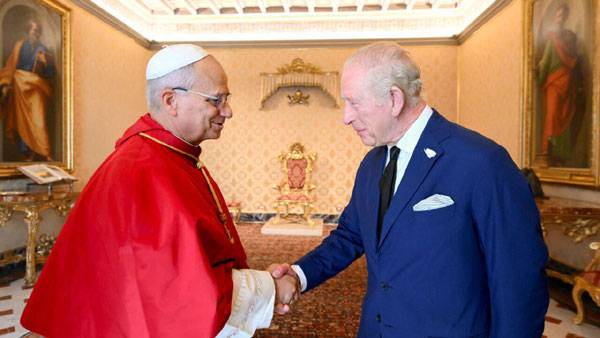
On 23 October 2025, history was made—or at least choreographed—in Rome. King Charles III and Queen Camilla arrived at the Vatican for what was hailed as an unprecedented day of “Christian unity.” Vatican News described the occasion as “a historic moment in Anglican-Catholic relations,” featuring an ecumenical prayer in the Sistine Chapel and a ceremony at the Basilica of Saint Paul Outside the Walls, where the King was made Royal Confrater of the Benedictine Abbey.¹
They were received by Pope Leo XIV, whose tone of diplomatic serenity matched the splendour of the surroundings. Beneath Michelangelo’s Last Judgement, the Pope, the King, and the Queen prayed together as the Sistine Choir joined the Choir of St George’s Chapel, Windsor, the royal chapel long purged of its altars and relics by the Reformation.² The scene was remarkable: the Supreme Pontiff and the Supreme Governor of the Church of England kneeling side by side. But beneath the aesthetic perfection lay the spiritual incoherence of modern ecumenism.
From heresy to handshakes
As Father Martin Browne OSB, an Irish Benedictine and official of the Dicastery for Promoting Christian Unity, observed, “An English King has not prayed in the same place as a Pope since before the Reformation, since long before the separation of the Church of England from the Church of Rome.”³ Indeed, the last English sovereign to pray with a Pope was Edward I, who worshipped alongside Gregory X during the Ninth Crusade in 1271. After Henry VIII’s Act of Supremacy (1534), such a meeting was not merely improbable—it was unthinkable.
Even in modern times, English monarchs met Popes only as private visitors: Edward VII met Leo XIII in 1903; George V met Pius XI in 1923. Only in the twentieth century, as ecumenical fashion replaced confessional identity, did these encounters become routine. Queen Elizabeth II met John XXIII, John Paul II, Benedict XVI, and Francis, yet she never prayed with one.⁴
Honours without holiness
The 2025 meeting went further than any before. In a series of reciprocal honours, Pope Leo XIV conferred upon King Charles the Knight Grand Cross of the Order of Pius IX, the Holy See’s highest lay distinction, and made Queen Camilla a Dame Grand Cross.⁵ In return, the King invested the Pope with the Order of the Bath, marking the first time a pontiff has ever received a British order of knighthood.⁶
The symbolism was deliberate. It was meant to suggest reconciliation between England and Rome—two thrones divided since the sixteenth century now reconciled through gesture and pageantry. But for Catholics who remember doctrine as more than decoration, it was a scene of contradiction.
The last English monarch to receive a papal honour was Henry VIII, who in 1521 was named Defender of the Faith by Leo X for his defence of the seven sacraments—a title that endures on every British coin, even as his heirs preside over their repudiation.⁷
The irony of Pius IX
That a Protestant monarch and a divorced, remarried consort should now bear the insignia of Pius IX is an irony that verges on sacrilege. It was Pius IX who defined the Immaculate Conception, convoked Vatican I, and anathematised in his Syllabus of Errors the proposition that “Protestantism is merely another form of the same true religion.”⁸ He founded his order not to charm dignitaries but to honour defenders of Catholic orthodoxy.
Now, its star gleams on the chest of a monarch whose Church officially denies the Mass itself—condemning “the sacrifices of Masses … as blasphemous fables and dangerous deceits.”⁹ The Queen’s investiture is worse still: her first marriage, performed in a Catholic rite, was never annulled, rendering her union with Charles canonically invalid and gravely irregular.
A chair for the unconverted
The day’s final ceremony took place at the Basilica of St Paul Outside the Walls, where Charles was seated among the Benedictine monks as a newly named Royal Confrater. The chair crafted for him bore the royal arms and the inscription Ut unum sint—“that they may be one.” Father Browne explained that “before the Reformation, English sovereigns were protectors of St Paul’s,” a legacy still visible in the abbey’s coat of arms encircled by the Garter.¹⁰
Yet if the symbol was meant to recall ancient unity, the reality was its opposite. The Church of England, under Charles’s governorship, has recently appointed a woman Archbishop of Canterbury, confirming once and for all the nullity of Anglican orders—a point declared definitively by Leo XIII in 1896: “We pronounce and declare that ordinations carried out according to the Anglican rite have been, and are, absolutely null and utterly void.”¹¹
To enthrone the King in a basilica of the Apostles, while ignoring this theological chasm, was to trade truth for optics.
The new faith of feelings
Father Browne sought to frame the occasion as one of “warmth,” “closeness,” and “shared commitment.” He spoke of an “ecumenism of our common home,” rooted in joint concern for creation and inspired by Laudato si’. “There is a huge amount of common ground, of shared faith, of shared spiritual tradition,” he said.¹² But shared sentiment is not shared faith. The Pope and the King may both wish to save the planet; neither seems intent on saving souls.
The liturgies of the day reflected this theological drift. Hymns by St John Henry Newman were chosen for their symbolism: a man who journeyed from Anglicanism to Rome, now presented as a bridge between them. Yet Newman himself wrote that “to be deep in history is to cease to be Protestant.” One wonders whether anyone in the Sistine Chapel noticed the irony.
The monarchy of moral mood
King Charles himself personifies the new Western religion—an ecumenism of feeling rather than faith. Long before his accession, he declared he would be “Defender of Faith,” not “Defender of the Faith.”¹³ It was the theology of modern pluralism in miniature: sincerity without substance.
Pope Leo XIV, fluent in the same moral dialect, has elevated such sentimentality into the currency of his pontificate. Once, Popes spoke of the conversion of nations; now, they speak of “common purpose” and “care for creation.” The Gospel has been replaced by good intentions.
The cost of courtesy
Charity without truth is not love but weakness. To honour a Protestant monarch and an adulterous consort with the Order of Pius IX is not mercy—it is mockery. It empties symbols of meaning, desecrates the memory of martyrs, and turns unity into an aesthetic. As the Archbishop of Selsey noted in his own reflection on the event, “It is a gesture of diplomacy, not of repentance; a sign of courtesy without confession.”¹⁴
The relic of a believing age
At St Paul’s, the royal chair still stands beneath the apse mosaic—oak, crimson, and beautifully empty. It is the perfect image of our time: a civilisation that preserves the form of faith but not its content.
When Edward I prayed with Gregory X, it was as a crusader seeking God’s favour. When Charles III prayed with Leo XIV, it was as a pluralist seeking goodwill. One prayed for victory of truth; the other for unity without truth. Between them lies not progress, but apostasy.
Footnotes
¹ Vatican News, “Pope Leo XIV meets King Charles III: Historic Day for Ecumenism,” 23 Oct 2025.
² Ibid.
³ Ibid., interview with Fr Martin Browne OSB.
⁴ BBC Archives; The Telegraph, “Royal Encounters with Popes,” 2025.
⁵ Catholic World Report, “King Charles and Queen Camilla awarded the Order of Pius IX,” 23 Oct 2025.
⁶ Religion Media Centre, “The Vatican Visit: Significance and Timeline,” 19 Oct 2025.
⁷ Letters and Papers of Henry VIII, Vol. 3 (1521).
⁸ Pius IX, Syllabus Errorum (1864), Prop. XVIII.
⁹ Book of Common Prayer (1662), Article XXXI.
¹⁰ Fr Martin Browne OSB, interview with Vatican News, 23 Oct 2025.
¹¹ Leo XIII, Apostolicae Curae (1896).
¹² Fr Martin Browne OSB, ibid.
¹³ BBC Panorama, interview with HRH The Prince of Wales, 29 Jun 1994.
¹⁴ Archbishop of Selsey, The Empty Chair: A Reflection on the Royal Visit to Rome, 22 Oct 2025.





Leave a Reply