
A Nation That Breaks Its Own Heart: When a 100-Year-Old Veteran Says Britain Wasn’t Worth the Sacrifice
A Voice We Were Never Meant to Hear
Alec Penstone is 100 years old. He served in the Royal Navy during the Second World War. He survived when hundreds of his comrades did not. And on national television—on Good Morning Britain, of all places—he uttered words that should chill this country to its bones. Looking back on those he buried and the freedom he fought for, he said:
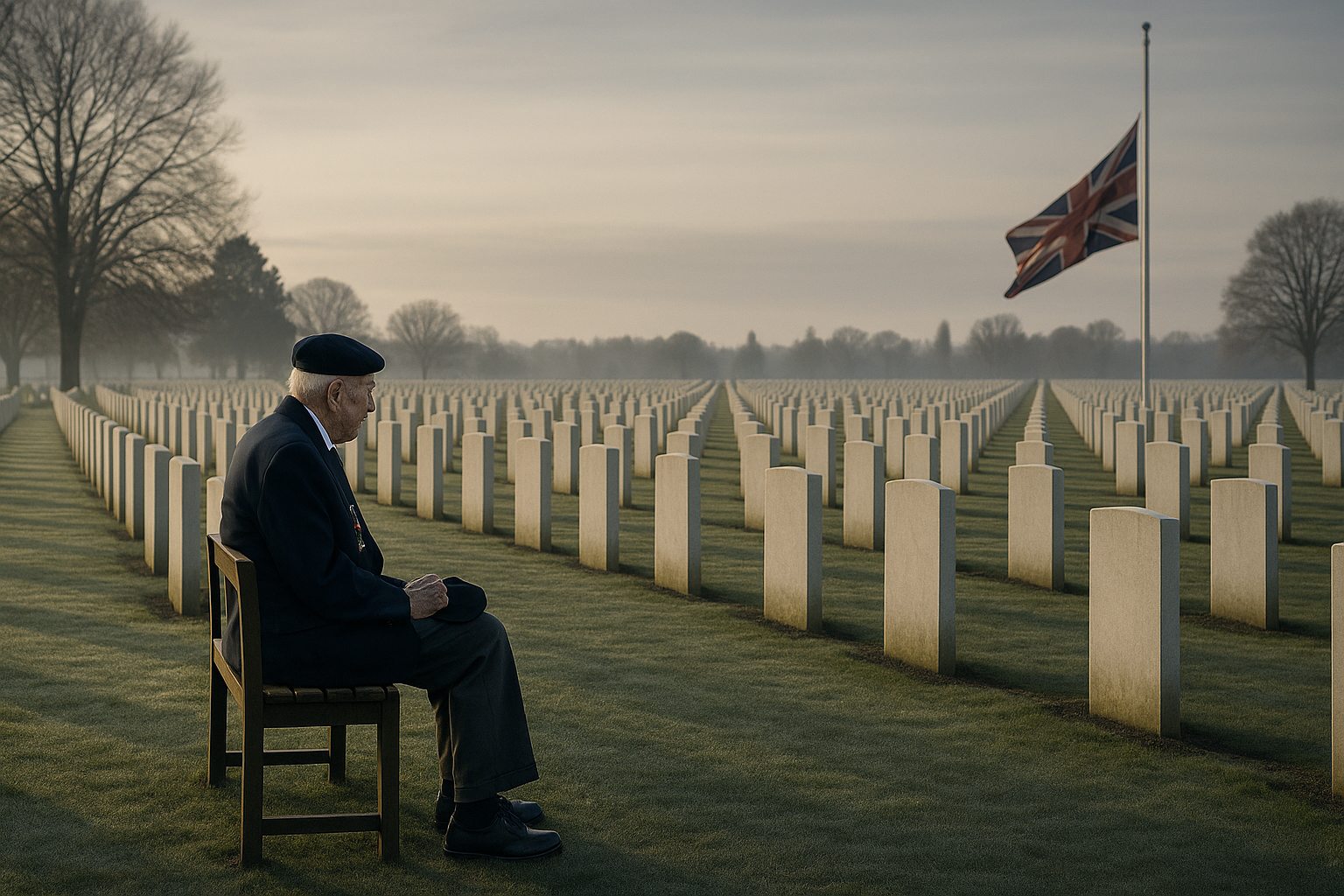
“I can see in my mind’s eye those rows and rows of white stones… all the hundreds of my friends who gave their lives. For what? The country of today? … No, I’m sorry — but the sacrifice wasn’t worth the result of what it is now.”¹
He added, with devastating clarity:
“What we fought for was our freedom… Even now, it’s a darn sight worse than when I fought for it.”²
These are not the words of a malcontent or a political agitator. They are the words of a man whose generation saved Europe from barbarism. They are the words of someone who has lived long enough to compare the Britain of his youth—scarred, hungry, bombed, but hopeful—with the Britain of today: anxious, fractured, ashamed of its own story, and unsure of its future.
When the Guardians of Freedom Lament Its Loss
Britain has heard many veterans speak of hardship, courage, and duty. We have heard their pride in what they achieved. We have heard their sorrow for what they lost. But rarely—if ever—have we heard a veteran say that the victory itself was not worth the state of the nation that followed.
It is not merely a personal lament. It is an indictment of a society that has squandered the moral inheritance purchased with blood. A nation that once stood for liberty, justice, and sacrifice is now visibly unsure of what, if anything, it stands for at all.
The veteran’s comments aired only days after new polling showed that barely half of Britons still report pride in their country.³ Public trust is collapsing; the moral horizon has flattened. A culture once moored by shared values is now buffeted by every passing ideological wind. It is no wonder that the moral clarity of the wartime generation feels like an accusation.
The Silence That Followed
Perhaps the most striking moment in the broadcast was not Penstone’s lament itself, but the stunned silence of the presenters. What does one say to a man who gave everything, only to judge the result unworthy of the sacrifice?
That silence was Britain’s silence.
A silence born not of disagreement but of recognition.
A silence born of shame.
For this was not a culture-war outburst. It was not a complaint about economics, or pensions, or party politics. It was a moral cry from a man who has earned the right to judge us—and found us wanting.
What It Says About Us Now
If a man who fought at sea under fire—who lost friends in their hundreds—can look at the nation today and feel that their sacrifice has been betrayed, then Britain has reached a moral crisis far deeper than political instability.
His words force us to confront what we have allowed ourselves to become:
A society that has forgotten its story.
A people that no longer knows what freedom is for.
A culture that cannot articulate why sacrifice matters—because it no longer believes in anything worth sacrificing for.
Alec Penstone has given the country a gift. A painful one, yes—but a gift nonetheless. He has spoken aloud the truth many feel but dare not say: that the Britain for which so many died has drifted from the Britain that exists today. The question is whether anyone—not the government, not the Church of England, not the commentariat, but the people—will have the courage to listen.
A Veteran’s Judgment, A Nation’s Reckoning
In the end, Penstone’s lament is not simply about Britain’s decline. It is about the loss of the virtues that made Britain a nation worth defending: duty, honour, sacrifice, family, faith, and freedom rooted in truth.
His generation fought for a Britain that believed in something eternal.
Our generation has inherited a Britain that believes in almost nothing.
And so the verdict of a 100-year-old sailor—delivered without bitterness but with heartbreaking clarity—should be taken as both prophecy and warning.
If Britain wishes to be worthy of the sacrifices that built it, then it must reclaim the moral foundations that sustained it. Otherwise, the judgment of our oldest guardians will stand: that the land they saved has forgotten why it was worth saving.
- Independent, “Veteran says sacrifice ‘wasn’t worth it’,” reporting on Penstone’s GMB interview.
- LBC, coverage of the same interview including Penstone’s remarks on freedom and decline.
- Evening Standard, reporting on polling showing declining national pride in the UK.


Latest
- THE KING’S OATH AND THE DEAD OF SAINT GEORGE’SA tragic attack during a Christian funeral in Karak, Jordan, resulted in nine fatalities and numerous injuries. King Abdullah II has pledged severe retaliation, leading to the arrest of three suspects. The Latin Patriarchate supports the monarchy’s role in ensuring religious freedom, while the Orthodox community vows to remain in their homeland amidst ongoing concerns for their safety.
- THE LAW OF A CHURCH THAT HAS NOT YET BEEN REUNITEDAt the Angelicum conference, Orthodox and Anglican scholars discussed the future of ecclesiastical law alongside Vatican cardinals. Cardinal Koch advocated for a new ecumenical juridical order, connecting these discussions to the upcoming Synodal Assembly of 2028. The conference aimed to address how different Christian governance models could influence Catholic law and authority.
- ‘DWARFS TAVISTOCK’: Baroness Cass demands Inquiry into Brighton NHS ScandalBaroness Hilary Cass has called for an independent inquiry into Brighton’s WellBN practice, claiming it overshadowed the Tavistock scandal. An investigation revealed severe clinical failures affecting 78 children, alongside the distressing treatment of safeguarding GP Dr Sarah Redvers, who raised alarms about these practices and faced retaliation. Accountability within the NHS is urgently needed.
- “THAT’S JUST PARANOIA”: Dr Joseph Shaw and the Crisis beyond the Latin MassDr Joseph Shaw’s recent interview highlights his support for the Traditional Latin Mass but inadequately addresses the Society of Saint Pius X’s (SSPX) concerns regarding the Church’s doctrinal crisis. He dismisses SSPX’s fears as paranoia, yet the Society’s extensive theological arguments underscore that preserving the older liturgy is insufficient for restoring Catholic Tradition.
- THE REFUSAL IS NOW IN WRITINGThe Vatican has formally denied the Summorum Pontificum pilgrims permission to enter St Peter’s Basilica together for prayer, a decision communicated through published correspondence. The situation has sparked debate over administrative failures and the Church’s treatment of traditional Catholics. Key questions remain regarding the explanation for this refusal amidst wider pastoral concerns.



Leave a Reply