
Riding the Dead Horse: Post-Conciliar Spin and the Crisis of Reality
How euphemism, pastoral fog, and synodal jargon replaced honesty in the modern Church
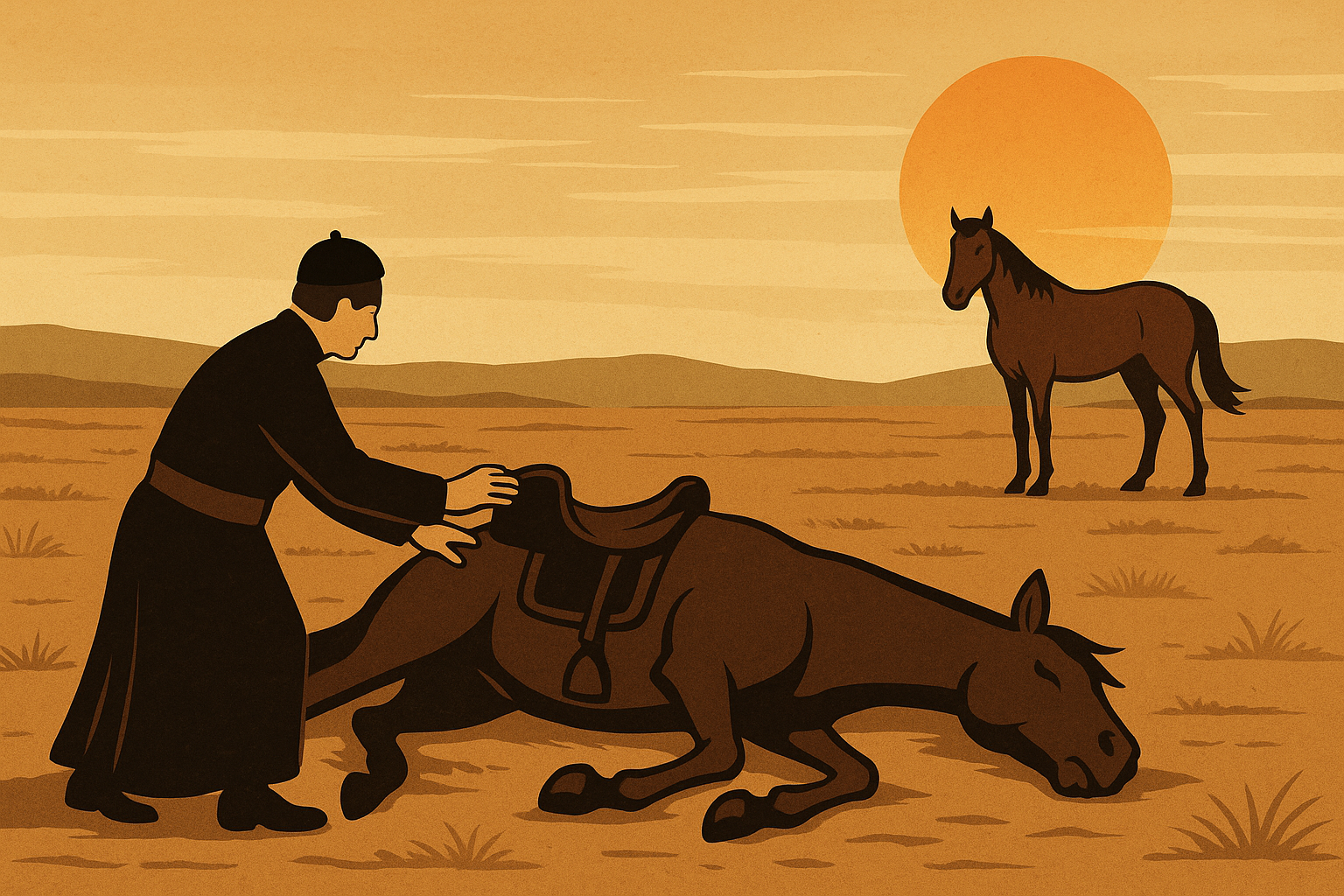
The old Roman saying was simple: when the horse is dead, dismount. The modern Catholic hierarchy, however, has developed a unique range of strategies for avoiding that most basic truth. A recent satirical list circulating among the faithful captured this dynamic with almost painful accuracy. Rather than admit the obvious, the post-conciliar establishment prefers to declare that the horse is not dead; create a commission to study “deadness”; launch a synodal process to “dialogue” with the horse; develop pastoral initiatives for integrating dead horses into ecclesial life; insist that the horse has never been ridden with proper understanding; mobilise youth to defend the horse; and rebuke the laity for their lack of enthusiasm, noting pointedly that a healthy horse—tradition—is grazing quietly at the far end of the pasture.
That satire resonates so deeply because it is not really a joke. It is an x-ray of the past sixty years. One could add, with equal plausibility, that the horse contains “elements of vitality that subsist”; that the faithful must avoid “backwardsism” in their attitude toward living horses; that the Church must hear “the cry of the earth and the cry of the dead horse”; or that the horse is not dead but undergoing “a new paradigm of equine relationality.” Satire collapses into reality when institutions lose the courage to acknowledge failure.
The tragedy of the post-conciliar era is not merely that experiments failed—poor catechesis, collapsing Mass attendance, vocational decline, doctrinal ambiguity, and the liturgical upheaval that alienated entire generations. The deeper tragedy is that the Church ceased to speak plainly about what was happening. Where once clarity and theological precision were hallmarks of the Magisterium, the new mode became the opposite: euphemism, ambiguity, and pastoral rhetoric designed to soothe rather than illuminate. The faithful were told that decline was renewal, that confusion was accompaniment, that the disappearance of religious life was a “new manifestation of the Spirit,” and that those who noticed decline were “rigid,” “ideological,” or insufficiently open to “surprises.”
The ancient wisdom of the Romans taught that if you realize your horse is dead then you should not attempt to ride it. The modern hierarchy of the Roman Catholic Church, however, prefers an array of alternative strategies. This might include…
1 Issuing a solemn decree that the horse is not dead.
2 Appointing a commission to examine the concept of “dead horse”.
3 Launching a synodal process to reach out to the horse.
4 Developing pastoral initiatives to increase acceptance of dead horses.
5 Insisting that the horse has yet to be ridden with true understanding.
6 Urging the youth to unite in defense of the dead horse.
7 Criticizing laity who point out that there’s a perfectly healthy old horse that was sent to the far end of the pasture.
8 Proclaiming a “fuller participation” in the mystery of the dead horse.
9 Publishing a document encouraging “accompaniment” with the horse in its “liminal state of vitality.”
10 Declaring that although the horse appears dead, “elements of equine dynamism subsist” within it.
11 Calling the healthy horse “rigid,” “ideologised,” or “obsessed with pre-conciliar hay.”
12 Commissioning an environmental working group to explore “ecological conversion” through the dead horse.
13 Admonishing critics to avoid “backwardsism,” because new paths forward can only be found by dragging the dead horse into the future.
14 Insisting that those who prefer the living horse are “weaponising the equine tradition.”
15 Explaining that the dead horse was never meant to be ridden in the first place, but to “initiate a new paradigm of relational horsemanship.
Verbiage: The Engine of Institutional Gaslighting
One defining trait of this new ecclesial culture is not merely ambiguity but verbosity. The modern Church has developed an extraordinary capacity to speak at length while saying very little, to replace clarity with volume, and to deploy words not as vessels of truth but as tools of evasion. This is the primary mechanism by which institutional gaslighting is sustained.
In the apostolic and patristic ages, words were used to illuminate reality. In the present era, they often obscure it. When doctrine becomes contested, when discipline collapses, or when pastoral strategies fail, the response is rarely straightforward teaching. Instead, a torrent of verbiage pours forth: pastoral letters swollen with abstractions, synodal documents padded with elastic phrases, and bureaucratic texts thick with euphemisms that promise much and commit nothing. The faithful are left with hundreds of pages to read and no truth to grasp.
This strategic verbiage performs three essential functions. First, it displaces clarity. Rather than state “the experiment has failed,” the institution offers “a renewed impulse toward missionary conversion through pathways of listening.” Second, it neutralises criticism by creating interpretative fog; anyone who seeks plain meaning is accused of rigidity or an inability to appreciate “the richness of ecclesial nuance.” Third, it simulates motion. A Church paralysed in practice can appear dynamic in prose. Documents multiply, meetings proliferate, vocabulary expands, and the machinery of speech becomes a substitute for the work of teaching, sanctifying, and governing.
Verbiage thus becomes ersatz governance—rule by rhetoric rather than rule by truth. It gives the illusion of responsiveness while ensuring no change of direction. This is the managerial dialect of a Church that has forgotten the apostolic voice.
A Synod Without the Faithful
A further symptom of this culture of institutional unreality is the Synod on Synodality itself. Its architects speak confidently of “listening to the People of God,” of “the voice of the whole Church,” and of a new ecclesial paradigm rooted in the experience of the faithful. Yet the empirical data tell a different story. No global participation statistics have ever been released by the Holy See, and where national figures are available, they reveal extraordinarily low engagement. In the United States, the bishops’ own reports indicate that roughly 700,000 out of more than 66 million Catholics took part—around one percent of the Catholic population.¹ ² Comparable figures appear in Europe: dioceses in Poland, Germany, and the United Kingdom recorded participation in the low thousands, representing similarly small fractions of their Catholic populations.³
It is therefore not merely inaccurate but misleading to suggest that the Synod speaks for “the entire People of God.” Available national data point to the opposite conclusion: in every region where numbers have been disclosed, participation hovered around one percent, and often less. The vast majority of Catholics did not attend a listening session, complete a survey, or contribute to a diocesan report. Yet the working documents produced from these exercises repeatedly claim to express the sensus fidelium and to represent the “voices from all continents.”⁴
A truthful assessment must therefore be made: the Synod on Synodality has proceeded with the rhetorical confidence of universality, while resting on a consultation that engaged only a small minority of the faithful. This stark mismatch between language and reality is not accidental; it is another instance of the institutional gaslighting sustained by verbiage. Where numbers are thin, words expand. Where participation is negligible, synonyms for “listening” proliferate. The illusion of consensus is generated not by the faithful, but by the vocabulary of process.
A Church that wishes genuinely to listen must first cease pretending that it already has.
The Cost of the Illusion
This culture of spin is not harmless. It corrodes trust, numbs leadership, and leaves the faithful spiritually malnourished. The Church can survive persecution, heresy, and institutional weakness; she cannot survive the abandonment of truthfulness. She is the guardian of divine revelation, not a public-relations firm. Her mission is to proclaim Christ crucified, not to repackage collapse as growth.
The living horse—the perennial faith, the traditional liturgy, the disciplines that formed saints—remains strong, yet it is kept at the outskirts, its vitality treated with suspicion. Meanwhile, the dead horse of failed pastoral experiments is dragged endlessly into the future through the sheer force of verbiage.
The beginning of healing lies in the recovery of honesty. The faithful recognise decline not because they are nostalgic but because they can see. The clergy who still preach, teach, and sanctify with clarity recognise it because they still believe. And young Catholics—those who crowd traditional parishes, confess frequently, pursue vocations, and rediscover the pre-conciliar liturgical and devotional life—recognise it because the living horse continues to carry them.
The satire of the dead horse cuts so deeply precisely because the truth is waiting to be spoken: the post-conciliar experiment has failed, and the Church will only begin to recover when she regains the courage to say so. The faithful are not asking for innovation but for honesty. They are not asking for new paradigms but for the faith handed down. They are not asking for synodal journeys but for the way to salvation.
The world does not need a Church that spins or manages decline into optimism. It needs the Church that speaks with the voice of Christ. For that Church, the first step is simple: dismount, bury the dead horse, and return to the living one.
- Vatican News reports the USCCB figure of “some 700,000 Catholics” participating in the diocesan phase of the Synod: vaticannews.va/en/church/news/2022-09/us-bishops-issue-synthesis-finalizing-diocesan-phase-of-synod.html
- National Catholic Reporter lists the U.S. Catholic population as approximately 66.8 million: ncronline.org/news/us-synod-report-finds-participants-share-common-hopes-lingering-pain
- In Poland, approximately 100,000 participants responded to the synodal questionnaires out of 32.5 million Catholics (Pillar Catholic): pillarcatholic.com/p/polands-synod-report-says-catholics
- The Synod preparatory documents repeatedly describe the process as involving “the entire People of God” while providing no global participation totals (Synod.va): synod.va/content/dam/synod/assembly/bookdocuments/The-synodal-journey-Documents-EN.pdf


Latest
- THE KING’S OATH AND THE DEAD OF SAINT GEORGE’SA tragic attack during a Christian funeral in Karak, Jordan, resulted in nine fatalities and numerous injuries. King Abdullah II has pledged severe retaliation, leading to the arrest of three suspects. The Latin Patriarchate supports the monarchy’s role in ensuring religious freedom, while the Orthodox community vows to remain in their homeland amidst ongoing concerns for their safety.
- THE LAW OF A CHURCH THAT HAS NOT YET BEEN REUNITEDAt the Angelicum conference, Orthodox and Anglican scholars discussed the future of ecclesiastical law alongside Vatican cardinals. Cardinal Koch advocated for a new ecumenical juridical order, connecting these discussions to the upcoming Synodal Assembly of 2028. The conference aimed to address how different Christian governance models could influence Catholic law and authority.
- ‘DWARFS TAVISTOCK’: Baroness Cass demands Inquiry into Brighton NHS ScandalBaroness Hilary Cass has called for an independent inquiry into Brighton’s WellBN practice, claiming it overshadowed the Tavistock scandal. An investigation revealed severe clinical failures affecting 78 children, alongside the distressing treatment of safeguarding GP Dr Sarah Redvers, who raised alarms about these practices and faced retaliation. Accountability within the NHS is urgently needed.
- “THAT’S JUST PARANOIA”: Dr Joseph Shaw and the Crisis beyond the Latin MassDr Joseph Shaw’s recent interview highlights his support for the Traditional Latin Mass but inadequately addresses the Society of Saint Pius X’s (SSPX) concerns regarding the Church’s doctrinal crisis. He dismisses SSPX’s fears as paranoia, yet the Society’s extensive theological arguments underscore that preserving the older liturgy is insufficient for restoring Catholic Tradition.
- THE REFUSAL IS NOW IN WRITINGThe Vatican has formally denied the Summorum Pontificum pilgrims permission to enter St Peter’s Basilica together for prayer, a decision communicated through published correspondence. The situation has sparked debate over administrative failures and the Church’s treatment of traditional Catholics. Key questions remain regarding the explanation for this refusal amidst wider pastoral concerns.



Leave a Reply