
The SSPX and the Question of New Bishops
Authority, Apostolic Continuity, and the Limits of Provisional Irregularity
The Priestly Fraternity of Saint Pius X has once again reached the unresolved question that has accompanied it since 1988: episcopal succession. Recent public remarks by Father Franz Schmidberger, former Superior General of the Society, confirm that internal discussions concerning the consecration of new bishops are ongoing, even if no concrete decision has yet been announced. What makes these remarks significant is not their novelty, but their admission—implicit rather than explicit—that the Society’s scale and longevity have changed the conditions under which earlier arguments were made.
Sacramental Succession and Ecclesial Reality
At the centre of the question lies a basic sacramental fact: only a bishop can ordain a priest. With the Society’s remaining bishops—Bernard Fellay and Alfonso de Galarreta—both advancing in age, the SSPX faces an objective deadline. A global priestly body numbering more than 700 clergy cannot sustain itself indefinitely without bishops capable of ordaining priests, confirming the faithful, and consecrating churches and sacred vessels.¹
Father Schmidberger explicitly acknowledges that, in the normal juridical order of the Church, episcopal consecrations require papal mandate.² This acknowledgement is significant. It signals a rhetorical narrowing compared with the atmosphere of the late 1980s. Rome is no longer treated merely as a hostile external authority, but as the juridical reference point—even if that reference point remains unresolved.
At the same time, Schmidberger reiterates that any future bishops would follow the same model adopted in 1988: auxiliary bishops without territorial jurisdiction, exercising sacramental functions but lacking ordinary governance. This distinction between sacramental power and canonical mission has always been central to the Society’s self-understanding.³
The 1988 Consecrations and the Appeal to Necessity
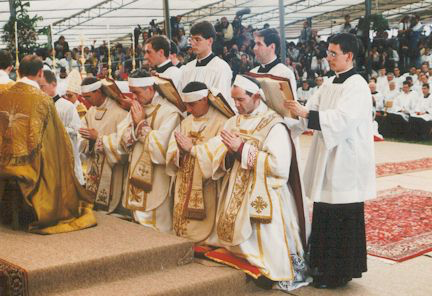
Schmidberger defends the 1988 episcopal consecrations carried out by Archbishop Marcel Lefebvre as a response to what he describes as a “crisis situation.” This defence reflects the Society’s longstanding claim that the consecrations were not an act of schism but an extraordinary measure taken under necessity.⁴
Priests formed under Archbishop Lefebvre in the late 1960s and 1970s were trained within a doctrinal world they understood as continuous with Trent and the pre-conciliar magisterium. The rapid post-conciliar changes in liturgy, theology, and discipline—combined with the 1975 suppression of the Society—produced not merely disagreement but deep institutional disorientation. When Archbishop Lefebvre faced declining health in the 1980s, many within the SSPX believed episcopal succession was necessary simply to preserve the priestly life they had been ordained to serve.⁵
The frequently invoked example of Saint Athanasius is illustrative. During the Arian crisis, Athanasius preserved orthodox episcopal succession and ministry despite exile and institutional hostility. Whether the analogy is historically exact is secondary; it explains the internal moral reasoning by which SSPX clergy interpreted their situation.⁶
Schmidberger also points to Cold War precedents in which bishops were consecrated illicitly under communist regimes and later recognised by Rome. Such cases demonstrate that episcopal consecration without papal mandate, while illicit, has not always been treated as schismatic per se.⁷
Validity, Liceity, and Jurisdiction
Classical Catholic sacramental theology distinguishes clearly between validity and liceity. A bishop consecrated without papal mandate acts illicitly but validly, provided the essential sacramental elements—proper matter, form, and intention—are present.⁸ Jurisdiction, by contrast, is not inherent to episcopal orders but is conferred juridically by competent authority.⁹
This distinction underlies Schmidberger’s insistence that any future SSPX bishops would exercise no territorial authority. The Society continues to deny that it seeks to establish a parallel hierarchy, claiming instead only the sacramental means necessary for priestly life while leaving juridical resolution to future regularisation.
From Remnant to Global Clerical Body
The decisive difference between 1988 and the present moment is scale. In 1988, the SSPX plausibly understood itself as a threatened remnant acting under emergency conditions. Today it is a stable, international clerical body with seminaries, schools, priories, and a coherent priestly culture. That growth weakens the claim that necessity alone can indefinitely justify juridical irregularity.¹⁰
Provisional arrangements may be tolerated in extremis; they cannot function as a permanent ecclesial settlement. Father Schmidberger’s remarks implicitly acknowledge this tension. The Society insists that it is already within the Church sacramentally, even if not juridically recognised. Rome, meanwhile, has increasingly treated the SSPX as tolerated but unresolved. Time is now forcing the inadequacy of this arrangement into the open.
Rome, Leo XIV, and Strategic Restraint
When asked about prospects under Pope Leo XIV, Schmidberger offers neither optimism nor confrontation. This restraint is itself revealing. A unilateral consecration today would not be interpreted as it was in 1988. What was once framed as emergency preservation would now appear as institutional defiance, regardless of internal justifications.
Comparative Perspective: SSPX and Old Roman Parallels
At this stage, the SSPX position increasingly converges with arguments long advanced by Old Roman and similar traditionalist bodies. Both emphasise the indelibility of sacramental character, the distinction between sacramental validity and canonical mission, and the claim that extraordinary circumstances may justify extraordinary measures without constituting schism.¹¹
The difference lies not in principle but in magnitude. The SSPX’s size, visibility, and global reach intensify the stakes. What may be tolerated for a small body becomes increasingly untenable when applied to a worldwide clerical institute.
Conclusion
The SSPX is no longer acting merely to survive. It is acting to continue.
A society of this size cannot indefinitely postpone episcopal succession. Informal toleration cannot substitute for juridical clarity forever. Rome will eventually be compelled either to regularise what already exists or to confront the consequences of another act justified—once again—by necessity. That is why the present moment, though less dramatic than 1988, is ultimately more decisive.
¹ Code of Canon Law (1983), cann. 1012–1014.
² Code of Canon Law (1983), can. 1013.
³ Marcel Lefebvre, They Have Uncrowned Him (Kansas City: Angelus Press, 1988), ch. 8.
⁴ Congregation for Bishops, Decree Ecclesia Dei adflicta (2 July 1988).
⁵ Michael Davies, Apologia Pro Marcel Lefebvre, vol. I (Kansas City: Angelus Press, 1979), 115–140.
⁶ St Athanasius, Historia Arianorum ad Monachos, §§2–4.
⁷ J. Beal, J. Coriden, T. Green (eds.), New Commentary on the Code of Canon Law (New York: Paulist Press, 2000), 1320–1323.
⁸ Council of Trent, Session XXIII, ch. 4; St Thomas Aquinas, Summa Theologiae, III, q. 64, a. 5.
⁹ Code of Canon Law (1983), can. 375 §2; can. 381 §1.
¹⁰ Pontifical Council for Legislative Texts, Communicationes 30 (1998): 195–210.
¹¹ Wernz–Vidal, Ius Canonicum, vol. II (Rome, 1938), §§453–456.


Latest
- DEO GRATIAS: HALFWAY THROUGH SISTER MARY SAVIO’S SURGICAL ORDEALSister Mary Savio has successfully completed two of four surgical procedures, with the remaining surgeries postponed to allow for recovery. While progress has been made, her medical care, estimated at $92,000, still needs funding. The community is encouraged to pray and contribute to her medical appeal.
- ASSISTANCE TO DIE — BUT NOT ASSISTANCE TO LIVE?Roger Foley has spent more than a decade fighting for the assistance necessary to live outside an Ontario hospital. Recorded MAID discussions, his parliamentary testimony, a later feeding and disability-accommodation dispute, and the present use of privately funded carers expose the weakness in describing assisted death as “autonomous” where adequate assistance to live is not equally available.
- THE POPE ANSWERS FRANCE: NOT HERITAGE ALONE, BUT CHRISTDuring his visit to France, Pope Leo XIV focused on proclaiming Christ, emphasising the need for life, doctrinal integrity, and priestly vocations. He faced tensions in reconciling revolutionary ideals with Christian teachings. While affirming the Eucharist, his interpretations shifted towards community experiences, sparking debates about theological priorities and liturgical significance.
- Today’s Mass: September 29 Sunday XVIII Post PentecostOn Sunday XVIII Post Pentecost, the Mass commemorates Sts. Cosmas and Damian, highlighting the importance of love, faith, and charity. St. Paul encourages gratitude for God’s graces, while the Gospel illustrates the healing power of Christ through faith. Prayers seek peace, protection from evils, and intercession of saints.
- Sermon for Eighteenth Sunday after PentecostIn the Gospel for the Eighteenth Sunday after Pentecost, Jesus heals a paralysed man and announces the forgiveness of his sins, asserting his authority as the Son of Man. This proclamation foreshadows the new covenant and challenges the perceptions of the scribes. Jesus positions himself as the definitive revealer of God’s will, offering salvation through his death and resurrection, distinguishing Christianity from other faiths.




Leave a Reply