
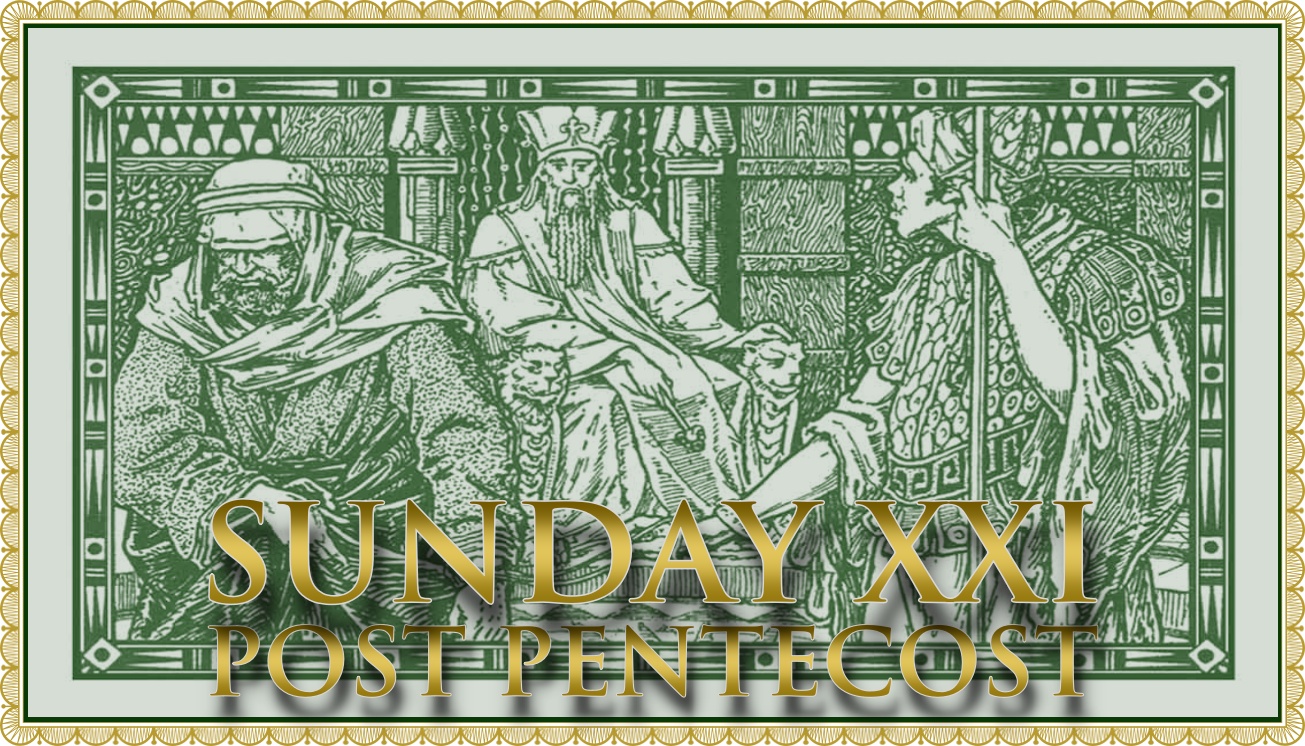
Twenty-first Sunday after Pentecost: Missa “In voluntáte tua, Dómine”
The Twenty-first Sunday after Pentecost, in the traditional Roman Missal, belongs to the final sequence of green Sundays that close the liturgical year. As the Church nears its end-of-year meditations on the Last Things, the tone of the propers turns ever more urgent and penitential. This Sunday’s Mass, In voluntáte tua, Dómine, gathers the faithful into a meditation on divine mercy and justice—the eternal balance between forgiveness and retribution, grace and judgment.
The Introit and the Theme of Divine Will
The Mass begins with the Introit from Esther 13:9–10: In voluntáte tua, Dómine, universa sunt posita, et non est qui possit resistere voluntáti tuae: tu enim fecísti ómnia, cælum et terram, et ómnia quæ cæli ambitu continentur: Dominus universorum tu es. “All things are in Thy will, O Lord, and there is none that can resist Thy will: for Thou hast made all things, the heaven and the earth, and all things that are under the cope of heaven: Thou art the Lord of all.” This text, taken from the supplication of Mardochai, sets the tone: man stands before the omnipotent sovereignty of God, dependent entirely on His will. Yet the same divine will that commands all creation also offers mercy to those who humble themselves.
The Psalm verse which follows—Beátus vir qui timet Dóminum (Ps. 111:1)—introduces the balance of fear and trust. The fear of God, rightly understood, is the beginning of wisdom and the guardian of peace. The liturgy thus prepares the soul to receive the mercy of God not presumptuously but reverently.
The Epistle and the Law of Forgiveness
The Epistle (Ephesians 6:10–17) is one of the most stirring passages of St. Paul’s writings. He exhorts the faithful to “put on the armour of God,” for “we wrestle not against flesh and blood, but against principalities and powers.” This martial imagery has long been associated with the spiritual warfare of the Christian life—the necessity of truth as a girdle, justice as a breastplate, faith as a shield, and the word of God as a sword. The Church, approaching the end of her liturgical year, calls her children to vigilance: the struggle will not cease until the coming of the Lord.
The Epistle harmonises beautifully with the Collect: Famíliam tuam, quǽsumus, Dómine, contínua pietáte custódi: ut a cunctis adversitátibus te protegénte sit libera, et in bonis áctibus tuo nómini sit devóta. The faithful are portrayed as God’s household, in need of constant protection and perseverance in good works. This is no passive waiting for divine help; rather, it is an active cooperation with grace, a standing ready with “the shield of faith” and “the sword of the Spirit.”
The Gospel and the Parable of Mercy
The Gospel (Matthew 18:23–35) contains the parable of the unmerciful servant. A king forgives his servant a vast debt, but that same servant refuses to pardon his fellow a mere trifle. The lesson is clear: divine mercy received must become mercy given. Yet the conclusion is stern—when the servant refuses mercy, the king retracts his forgiveness and delivers him to the tormentors. “So also shall my heavenly Father do to you, if you forgive not every one his brother from your hearts.”
This Gospel encapsulates the moral rhythm of the entire Tridentine liturgy: forgiveness must issue from a contrite heart, not a cheap indulgence. In the light of the approaching end of the liturgical year, it is also a warning of judgment—God’s mercy is infinite, but it is not unconditional; it demands repentance and imitation of His goodness.
The Offertory and the Desire for Deliverance
The Offertory verse (Job 1:2) is a poignant cry of the just man: Vir erat in terra nomine Job, simplex et rectus, ac timens Deum. Job’s integrity, even amid trial, is a model for the Christian life. The ensuing Secret prays that the sacrifice offered may free the faithful from their sins and draw down divine protection. The old Roman sense of propitiation remains unmistakable: the Sacrifice of the Mass is no mere communal thanksgiving but the re-presentation of Calvary, where the debt of sin was truly remitted.
The Communion and the Cry for Mercy
The Communion verse returns to Psalm 118:81, In salutári tuo sperávi, Dómine: et mandáta tua diléxi. “My soul hath fainted after Thy salvation: but I have hoped in Thy word.” Here the faithful, nourished by the Eucharist, express the same longing that animated the saints of old: to see salvation fulfilled and the divine promise kept. The Postcommunion collects this yearning into a plea that the heavenly mysteries may cleanse us and strengthen us against all adversity.
Spiritual Application
The Twenty-first Sunday after Pentecost stands as a mirror of the Christian conscience. Having been forgiven so much, we are called to forgive others with sincerity. Having been armed with grace, we must not grow slothful in battle. The Tridentine liturgy’s tone—sober yet hopeful, penitential yet confident—teaches the soul how to live in the tension between mercy and justice.
As the year wanes, the faithful are reminded that time itself is hastening toward judgment. The Church’s prayer becomes that of Mardochai and Job alike: submission to the divine will, trust amid adversity, and a heart purified by forgiveness. Thus the Mass of this Sunday is a school of sanctity in miniature—forming the soul to live and die within the will of God, clothed with the armour of faith, and ready to meet the King when He calls.
Footnotes
¹ Missale Romanum (Editio Typica 1962), Dominica XXI post Pentecosten.
² Council of Trent, Session XXII, Doctrina de Sacrificio Missæ (1562).
³ St. Paul, Epistola ad Ephesios 6:10–17.
⁴ St. Matthew 18:23–35, Parabola de servo nequam.
⁵ Dom Prosper Guéranger, L’Année Liturgique, Vol. XI, “Twenty-first Sunday after Pentecost.”
⁶ St. Augustine, Sermon 83 on the Gospels: “He who refuses mercy closes the door of mercy against himself.”



Leave a Reply