
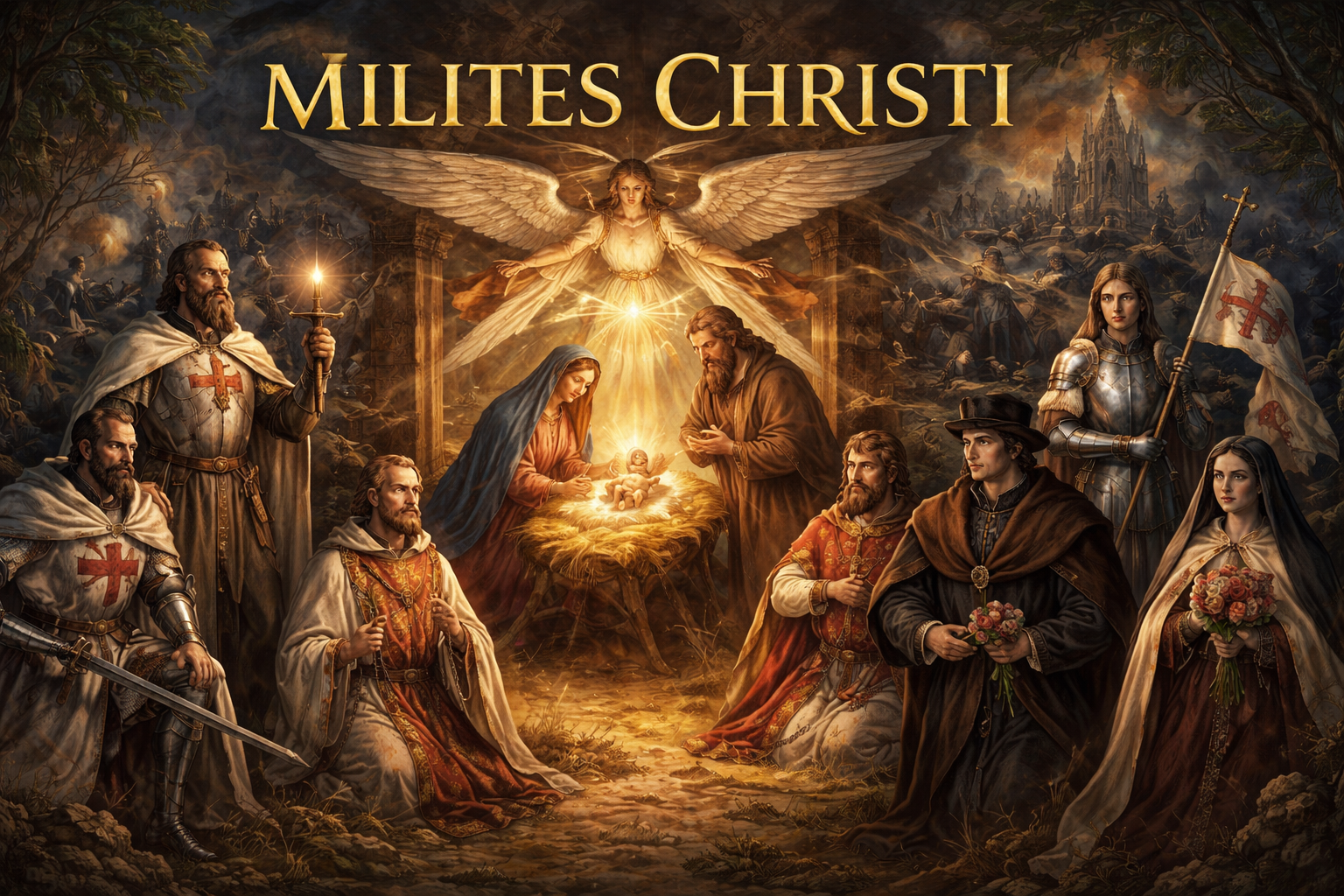
Milites Christi: Enlistment at the Crib and Fidelity in an Age of Drift
The Church does not invent the milites Christi; she recognises them. Scripture names them before hagiography adorns them, before mysticism maps their interior terrain, and long before catechisms or councils give them formal definition. From the beginning, the Christian life is not framed as therapeutic self-improvement or cultural belonging, but as enlistment. “Thou therefore endure hardship, as a good soldier of Christ Jesus.”¹ The Incarnation does not soften this demand; it clarifies it. God does not arrive with leverage but with claim. He does not overwhelm the will; He summons it.
At Bethlehem, the summons is unmistakable. “A sign unto you: you shall find the infant wrapped in swaddling clothes and laid in a manger.”² The sign is abasement. The Fathers insist that this is not concealment but revelation: God discloses the manner of His rule.³ The soldier who kneels here learns at once that victory will not resemble the world’s victories. He will be trained not in domination but in patience, not in assertion but in obedience, not in control but in truth.
Scripture frames even the Nativity in martial terms. “Suddenly there was with the angel a multitude of the heavenly host.”⁴ The term host (stratia) is not poetic decoration but military language, denoting an army assembled for battle.⁵ Heaven mobilises because the decisive phase of the conflict has begun. The Incarnation is not an interruption of the war between light and darkness; it is its turning point.⁶ Christ is born into a contested world. Neutrality evaporates. Those who draw near do so knowing—whether fully articulated or not—that allegiance will cost.
The Church ensures that this cost is neither postponed nor diluted. The Christmas Octave is constructed as a sustained argument, not a sequence of seasonal embellishments. Saint Stephen follows immediately upon the Nativity because the Church refuses to allow Bethlehem to be misread. “Lord, lay not this sin to their charge.”⁷ Stephen’s forgiveness is not resignation; it is weaponised charity. The Church calls this martyrdom—from martyria, witness—because it is the soldier’s supreme act: truth preferred to life.⁸
Hagiography is unsparing here. The Martyrdom of Polycarp presents an old bishop formed by decades of obedience, not a reckless zealot intoxicated by death.⁹ Ignatius of Antioch, writing under guard on the road to execution, does not speak the language of grievance or protest but of vocation; martyrdom is his birth into God.¹⁰ These men do not seek suffering. They refuse false peace. Their soldiering consists not in violence, but in non-negotiation.
Mysticism presses the same reality inward. The battlefield is not only public; it is interior. Teresa of Ávila describes prayer itself as determinada determinación—a “determined determination”—to remain with God despite aridity, fear, and self-knowledge.¹¹ This is not retreat from combat but its intensification. As open persecution gives way to interior attrition, the enemy adapts. Discouragement, distraction, and compromise become the preferred weapons.¹²
John of the Cross names this training the dark night. It is not punishment but purification: the stripping away of consolation so that obedience may be free.¹³ The milites Christi are forged here. They learn to act without visible success, to love without emotional return, to remain when God seems silent. “If any man will come after me, let him deny himself, take up his cross daily, and follow me.”¹⁴ Daily—not dramatically, but faithfully.
This understanding is not confined to mystics. It is embedded in the Church’s catechetical tradition. The Catechism of the Council of Trent teaches that Baptism effects a real transfer of allegiance: the baptised are “withdrawn from the dominion of the devil and translated into the kingdom of Christ.”¹⁵ Baptism is therefore not merely regenerative; it is enlistment. One kingdom is renounced; another is entered. There is no neutral ground.
For this reason, the Trent Catechism repeatedly insists upon discipline of the passions, obedience to divine law, and readiness for suffering. In its exposition of the First Commandment, it warns against placing fear, advantage, or comfort above obedience to God.¹⁶ The soldier of Christ is the one who refuses that inversion of order. Fidelity, not survival, becomes the governing principle of life.
The Baltimore Catechism, written for ordinary Catholics rather than theologians, makes the same claim with disarming clarity. When asked “Why did God make you?” the answer is not psychological but teleological: “To know Him, to love Him, and to serve Him in this world, and to be happy with Him forever in the next.”¹⁷ Service—not self-actualisation—is the organising category. The Christian is not formed to adapt indefinitely, but to serve under authority.
This catechetical clarity explains why the Church never treats persecution as an anomaly. The Catechism of Trent, in its teaching on the Lord’s Prayer, explains that “Lead us not into temptation” presupposes constant spiritual assault.¹⁸ The Christian does not pray to be spared conflict, but to be preserved from defeat. The soldier does not ask that the war cease; he asks for grace to remain faithful within it.
The same catechism is equally clear that faith demands public confession, not merely interior assent.¹⁹ Silence in the face of falsehood is not neutrality; it is dereliction. The soldier who refuses to witness has already abandoned his post. This is why martyrdom holds such a privileged place in Catholic teaching. The Catechism of Trent calls it the highest imitation of Christ and the supreme act of charity, because it places obedience above life itself.²⁰
Here the saints cease to be inspirational figures and become catechetical proofs. Saint Stephen’s death is not an unfortunate by-product of zeal; it is the logical outcome of baptismal allegiance. The confessors and long-suffering saints—those who endure without dying—stand alongside the martyrs, not beneath them. The Baltimore Catechism teaches that actual grace is given precisely to enable perseverance under difficulty.²¹ Endurance is not stoicism; it is grace-sustained obedience.
All of this bears directly upon the contemporary faithful. The language of milites Christi can feel severe in an age trained to prize accommodation, reassurance, and social harmony. Yet the battlefield has not disappeared; it has become quieter and more polite. The modern Christian is rarely asked to die publicly. He is asked, incessantly, to yield quietly—to soften conviction, to relativise truth, to keep faith private and non-intrusive.
Scripture anticipated this form of trial. “Having the appearance of godliness, but denying its power.”²² The pressures are subtle but relentless: professional cost, social exclusion, reputational damage. These are not trivial inconveniences. They are instruments of slow erosion, designed to make obedience appear unreasonable and clarity appear extreme.
Hagiography corrects our expectations here as well. Saint Thomas More did not wake one morning intending martyrdom. He simply refused, repeatedly and patiently, to affirm what he knew to be false.²³ His soldiering consisted in saying “no” again and again, until the world exhausted itself.
Mysticism again proves practical. Thérèse of Lisieux understood that most sanctity is worked out in obscurity, irritation, fatigue, and misunderstanding.²⁴ Her little way is not minimisation but realism. The contemporary soldier of Christ must resist the temptation to despise this arena. The hidden struggle is not inferior; it is normative.
This is where the battle lines are now drawn. The milites Christi of our time are those who refuse to surrender moral language when it is redefined; who continue to worship reverently when worship is treated as optional; who form their children intentionally rather than outsourcing formation to a culture indifferent—or hostile—to Christ. “Be not conformed to this world; but be transformed by the renewal of your mind.”²⁵ This is not abstract counsel. It is daily resistance to drift.
The Catechism of Trent warns that ignorance of the faith leaves the soul undefended.²⁶ In an age of deliberate confusion, catechetical clarity itself becomes a form of resistance. To know what the Church teaches—and to live accordingly—is already to stand in opposition to the reigning assumptions of the age.
The soldier of Christ today is therefore distinguished not by volume but by order: ordered worship, ordered speech, ordered family life, ordered obedience. He does not seek conflict, but neither does he flee it. He understands that Christ did not promise cultural success, but fidelity unto the end. “He that shall persevere unto the end, he shall be saved.”²⁷
The crib remains the place of enlistment. Christ still comes without leverage, asking for allegiance that will not be rewarded by comfort. To kneel there now is to accept a life slightly exposed, slightly out of step, and quietly resolute. This is not failure. It is vocation.
“Fight the good fight of faith; lay hold on eternal life.”²⁸ This is not rhetoric. It is instruction. The milites Christi are those who have heard it—and stayed.
- 2 Timothy 2:3–4 (Douay-Rheims).
- Luke 2:12 (Douay-Rheims).
- St Leo the Great, Sermon 1 on the Nativity.
- Luke 2:13 (Douay-Rheims).
- Liddell–Scott–Jones Greek Lexicon, entry on stratia.
- Revelation 12:7–9; patristic consensus on the Incarnation as the decisive phase of cosmic conflict.
- Acts 7:60 (Douay-Rheims).
- St Augustine, Sermon 306, on martyrdom as witness.
- The Martyrdom of Polycarp, chapters 8–19.
- Ignatius of Antioch, Letter to the Romans, chapter 6.
- Teresa of Ávila, Way of Perfection, chapter 21.
- Teresa of Ávila, Life, chapters 8–9.
- John of the Cross, Dark Night of the Soul, Book I, chapters 8–10.
- Luke 9:23 (Douay-Rheims).
- Catechism of the Council of Trent, Part II, On Baptism.
- Catechism of the Council of Trent, Part III, The First Commandment.
- Baltimore Catechism No. 1, Question 6.
- Catechism of the Council of Trent, Part IV, Lord’s Prayer, Sixth Petition.
- Catechism of the Council of Trent, Part I, On Faith and the Creed.
- Catechism of the Council of Trent, Part III, On the Fifth Commandment, on martyrdom as supreme charity.
- Baltimore Catechism No. 3, Questions 127–130.
- 2 Timothy 3:5 (Douay-Rheims).
- William Roper, Life of Sir Thomas More.
- Thérèse of Lisieux, Story of a Soul, Manuscript C.
- Romans 12:2 (Douay-Rheims).
- Catechism of the Council of Trent, Preface, on the necessity of catechetical instruction.
- Matthew 24:13 (Douay-Rheims).
- 1 Timothy 6:12 (Douay-Rheims).
related articles


Latest articles
- Today’s homily: Christ the KingThe homily reflects on Christ’s kingship as seen in the Gospel narrative. It contrasts earthly authority with divine truth, emphasising that true allegiance to God requires genuine obedience and transformation. Believers are called to examine their personal commitments and respond to Christ’s demands in everyday life, ultimately recognising their identity as bearers of God’s image.
- Sermon for Christ the KingToday marks the celebration of Christ the King and the Twenty Second Sunday after Pentecost, a feast asserting Christ’s sovereignty against totalitarianism. St. Paul emphasised Christ’s supremacy over power and principalities, challenging early Gnostic beliefs. The early Church’s victory over evil is affirmed in Christ’s resurrection, offering hope and unity amidst contemporary struggles.
- Today’s Mass: October 25 SOVEREIGNTY OF OUR LORD JESUS CHRIST, SUPREME KINGThe Feast of the Sovereignty of Our Lord Jesus Christ celebrates Christ’s dual kingship by birth and conquest. Established by Pius XI, it aims to deepen faith and counter anti-clericalism. The liturgical observance underscores His authority as King, advocating for societal recognition of His reign to bring peace and harmony.
- TRADITION BEHIND THE FENCEThe Vatican’s prohibition of the traditional Ad Petri Sedem pilgrimage to St Peter’s Basilica has sparked controversy, especially among traditional Catholics. While some cite scheduling conflicts, the broader issue lies in the restrictive policies of Traditionis custodes, which may confine traditional liturgical practices to specific enclaves, risking the transmission and recognition of Catholic Tradition within the wider Church.
- Today’s Mass: October 24 St Raphael the ArchangelThe Feast of Saint Raphael the Archangel highlights his healing powers as depicted in the Book of Tobit, where he aids Tobit and his son, Tobiah. Venerated as a protector of travellers and the blind, Raphael is celebrated for his miraculous interventions. His legacy includes support for nurses, matchmakers, and Catholic studies.





Leave a Reply