
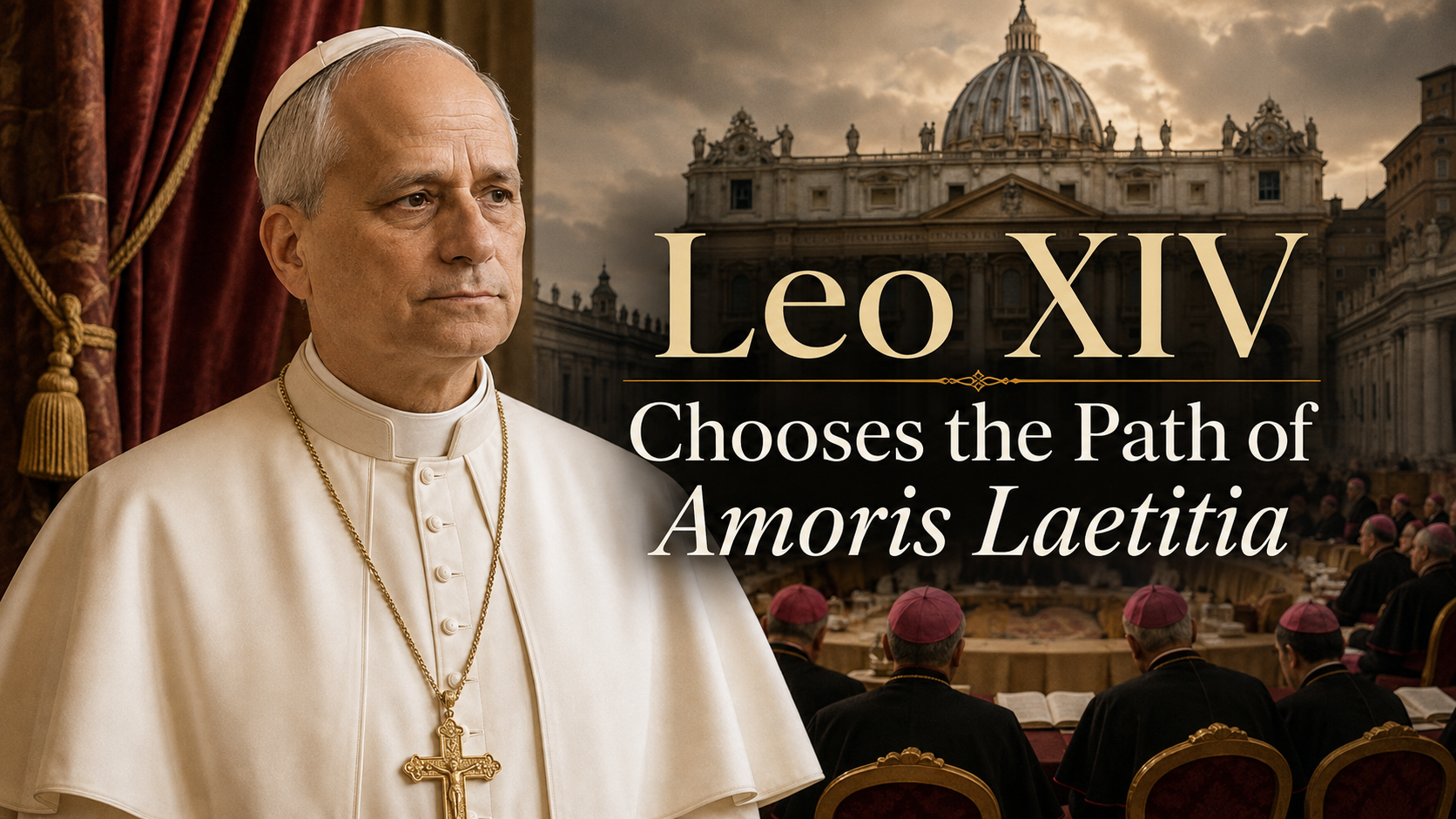
Ten years after Francis’s disputed exhortation, Rome is asking the world’s bishops not whether the path should be corrected, but how it should be continued
There are moments when the choice of an agenda tells us almost as much as the conclusions eventually reached. Pope Leo XIV has now provided such a moment. On 19 March 2026, the tenth anniversary of Pope Francis’s post-synodal exhortation Amoris Laetitia, Leo announced that he would summon the presidents of the world’s episcopal conferences and the heads of the Eastern Catholic Churches to Rome from 7–14 October. Their task, he said, would be to undertake a “synodal discernment” concerning the proclamation of the Gospel to families today specifically “in light of Amoris Laetitia.”¹ This is no mere academic conference marking an anniversary. The official thematic framework subsequently prepared by the General Secretariat of the Synod and the Dicastery for the Laity, Family and Life makes the intention clearer still. It describes the process as part of an ongoing “pastoral conversion” and expressly asks that the Church be given “the courage to persevere on this path” opened by Amoris Laetitia.² The direction of travel, therefore, has already been indicated. The bishops are not being summoned principally to decide whether the path opened in 2016 was prudent, doctrinally secure in all its applications, or pastorally successful. They are being summoned to continue along it.
That distinction matters because Amoris Laetitia was never simply an exhortation encouraging husbands and wives to love one another more generously. Much of the document is unobjectionable, sometimes beautiful, and its treatment of the difficulties confronting contemporary families contains observations any Catholic pastor could recognise. But its historical significance lies elsewhere: in Chapter VIII and particularly paragraphs 300–305 and the notorious footnote 351, where the traditional relationship between objective moral disorder, repentance, sacramental absolution and reception of the Holy Eucharist was subjected to a new pastoral calculus. Francis wrote that a person might remain in an “objective situation of sin” while lacking full subjective culpability, and footnote 351 added that in certain cases the Church’s assistance might include “the help of the sacraments.”³ It was precisely the ambiguity of what this meant in practice that produced one of the most damaging doctrinal controversies of the Francis pontificate.
The controversy was not invented by traditionalists, nor did it arise because Catholics hostile to Francis maliciously misread an innocent text. Bishops themselves reached incompatible conclusions. Some maintained the existing sacramental discipline expressed by St John Paul II and Benedict XVI; others understood Amoris Laetitia as permitting, in certain circumstances, divorced Catholics living in a new sexual union to receive absolution and Holy Communion without undertaking to live in continence. In September 2016 four cardinals — Walter Brandmüller, Raymond Burke, Carlo Caffarra and Joachim Meisner — submitted five formal dubia to Francis. They asked whether previous Catholic moral teaching remained intact on precisely the matters now thrown into dispute: intrinsically evil acts, absolute moral norms, conscience, habitual grave sin and sacramental discipline. Francis did not answer them. Cardinal Caffarra subsequently requested an audience with the Pope on behalf of the four and recorded that the questions had received no response. That request too went unanswered.⁴ The questions were not speculative exercises in academic theology. They concerned adultery, repentance, the moral law and reception of the Blessed Sacrament.
Eventually, however, the ambiguity acquired an official interpretation. In September 2016 the bishops of the Buenos Aires pastoral region issued criteria explaining how Chapter VIII should be applied. They stated that while continence should be proposed wherever possible, there might be circumstances in which a person judged that he or she would fall into further fault by attempting it, and that in certain such cases Amoris Laetitia opened the possibility of access to the sacraments of Reconciliation and the Eucharist. Francis replied that their text was “very good” and “fully expresses the meaning of Chapter VIII,” adding emphatically: “There are no other interpretations.” Both the Buenos Aires criteria and Francis’s approving letter were subsequently published in the Acta Apostolicae Sedis, accompanied by a rescript describing them as authentic Magisterium.⁵
The matter did not end there. In 2023 Cardinal Dominik Duka submitted a series of questions to the Dicastery for the Doctrine of the Faith concerning the administration of the Eucharist to divorced persons living in new unions. The Dicastery, under Cardinal Víctor Manuel Fernández, explicitly referred to the Buenos Aires criteria and Francis’s approval of them. It reiterated that the documents had been published as Magisterium authenticum and stated that Francis had maintained the traditional proposal of continence while acknowledging that difficulties might arise in practising it. The Dicastery then expressly confirmed that, following pastoral discernment in particular cases, Amoris Laetitia opened the possibility of access to the sacraments of Reconciliation and the Eucharist even where complete continence had not been achieved.⁶ Whatever theological judgement one makes of that development, it is no longer credible to pretend that the controversy concerned merely a hypothetical possibility invented by Francis’s critics. The disputed interpretation became an officially endorsed interpretation.
For the contrast with what preceded it is unmistakable. St John Paul II taught in Familiaris Consortio that the Church, while embracing divorced and remarried Catholics with genuine pastoral solicitude, “reaffirms her practice, which is based upon Sacred Scripture, of not admitting to Eucharistic Communion divorced persons who have remarried.” He explained why. Their state of life objectively contradicts the nuptial union of Christ and His Church signified by the Eucharist, and admitting them to Communion would risk leading the faithful into error concerning the indissolubility of marriage. Where separation was impossible for serious reasons — for example, because of obligations towards children — reconciliation and sacramental reception required the couple to undertake to live in complete continence, “that is, by abstinence from the acts proper to married couples.”⁷
Benedict XVI repeated precisely the same discipline in Sacramentum Caritatis in 2007. He stated that the Synod of Bishops had confirmed the Church’s practice, “based on Sacred Scripture,” of not admitting the divorced and remarried to the sacraments because their state and condition of life objectively contradicted the loving union of Christ and the Church signified and made present in the Eucharist. He too insisted upon pastoral concern and appropriate integration into the life of the Church, but the sacramental discipline itself was not treated as a matter for local pastoral experimentation.⁸ These were not expressions of cruelty. Both pontiffs insisted upon compassionate pastoral accompaniment. What they refused to do was set mercy against truth, as though the medicine of the sacraments could somehow be detached from repentance and conversion.
That is why the language chosen for the October 2026 meeting deserves close attention. The official preparatory framework repeatedly speaks of “discernment,” “accompaniment,” “fragility,” the gap between “ideal and reality,” and the necessity of recognising grace within complex situations. It asks how couples who cohabit can be accompanied in a process of discernment and growth towards marriage. It asks how those who have experienced separation and divorce can become increasingly “listened to, involved and co-responsible” within Christian communities. It encourages participants to consider the various familial situations encountered in pastoral life without beginning simply from abstract models.² None of those aspirations is objectionable per se. The Church must seek the lost sheep. She must bind wounds. She must distinguish between objective disorder and subjective culpability. She must patiently lead sinners towards conversion, because that is what pastors have always done.
But the crucial question is the destination of the accompaniment.
Catholic pastoral care has traditionally accompanied the sinner out of sin, not accompanied him indefinitely within a situation contrary to the commandments while gradually redescribing that situation as an imperfect participation in an “ideal.” The language matters because Christian marriage is not merely an aspirational ideal, one particularly excellent arrangement placed at the summit of a sliding scale of relational possibilities. It is an objective moral and sacramental reality. Likewise, “Thou shalt not commit adultery” is not an ideal towards which different people advance at different speeds according to circumstance. Our Lord did not tell the woman taken in adultery that her complicated circumstances might constitute a place where grace was already sufficiently present to make conversion unnecessary. He showed her a mercy so complete that He refused to condemn her, and a mercy so truthful that He commanded: “Go, and now sin no more” (John 8:11).
Catholic moral theology has always recognised that subjective culpability may be diminished by ignorance, fear, coercion, habit, psychological factors and other circumstances. That principle is not novel, and Amoris Laetitia did not invent it. But diminished culpability does not transform an objectively disordered act into a good act, nor does it remove the distinction between subjective guilt and the public sacramental discipline of the Church. The question raised by the Francis-era interpretation is therefore not whether every person in an irregular union is maximally culpable before God. No serious theologian has ever maintained that. The question is whether a settled intention to continue sexual relations outside a valid marriage can, after a process of discernment, be reconciled with sacramental absolution and Eucharistic reception without the traditional requirement of continence.
That is precisely where “accompaniment” becomes theologically decisive. Accompaniment is valuable when it accompanies a soul towards conformity with Christ. “Discernment” is authentically Catholic when it discerns how the commandments are to be obeyed in particular circumstances, not whether those commandments apply. “Integration” is an act of charity when it restores the sinner to the fullness of sacramental life through conversion, repentance and absolution. And “mercy” ceases to be recognisably Christian if it leaves a person comfortably reconciled to that from which Christ came to save him. The Church possesses no pastoral authority to create an exception to a divine commandment. She cannot pronounce adultery good, nor can she change the nature of sacramental repentance merely because fidelity to Christ has become culturally difficult.
This is precisely why Leo XIV’s decision is so consequential. The new Pope inherited an obvious opportunity to clarify. He could have acknowledged the suffering of broken families while restating unequivocally the sacramental principles taught by Familiaris Consortio and Sacramentum Caritatis. He could have distinguished carefully between reduced subjective imputability and the objective conditions governing sacramental discipline. He could have answered the questions which fractured episcopal unity during the previous pontificate. He could, above all, have reminded the Church that genuine pastoral development must always proceed in continuity with what she has already taught concerning marriage, adultery, confession and the Eucharist.
Instead, at least thus far, he has chosen Amoris Laetitia itself as the lens through which the bishops are to consider the future.
Precision requires us to add that Leo XIV has not personally ordered the universal admission to Communion of divorced and civilly remarried Catholics living more uxorio. Nor does the July thematic framework explicitly discuss footnote 351 or command every episcopal conference to adopt the Buenos Aires criteria. The framework was prepared by the General Secretariat of the Synod together with the Dicastery for the Laity, Family and Life rather than written personally by Leo. Those qualifications matter, and Catholic criticism should never attribute to a Pope words he has not spoken.
Yet they cannot erase what has actually happened. Leo himself summoned the October meeting. Leo himself stipulated that its deliberations should proceed “in light of Amoris Laetitia.” The official framework for that meeting now explicitly speaks of continuing the path opened by the exhortation. The controversy surrounding that path is not an obscure secret known only to theologians. It has dominated Catholic discussion of marriage and sacramental discipline for a decade. To choose that path as the basis of a worldwide episcopal process without first resolving the doctrinal questions raised by it is itself an ecclesial choice.
There is a deeper ecclesiological problem here as well. The October meeting is to proceed through “synodal discernment,” taking account of what has already been undertaken in the local Churches. But the truth about the sacraments does not emerge statistically from a survey of pastoral experiments. Catholic doctrine is not generated by comparing the practices of Germany, Argentina, Poland, Africa and the United States and discerning which synthesis seems pastorally sustainable. If different local Churches have reached mutually incompatible conclusions concerning sacramental discipline because of an ambiguous Roman document, the remedy is not another exercise in decentralised listening. It is the exercise of the Petrine office: “confirm thy brethren” (Luke 22:32).
The Pope exists, among other reasons, precisely so that Catholics in Buenos Aires and Catholics in Warsaw do not receive contradictory answers to the same question of faith and morals while both are assured that their local “discernment” represents the authentic pastoral application of Catholic doctrine. Universality is not merely geographical. The Catholicity of the Church demands unity in the profession and application of essential sacramental truths.
The irony is considerable. The Church has spent more than a decade speaking almost obsessively about listening, dialogue and synodality, yet some of the most urgent voices asking for doctrinal clarification were never listened to at all. Four cardinals asked five concise questions capable, in substance, of receiving straightforward answers. They did not demand that Francis reverse a council or abandon an entire pontificate. They asked whether principles of Catholic moral theology which had always been taught remained true. No answer came. Yet today the machinery of synodality prepares another international gathering to discuss how the path opened by the document which provoked those questions may be continued.
The contrast deserves to be stated plainly. There appears to be almost unlimited institutional enthusiasm for “listening” when pastoral practice is being expanded, decentralised or reconsidered; yet considerably less enthusiasm for answering Catholics who ask whether established doctrine and sacramental discipline still bind. A process that endlessly multiplies questions while resisting definitive answers is not discernment. Eventually it becomes government by ambiguity.
And this reaches beyond the relatively small number of cases ordinarily invoked to justify pastoral exceptions. The deepest question raised by Amoris Laetitia was never merely whether one particular divorced person could receive Communion. It concerned the relationship between doctrine and practice. Can the Church leave a doctrine verbally untouched while adopting a pastoral discipline whose operative logic appears to contradict it? Can an absolute moral norm remain theoretically absolute while “discernment” produces practical exceptions? Can adultery remain objectively grave matter while a settled intention to continue the sexual relationship becomes compatible, in particular circumstances, with sacramental absolution? Can sacramental discipline change substantially while the faithful are assured that doctrine has remained completely unchanged?
If pastoral practice communicates theology — and Catholic sacramental practice certainly does — these are not technical questions. They concern whether doctrine can effectively be altered in practice without ever admitting that a doctrinal change has occurred.
The tragedy is that families today desperately need something far more substantial than another ecclesiastical process. Marriage is collapsing throughout much of the West. Divorce has been normalised. Cohabitation frequently precedes or replaces marriage. Pornography has grotesquely distorted the understanding of sexuality and intimacy. Children are increasingly raised without both their natural parents. The contraceptive mentality has separated sexuality from procreation and marriage from sacrifice. Many Catholics themselves scarcely understand that Christian marriage is indissoluble, sacramental, ordered towards children and founded upon the complementary union of one man and one woman.
What these families need from the Church is not uncertainty about whether her teaching represents an “ideal.” They need the trumpet to give a certain sound. They need priests who will preach chastity without embarrassment, teach the ends and properties of marriage, prepare couples seriously for the sacrament, defend abandoned spouses who remain faithful to their vows, assist struggling marriages before they collapse, teach children the virtue of purity, and proclaim that supernatural grace really does make heroic fidelity possible.
For Christianity has never promised that the commandments will always be easy. It promises that grace makes holiness possible.
There is still time for Leo XIV to redirect the October gathering. The Pope could use it to resolve rather than perpetuate the confusion of the last decade. He could insist that nothing called pastoral accompaniment may contradict the divine law, that diminished culpability does not transform an objectively adulterous relationship into a marriage, that sacramental absolution requires genuine contrition and a purpose of amendment, and that the Eucharist cannot be used as an instrument for normalising situations objectively contrary to the sacrament of Matrimony.
He could make clear that Amoris Laetitia must itself be interpreted through the perennial Magisterium rather than allowing earlier and clearer teaching to be retroactively interpreted through the ambiguities of Amoris Laetitia. That would be the authentically Catholic hermeneutic. The later and less precise must be read according to the earlier and more certain, not the reverse. Such clarification would not represent a retreat from mercy. It would rescue mercy from sentimentality and restore its authentic purpose: the reconciliation of sinners with God in truth.
But the present signs point elsewhere. Leo XIV has not inherited Amoris Laetitia merely as an historical document belonging to his predecessor. He has deliberately made it the starting point of a major international episcopal gathering. The Curial framework prepared for that gathering does not ask whether the path opened ten years ago led the Church into confusion. It asks for courage to continue along it.
That is the fact Catholics must now confront.
Ten years after Amoris Laetitia, the Church does not need another decade of ambiguity. Families do not need their wounds baptised as new pastoral paradigms. Sinners do not need the commandments softened until conversion becomes optional. Bishops do not need another vocabulary with which incompatible practices can coexist beneath the reassuring word “discernment.” They need clarity from Peter.
The merciful answer of Christ remains what it has always been: neither condemnation without hope nor acceptance without conversion, but grace and truth together — “Neither will I condemn thee. Go, and now sin no more.”
If Leo XIV wishes truly to strengthen families, that is the path which must be continued.
¹ Pope Leo XIV, Message for the Tenth Anniversary of Amoris Laetitia, 19 March 2026.
² General Secretariat of the Synod and Dicastery for the Laity, Family and Life, thematic framework for the meeting of 7–14 October 2026, published 6 July 2026.
³ Francis, Amoris Laetitia, nn. 300–305, especially n. 305 and footnote 351, 19 March 2016.
⁴ Walter Cardinal Brandmüller, Raymond Cardinal Burke, Carlo Cardinal Caffarra and Joachim Cardinal Meisner, Dubia concerning Amoris Laetitia, submitted 19 September 2016; Cardinal Caffarra’s subsequent request for an audience with Pope Francis, 25 April 2017.
⁵ Bishops of the Buenos Aires Pastoral Region, Criterios básicos para la aplicación del capítulo VIII de Amoris Laetitia, 5 September 2016; Pope Francis, Letter approving the criteria, 5 September 2016; Acta Apostolicae Sedis 108 (2016).
⁶ Dicastery for the Doctrine of the Faith, response to Cardinal Dominik Duka concerning Eucharistic Communion for divorced persons living in a new union, 25 September 2023.
⁷ St John Paul II, Familiaris Consortio, n. 84, 22 November 1981.
⁸ Benedict XVI, Sacramentum Caritatis, n. 29, 22 February 2007.



Leave a Reply