
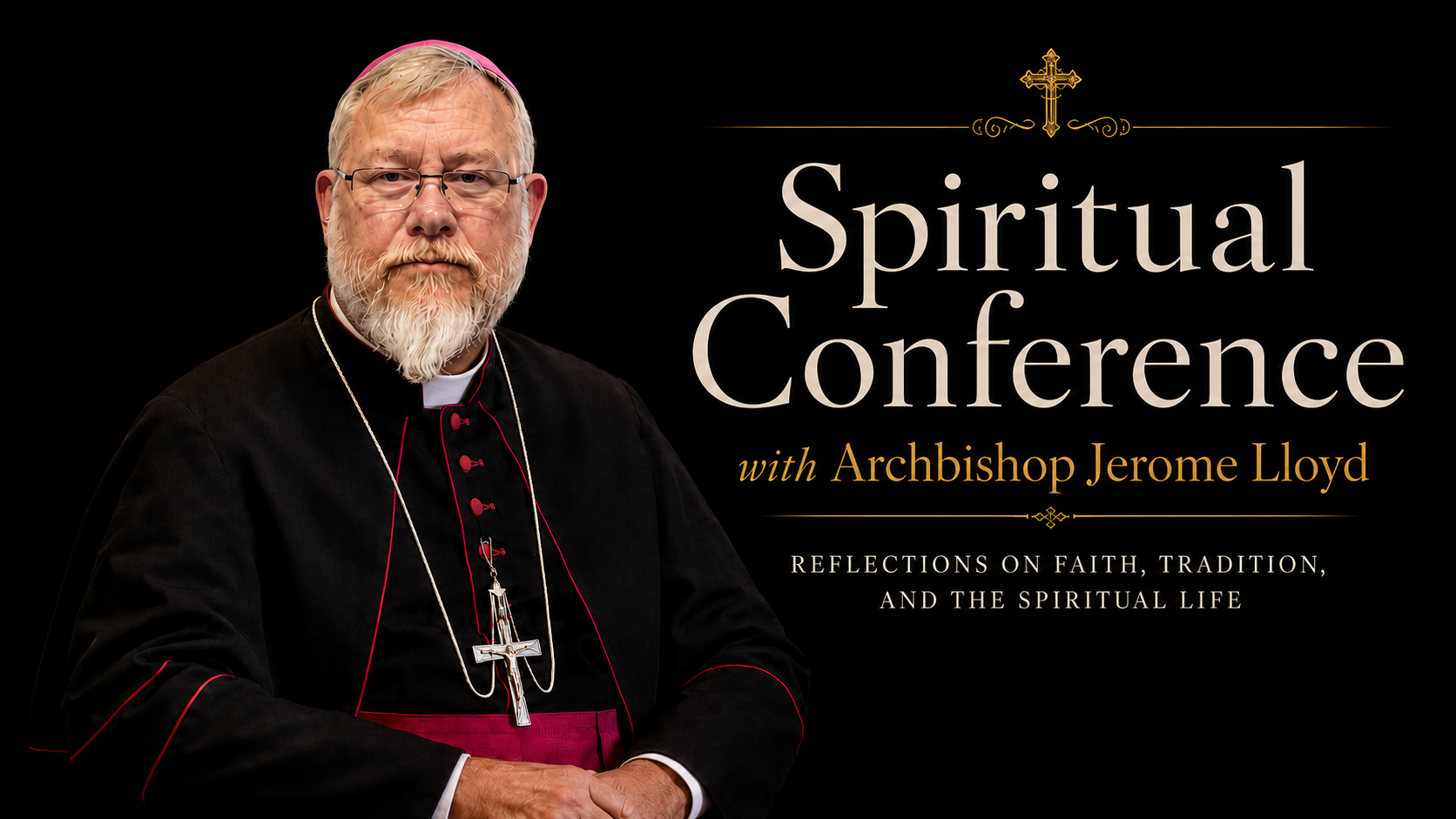
A spiritual conference for the close of the liturgical year
My dear friends, among the souls we remember in November are people who helped us to know and love God. Some taught us our prayers. Others showed us, by the way they lived, what those prayers meant. We may remember a father getting ready for Mass, or a priest who listened patiently when we hardly knew how to explain what was troubling us. They have gone before us now. We pray for the repose of their souls, and we thank God for what we received through them.
Sometimes it takes years to realise how much somebody gave us. At the time, we scarcely noticed. Going to church was what the family did. The priest was there when we needed him. Someone explained the faith, answered a question or helped us begin again after we had made a mess of things. We went on with our lives. Looking back, we can see that something important happened. Through another person’s patience, God gave us help which we might otherwise never have sought.
That is worth remembering as the Church’s year comes to an end. On Sunday we heard Our Lord say, “Heaven and earth shall pass, but my words shall not pass.” Those who first taught us His words have passed from this life. The words remain. We have our own lives to live by them now, and in due course we shall stand before Him to give an account of what we did with all that we received.¹
The Four Last Things concern us personally. We shall die. We shall come before Christ in judgement. Heaven is the life for which God made us, and hell is the terrible possibility of losing Him through dying in unrepented mortal sin. Our Lord has told us these things because He wants us to be saved. He has given us time in which to repent and the grace to do it. A confession we have postponed can still be made. A wrong we have done may still be put right, at least in part. We have today.
There is mercy in that. Some people are so troubled by what they failed to do years ago that they scarcely notice what they could do now. Perhaps a mother wishes she had taught her children more of the faith. They are grown up. She cannot have those years again. She can pray for them, and she can listen carefully when one of them begins to ask a question. She may discover that God has been at work where she could see very little happening. Regret can become a prayer, and a prayer can help us recognise the next small thing He asks of us.
Advent is approaching. We shall begin the Church’s year again, with familiar prayers and the familiar feeling that Christmas is rather nearer than we had realised. There will be preparations at home, people to think about and arrangements to make. Within all that, the Church calls us to prepare for Christ. The Child we shall worship is the Lord before whom we shall stand. He comes to us now with mercy. We ought to make time to receive it.
For some of us, that means going to confession. For others, it may mean doing something about a quarrel which has gone on quite long enough. There may be somebody who needs an answer from us, or a kindness we have kept meaning to do. We need hardly search for an elaborate spiritual undertaking if we already know that we owe an apology to the person sitting beside us. The ordinary duties of our lives give God ample room to work, if we will allow Him.
Our Lord has spoken plainly about the hungry and the sick, and about the welcome we give to a stranger. We shall answer for how we treated them. The needs of a soul deserve our attention too. A person may need help learning to pray. A parent may need an explanation he can give his child. Someone who has stayed away from the sacraments may need a friend to say, gently, “Why don’t you speak to Father?” It can seem a small kindness to the person who offers it. The one who receives it may remember it for the rest of his life.
This is why teaching the faith is such a serious work of charity. What a person believes affects what he will do. Tell a man that his conduct calls for no repentance, and he is unlikely to confess it. Leave him thinking that God could never forgive him, and fear may keep him away. He needs to understand both the seriousness of sin and the mercy available to him. Then he can act. He can make his confession, receive absolution with the proper dispositions, and begin again. Anybody who has returned after a long absence knows what kindness there is in being told the truth clearly enough to do something about it.
When I speak of traditional Catholic doctrine as necessary for the salvation of souls, that is what I mean. There is one Catholic faith, received from Christ and handed on by His Church. It teaches us who God is, what He has done for us and how we are to respond. We need to know what He asks of us. We need the sacraments He has provided. These things bear directly upon the choices we make, sometimes when we are frightened, confused or very close to death.
A bishop ought to remember that before he answers a question. One day I shall have preached my last homily and heard my last confession. What will matter then is whether I helped the people entrusted to me find their way to God. If a man willing to repent came to me and went away persuaded that repentance was unnecessary, I should have failed him badly. I should have failed him, too, if I let him go without understanding that God was ready to forgive him. A pleasant conversation would be poor compensation for either failure.
The thought of judgement gives us reason to examine what we say, and what we leave unsaid. It also gives us hope. God sees the patience which nobody thanked us for. He knows about the difficult kindness, the effort to forgive and the prayer offered when we could manage very little else. Much of the good done in a Catholic household would never find its way into a parish report. It may be among the most important things happening there.
At Mass we come before the generosity of Our Lord Himself. He offers Himself to the Father for us. We bring our weakness, sometimes hardly knowing how to pray, and find that He has already provided what we could never provide for ourselves. If we keep returning to that sacrifice, we ought gradually to become more willing to give ourselves. There will be an afternoon we could spend with someone who is lonely, or money we could use to relieve a need. St Paul brings this home to the Corinthians when he asks them to help their brethren. He reminds them of Christ who became poor for their sake. Their generosity was to grow from the grace they had received.²
We shall come to the same mystery at Christmas. Before the crib, we shall adore the Son of God who has come among us for our salvation. We may find ourselves wondering what we can give Him. There are people He has already placed within reach of our kindness. We can begin with them.
Of course, we cannot meet every need. Most of us have enough difficulty meeting the duties we already have. Charity asks us to consider honestly what we can do. Sometimes we can give time. Sometimes we have knowledge which would spare somebody a great deal of distress. There are occasions when the useful thing is to put our hand in our pocket. That can require humility, especially when we had hoped to offer advice. The person may already know perfectly well what needs doing. His difficulty is paying for it.
Think again of the priest who was there when you needed him. You may remember him with affection. You probably have no idea who helped meet his living expenses or kept the chapel in order. You had a confession to make or a child to have baptised. It was right that you could attend to that. Somewhere else, Catholics had made arrangements which allowed him to be there. Their generosity formed part of a kindness you received without knowing all the people involved.
St Luke has left us the names of some who did this during Our Lord’s own ministry. He tells us that Jesus went through cities and towns preaching the kingdom of God, accompanied by the Twelve. Women who had received healing at His hands went with them. Luke names Mary Magdalen, Joanna and Susanna, and tells us that they and others provided from their own means. Of Susanna we learn scarcely anything else. Christians have heard her name for centuries because an Evangelist thought it worth remembering that she helped.³
Someone who heard Our Lord preach in one of those towns might never have known who provided the meal on the road. Susanna could scarcely have known what would follow from a particular journey. She knew what was needed and gave what she could. There is encouragement there for us. We rarely see the whole consequence of an act of charity. We can meet the need before us and leave the rest to God.
In my Easter message in 2020, when so many of you were unable to enter a church, I asked us to become “demonstratively grateful” for Christ’s love. I meant that the love we expressed in our prayers should be visible in our lives. A gift can be one way of thanking Him for what we have received: the priest who helped us return to confession, perhaps, or the teaching which steadied us when we were troubled. We are grateful enough to want somebody else to receive that help too.⁴
Giving becomes sacrificial when another person’s good is allowed to change a decision we would otherwise have made for ourselves. We had a use in mind for the money. We might properly have enjoyed it. Then we learn of a need and decide we would rather help. Yesterday these people were strangers. Today we have made room for them in our plans. The amount may be small. God knows what it cost us, and He knows the love with which it was given.
There is a sacrifice involved in remembering as well. We can be moved by an appeal tonight and forget it by next week. Making a regular gift means allowing the need a lasting place in our lives. Much of Christian fidelity has that quiet character. We make a good decision, and then keep it through days when the feeling which first moved us has passed. St Paul understood this. The Corinthians had wanted to contribute to the relief of their brethren. He encouraged them to finish what they had begun and took care over who would accompany the gift. The people in need would eventually require what had been promised.²
[Halfway point — pause briefly.]
Advent gives us an opportunity to act upon a good intention before it disappears into the Christmas rush. The season of goodwill brings a great deal of generosity. A person buying food for his own family remembers another household which cannot afford much. We might also remember what makes it possible for people to receive faithful teaching and the sacraments. If that help has mattered in our own lives, we have reason to want it available to others.
This is where I want to speak about the work you know through Old Roman TV and Nuntiatoria. You come here for Mass, for teaching and sometimes because you need to put a question to a bishop. I take that seriously. You should be able to ask what the Church teaches and receive an answer which helps you understand it and live by it. When something troubling happens in the Church, you should be able to expect me to look into it before I ask you to accept my judgement.
That can involve saying plainly that the trouble has come from ecclesiastical authorities themselves. A bishop may have said something which misleads the faithful. A decision may have harmed people who are trying to live as Catholics. I must be able to explain the difficulty, show you what the Church has taught and say where I believe resistance is necessary. Then I must remain available to help those who act upon that advice. It would be easy enough to tell you what is wrong and leave you to manage the consequences.
Here we come to the reason for the distance I maintain from the ordinary structures. You may know excellent priests in traditional institutes which enjoy the Pope’s favour. Support them, and be grateful for what they do. Their ministry can be a blessing to the people they serve. There remains a need for bishops able to challenge harmful teaching and policies, including when the authority responsible is the same authority upon whose favour a recognised apostolate depends.
A priest in such an institute may understand the difficulty as clearly as I do. He also knows that anything he says may have consequences for his brethren and his congregation. I would be slow to judge his courage. But the faithful still need somebody willing to answer. They need a bishop who can say, “This is what the Church has taught, and this is why I believe we must hold to it,” even when doing so makes his position uncomfortable.
That is why I believe this ministry remains necessary. Having permission to attend the traditional Mass does not settle every difficulty a Catholic faces. The faith expressed in that Mass concerns the whole Church. Children who have never entered a traditional chapel have as much claim upon Catholic doctrine as children who can follow every page of the missal. We must be free to teach it fully, and to explain why the inherited rites deserve to be handed on to another generation.
I recognise the Pope and the authority of his office. I have a responsibility before God for the souls who seek my care. My own irregular position requires an explanation, and pastoral necessity is the explanation I give. Where I believe compliance would harm those souls, I must be prepared to resist and give the Catholic grounds for doing so. I must also be fair. If an allegation turns out to be mistaken, you ought to hear that from me. If a document has been misrepresented by people whose sympathies I share, friendship gives me no permission to repeat the error.⁵
Those responsibilities shape both Old Roman TV and Nuntiatoria. They also take me beyond Brighton. A few weeks ago I was in rural France to give Confirmation and First Holy Communion. My responsibilities take me to Slovakia and the Philippines too. A priest preparing his people needs to know when their bishop is coming. Before I can give him a date, I have to know how I shall pay the fare. I can explain the traditional rite of Confirmation from my desk. To confirm the child, I have to go.
If I encourage parents to bring up their children in the traditional faith, they have a reasonable claim upon my help. Priests need time with their bishop. People need answers which have been thought through. Those duties take hours, and they bring expenses. I cannot fulfil them simply by being willing. At some point there has to be enough money to make the journey, keep the chapel open and pay the bills.
As a traditional Catholic bishop, I receive no salary or regular stipend from the Church. I own no property and I have no pension. I depend upon private benefactors for my living. From those same gifts I pay virtually all the running costs of Old Roman TV and Nuntiatoria. Some of you have helped me quietly for years. You have my heartfelt thanks. You have made possible more than you know.
I need now to ask more people to share that expense. When donations have fallen short, I have had to borrow to pay the apostolate’s bills and meet my own living expenses. My creditors are now chasing me for repayment. It is uncomfortable to tell you that, but I owe you the truth. I cannot continue to finance this work in that way.
Let me give you the figures. The chapel and office in Brighton, from which I make the broadcasts, cost £750 a month to rent. Channel hosting and the subscriptions I use for editing, graphics and other software cost another £100 a month altogether. Hosting selsey.org costs £250 a year, and hosting nuntiatoria.org costs a further £250. Those bills come to £10,700 a year. My own living expenses, apostolic visits and repayment of what I have borrowed are additional.
I want you to know exactly what is involved. Meeting next year’s running costs would keep the work going through next year. I should still have to repay the money already owed and find the cost of visits abroad. But knowing that the ordinary bills were provided for would make an enormous difference. It would allow me to make plans with some confidence that I could keep them.
We began broadcasting the traditional Latin Mass from Brighton on the feast of the Assumption in 2008. Between 150 and 200 individual viewers now join us for Mass on an average day. Each day I offer Mass and preach a homily for those following it. If you are housebound, or caring for somebody who cannot safely be left alone, you know what that regularity means. You can put out your missal, hear the Gospel preached and make your spiritual communion. After eighteen years, it would be quite reasonable to assume that somebody had long since arranged how it was all to be paid for. The means have come from gifts, and often from very few people.
The Spiritual Conferences, Old Romans Unscripted and the Live Q&A draw a further 600 to 800 viewers each week, with some overlap between programmes. On Thursdays you can put your own question to me. You need never decide whether it is sufficiently important to ask for a formal appointment. I value hearing what you want to ask. Occasionally a second question tells me that my first answer was clear chiefly to another clergyman. That does a bishop good. It reminds him whom he is meant to be helping.
Nuntiatoria takes up much of the week. Before I write about a bishop’s decree concerning a monastery, for example, I ought to read it, find out what preceded it and consider what the bishop was entitled to do. You need to know whether there are good grounds for objecting in that particular case. An afternoon can go into checking a sentence which takes you ten seconds to read. I am quite content for you to have those ten seconds. You have your own work to do. My responsibility is to make sure that what I give you is worth relying upon.
When I checked on 26 October, Nuntiatoria had 148 subscribers on Substack, three of whom were paying. On WordPress there were 41 subscribers and one paid subscription. I hope it will continue to reach people unable to pay. One good reason for a reader who can afford a subscription to take one out is that somebody in different circumstances can then receive the same work freely. The person helped may be trying to answer a question from his children, or simply trying to understand something which has unsettled his faith.
Now consider the audience alongside the bills. £1 a week from 206 people would raise £10,712 in a year. The ordinary annual running costs are £10,700. That is the scale of the help needed. If everyone who regularly watches gave a pound a week, those costs would be covered. A gift which looks very small from your end could become, alongside the gifts of others, something upon which I could depend.
So I am asking you quite plainly. If you can afford £1 a week, please make it a regular gift. You can arrange that through the donation page at selsey.org. If monthly giving is easier, £5 a month comes to a little over a pound a week. If Nuntiatoria is what brings you here, please consider a paid subscription. A Christmas offering would be very welcome towards the debt or the cost of an apostolic visit. If you can give substantially more, you could relieve a burden which has become a real personal difficulty.
Please look honestly at your own circumstances. If your child needs shoes, buy them. Some of you are already helping an elderly relation through the winter at considerable cost to yourselves. St Paul speaks of a willing gift being acceptable according to what a person has.² Our Lord knew what the widow’s two coins cost her. An observer could never have discovered that by counting them.⁶ God knows the charity already being practised in your home.
Others may be able to reconsider an amount decided upon years ago, when circumstances were tighter. It is easy to leave a standing order untouched while the rest of life changes around it. Advent is a good time to look again. You might find that a kindness which was once beyond your means has become possible. You might also discover that a modest regular gift is something you could make without much difficulty, having simply never been asked.
Paul leaves the decision in the giver’s heart. “God loveth a cheerful giver.”⁷ Take this into your prayer and decide what you can carry through. If you cannot give, come to Mass tomorrow, bring your question on Thursday and remember me in your prayers. I value them. Some people sustain a priest by mentioning him to Our Lord through a long night when they can do very little else. I would be sorry indeed if anybody thought that kindness counted for little.
We began by remembering people through whom we received the faith. Before Advent Sunday, recall one of them by name. Pray for that person, especially if he or she has died. Think of what you received because somebody was willing to be there for you. It may have seemed ordinary at the time. You have lived long enough to know what followed from it.
We cannot go back and give those people their time again. We can pray for them, and we can take our turn in helping somebody else. There are children whose parents are trying to hand on the faith. There are Catholics who have yet to find their way back to the sacraments. Someone must be there when they are ready to come.
Tomorrow morning, God willing, I shall go to the altar again. I shall remember those who helped us towards the faith, and those whose generosity enables me to minister now. If you can take a share in sustaining this work during Advent, please do. You may never know the person who benefits. He may one day remember a priest who listened, or a bishop who came, and have no idea that you helped make it possible.
May Our Lord grant rest to those who helped us on our way to Him, give us a fruitful Advent, and bring us at last into the life for which He made us. Amen.
God bless you.
Spiritual invitation
Before Advent Sunday, pray for someone who helped you receive the faith. Consider what you could give, according to your means, to help someone else receive that same care. Support Archbishop Jerome’s ministry.⁸
The weekly-giving calculation assumes 52 payments and gives the gross total before payment fees.
FOOTNOTES
¹ The Gospel according to St Matthew, 24.35
² The Second Epistle of St Paul to the Corinthians, 8.9–24
³ The Gospel according to St Luke, 8.1–3
⁴ A message for Easter 2020
⁵ On the SSPX Announcement of New Episcopal Consecrations: Necessity, Succession, and the Care of Souls
⁶ The Gospel according to St Mark, 12.41–44
⁷ The Second Epistle of St Paul to the Corinthians, 9.7
⁸ Support Archbishop Jerome’s ministry





Leave a Reply