
GRAFFITI IN THE CATHEDRAL: THE CHURCH OF ENGLAND’S CRISIS OF RELEVANCE
The spectacle of confusion
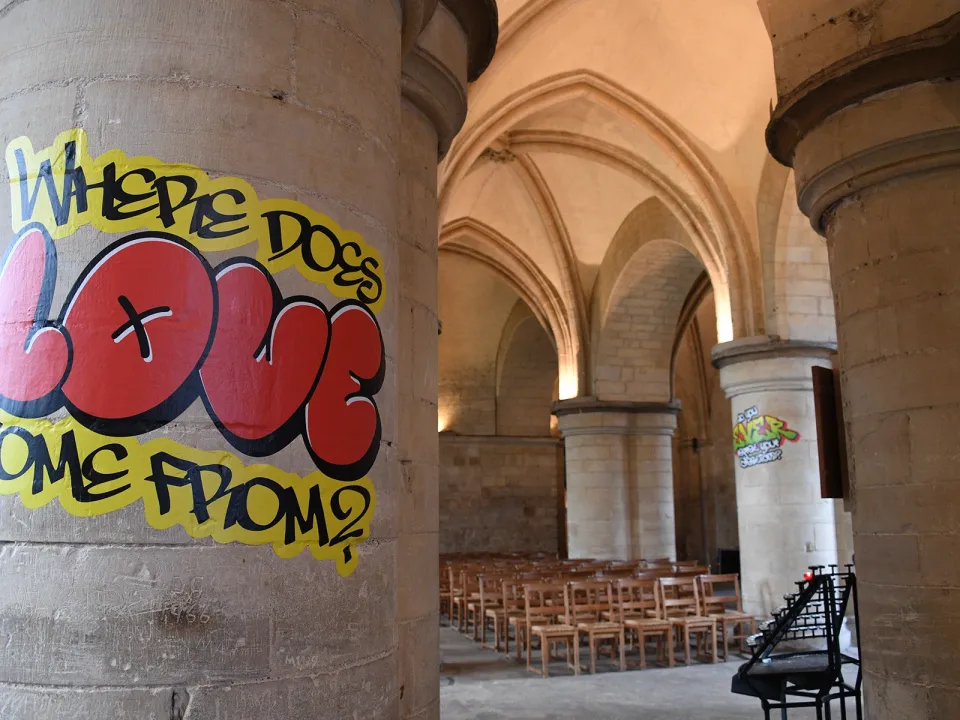
When Canterbury Cathedral unveiled its graffiti-style installation Hear Us in October 2025, the intent was clear: to appear relevant, raw, and “conversational.” Its organisers spoke of “marginalised voices” and “unfiltered honesty,” hoping to awaken curiosity among those alienated from faith. Yet what followed was not dialogue but dismay. From American politicians to English parish priests, from secular journalists to Catholic commentators, the reaction was overwhelmingly one of shock. The dissonance between medieval sanctity and street art provoked not reflection but recoil. Even those unacquainted with theology sensed that something sacred had been profaned.
For generations, Canterbury has symbolised the spiritual centre of English Christianity—the place where St Thomas Becket shed his blood for the rights of conscience and where countless pilgrims have knelt before the shrine of a martyr. To cover those same stones in spray-painted slogans, however carefully curated, struck many as a tragic inversion of meaning. What had once proclaimed the transcendent now appeared to advertise the temporal.
The failure of relevance
Mike Judge, editor of Evangelical Times, gave voice to what many Christians felt: “The world doesn’t need a controversial art installation. It needs the scandal of the Cross.”¹ His critique is not aesthetic but theological. The problem is not that the art is modern, but that it is mute. When the Church trades preaching for performance, repentance for rhetoric, and truth for trend, it ceases to believe in its own message. Judge’s verdict is uncompromising: a church that mimics the world’s fashions “reveals how far its leadership has lost confidence in the power of Christ’s finished work.”²
His words recall an older warning from St Paul: “Having a form of godliness, but denying the power thereof.” The modern Church, in its fear of irrelevance, has become trapped in a cycle of imitation. Each attempt to appear “relatable” only underscores its spiritual uncertainty. Where once the Church converted the world, it now imitates it. And imitation, however well meant, never wins respect.
Even secular observers have echoed the sentiment. Patrick West, writing in The Spectator, dismissed the exhibit’s “edgy” questions as “inoffensive and pedestrian,” exposing the Church’s desperation to appear youthful rather than faithful.³ Visitors told The Times that the cathedral now resembled “an underground car park in Peckham.”⁴ What was meant to be prophetic instead became pitiful—proof that a Church uncertain of its purpose will always mistake attention for evangelisation.
The silence of substance
Defenders have argued that graffiti has long existed in English cathedrals, from medieval masons’ marks to pilgrims’ inscriptions.⁵ Yet those ancient marks were prayers in stone, not marketing in paint. They bore witness to faith, not confusion. To liken the two is to misunderstand the spirit that animated the builders of England’s cathedrals—men who chiselled crosses and invocations as acts of devotion, not as artistic “statements.”
As Catherine Pepinster observed in Religion News Service, the project’s defenders speak much of “dialogue” and “inclusion,” but little of conversion or grace.⁶ It is this silence that speaks most loudly. A Church that dares to scrawl questions upon its own walls but cannot proclaim answers from its pulpit confesses not humility but doubt.
Premier Christianity reached the same conclusion: “Our generation does not need art that ‘asks questions.’ We need answers: ‘Christ died for sinners.’”⁷ The great cathedrals were never built to provoke speculation; they were built to manifest truth. Their stones were catechisms. Their windows were sermons in light. Yet now, where Scripture once thundered, slogans whisper.
By its own admission, the installation sought to “honour marginalised voices.” Yet the irony, as US Vice President JD Vance remarked, is that by trying to honour such voices, the cathedral made “a beautiful historical building really ugly.”⁸ Elon Musk’s single-word response—“Shameful”—was no theological treatise, but it captured a universal intuition: that desecration, even in the name of compassion, remains desecration. In striving to hear everyone, the Church has forgotten to speak with the authority of Him who is the Word.
From house of prayer to hall of performance
The outcry surrounding Hear Us is not only about aesthetics. It reflects a deeper malaise: the Church of England’s continual effort to reinvent itself as a cultural enterprise. Each new “edgy” project—female archbishops, rainbow blessings, raves in the nave—only deepens the suspicion that the institution has lost confidence in its divine mission. The irony is cruel but instructive: the more the Church seeks to be accepted by the world, the less the world takes it seriously.
As one Anglican priest warned, “Graffiti in a cathedral is not prophetic. It’s pandering.”⁹ To sanctify vandalism as “engagement” is to mistake rebellion for revelation. The faithful and the world alike hunger for truth, not trend. They seek holiness, not hashtags. For when sacred architecture becomes a stage for self-expression, it no longer lifts souls heavenward—it mirrors back the chaos of the age.
Historically, the Church’s most powerful art has always emerged from obedience to revealed truth, not rebellion against it. The frescoes of Giotto, the icons of Byzantium, the vaults of Chartres—all were born from a theology that saw beauty as the radiance of the divine order. Once art is detached from that order, it becomes propaganda or protest. The graffiti at Canterbury is not the child of contemplation but of confusion.
The deeper symbolism
What took place in the nave of Canterbury is emblematic of a wider ecclesial decline. The Church of England no longer knows whether it stands for Revelation or for relevance, for conversion or for conversation. The slogans sprayed across the stone pillars—“Where are you, God?” “Do you hear me?”—are not merely artistic expressions; they are the unconscious confession of an institution that has lost its sense of the sacred.
One might say that the real graffiti has long been written not on Canterbury’s walls but on its conscience. Each act of accommodation—each redefinition of sin, marriage, or ministry—adds another layer of paint over the Gospel’s clarity. And no amount of scrubbing will restore the original image until the Church repents of trying to be loved by the world.
The last word
The graffiti may fade. The embarrassment may pass. But the lesson endures: where the Cross is eclipsed, the Church becomes an empty gallery. For the true scandal the world needs is not scrawled upon stone but engraved upon the heart. St Paul wrote, “We preach Christ crucified, unto the Jews a stumbling block, and unto the Greeks foolishness.”¹⁰ The power of Christianity has never lain in novelty, but in the timelessness of that foolishness—the divine wisdom that saves souls rather than pleases sensibilities.
As long as cathedrals are treated as canvases rather than sanctuaries, the faith they once proclaimed will continue to fade beneath the paint. Only when the Church learns once more to kneel before its own altars, not to decorate them, will the voice of truth be heard again within its walls.
Footnotes
¹ Mike Judge, “Graffiti in Canterbury: spray paint can’t cover over the cracks,” Evangelical Times, 15 Oct 2025.
² Ibid.
³ Patrick West, “When will the Church of England speak up for outcasts and the voiceless?” The Spectator, 16 Oct 2025.
⁴ The Times (London), “Graffiti makes Canterbury Cathedral resemble underground car park,” 15 Oct 2025.
⁵ Catherine Pepinster, “Rejecting comments by Vance and Musk, UK cathedral paints graffiti show as ‘meaningful,’” Religion News Service, 15 Oct 2025.
⁶ Ibid.
⁷ Premier Christianity, “Canterbury Cathedral’s graffiti merely raises questions; our world needs answers,” 15 Oct 2025.
⁸ Quoted in Christian Daily, “Canterbury Cathedral Graffiti Installation Draws Criticism from JD Vance, Elon Musk and UK Church Leaders,” 16 Oct 2025.
⁹ Rev. Marcus Walker, quoted in Christian Daily, ibid.
¹⁰ 1 Corinthians 1:23.



Leave a Reply