
Twenty First Sunday after Pentecost
by the Revd Dr Robert Wilson PhD (Cantab), Old Roman Apostolate UK
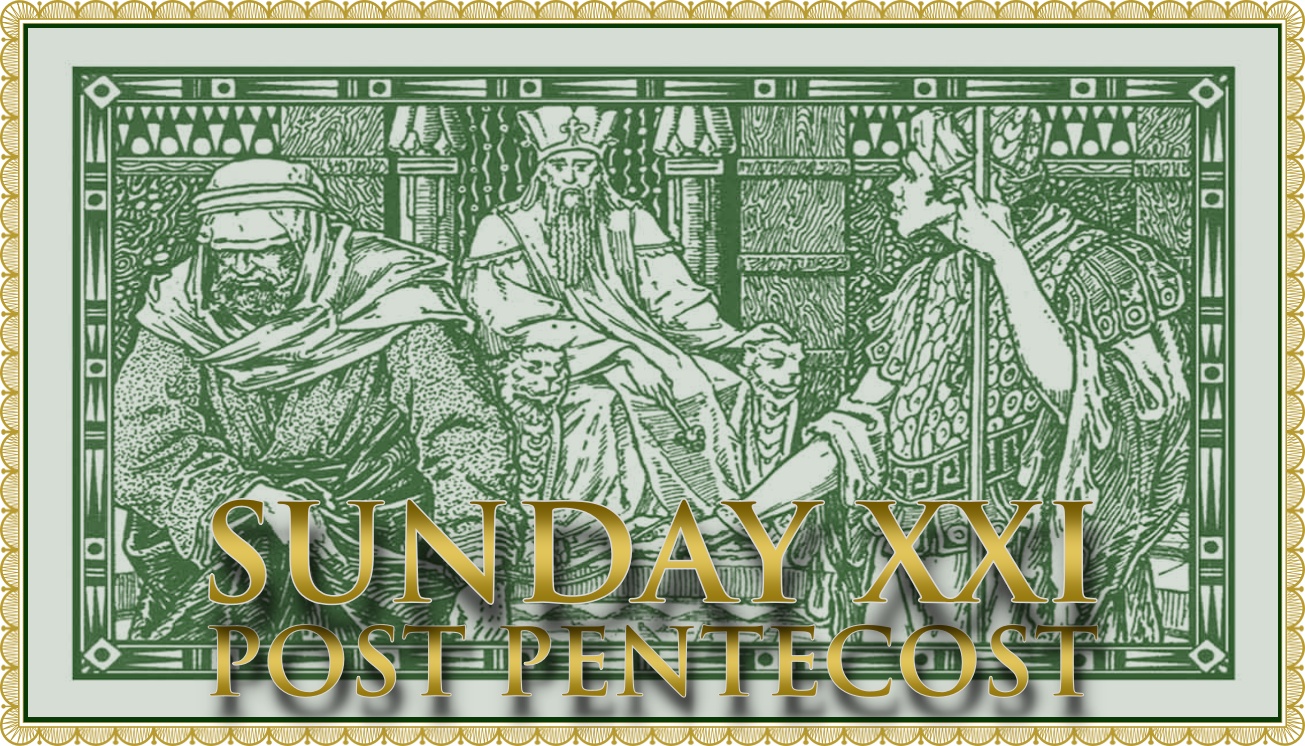
In today’s Gospel from St. Matthew we hear the parable of the Unforgiving Servant. Jesus told his disciples that the Kingdom of Heaven could be likened to a king who would take an account of his servants. One was brought to him who owed him ten thousand talents. Since he had not the means to pay it his lord commanded that he should be sold along with his wife and children and all that he had so that payment could be made. The servant pleaded for mercy and his lord was moved with pity for him and forgave him his debt. Subsequently that servant found one of his fellow servants who owed him a hundred pence. He laid hold of him and throttled him and demanded to receive the payment. The servant pleaded with him for patience, but his request was refused and he was cast into prison until he paid the debt. His fellow servants were grieved by what had happened and went and told their lord about it. The lord called his servant and said, “thou wicked servant, I forgave thee all the debt, because thou besoughtest me; shouldst not thou then have had compassion on thy fellow servant, even as I had compassion on thee?” The lord therefore delivered him to the torturers until he paid his debt. Jesus concluded the parable by warning “So also shall my heavenly Father do to you, if you forgive not every one his brother from their hearts.”
What was the context in which Jesus told this parable? It was in response to Peter’s question about how often should he forgive his brother when he sinned against him, up to seven times. Jesus responded, not unto seven times but until seventy times seven. He then told the parable of the Unmerciful servant to illustrate this point, for it was the story of one who had been forgiven a huge amount, but then refused to forgive another for a far smaller offence.
It was natural for someone brought up in the Jewish tradition to ask Peter’s question. The scribes sought to make a fence around the Law by defining how far it was necessary to go to ensure that one had not transgressed a commandment. It was therefore entirely reasonable for Peter to ask how far one should go to forgive someone who had sinned against him. The most generous possible interpretation would seem to be up to seven times. Beyond that was surely the point of no return and any further attempt at forgiveness and reconciliation impossible. But Jesus taught a higher righteousness than that of the scribes. He proclaimed that the time of the new covenant that the prophet Jeremiah had looked forward to, in which sins would be forgiven and the law written on the hearts of men, had now come in his own person and ministry. Since the mercy and forgiveness of God had no limits and went beyond anything we could ask or deserve, there could be no restrictions placed on forgiveness of others. It should be up to seventy times seven, in other words as infinite as the merciful nature of God.
In the Sermon on the Mount Jesus taught his followers to love their enemies and to pray for those who persecute them and despitefully use them. This is perhaps the most difficult of all the Gospel precepts to follow. Human beings are tribal creatures and find it easy to love those in their own tribe and social grouping, but very difficult to love those outside it. Indeed, they may be actively taught to despise them, because they have in the past mistreated either them or other members of their own tribe and social grouping.
Forgiveness is not a natural human reaction. It can only come about as the result of the divine charity at work in us, for divine charity is the very bond of peace and of all virtues. For Jesus did not simply teach us to love our enemies, he actually lived it and on the cross took evil upon himself and somehow subsumed it into good. He no longer taught, but acted and suffered. He was condemned unjustly to die, and yet he bore the other cheek and went the second mile. He fulfilled the role of the Suffering Servant, despised and rejected by men, a man of sorrows and acquainted with grief. He has borne our griefs and carried our sorrows. The chastisement of our peace was upon him and by his stripes we are healed. The message of the Cross is that hatred cannot conquer hatred, only love can do that.
Since God was in Christ reconciling the world to himself, a world that had become estranged and in enmity with him because of human sin, so we too must become ourselves instruments of his reconciling love. As we have been forgiven, so we too must forgive. Since the forgiveness of God is infinite, for it was extended even to the human race who had become God’s enemies due to human sin, so we too should forgive our enemies.
This is something that is much easier said than done. It is very easy to talk about forgiveness, much more difficult to practice it. There is an old saying “forgive and forget”, but this is all too glib an attitude. How can we forget those we believe have wronged us? Forgiveness is much more costly and difficult than that. We cannot do it by our own strength, but only when we allow the divine charity that was at work in the world in Christ to also work in us, to heal us and to transform us. The Christian can have no other basis for action than gratitude for forgiveness experienced. Only as we ourselves recognise that we have been forgiven are we also able to forgive.
But, we might say, in our own case those who have wronged us have remained unrepentant and have resisted any attempt to bring about reconciliation. It is certainly true that for forgiveness to work properly, it has to be a two way process. However, if we cannot be reconciled to someone or some group and have to shake the dust off our feet and move on, at least we should strive not to regard that person or group with hatred and bitterness, mindful of him who prayed, “Father, forgive them for they know not what they do”.
There was much hatred and violence in the world then, and there is much now. Yet the Gospel message remains the same, do not overcome evil with evil, but overcome evil with good. Let us pray for God’s grace to work in us, that we may be enabled to forgive as we have been forgiven and to overcome evil with good in our own time and place.






Leave a Reply