
The Christmas carol service that was not a culture war: a peaceful celebration that confirms a wrong turn by mainstream religious leaders
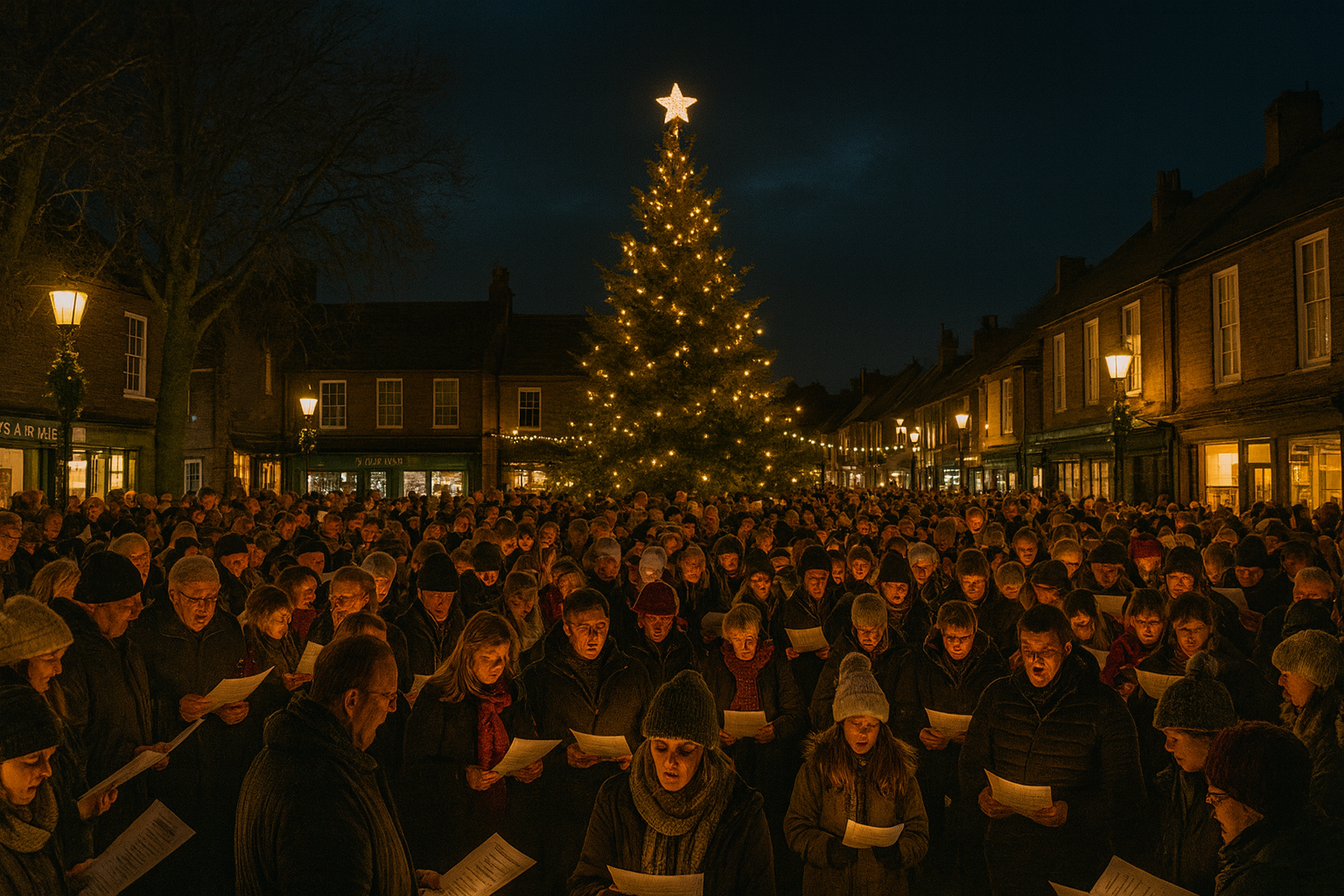
On Saturday 13 December 2025, an outdoor Christmas carol service convened in central London by Tommy Robinson (aka Stephen Yaxley-Lennon) proceeded peacefully, lawfully, and without incident.¹ ⁸ The gathering took place in the vicinity of Parliament Square and Whitehall, an area frequently associated with demonstrations, heightened security, and public-order sensitivity. Approximately one thousand people attended—families, older couples, and individuals drawn by the promise of a traditional Christmas observance rather than by any organised political mobilisation.² ³ Despite sustained media speculation and advance warnings of unrest, the event concluded without disorder, confrontation, or escalation.⁴ By any objective measure, the service was calm, restrained, and recognisably devotional in form.¹ ⁹
Attendees gathered to sing well-known carols, many drawn directly from the traditional English repertoire, accompanied by printed hymn sheets. Seasonal clothing and modest festive adornments predominated; there was no staging suggestive of a rally or campaign event. The emphasis remained on music, shared observance, and brief spoken reflections oriented toward the Nativity.⁵ In contrast to the charged atmosphere that often surrounds demonstrations in the same location, the tone was notably subdued and communal.⁶ The scale of the gathering itself—modest by London protest standards—further undermined claims that the event represented an attempt at mass political mobilisation.²
This reality stood in stark contrast to the tone adopted in advance by the Church of England and several other mainstream denominations. Statements issued by Anglican bishops, echoed by leadership voices within the Baptist Union of Great Britain and the Methodist Church, framed the proposed gathering as an imminent moral threat: an anticipated co-option of Christian symbolism for exclusionary or nationalist ends, and a misuse of Christmas for political purposes.⁷ ⁸ Christians were urged publicly to distance themselves from the event, and the language employed was not cautionary but condemnatory, deployed before a single carol had been sung.⁹ ¹⁰
What followed exposed not merely an error of judgment, but a deeper pattern already identified in the earlier Nuntiatoria Christmas editorial series.¹¹
What was predicted — and what actually occurred
In the days preceding the service, denunciations were issued not in response to concrete actions or stated intentions, but to projected meanings and assumed trajectories. Christmas, it was claimed, was at risk of being “weaponised.”¹⁰ Christian symbols were described as vulnerable to appropriation. The service was pre-emptively classified as political agitation masquerading as worship, despite the absence of any published political platform or programme associated with the event.⁹
The actual proceedings bore no resemblance to those forecasts. No political programme was announced. No policy demands were advanced. There were no chants, slogans, or calls to action. Hymns were sung in full. Short reflections focused on the birth of Christ and the meaning of Christmas as a religious feast. Attendees dispersed gradually and without incident. Police presence, though visible, proved precautionary rather than reactive, consistent with standard practice for any organised gathering in that part of London.¹² ¹³
The Metropolitan Police subsequently confirmed that the event remained orderly throughout, with no arrests and no public-order incidents linked specifically to the carol service itself.¹⁴ ¹⁵ The gathering was treated as a lawful assembly, stewarded and contained, and did not materially disrupt public life in central London.¹⁴ This official assessment matters not rhetorically, but empirically, directly contradicting claims that the service posed an inherent threat to public order or civic peace.
The discrepancy between prediction and reality was therefore not marginal. It was decisive.
Ideological capture and the collapse of ecclesial discernment
In Putting Christ Back into Christmas, Nuntiatoria argued that many institutional churches now operate under conditions of ideological capture—not in the crude sense of explicit party alignment, but in the subtler absorption of contemporary moral frameworks treated as unquestionable norms.¹¹ ¹⁶ These frameworks prioritise reputational safety, symbolic alignment, and avoidance of cultural offence over theological clarity and pastoral judgment.
Under such conditions, discernment gives way to signalling. The operative question shifts from Is this act Christian? or Is it rightly ordered? to How will this be read within prevailing cultural narratives? Once that shift occurs, condemnation becomes anticipatory rather than responsive, and orthodoxy is displaced by conformity to external moral vocabularies that the Church neither generated nor controls.
The reaction to the carol service illustrates this dynamic with particular clarity. The service itself posed no threat to doctrine, worship, or public order. What it disrupted was an unspoken assumption about who may publicly name Christ, and under what cultural and institutional conditions that naming is deemed acceptable.
Language, moral reasoning, and the abandonment of classical categories
A closer examination of the language employed by denominational leaders reveals a further departure from classical Christian moral reasoning. The vocabulary deployed in official statements was abstract, predictive, and associative. Terms such as “weaponisation,” “harm,” “dangerous symbolism,” and “exclusionary narratives” were used without reference to specific acts, words, or behaviours capable of moral evaluation.⁹ ¹⁰
Classical Christian moral theology proceeds in the opposite direction. It evaluates acts according to their object, intention, and circumstances. Moral culpability attaches to what is actually done, not to what is conjectured or feared.¹⁷ Words matter insofar as they signify real choices and real acts. To condemn in advance on the basis of projected meaning is to abandon moral analysis in favour of speculation.
Notably, denominational statements did not ask whether the service would involve blasphemy, incitement, or disorder—long-recognised grounds for ecclesial censure.¹⁸ Instead, the event was framed as morally suspect because of how it might be interpreted or aligned within wider cultural narratives. This represents a shift from moral theology to reputational ethics, where perceived association replaces demonstrable wrongdoing.
Equally striking was the collective nature of the moral language employed. Warnings were addressed broadly to “Christians,” urging distance and disavowal rather than offering specific correction. Classical Christian exhortation, by contrast, is ordinarily particular and discriminating, distinguishing between persons, acts, and intentions.¹⁷
This linguistic pattern is characteristic of ideological capture. Moral language becomes precautionary rather than judicial, expressive rather than discerning. The Church ceases to speak as a moral teacher and begins to speak as a risk-management body. Measured against the peaceful reality of the event, the inadequacy of this language becomes evident. The denunciations were not merely disproved by events; they were exposed as operating within a different moral grammar altogether.
The error of guilt by association — and anticipation
The theological error underpinning the denunciations was twofold. First, guilt was imputed by association: the organiser’s controversial public history was treated as sufficient grounds to condemn the act of worship itself. Second, condemnation was issued by anticipation: conclusions were drawn before content could be evaluated or fruits observed.
Classical Christian theology has always rejected such reasoning. The Church distinguishes between the objective act and the subjective disposition of those involved. Worship is judged by what it is, not by speculative readings of motive or by the social acceptability of its convenor. The Incarnation itself—unsanctioned, publicly misunderstood, and recognised first by shepherds rather than authorities—stands as the definitive rebuke to reputational moralism.¹⁹
Public worship, free assembly, and England’s inheritance
There is also a juridical and historical dimension that sharpens the point. England’s legal and cultural inheritance has long afforded protection to peaceful religious assembly in public space, even when such assembly unsettles prevailing opinion.²⁰ Peaceful religious assembly is protected under domestic law and under Article 9 of the European Convention on Human Rights, subject only to proportionate limitations necessary in a democratic society.²¹ ²²
The carol service complied fully with these norms. It was lawful, stewarded, and orderly. The alarmist tone adopted by ecclesial authorities therefore sat uneasily not only with Christian theology, but with England’s constitutional and civic traditions.
Conclusion — Christmas and the loss of ecclesial confidence
The earlier Christmas editorial series concluded by observing that Christmas ultimately tests whether the Church still trusts the Incarnation it proclaims.¹¹ Christ entered the world without institutional permission, recognised first by the lowly rather than the powerful, and received amid suspicion rather than acclaim.
The London carol service did not vindicate any political ideology. It did, however, expose a troubling reflex within parts of institutional Christianity: a fear of uncontrolled public expressions of faith combined with a confidence that denunciation itself constitutes moral leadership.
Ideological capture has rendered some churches more fluent in the language of cultural anxiety than in the grammar of the Gospel. Until that imbalance is corrected, similar misjudgments will recur—not because Christ is absent from public life, but because His presence is increasingly filtered through the priorities of the age.
Christmas does not belong to culture warriors, nor to ecclesial gatekeepers shaped by fashionable moral frameworks. It belongs to Christ. And where He is named peacefully and truthfully, the Church should recognise Him—even when He appears outside its preferred boundaries.
- The Guardian, “Tommy Robinson’s London Christmas carol service draws about 1,000 people,” 13 December 2025.
- The Independent, “Only around 1,000 people turn out for Tommy Robinson Christmas service,” 13 December 2025.
- BBC News, reporting on crowd size and policing context, 13 December 2025.
- Reuters, UK politics and public order coverage, 13 December 2025.
- Premier Christianity, “Tommy Robinson just held a Christmas carol concert — here’s what happened,” December 2025.
- Christian Today, “Large crowds join Tommy Robinson’s Christmas carol service,” 13 December 2025.
- Diocese of Southwark, episcopal statement on the proposed carol service, December 2025.
- Church of England, national communications briefing, December 2025.
- The Guardian, “C of E responds to Tommy Robinson’s carols event with ‘Christmas is for all’ message,” 13 December 2025.
- Rowan Williams, comments reported in The Guardian and New Statesman, December 2025.
- Nuntiatoria series, Putting Christ Back into Christmas, Christmas Editorial Series, 2025.
- Metropolitan Police Service, operational policing summary, 13 December 2025.
- Evening Standard, public order reporting, 13 December 2025.
- Metropolitan Police Service, post-event statement to media, 13 December 2025.
- PA Media, police confirmation of no arrests, 13 December 2025.
- Charles Taylor, A Secular Age, on social imaginaries and moral frameworks.
- Thomas Aquinas, Summa Theologiae, I–II, q.18.
- Augustine, De ordine.
- Luke 2:8–20; Matthew 2:1–12; John 1:10–11.
- Mark Hill QC, Religious Liberty and Human Rights in England and Wales.
- European Convention on Human Rights, Article 9.
- Kokkinakis v Greece (1993) ECHR 14307/88.
RELATED ARTICLES


LATEST ARTICLES
- THE KING’S OATH AND THE DEAD OF SAINT GEORGE’SA tragic attack during a Christian funeral in Karak, Jordan, resulted in nine fatalities and numerous injuries. King Abdullah II has pledged severe retaliation, leading to the arrest of three suspects. The Latin Patriarchate supports the monarchy’s role in ensuring religious freedom, while the Orthodox community vows to remain in their homeland amidst ongoing concerns for their safety.
- THE LAW OF A CHURCH THAT HAS NOT YET BEEN REUNITEDAt the Angelicum conference, Orthodox and Anglican scholars discussed the future of ecclesiastical law alongside Vatican cardinals. Cardinal Koch advocated for a new ecumenical juridical order, connecting these discussions to the upcoming Synodal Assembly of 2028. The conference aimed to address how different Christian governance models could influence Catholic law and authority.
- ‘DWARFS TAVISTOCK’: Baroness Cass demands Inquiry into Brighton NHS ScandalBaroness Hilary Cass has called for an independent inquiry into Brighton’s WellBN practice, claiming it overshadowed the Tavistock scandal. An investigation revealed severe clinical failures affecting 78 children, alongside the distressing treatment of safeguarding GP Dr Sarah Redvers, who raised alarms about these practices and faced retaliation. Accountability within the NHS is urgently needed.
- “THAT’S JUST PARANOIA”: Dr Joseph Shaw and the Crisis beyond the Latin MassDr Joseph Shaw’s recent interview highlights his support for the Traditional Latin Mass but inadequately addresses the Society of Saint Pius X’s (SSPX) concerns regarding the Church’s doctrinal crisis. He dismisses SSPX’s fears as paranoia, yet the Society’s extensive theological arguments underscore that preserving the older liturgy is insufficient for restoring Catholic Tradition.
- THE REFUSAL IS NOW IN WRITINGThe Vatican has formally denied the Summorum Pontificum pilgrims permission to enter St Peter’s Basilica together for prayer, a decision communicated through published correspondence. The situation has sparked debate over administrative failures and the Church’s treatment of traditional Catholics. Key questions remain regarding the explanation for this refusal amidst wider pastoral concerns.



Leave a Reply