
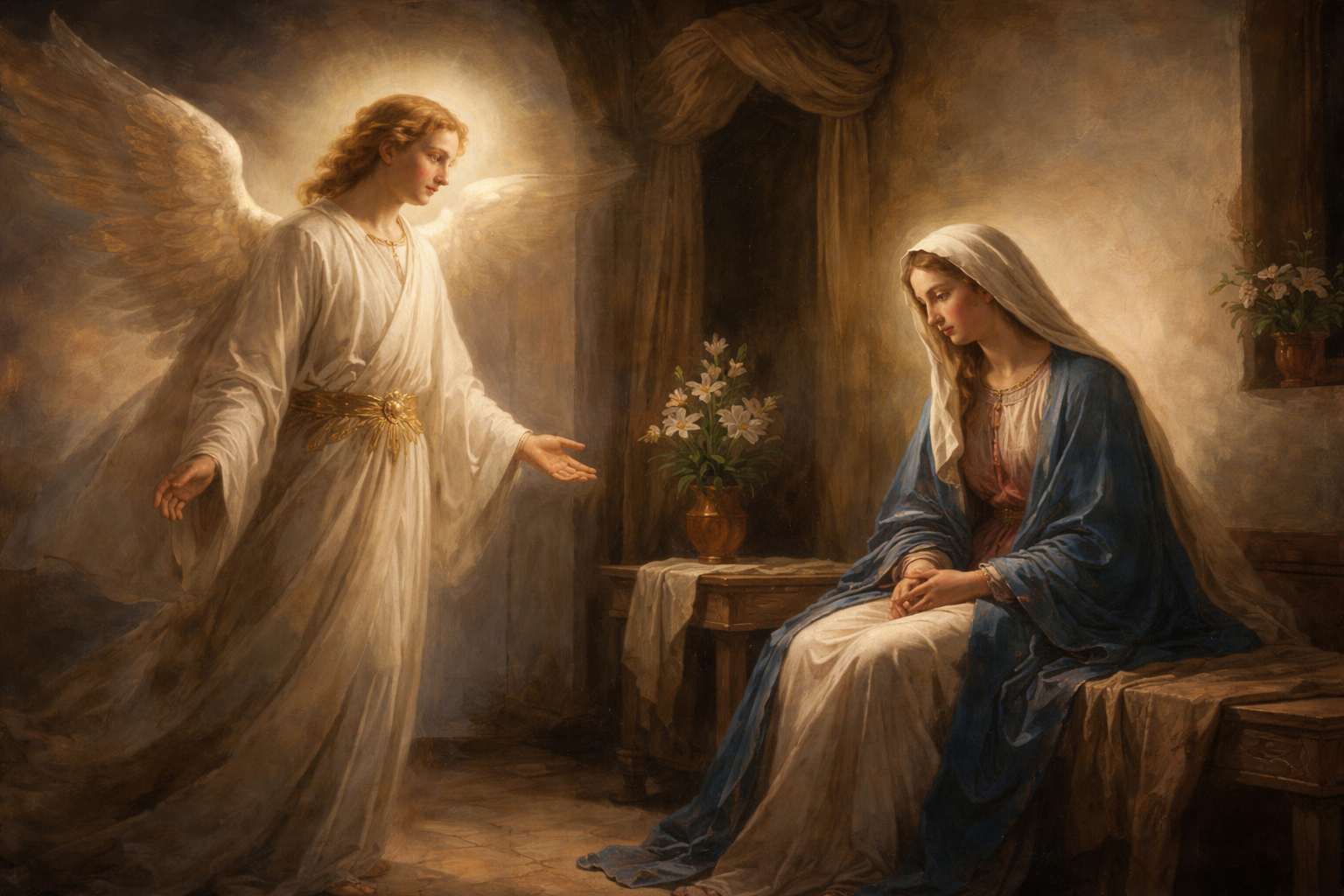
Mary, Consent, and the Modern Collapse of Freedom into Power
A theological response to contemporary claims that Christian doctrine sanctifies coercion
In December 2025, an essay by Dr Stacey Patton circulated widely under the title *Did Mary Really Consent to Giving Birth to Jesus?*¹ The article advances a stark claim: that Christianity’s moral authority rests upon a story of coerced compliance, retroactively sanitised by theology in order to obscure domination, erase female agency, and legitimise hierarchical power. Mary of Nazareth, Patton argues, could not meaningfully consent to the Incarnation because she was young, poor, female, colonised, and without bodily autonomy. Her celebrated “yes” is therefore not consent at all, but submission mistaken for virtue.
The argument is framed not as an attack on Christianity, but as an ethical unmasking of how power operates through religious narrative. Theology, on this account, functions to “launder” domination by recoding inevitability as agreement and obedience as holiness. The Annunciation becomes the template by which coercion is rendered morally invisible, first in doctrine, and later in colonialism, patriarchy, and racial hierarchy.
Such claims cannot be dismissed as mere provocation. They engage questions of freedom, agency, embodiment, and moral responsibility that lie at the heart of Christian anthropology. Yet the critique ultimately collapses under the weight of its own assumptions. It does so not because it names power, but because it reduces freedom to resistance, conflates asymmetry with coercion, and imports a modern juridical concept of consent into a theological framework that explicitly rejects it.
“Consent Requires the Ability to Refuse”
Patton’s argument turns repeatedly on a single assertion:
“Consent requires the ability to refuse. The story never allows for refusal to exist as a meaningful possibility.”²
This claim is presented as self-evident. If refusal is not meaningfully imaginable, then consent is void. Mary’s words may sound voluntary, but they merely sanctify an outcome already determined by divine will.
The difficulty is that this definition of consent is neither universal nor philosophically neutral. It is a modern, liberal, juridical construction, shaped by contract theory and legal protections. Christianity does not share it, nor has it ever claimed to.
For St Augustine, freedom is not defined by the multiplication of options, but by liberation from disordered desire. True freedom is the capacity to will the good without interior compulsion.³ St Thomas Aquinas develops this further: the will is free because it is rationally ordered toward truth, not because it is indifferent between alternatives.⁴
By Patton’s standard, no human being before modernity could meaningfully consent to anything of moral significance. Every prophet addressed by God, every martyr who chose death over apostasy, every monk or nun who embraced a vocation under social constraint would be rendered morally null. The argument therefore does not expose a Christian inconsistency; it imposes a foreign anthropology and condemns Christianity for failing to conform to it.
The Annunciation and the Question of Agency
Patton writes:
“What Luke never gives Mary is an option. There is no ‘Would you like to?’ There is no alternative future imagined for her.”⁵
This reading mistakes narrative economy for moral exclusion. Scripture does not present divine encounters as contractual negotiations, yet Luke’s account of the Annunciation is striking precisely for its insistence on dialogue. The angel announces. Mary questions. The angel explains. Only then does Mary respond (Luke 1:26–38).
The narrative pauses. The Incarnation does not proceed until she speaks.
This pause has always been understood theologically. The Fathers repeatedly emphasise that God waits upon Mary’s assent, not because He lacks power, but because He refuses to redeem humanity without human cooperation. Irenaeus frames Mary as the New Eve, whose obedience unties the knot of Eve’s disobedience.⁶ Ambrose insists that Mary “consented in faith, not compelled by necessity.”⁷ Bernard of Clairvaux famously dramatizes the moment as all creation holding its breath for her reply.⁸
If Mary’s words are merely decorative, then their narrative centrality is inexplicable. The Christian tradition has treated them not as rhetorical flourish, but as doctrinal assertion: grace proposes; it does not impose.
Asymmetry Is Not Coercion
A central move in Patton’s essay is the collapse of asymmetry into violation. God’s omnipotence, she argues, renders refusal “unthinkable,” and therefore consent meaningless.⁹ Yet Christian moral theology has never held that power disparity alone invalidates agency.
Coercion, in classical ethics, requires force, threat, or compulsion. Aquinas is explicit: an act is involuntary only when the will is overridden from without.¹⁰ Knowledge of consequences, fear of cost, or reverence for authority do not in themselves negate freedom. If they did, moral responsibility would be impossible.
The Annunciation contains no threat, no punishment, no ultimatum. The angel does not say “you must,” nor “or else.” To redefine coercion so broadly that any encounter with transcendent authority becomes abuse is to render all moral obligation suspect and all worship pathological.
Submission, Obedience, and the Christian Moral Imagination
Patton repeatedly treats submission as inherently degrading:
“Christianity elevates submission when it serves order and calls it humility, but renames resistance as sin.”¹¹
This claim cannot be reconciled with Christianity’s own centre. The New Testament presents Christ Himself as “obedient unto death” (Phil 2:8), yet insists that this obedience is the fullest expression of freedom and love, not its negation. The Son’s obedience to the Father is not coerced submission, but willed self-gift.
Mary’s obedience participates in this same moral logic. To equate obedience with subjugation is to import a framework foreign to Christian anthropology. If submission is always immoral, then Christology itself collapses.
The Virgin Birth and the Charge of Moral Evasion
One of the essay’s most provocative claims is that the virgin birth functions as a “theological escape hatch,” allowing Christianity to claim pregnancy while avoiding the ethical implications of sex, power, and consent.¹² God, Patton suggests, becomes an “impregnator without culpability,” shielded from the moral standards imposed on human men.
This reverses the doctrine’s meaning. The virgin birth does not exist to erase embodiment or female agency; it exists to deny that God enters history through sexual domination or human exploitation. It insists that divine causality is not morally analogous to human sexual action at all.¹³
To accuse the doctrine of shielding God from accountability assumes, without argument, that divine action must be judged as if it were male sexual power. That is a category error. Christianity does not claim that God performs a sex act without consent; it denies that the Incarnation is a sex act in the first place.
Mary as Participant, Not Instrument
Patton repeatedly describes Mary as a “vessel” whose reproductive labour is extracted for a higher cause.¹⁴ Classical theology does not permit this reduction. Mary is consistently named as co-operator, New Eve, representative of Israel, and type of the Church. Her assent is meaningful precisely because it is not instrumentalised.
The Eve–Mary parallel, central to patristic theology, collapses if Mary’s obedience is illusory. Eve’s disobedience involved real assent; Mary’s obedience must also, or the typology fails.¹⁵
Colonialism, White Supremacy, and Theological Overreach
The essay concludes by extending its argument to colonialism and white supremacy, claiming that Marian consent provides a template for sanctifying domination while calling it love. Historical abuses are real, and Christian institutions have often betrayed their own theology. Yet the inference does not follow.
Christian doctrine explicitly condemns forced conversion, rape, and coercion because they violate free will. That Christians ignored this teaching indicts Christians, not the doctrine of consent itself. To argue otherwise is to confuse hypocrisy with principle.
Conclusion
The question of Mary’s consent matters because it touches the core of Christian moral anthropology. Yet the contemporary critique fails not because it names power, but because it collapses freedom into resistance and vulnerability into incapacity. Christianity makes a different claim: that freedom is the capacity to recognise and will the good, even when doing so is costly.
Mary’s “yes” is not meaningful because she was insulated from risk, protected by autonomy, or free from consequence. It is meaningful because she was human — and because God refused to redeem humanity without humanity’s assent.
That claim may be rejected. But it cannot be dismissed as a laundering of power without first abandoning the very conception of moral agency on which the critique itself depends.
Feminist Theology and the Question of Mary’s Agency
The argument advanced by Dr Stacey Patton is often framed as a feminist unmasking of theological power. It is therefore important to note that feminist theology within Christianity has not spoken with one voice on Mary, nor has it generally arrived at the conclusion that Mary’s consent is illusory or meaningless.
Rosemary Radford Ruether, while sharply critical of Marian idealisation when it is used to enforce passive gender norms, nevertheless insists that Mary functions symbolically as an active historical subject, not a passive instrument. Ruether argues that Marian doctrine becomes oppressive only when severed from its Christological and ecclesiological context, observing that “Mary’s obedience is not submission to male power, but a paradigmatic act of prophetic response to God.”¹⁶ Her critique is directed primarily at later ecclesial misuse, not at the Annunciation narrative itself.
Elizabeth A. Johnson situates Mary deliberately within the concrete realities of first-century Jewish womanhood: poverty, risk, political marginality, and vulnerability. Far from concluding that these realities negate consent, Johnson argues that they intensify its significance. Mary’s assent, she writes, is “spoken in danger, not safety,” and therefore represents “active courage rather than conditioned acquiescence.”¹⁷
What is striking is that neither Ruether nor Johnson defines freedom as the absence of asymmetry. Both reject the assumption—central to Patton’s argument—that agency requires insulation from power, consequence, or obligation. Instead, they locate Mary’s freedom precisely in her capacity to respond meaningfully within constraint.
Even feminist critiques sceptical of Marian devotion have generally resisted the claim that the Annunciation narrates coercion. Their concern has been the later instrumentalisation of Mary’s obedience as a disciplinary model imposed upon women, rather than the denial of Mary’s own agency at the moment of the Incarnation.¹⁸
This contrast matters. It demonstrates that the rejection of Mary’s consent is not a necessary feminist conclusion, but a particular ideological move grounded in a modern juridical framework of consent that feminist theology itself has frequently questioned.
¹ Stacey Patton, Did Mary Really Consent to Giving Birth to Jesus?, Substack, 13 December 2025.
² Patton, Did Mary Really Consent, ibid.
³ Augustine, De Libero Arbitrio, I–III.
⁴ Thomas Aquinas, Summa Theologiae I–II, q.13.
⁵ Patton, Did Mary Really Consent, ibid.
⁶ Irenaeus, Adversus Haereses III.22.4.
⁷ Ambrose, De Institutione Virginis, c.5.
⁸ Bernard of Clairvaux, Homiliae super Missus Est, Hom. IV.
⁹ Patton, Did Mary Really Consent, ibid.
¹⁰ Aquinas, Summa Theologiae I–II, q.6, a.4.
¹¹ Patton, Did Mary Really Consent, ibid.
¹² Ibid.
¹³ Council of Chalcedon (451); Athanasian Creed.
¹⁴ Patton, Did Mary Really Consent, ibid.
¹⁵ Romans 5:12–21; Irenaeus, Adversus Haereses III.22.
¹⁶ Rosemary Radford Ruether, Sexism and God-Talk: Toward a Feminist Theology (Boston: Beacon Press, 1983), 137–141.
¹⁷ Elizabeth A. Johnson, Truly Our Sister: A Theology of Mary in the Communion of Saints (New York: Continuum, 2003), 264–271.
¹⁸ Tina Beattie, God’s Mother, Eve’s Advocate: A Marian Narrative of Women’s Salvation (London: Continuum, 2002), ch. 6.


LAtest
- THE KING’S OATH AND THE DEAD OF SAINT GEORGE’SA tragic attack during a Christian funeral in Karak, Jordan, resulted in nine fatalities and numerous injuries. King Abdullah II has pledged severe retaliation, leading to the arrest of three suspects. The Latin Patriarchate supports the monarchy’s role in ensuring religious freedom, while the Orthodox community vows to remain in their homeland amidst ongoing concerns for their safety.
- THE LAW OF A CHURCH THAT HAS NOT YET BEEN REUNITEDAt the Angelicum conference, Orthodox and Anglican scholars discussed the future of ecclesiastical law alongside Vatican cardinals. Cardinal Koch advocated for a new ecumenical juridical order, connecting these discussions to the upcoming Synodal Assembly of 2028. The conference aimed to address how different Christian governance models could influence Catholic law and authority.
- ‘DWARFS TAVISTOCK’: Baroness Cass demands Inquiry into Brighton NHS ScandalBaroness Hilary Cass has called for an independent inquiry into Brighton’s WellBN practice, claiming it overshadowed the Tavistock scandal. An investigation revealed severe clinical failures affecting 78 children, alongside the distressing treatment of safeguarding GP Dr Sarah Redvers, who raised alarms about these practices and faced retaliation. Accountability within the NHS is urgently needed.
- “THAT’S JUST PARANOIA”: Dr Joseph Shaw and the Crisis beyond the Latin MassDr Joseph Shaw’s recent interview highlights his support for the Traditional Latin Mass but inadequately addresses the Society of Saint Pius X’s (SSPX) concerns regarding the Church’s doctrinal crisis. He dismisses SSPX’s fears as paranoia, yet the Society’s extensive theological arguments underscore that preserving the older liturgy is insufficient for restoring Catholic Tradition.
- THE REFUSAL IS NOW IN WRITINGThe Vatican has formally denied the Summorum Pontificum pilgrims permission to enter St Peter’s Basilica together for prayer, a decision communicated through published correspondence. The situation has sparked debate over administrative failures and the Church’s treatment of traditional Catholics. Key questions remain regarding the explanation for this refusal amidst wider pastoral concerns.




Leave a Reply