
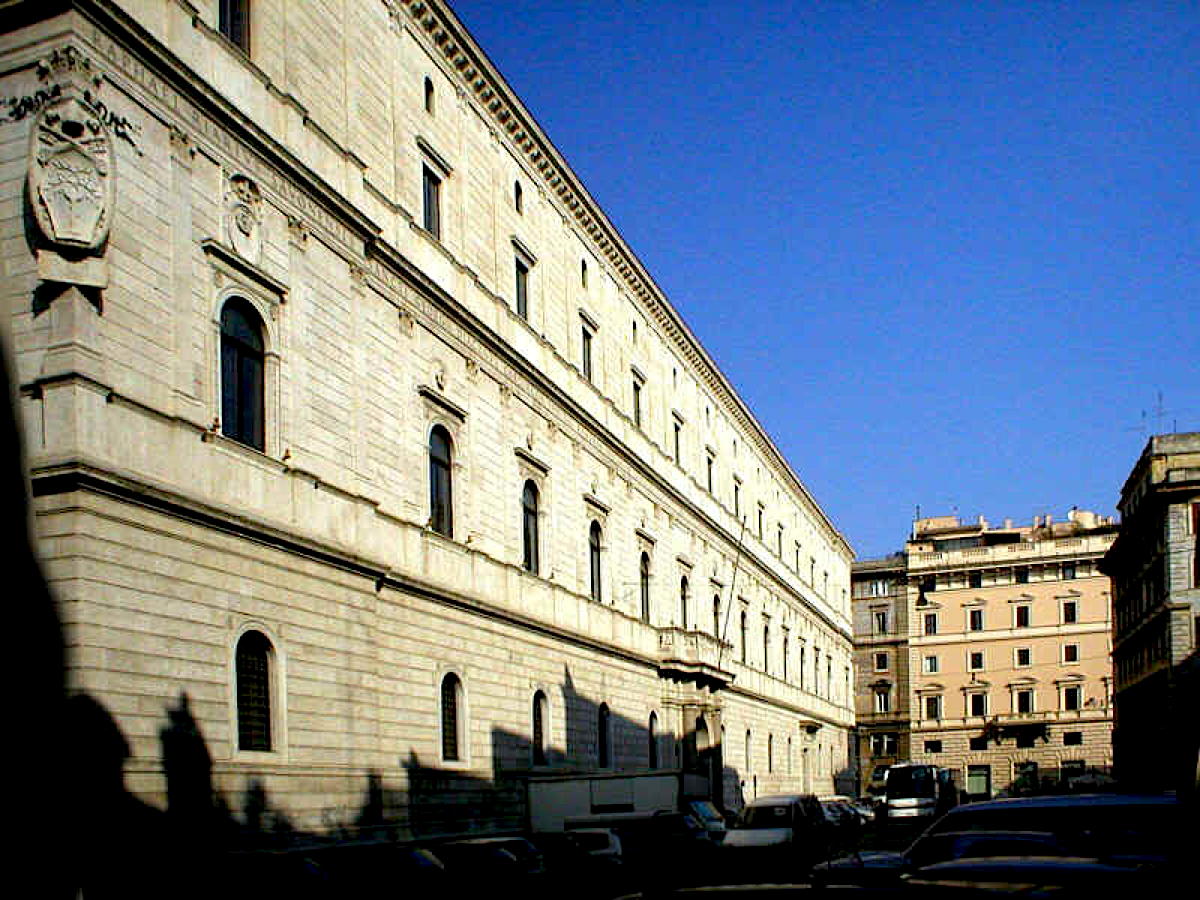
Statio ad St Laurentium in Damaso
The Roman Lenten pilgrimage leads us today to San Lorenzo in Damaso, one of the most ancient parish churches of Christian Rome. The original basilica was founded in the fourth century by Pope St. Damasus (366–384), who built it over his own family residence near the Theatre of Pompey and dedicated it to the beloved Roman martyr St. Lawrence the Deacon. It became the titulus Damasi, one of the twenty-five original parish churches that served the Christian faithful of the city.
St. Damasus was not only a pope but a scholar and defender of the memory of the martyrs. His pontificate came at a decisive moment in the Church’s history, shortly after Christianity emerged from persecution into imperial favor. Recognizing that the heroic witness of the martyrs must never be forgotten, Damasus commissioned inscriptions and monuments throughout Rome honoring those who had died for Christ. His basilica here served not only as a parish church but as a place where the archives and records of the Roman Church were preserved, safeguarding the memory of the faith for future generations.
The ancient church did not survive the transformation of Rome during the Renaissance. In the late fifteenth century the original basilica and surrounding structures were demolished to make way for the magnificent Palazzo della Cancelleria, constructed for Cardinal Raffaele Riario, nephew of Pope Sixtus IV. The palace remains one of the earliest and most elegant examples of Renaissance architecture in Rome. Though the architect is unknown, the harmonious courtyard is often associated with the influence of Donato Bramante, whose work helped establish the classical architectural language of the High Renaissance.
Within this palace the present basilica of San Lorenzo in Damaso was incorporated, creating a remarkable union of sacred and administrative space. The palace today houses the highest tribunals of the Roman Curia: the Apostolic Penitentiary, the Roman Rota, and the Supreme Tribunal of the Apostolic Signatura. Thus the church is physically surrounded by the structures through which the Church exercises her judicial authority, reminding the pilgrim that the visible Church is not merely a spiritual fellowship but a living society governed by law and ordered toward the salvation of souls.
Inside the basilica, the faithful encounter a rich treasury of sacred memory. Beneath the high altar designed by Gian Lorenzo Bernini rest the relics of Pope St. Damasus, together with those of other saints and martyrs including St. Eutychius, St. Hippolytus, and St. John Calybites. Along the aisles stand devotional images that have inspired generations of prayer: a Byzantine Black Madonna revered by Roman devotees, and a fourteenth-century crucifix before which St. Bridget of Sweden prayed during her years in Rome. Above the colonnades runs a cycle of paintings recounting the life and martyrdom of St. Lawrence, whose heroic witness forms the spiritual heart of the basilica.
For the Lenten pilgrim, the presence of St. Lawrence is especially significant. As deacon of the Roman Church in the third century, Lawrence was entrusted with the care of the Church’s treasures and the distribution of alms to the poor. When the Roman authorities demanded that he surrender the Church’s wealth, he gathered the poor, the sick, and the marginalized and presented them to the prefect, declaring: “These are the treasures of the Church.” Shortly afterward he was condemned to death and burned upon a gridiron, sealing his testimony with martyrdom.
The lesson of Lawrence resounds with particular force during Lent. The world measures wealth in gold and power, but the Gospel measures it in charity. The Church’s true riches are not marble basilicas or papal palaces but the living members of Christ’s Body—the poor, the faithful, and the saints.
Yet the station also reminds us of another dimension of the Church’s life. Surrounding the basilica are the tribunals through which the Church exercises her authority to judge and to reconcile. At first glance this might seem far removed from the charity of St. Lawrence, but in truth it expresses the same mission in another form. The Church administers law so that she may administer mercy.
The Apostolic Penitentiary addresses matters of conscience and absolution. The Roman Rota judges complex cases concerning marriage and ecclesiastical discipline. The Apostolic Signatura safeguards the integrity of canonical justice. These institutions exist not for the sake of bureaucracy but for the salvation of souls, ensuring that the Church’s ministry is guided by truth and fairness.
This dual presence—martyrdom and judgment, charity and law—reveals something essential about the Church herself. She is both mother and teacher, both guardian of truth and dispenser of mercy. The law she upholds exists not to crush the sinner but to guide him back to grace.
Thus the pilgrim standing in San Lorenzo in Damaso confronts a profound spiritual question. Each human heart contains its own tribunal of conscience. The commandments of God stand as the law; the Gospel offers mercy. Lent is the season when we allow that interior tribunal to function honestly. We examine our lives, confess our sins, and return to the grace that restores the soul.
In this sense the station church becomes a mirror of the Christian life itself. Beneath the altar rest the saints who have already completed the race; around the basilica operate the courts that guide the Church’s earthly pilgrimage; and within the soul the drama of conversion unfolds.
St. Lawrence shows us that the riches of the Church are the souls she serves. St. Damasus reminds us that the Church must preserve the truth entrusted to her through the centuries. The tribunals surrounding the basilica remind us that justice and mercy must walk together.
And so the pilgrim departs from this station with a renewed understanding of the Lenten journey. To follow Christ is to hold lightly the wealth of this world, to cherish the poor as the treasure of the Church, and to stand humbly before the tribunal of God with confidence in His mercy.
For the Judge before whom we appear is also the Redeemer who died for us.
RELATED ARTICLES


LATEST ARTICLES
- STABAT MATER DOLOROSA: The Seven Sorrows of the Blessed Virgin MaryThe traditional feast of the Seven Sorrows on 15 September contemplates Mary’s spiritual martyrdom from Simeon’s prophecy to the Burial of Christ. Distinct in origin from the Passion Friday feast of the Compassion, the September observance came especially through the Servite tradition and was extended to the Latin Church by Pius VII before being raised in rank and fixed to 15 September under St Pius X. Its Mass, Stabant juxta Crucem, presents Mary’s sorrow not as sentimental grief but as perfect faith, charity and conformity to Divine Providence, wholly dependent upon and ordered to the unique redemptive Sacrifice of Christ.
- THE FLAG THEY NEVER EXPLAINEDThe transgender pride flag has become ordinary institutional iconography, but the civic account of its origins is highly abbreviated. Its creator, Monica Helms, is male and began living as a woman in 1997. Helms’s autobiography describes sexual excitement associated with presenting himself as female, closely corresponding to what sexologist Ray Blanchard termed autogynephilia, alongside stolen women’s underwear, adult-video work, sex clubs and sexually themed fiction. The flag’s blue and pink also have separate documented uses as sex-coded colours within paedophile symbolism and child-sex markets, although there is no evidence of any connection with Helms’s design. More significant is the flag’s institutional history. It became embedded throughout public life during the same period in which gender-identity assumptions entered law, medicine, schools and safeguarding practice. The Supreme Court, revised RSHE guidance, KCSIE 2026 and the WellBN investigation now reveal a substantial correction towards biological reality, parental involvement, evidence and professional curiosity.
- NSPCC: THE SAFEGUARD THEY REMOVEDThe NSPCC has removed from its new schools guidance the previous recommendation that, where possible, children changing clothes should be supervised by adults of the same sex. Yet in the same month NSPCC Sport retained precisely that principle, while the 2026 statutory safeguarding framework strengthened sex-based protections for school changing rooms. The issue is not suspicion of teachers but why an elementary safeguard protecting children’s privacy, dignity and staff themselves has quietly disappeared.
- PEACE WITHOUT THE KING, UNITY WITHOUT THE CHURCHThe CCEE–CEC meeting in Germany marks the active reception of the revised Charta Oecumenica, whose programme reaches from common prayer and evangelisation to movement towards Eucharistic fellowship. Read beside Pius XI’s Quas Primas and Mortalium Animos, and against the clarifications of Unitatis Redintegratio, Dominus Iesus, Ecclesia de Eucharistia and Apostolicae Curae, the issue is not whether Catholics may cooperate with other Christians. It is whether an ecumenical culture of convergence is beginning to obscure the Social Kingship of Christ, the Catholic missionary claim and the already-existing visible unity of His Church.
- DEFEATED — BUT NOT SETTLEDThe Commons has voted against assisted suicide in England and Wales, with scrutiny revealing concerns over vulnerability, prognoses, and palliative care. Shifted positions among some MPs and the absence of others led to the defeat. The debate underlines the challenges of translating public support into effective legislation amid complex ethical considerations.



Leave a Reply